Inside the secret compartment was a sealed envelope.
I had found it years earlier.
But I had never opened it.
On the front, in my grandmother’s handwriting, were the words:
“For Seo-jin, when they try to convince you that you remember incorrectly.”
My mother recognized the handwriting immediately.
Her smile disappeared.
I unfolded the first document.
It was a bank certificate.
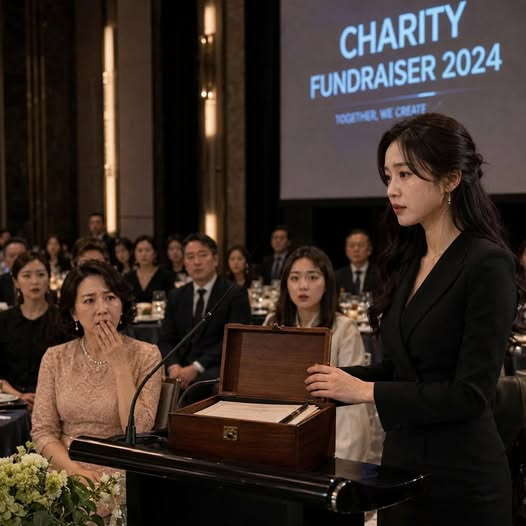
“Seven years ago,” I told the audience, “I asked my mother what happened to fifteen million won left specifically for my education.”
Nobody moved.
“My family answered by telling everyone I was unstable.”
My mother stood.
“Seo-jin, this is a charity event.”
“I know.”
I looked directly at her.
“That’s why financial honesty seems relevant.”
A few uncomfortable laughs came from the audience.
Then I held up the certificate.
“My grandmother established an education account in my name.”
The beneficiary was clear.
Han Seo-jin.
The instructions were clearer.
The money was exclusively for my university education.
My mother had been named temporary administrator because I was young when the account was created.
She had never owned it.
Soo-ah stood abruptly.
“Stop this!”
I looked at my sister.
“Why?”
“You’re humiliating Mom!”
“No.”
I placed the document down.
“I’m correcting the story she told about me.”
Then I removed the second document.
A withdrawal statement.
Fifteen million won.
Transferred six months before that Chuseok dinner.
Destination:
an account associated with Soo-ah’s education and living expenses.
The ballroom erupted in whispers.
My mother finally lost her composure.
“I raised both of you! Do you understand how much money that cost?”
“That isn’t the question.”
“I decided which daughter needed the money more!”
There it was.
Not denial.
Admission.
Several phones rose in the audience.
My mother’s face changed when she realized what she’d said.
I remained calm.
“That was all I wanted seven years ago.”
“What?”
“The truth.”
But the envelope contained something else.
Something even I hadn’t expected.
A letter.
I opened it.
My grandmother explained that fifteen million won was intentionally a relatively small amount.
She had suspected my mother might try to redirect it.
So she had created what she called a test.
If the money remained untouched until I completed university, another asset would transfer normally.
If someone misused the education account, control of that asset would remain locked until I personally claimed it.
My fingers stopped.
I looked toward the audience.
My mother had gone completely pale.
She knew.
“Mom?”
She sat down.
I continued reading.
My grandmother had owned a small commercial property outside Seoul.
At least, it had been small when she bought it.
Twenty years of redevelopment had transformed the surrounding district.
The property was now worth several billion won.
The audience became silent.
Soo-ah stared at our mother.
“You knew about this?”
My mother didn’t answer.
That was enough.
The gala ended early.
Not because I demanded it.
The foundation board did.
Within an hour, several board members requested an emergency review of my mother’s financial management.
I made one thing clear.
“My family’s dispute and the foundation’s finances are separate matters. Review the foundation based on evidence, not tonight’s emotions.”
I had spent seven years being judged through rumors.
I wasn’t going to do the same thing to someone else.
My mother followed me backstage.
“You planned this.”
“I planned to tell the truth.”
“You wanted everyone to hate me.”
“No.”
I closed the wooden box.
“I wanted them to stop believing a lie about me.”
She grabbed my arm.
“You think you’re better than us because you’re successful now?”
I gently removed her hand.
“My job has nothing to do with this.”
“Then why come back?”
I looked at her.
“Because you asked me to guarantee Soo-ah’s loan.”
Her expression froze.
“And because after seven years, your first reason for contacting me was still money.”
My father found me outside.
He looked older than I remembered.
“Seo-jin.”
I kept walking.
“I should have defended you.”
I stopped.
At least those words were different.
“Why didn’t you?”
His eyes lowered.
“Because your mother said keeping the family together was more important.”
“And losing one daughter was acceptable?”
He couldn’t answer.
I nodded.
“That is what I thought.”
“Can we fix this?”
“I don’t know.”
It was the most truthful answer I could give him.
Forgiveness wasn’t a switch.
Neither was family.
Soo-ah contacted me three days later.
Not to apologize.
At first.
She demanded the property be divided.
“Grandma loved both of us.”
“Then speak to the attorney handling her estate.”
“You know Mom used that money for me.”
“Yes.”
“I was nineteen! I didn’t know where it came from!”
That stopped me.
“Did you really not know?”
“No.”
For the first time, Soo-ah sounded less angry than frightened.
“I thought Mom paid my expenses.”
I believed that possibility deserved investigation.
So I didn’t blame her for the fifteen million without proof she knew.
That was another lesson my family had accidentally taught me.
Evidence first.
Judgment afterward.
My grandmother’s attorney was still alive.
When I met him, he recognized the wooden box.
“I wondered when you’d bring this.”
“You knew?”
“Your grandmother was an unusually careful woman.”
He opened an archived file.
The commercial property was real.
So was the trust protecting it.
Its estimated value was now 6.8 billion won.
I stared at the number.
“I don’t understand.”
“There is more.”
Of course there was.
He placed another document before me.
My grandmother hadn’t simply protected the property from my mother.
She had given me controlling authority over a family investment company.
A company my mother had been managing for years.
“She told me Grandma left that company to her.”
“Operational control, temporarily.”
“Until when?”
The attorney looked at me.
“Until you claimed the trust.”
My mother hadn’t contacted me because Soo-ah suddenly needed a loving sister.
She needed my signature on the loan guarantee because the bank had discovered the controlling beneficiary of the underlying family assets wasn’t Park Mi-ran.
It was me.
I refused the loan.
Not out of revenge.
The business proposal was terrible.
Soo-ah wanted to invest in a cosmetics startup carrying enormous debt.
When I reviewed the numbers, I found inflated revenue projections and undisclosed liabilities.
“You would lose this money,” I told her.
She became furious.
“Now you’re controlling me just like Mom!”
“No.”
I pushed the financial report toward her.
“I’m refusing to guarantee your decision with assets you don’t own.”
She stormed out.
Three months later, the cosmetics company collapsed.
Soo-ah called me that evening.
She didn’t say thank you.
She cried.
And for the first time since we were children, we spoke without our mother between us.
A year passed.
My mother resigned from the foundation after its board completed an independent review.
The review found governance problems and poor documentation, though not every rumor circulating after the gala was supported.
I refused interviews about her.
My story had never required destroying hers.
My father began contacting me occasionally.
Sometimes I answered.
Sometimes I didn’t.
Soo-ah slowly rebuilt her career.
Our relationship wasn’t magically repaired.
But it became honest.
That was enough to begin.
As for the 6.8-billion-won property, I didn’t sell it.
I placed part of its income into an education fund for students whose family circumstances threatened their studies.
I named it after my grandmother.
Han Young-sook.
The woman who had taught me that money could disappear but ability remained.
Two years after the gala, the attorney called again.
“We’re closing your grandmother’s remaining archive.”
I visited his office.
He gave me one last envelope.
Inside was an old photograph.
My grandmother stood beside my mother.
Between them was a man I didn’t recognize.
On the back:
“Seoul, 1998.”
There was also a contract.
I read the first page.
Then the second.
My confusion grew.
The commercial property hadn’t originally belonged solely to my grandmother.
It had been purchased jointly.
The other owner was the man in the photograph.
“Who is he?”
The attorney hesitated.
“Your grandmother asked me never to answer that question unless you discovered this yourself.”
“Why?”
He turned the contract around.
The man’s signature was visible.
Han Joon-ho.
My father’s surname was Han too, but this man wasn’t related to him.
At least not according to anything I’d ever been told.
Then I noticed another document.
My birth registration.
There were two versions.
The official version listed Han Min-jae as my father.
The older draft contained another name.
Han Joon-ho.
I stared at the attorney.
“What is this?”
He didn’t answer immediately.
Instead, he opened my grandmother’s final letter.
“Seo-jin,” it began.
“If you are reading this, then Mi-ran has probably already told you that I protected the property because I did not trust her with money.”
I swallowed.
“That is only half the truth.”
My hands tightened around the page.
“The property was never primarily about money.”
I continued reading.
“It was about proving who you are.”
Inside the envelope was a DNA report from twenty-three years earlier.
And suddenly the fifteen million won, the stolen education fund, my mother’s desperate attempt to portray me as unstable, and her determination to keep control of my grandmother’s property no longer looked like separate events.
My grandmother hadn’t created the trust merely to protect my inheritance.
She had created it to protect evidence.
Evidence my mother had spent my entire life making sure I would never find.
And according to the final line of my grandmother’s letter, Han Joon-ho wasn’t just the man who had helped purchase that billion-won property.
He was the man my grandmother believed was my biological father.
