“So you did exist?”
The boy’s question hurt more than Ethan’s words.
I crouched until we were eye level.
“What did they tell you about me?”
He looked at Ethan.
Ethan answered instead.
“That his mother couldn’t stay.”
The boy frowned.
“Dad said you had to go somewhere far away.”
Dad.
Of course.
“What is your name?”
“Oliver.”
My throat tightened.
I’d never been allowed to name him.
Five years earlier, the contract had been brutally clear.
I would carry the child.
After the birth, all parental responsibilities would belong to Ethan’s family.
I would receive the agreed payment.
No contact afterward.
No photographs.
No visits.
No future claims.
At twenty-two, I’d signed because my father needed expensive medical treatment and our family had exhausted almost everything we had.
I had convinced myself it was an arrangement.
A job.
Nine months exchanged for enough money to save someone I loved.
But the moment Oliver was born, that lie became impossible to maintain.
I had held him only briefly.
Then a nurse had taken him away.
For five years, I had wondered whether he liked music.
Whether he was afraid of thunderstorms.
Whether someone remembered to cover him at night.
Now he was standing outside my apartment.
I looked at Ethan.
“Why are you doing this?”
“May we come inside?”
“No.”
His eyebrows lifted.
Five years ago, I would have obeyed that expression.
Not anymore.
“Explain first.”
Ethan looked at Oliver.
“Can you wait with Mrs. Chen downstairs for five minutes?”
An older woman appeared from beside the stairwell.
Oliver clearly knew her.
He hesitated before taking her hand.
“Are you leaving?”
The question was directed at me.
I swallowed.
“I’ll still be here.”
Only after the elevator closed did Ethan speak.
“He started asking about you.”
“So you brought him to my door?”
“He found the original contract.”
I stared.
“How?”
“My father died last year. We were clearing his study.”
So Ethan’s father had arranged everything.
I’d met him only twice.
Both times he’d spoken about the baby as an heir, never as a child.
“Oliver found your name.”
Ethan continued.
“He asked who Laura Bennett was.”
“And you told him?”
“Eventually.”
“Eventually?”
“I didn’t know what to say.”
I laughed bitterly.
“You had five years.”
His expression hardened.
“I didn’t know where you were.”
“You became CEO of the company where I work.”
“I learned that three weeks ago.”
My anger paused.
“You knew before this morning?”
“Yes.”
“And you pretended not to recognize me.”
“Yes.”
“Why?”
“Because I didn’t know whether you wanted to be recognized.”
That answer surprised me.
Five years ago, Ethan had barely spoken to me.
He had been recovering from a serious illness.
His family controlled almost everything around him.
I had assumed his silence meant indifference.
Perhaps I’d been wrong about some things.
Not all.
“Why did your family need this arrangement?”
His jaw tightened.
“You were told I needed an heir because I might not recover.”
“Yes.”
“That wasn’t the entire truth.”
I waited.
“My father wanted control of the family trust.”
I frowned.
“The trust required a direct descendant before certain shares could be transferred.”
Suddenly, everything looked different.
My pregnancy hadn’t simply been about an ill man’s wish for a child.
It had been part of a succession battle.
“Did you know?”
“Not at first.”
“When did you find out?”
“After you were already pregnant.”
“And you said nothing.”
“No.”
That mattered.
Whatever control his father had exercised, Ethan had eventually learned the truth.
And he’d remained silent.
“You could have told me.”
“I should have.”
He didn’t defend himself.
That almost made it worse.
“Why didn’t you?”
“Because I was afraid you’d leave.”
I stared at him.
“The contract wouldn’t have allowed me to leave.”
“I know.”
His voice dropped.
“And that is exactly why I should have told you.”
Silence settled between us.
Then I asked the question that mattered most.
“Why is Oliver asking whether I existed?”
Ethan looked ashamed.
“My father told him his mother had gone away.”
“What does that mean?”
“That you chose another life.”
My hands became cold.
“He told my son I abandoned him?”
“Yes.”
“And you allowed that?”
“For too long.”
I stepped backward.
“Take Oliver home.”
“Laura—”
“I need time.”
“He came because he wanted to meet you.”
“And I’m a stranger.”
I looked toward the elevator.
“You don’t repair five missing years by dropping a child at someone’s door.”
Ethan went quiet.
Then he nodded.
“You’re right.”
He left.
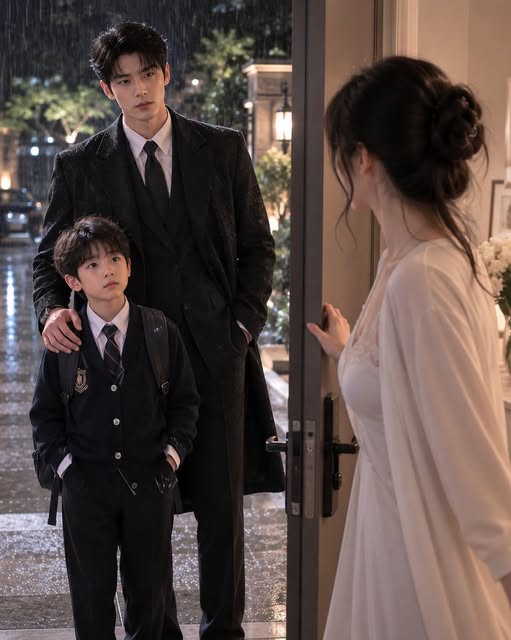
But Oliver returned three days later.
This time, Ethan called first.
He asked permission.
I said yes.
We met in a park.
Oliver brought a plastic dinosaur.
For forty minutes, he explained everything scientists knew about Tyrannosaurus rex.
I listened as though he were presenting the most important research in human history.
Before leaving, he asked:
“Can I see you again?”
I looked at Ethan.
He didn’t answer for me.
That mattered too.
“Yes.”
Oliver smiled.
“Saturday?”
“Saturday.”
That became our beginning.
Not motherhood overnight.
Not an instant family.
Saturdays.
Then Wednesday dinners.
Then school performances.
Slowly, Oliver learned who I was.
And I learned who he’d become without me.
He hated peas.
Loved astronomy.
Slept with one sock on and one sock off.
He became quiet when frightened.
He had my habit of reading the last page of a book before reaching the middle.
Every similarity felt like discovering something I’d lost before knowing I owned it.
Months later, Ethan gave me a folder.
“What is this?”
“The original trust documentation.”
I read it carefully.
Then found something strange.
A payment schedule.
The amount listed beside my name was much larger than what I’d received.
I looked up.
“Ethan.”
“I know.”
“Where did the rest go?”
“My father arranged the payments through an intermediary.”
My heart sank.
The money that had changed my life had been only part of what his family had promised.
Ethan’s father had withheld the remainder after the birth.
For years, I’d believed I’d signed away my right to complain.
Ethan didn’t ask me to forget it.
He didn’t offer me a private envelope.
He gave the documents to my attorney.
The estate eventually paid what the agreement required.
I placed most of it into an education fund.
Not for Oliver.
He already had more financial security than he could ever need.
I created a scholarship for young parents returning to university after financial hardship.
I wanted that money to become something other than the price of a child.
A year passed.
Ethan and I learned to speak without the past sitting between every sentence.
He apologized once.
Properly.
Not for everything in one convenient speech.
For specific choices.
For knowing more than he’d told me.
For allowing his father to create a false story about my absence.
For pretending not to recognize me in the office because avoidance had seemed easier than truth.
I accepted the apology.
I didn’t turn it into romance.
Oliver didn’t need his biological parents to become a couple.
He needed adults who wouldn’t make him responsible for their unfinished history.
One evening, while the three of us were eating noodles, Oliver suddenly asked:
“Can I call you Mom?”
My hand stopped.
Ethan looked down at his bowl.
He left the answer entirely to me.
I asked:
“Do you want to?”
Oliver nodded.
“Sometimes.”
I smiled.
“Then sometimes is perfect.”
His face lit up.
“Okay, Mom.”
I had imagined that word for five years.
When it finally arrived, it wasn’t dramatic.
There was no music.
No audience.
Just a little boy with noodles on his shirt.
And somehow that made it better.
Three years later, I left Ethan’s company.
Not because we had fought.
Because I wanted a career that wasn’t connected to the Graves family.
I became project director at another firm.
Oliver spent weekends with me whenever he wanted.
Ethan remained his primary parent, but our arrangement gradually became something neither old contract nor inheritance document had imagined.
Choice.
Oliver had choices.
So did I.
On his ninth birthday, he handed me a handmade card.
On the front he’d drawn three people.
Ethan.
Himself.
Me.
Inside he’d written:
“My family is weird, but it works.”
I laughed until my eyes watered.
Ethan read it over my shoulder.
“That’s brutally accurate.”
“For once, we agree.”
He smiled.
There was affection between us by then.
Perhaps there always would be.
But affection didn’t require us to rewrite the past into a love story.
Five years earlier, I had believed I’d sold my womb for money.
For a long time, shame made me describe it that way even to myself.
Eventually, I stopped.
I had been a frightened twenty-two-year-old who made an enormous decision under financial pressure.
Oliver wasn’t something I’d sold.
He was a person.
And I wasn’t a transaction either.
That was the truth the old contract had failed to understand.
The Graves family had believed signatures could permanently define every relationship.
Who was the parent.
Who disappeared.
Who belonged.
Who was paid.
Who was allowed to return.
But paper couldn’t decide what happened five years later when a little boy stood at my door and asked:
“So you did exist?”
Yes.
I existed.
So did he.
And once we finally met, neither inheritance, money nor an old contract could write the rest of our story for us.
We wrote that part ourselves.
