The judge returned first.
His expression was completely different.
Behind him walked Co An.
And finally, Co Bac Van.
My former husband’s face was pale.
The confidence he’d carried into court had vanished.
“Court will resume.”
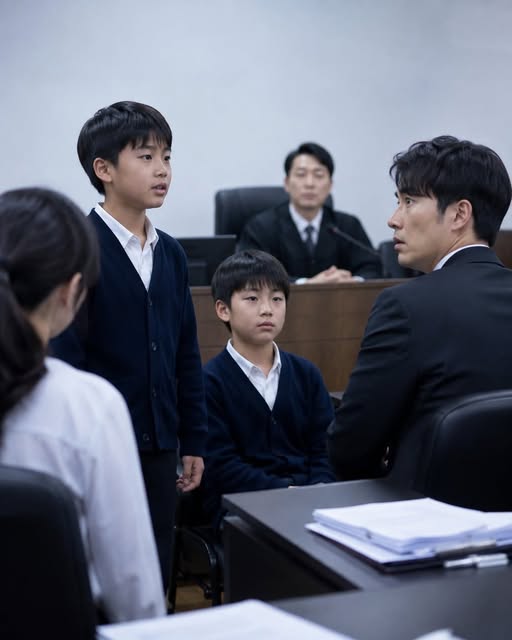
Everyone returned to their places.
I pulled Co An close.
“What happened?”
He squeezed my hand.
“Mom, don’t worry.”
The judge looked directly at Co Bac Van.
“Mr. Co, before we continue discussing custody, the court needs clarification regarding evidence your son has just presented.”
Evidence?
I stared at An An.
The judge placed a small USB drive on the table.
Co Bac Van’s lawyer immediately stood.
“Your Honor, evidence provided by a nine-year-old child without proper verification—”
“It will be verified.”
The judge interrupted.
“But its contents are serious enough that this court cannot ignore them.”
Co Bac Van suddenly spoke.
“They’re private family recordings.”
My heart stopped.
Recordings?
The judge looked at him.
“So you acknowledge the voices may be genuine?”
His lawyer’s face changed.
Co Bac Van realized he’d made a mistake.
He stopped speaking.
The first recording was played.
Bach Mong’s voice came from the speakers.
“When you get custody, send the twins to boarding school.”
Then Co Bac Van answered.
“After the ruling.”
My entire body went cold.
Bach Mong laughed.
“Good. I don’t want to raise another woman’s children.”
Co Bac Van replied calmly:
“Neither do I.”
I covered my mouth.
Beside me, Ninh Ninh began crying.
Co An held his brother’s hand.
But the recording continued.
Bach Mong asked:
“Then why fight for them?”
A pause.
Then my former husband’s voice answered.
“Because if Tri Ha keeps the children, she’ll have grounds to demand more support.”
The courtroom became completely silent.
I looked at the man I’d spent ten years beside.
He wasn’t fighting because he loved our sons more.
He was using them as pieces in a divorce.
The second recording was worse.
Co Bac Van and his lawyer were discussing how my years outside the workforce could be presented against me.
“Emphasize emotional instability.”
“But there’s no diagnosis.”
“Then don’t say there’s a diagnosis. Say there is a tendency.”
“And the children?”
“Say they sometimes went hungry.”
My hands shook.
Everything suddenly made sense.
They had carefully chosen statements difficult to disprove.
Not direct accusations with documents behind them.
Suggestions.
Implications.
Half-truths.
Enough to make me look unstable.
The judge stopped the recording.
“Co An, how did you obtain these?”
My son stood.
“Dad gave me his old tablet.”
He swallowed.
“One night it connected to his phone automatically.”
“He was talking to Aunt Bach.”
“I heard Mom’s name.”
“So I recorded it.”
Co Bac Van snapped:
“You had no right!”
The judge’s expression hardened.
“Mr. Co.”
He fell silent.
Co An continued.
“I didn’t tell Mom because she cries when she thinks we’re asleep.”
My eyes filled instantly.
An An looked at me.
“I wanted to help her.”
I pulled him into my arms.
“You shouldn’t have had to.”
That was what hurt most.
A nine-year-old should have been thinking about homework and football.
Not collecting evidence because he was afraid his mother would lose him.
The custody decision was not made solely because of one recording.
The court ordered further review.
Teachers were interviewed.
Medical records were examined.
School attendance.
Meal records.
Messages.
Household expenses.
Everything Co Bac Van had tried to turn into accusations was investigated.
And slowly, the truth emerged.
The children were healthy.
Their school performance was good.
Teachers consistently described me as the parent who attended meetings, collected them when sick and communicated with the school.
There was no evidence I’d deliberately deprived them of food.
No evidence supporting the picture Co Bac Van had painted.
More importantly, financial records showed something else.
I hadn’t been “living off my husband” for ten years.
I had been doing unpaid work that allowed him to build his career.
When Co An and Co Ninh were babies, Co Bac Van traveled constantly.
I handled everything.
Children.
Home.
His parents.
Family obligations.
He could work late because I was always there.
He could travel because I stayed.
Yet during divorce proceedings, the very sacrifice that supported his success had been rewritten as proof that I was useless.
This time, I refused to leave empty-handed.
My attorney looked at me.
“You contributed to this marriage for ten years.”
I finally understood.
Wanting fairness wasn’t greed.
The final custody hearing took place months later.
The judge reviewed both households and the children’s interests.
Co Bac Van was no longer smiling.
When the decision was announced, the twins would primarily live with me, with structured contact arrangements for their father.
I closed my eyes.
Ninh Ninh immediately hugged me.
Co An remained still for several seconds.
Then his shoulders finally relaxed.
Outside the courthouse, Co Bac Van stopped me.
“Tri Ha.”
I turned.
His eyes moved toward the children.
“Can we talk alone?”
“No.”
“Please.”
I asked my lawyer to remain nearby.
Co Bac Van lowered his voice.
“I shouldn’t have done what I did.”
“No.”
“I was afraid you’d take everything.”
I almost laughed.
“I asked for nothing.”
“I know.”
That seemed to hurt him now.
“You were willing to walk away from the house, savings, everything.”
“Yes.”
“And I still tried to take the boys.”
“Yes.”
He looked ashamed.
“Bach Mong and I are over.”
“That isn’t relevant.”
“I thought maybe—”
“No.”
One word.
That was enough.
For ten years, I’d explained myself endlessly.
That day I discovered the freedom of not explaining.
I rebuilt slowly.
I returned to the accounting profession I’d left after giving birth.
At first, everything felt unfamiliar.
New software.
New regulations.
Younger colleagues.
I studied at night after the twins slept.
Six months later, I passed a professional certification exam.
A year later, I was promoted.
Our apartment wasn’t a villa.
The boys shared a bedroom.
We bought ordinary groceries and counted expenses carefully.
But nobody in that home treated love like leverage.
Co Bac Van remained their father.
I never taught the boys to hate him.
He had made terrible decisions during the divorce.
But they deserved the freedom to build their own relationship with him.
Gradually, even he changed.
He stopped arriving with expensive gifts every visit.
He started asking about homework instead.
He learned the names of their teachers.
He attended Co Ninh’s school performance.
He sat through Co An’s entire science competition.
Two years later, after dropping them home, he stood at my door.
“Tri Ha.”
“Yes?”
“I finally understand why An An recorded me.”
I waited.
“He didn’t trust me.”
“No.”
His eyes lowered.
“And that was my fault.”
“Yes.”
He nodded.
There was nothing else to say.
That night, after the boys went to bed, I found Co An sitting at his desk.
He was eleven now.
Older.
Taller.
Still too serious sometimes.
“Mom?”
I sat beside him.
“Do you remember the secret you told the judge?”
His expression became cautious.
“Yes.”
I took his hand.
“Thank you for wanting to protect me.”
He smiled slightly.
“But never do that again.”
He blinked.
“Why?”
“Because protecting adults isn’t your job.”
I touched his hair.
“You are my son.”
“You get to be a child.”
His eyes became red.
For the first time, I realized he’d carried that responsibility for years.
He leaned against me.
“Mom?”
“Yes?”
“Were you really going to leave without taking any money?”
“Yes.”
“That was stupid.”
I stared at him.
Then burst out laughing.
From the bedroom, Co Ninh shouted:
“Brother said a bad word!”
“Stupid isn’t a bad word!”
“It is when you call Mom stupid!”
Our tiny apartment filled with their argument.
And suddenly I understood something.
The day Co Bac Van filed for divorce, I believed I had lost everything except my children.
I was wrong.
I hadn’t lost my life.
I’d only lost the version of it that required me to disappear so everyone else could succeed.
My sons didn’t save me by choosing me over their father.
Co An’s secret simply opened the door.
I still had to walk through it myself.
I had to rebuild a career.
Learn independence.
Accept help.
Demand fairness.
And finally understand that being a good mother didn’t require sacrificing every part of myself.
Years later, when people asked how I survived that divorce, they expected me to tell them about the courtroom recording.
But that wasn’t the moment that changed my life.
It was what happened afterward.
The moment I stopped saying:
“I don’t want anything. Just give me my children.”
And started saying:
“My children deserve their mother.”
“And their mother deserves a life too.”
