Adrian kept saying the same words.
“My children.”
Again.
And again.
As if repeating them could make them his.
I watched from the hospital bed while security pulled him away from the broken glass.
“My children…”
Something inside me finally stirred.
Not grief.
I had already fallen through grief and landed somewhere colder.
“They were never yours.”
Adrian stopped struggling.
His eyes found mine.
“What?”
“You became their father the moment you protected them.”
My voice was barely louder than a whisper.
“You never got that chance because you chose Clara before you even knew they existed.”
His face crumpled.
I turned toward the wall.
“Get him out.”
The police came that afternoon.
The story Adrian had apparently given when I was unconscious was that we’d had a “domestic argument” and I had been accidentally injured.
Accidentally.
Two stab wounds.
Fortunately, evidence was less sentimental than marriage.
The paramedics had documented my condition.
The knife had been recovered.
The house had security cameras.
And the living room camera had captured enough.
Adrian picking up the knife.
His threat.
The attack.
Then leaving me bleeding while he carried Clara outside.
There was something else.
The ambulance hadn’t been called by Adrian.
It had been called by our housekeeper, Mrs. Miller, when she returned twenty-three minutes later and found me unconscious.
Twenty-three minutes.
That number stayed with me.
My babies had been losing blood with me for twenty-three minutes while their father comforted another woman.
The detective asked:
“Do you want to make a formal statement?”
“Yes.”
Adrian’s attorney called me before sunset.
I blocked the number.
His mother called.
I blocked hers too.
Then Clara called.
I answered.
Her first sentence was:
“I didn’t know you were pregnant.”
I closed my eyes.
“You didn’t need to.”
Silence.
“He shouldn’t have done that.”
“No.”
“I never asked him to stab you.”
“No.”
Her voice trembled.
“You believe me?”
“I believe you didn’t have to ask.”
She went quiet.
I continued.
“You knew exactly what would happen when you came crying to Adrian and blamed me.”
“I didn’t blame—”
“You said, ‘It was her.’”
Silence.
“I have the recording, Clara.”
She hung up.
Two days later, the truth about Clara’s wound arrived.
It hadn’t come from me.
Obviously.
But it hadn’t come from some mysterious attacker either.
The building camera from her apartment showed Clara leaving home without any visible injury.
Twenty minutes later, footage from a convenience store showed her entering the restroom.
When she emerged, her sleeve was pulled down.
She drove directly to our house.
Investigators later found messages she’d sent a friend.
One sentence mattered most:
“Adrian only needs a reason to remember who matters.”
That reason cost me two children.
Clara had apparently expected a confrontation.
Jealousy.
Perhaps divorce.
She had not expected attempted murder.
But intentions don’t reverse consequences.
She had lied.
Adrian had chosen violence.
And I had almost died between them.
Adrian was arrested before I left the hospital.
I did not visit him.
I did not answer his letters.
There were seventeen in the first month.
I opened only one.
It began:
“My love, if I had known about the babies—”
I stopped reading.
That sentence told me everything.
If I had known.
As though stabbing his wife would have been acceptable if my womb had been empty.
I gave the rest to my lawyer unopened.
Then I filed for divorce.
Clara came to the hospital once.
By then I had been moved out of intensive care.
She stood in the doorway wearing no makeup.
“I need to speak to you.”
“No.”
“Please.”
“No.”
Tears appeared.
“I need you to understand that Adrian misunderstood me.”
I almost laughed.
“You walked into my home with a deliberately manufactured accusation.”
“I wanted him to choose me.”
“He did.”
Her face collapsed.
“You won.”
I looked at her.
That word disgusted me.
“Won?”
“You have everyone on your side now.”
I pushed myself upright despite the pain.
“Clara, my children are dead.”
She froze.
“My abdomen has two stab wounds.”
I pointed toward the door.
“My husband is in custody.”
My voice shook for the first time.
“My marriage is over.”
“And you think this is winning?”
She started crying.
“I loved him first.”
There it was.
The childish logic beneath everything.
First.
As if love were a queue.
As if arriving earlier gave her ownership forever.
“You can have the title,” I said.
She looked confused.
“First love.”
I swallowed.
“I was supposed to be his last.”
Then I pressed the call button.
A nurse escorted her out.
Recovery was ugly.
There was nothing cinematic about it.
I couldn’t stand straight for weeks.
I woke at night reaching for a stomach that was no longer carrying anything.
My body continued behaving as though pregnancy had happened, while my life had already been emptied of it.
The nursery was the worst.
Adrian didn’t know about it.
I had started preparing secretly.
Two tiny wooden cribs had been ordered.
Two pairs of socks sat inside a drawer.
And on my phone was a video I had planned to show him that night.
Two heartbeats.
Fast.
Alive.
I watched it once.
Then I couldn’t breathe.
My sister took the phone from me and held me until morning.
That was the night I stopped thinking about revenge.
Not because I forgave Adrian.
I didn’t.
But revenge still meant organizing my future around him.
I had already given him enough.
I wanted accountability.
Then I wanted my life.
The legal process lasted far longer than my wounds took to close.
Adrian’s defense tried to characterize the attack as an explosive emotional reaction caused by Clara’s accusation.
The video made that difficult.
So did the fact that he had threatened me immediately before stabbing me.
So did leaving without calling for help.
Clara faced consequences of her own for the false story and the evidence surrounding how it had been manufactured.
I attended the proceedings when I needed to.
I didn’t attend when I didn’t.
I refused to turn my recovery into a front-row seat to Adrian’s collapse.
The only time I spoke directly to him again was during the legal process.
He looked thinner.
Older.
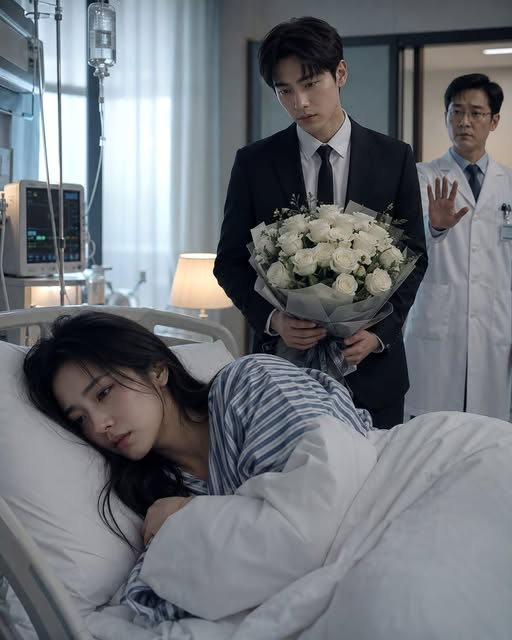
Nothing like the immaculate man who had brought white roses to my ICU room.
He stared at me as though seeing a ghost.
When I finished speaking, he whispered:
“I am sorry.”
I looked at him.
“For what?”
His mouth opened.
“For hurting you.”
“Be specific.”
His eyes filled.
“For stabbing you.”
I waited.
“For leaving you there.”
I waited.
“For our children.”
There.
Finally.
Not “losing.”
Not “what happened.”
“For killing them,” he whispered.
I closed my eyes for one second.
Then opened them.
“That apology belongs to three people.”
He broke down.
I didn’t.
The divorce was finalized while the criminal case was still unfolding.
I took back my maiden name.
I sold the house.
People told me I might regret that.
I didn’t.
A house remembers.
The couch remembered Clara crying.
The floor remembered my blood.
The kitchen remembered an apple rolling across it while Adrian reached for a knife.
I wanted walls that knew nothing about me.
So I bought a smaller apartment.
Sunlight in the bedroom.
A balcony full of plants.
No security cameras inside.
For months, I slept with every light on.
Then one evening, without noticing, I turned them all off.
I woke the next morning and realized I had slept six hours.
It felt like victory.
A year later, the hospital contacted me.
They were creating a support program for women recovering from severe domestic violence and pregnancy loss.
They asked whether I wanted to contribute anonymously.
I did.
Not because suffering had magically made me noble.
I hated when people said things like that.
My babies did not die so I could learn a lesson.
There was no beautiful purpose hidden inside what Adrian did.
It was simply terrible.
But terrible things can leave resources behind.
Money.
Experience.
Understanding.
I couldn’t change what happened.
I could decide what happened next.
So I funded two private recovery rooms.
I didn’t name them after myself.
I named them after the names I had written in my pregnancy journal.
Elliot.
And James.
My sons.
For the first time, their names existed somewhere outside my grief.
Almost two years after the attack, a letter arrived from Adrian.
My lawyer asked if I wanted it destroyed.
“No.”
I took it home.
It contained only a few paragraphs.
No request for forgiveness.
No request to see me.
He wrote that he’d spent months obsessing over the twins because mourning them allowed him to avoid something worse.
Facing what he’d done to me.
He had imagined himself as a protector his entire life.
But when someone he loved accused another person, he hadn’t investigated.
Hadn’t listened.
Hadn’t even asked a question.
He had simply chosen the person whose tears mattered more to him and turned the other into an enemy.
At the bottom he wrote:
“I used to think my punishment was discovering that I killed my sons. I understand now that the person I tried to kill was already enough.”
I folded the letter.
Then I put it away.
Not because I forgave him.
Because for once, Adrian had finally understood something without requiring me to explain it.
Years later, I was peeling an apple in my new kitchen when the knife slipped.
It nicked my finger.
A tiny bead of blood appeared.
I froze.
Suddenly I was back there.
Clara crying.
The knife.
Adrian’s face.
My white clothes turning red.
I put the knife down.
My hands were shaking.
Then I looked around.
Sunlight.
Plants.
Music playing softly.
No Adrian.
No Clara.
No blood on the floor.
I washed my finger.
Put on a bandage.
Then finished cutting the apple.
That was recovery.
Not forgetting.
Not becoming fearless.
Simply discovering, again and again, that the terrible moment had ended.
Adrian once told me that if I hurt Clara, he would kill me.
He almost kept that promise.
But the woman he stabbed did not die.
She woke up.
She testified.
She divorced him.
She buried her sons.
She built another home.
And eventually, she stopped needing revenge.
Because Adrian had already lost the life he destroyed.
I still had mine.
