Julian stared at the resignation confirmation on my screen.
For the first time that afternoon, his expression actually changed.
Not when I collapsed.
Not when he saw blood on my knee.
Not when I told him I hadn’t eaten.
Only when he realized I was leaving his company.
“Withdraw it.”
I picked up my bag.
“No.”
“Emma, stop acting emotionally.”
I looked at him.
“My resignation has a notice period. Human Resources can contact me about the formalities.”
“I’m not talking about HR.”
“Then there’s nothing else to discuss.”
I walked past him.
He caught up with me outside the break room.
“You’re ending seven years because I ordered the wrong lunch?”
I stopped.
There were people nearby.
Exactly the audience Julian had spent seven years fearing.
So I smiled politely.
“Director Hayes, please maintain an appropriate distance.”
His face went rigid.
I had used his own rules against him.
“Emma.”
Several colleagues looked over.
I stepped farther away.
“You’ve spent years making sure nobody could misunderstand our relationship. I’d hate to ruin all that work now.”
Then I left.
Serena called that evening.
I was sitting in urgent care while a nurse cleaned my knee.
“Emma, what happened?”
“I resigned.”
“I know! Everyone knows.”
Her voice sounded genuinely shocked.
“Why?”
I looked at the purple bruise forming around my kneecap.
“I received another offer.”
That wasn’t entirely a lie.
Three weeks earlier, a technology group had contacted me after one of my university professors recommended me.
The position was permanent.
Better salary.
Real training.
I had declined the interview because accepting it would mean leaving Julian’s company.
That night, I emailed them.
“I’d like to know whether the position is still available.”
Their reply came twenty minutes later.
“Yes.”
Serena continued talking.
“Julian has been terrifying since you left. He canceled two meetings.”
I almost laughed.
“That sounds like a management problem.”
“Emma…”
She hesitated.
“Did something happen between you two?”
I looked at the ceiling.
For seven years, I had protected the secret automatically.
“No.”
The word came easily.
“Nothing that matters anymore.”
My interview was Friday.
I received the offer Monday.
I accepted Tuesday.
Julian found out Wednesday.
Apparently, he called my new employer.
I learned because their HR director asked me:
“Does Julian Hayes have authority over any contractual obligation you have with us?”
“No.”
“Good.”
That afternoon, Julian was waiting outside my apartment.
“You’re going to Alden Technologies?”
“Yes.”
“They’re our competitor.”
“Not directly.”
“You know what I mean.”
I unlocked the door.
He put his hand against it.
“Emma, can we talk like normal people?”
I turned.
“Normal people?”
His jaw tightened.
“Fine. Like a couple.”
“We aren’t a couple.”
“You don’t erase seven years in a week.”
“You erased them every morning when we entered the office.”
His hand dropped.
“That was different.”
“Everything was always different when you did it.”
He followed me inside before I could close the door.
I didn’t argue.
I was too tired.
He looked around.
His toothbrush was still in my bathroom.
His slippers were beside the couch.
There were seven years of him everywhere.
He saw a cardboard box near the wall.
Inside were his things.
His expression darkened.
“You packed my stuff?”
“Yes.”
“You’re serious.”
“I thought the resignation clarified that.”
He rubbed his forehead.
“I made a mistake.”
“One?”
“Emma.”
“One mistake was forgetting my food.”
I faced him.
“One mistake was stepping away when I fell.”
“One mistake was rejecting me from the company because you were afraid people might think I benefited from dating you.”
“One mistake was allowing colleagues to mock me because correcting them might expose us.”
I pointed toward the box.
“But seven years of mistakes with the same purpose becomes a decision.”
He stared at me.
“What purpose?”
“Protecting yourself.”
Silence.
“Every rule protected you, Julian.”
“Your reputation.”
“Your authority.”
“Your comfort.”
“What protected me?”
He had no answer.
Then he said something I wasn’t expecting.
“Serena is being appointed permanent assistant.”
I laughed.
“You came here to tell me that?”
“No. I’m explaining why things looked wrong.”
“They looked exactly as they were.”
“She got the position because she’s suitable.”
“Good for her.”
His frustration increased.
“You always compete with her.”
I stared at him.
“I don’t.”
“You’ve always been sensitive about Serena.”
“Because you gave her the interview opportunity you refused me.”
“She wasn’t my girlfriend.”
Exactly.
Julian heard it too late.
I nodded.
“That sentence is our entire relationship.”
His face changed.
“You gave her opportunities because she wasn’t your girlfriend.”
“You gave me disadvantages because I was.”
“You didn’t want anyone to accuse you of favoritism, so you went in the opposite direction and treated me worse.”
“That isn’t fair.”
“Neither was what you did.”
I opened the door.
He didn’t move.
Then, very quietly, he asked:
“Did you ever think about how difficult this was for me?”
“Yes.”
I surprised him.
“For seven years.”
“That was the problem.”
“I spent seven years understanding you.”
“You spent seven years asking me to.”
He left without another word.
My new job started three weeks later.
On my first day, my manager introduced me to the team.
“This is Emma Jiang. Her university project work is excellent, and her previous evaluations were outstanding.”
That was it.
Nobody whispered about whose girlfriend I was.
Nobody cared who I dated.
My work belonged to me.
It was almost embarrassingly simple.
Two months later, I led my first client presentation.
Afterward, my manager said:
“Good job.”
Two words.
I went to the bathroom and cried.
Not because the compliment was extraordinary.
Because I had spent years believing basic professional recognition was something dangerous to want.
Serena messaged occasionally.
Then, one evening, she asked to meet.
I almost refused.
But curiosity won.
She looked exhausted.
“Being Julian’s assistant isn’t what I expected.”
I stirred my coffee.
“What did you expect?”
She laughed bitterly.
“I don’t know.”
Then she looked at me.
“Were you and Julian together?”
I didn’t answer immediately.
She understood anyway.
Her eyes widened.
“Oh my God.”
“Seven years.”
She covered her mouth.
“Emma…”
I watched the realization move across her face.
The elevator.
The closed office doors.
The way he avoided sitting beside me.
Every time colleagues mocked me for supposedly chasing him.
“You let everyone think…”
“I didn’t.”
“He did.”
Serena became pale.
“I didn’t know.”
“I know.”
She looked down.
“The crab noodles…”
I waited.
“I mentioned them that morning when Julian came through the cafeteria.”
“I know.”
Her eyes lifted.
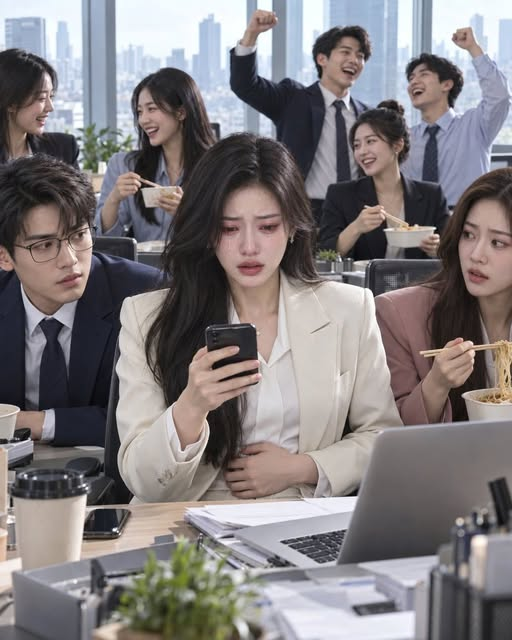
“I wasn’t trying to flirt with him.”
“I know that too.”
That surprised her.
I had spent weeks thinking about it.
Serena had enjoyed the attention.
She had enjoyed colleagues teasing her about Julian.
But she had never promised me anything.
Julian had.
“You’re not why I left,” I said.
She looked relieved.
Then uncomfortable.
“There’s something you should know.”
“What?”
“Julian rejected three candidates for my position.”
I frowned.
“Why?”
“He said they weren’t suitable.”
“And?”
“One of them was Chloe.”
The intern who had accused me of pretending to faint.
I almost smiled.
“Karma?”
“No.”
Serena shook her head.
“He reviewed the office camera.”
I stopped.
“What camera?”
“The corridor camera outside the meeting room.”
She swallowed.
“It showed you falling.”
I said nothing.
“It showed him moving toward you.”
Then stepping back.
My fingers tightened around the cup.
Serena continued.
“Apparently he watched it over and over.”
That image followed me home.
Not because I wanted Julian to suffer.
Because I finally understood something.
He had known instinctively what to do.
His body moved to catch me.
Then his fear of being seen caring about me overruled the instinct.
That was worse.
Six months after I left, our companies attended the same industry conference.
I was speaking on a panel.
Julian sat in the third row.
I noticed him immediately.
I didn’t lose my place.
Afterward, he waited near the exit.
“Congratulations.”
“Thank you.”
“You were good.”
“I know.”
That made him smile sadly.
“You’ve changed.”
“No.”
I adjusted my conference badge.
“I just stopped apologizing.”
His smile disappeared.
We stood there awkwardly.
Then he said:
“I told people.”
“What?”
“About us.”
I stared at him.
“At the company.”
“Why?”
“Because after you left, I heard what people had been saying about you.”
His voice became quieter.
“I realized my silence hadn’t protected you.”
“It protected me.”
I nodded.
“Yes.”
He swallowed.
“I corrected everything.”
“Good.”
“I told them you never pursued me.”
“Good.”
“I told them I was the one who asked you out.”
I almost laughed.
Seven years too late.
“Thank you.”
He stepped closer.
“Emma, I know that doesn’t fix anything.”
“It doesn’t.”
“I’ve been seeing a therapist.”
I said nothing.
“I think I was obsessed with appearing impartial.”
“You weren’t impartial.”
“I know.”
He looked at me.
“I punished you for being close to me.”
That was the first time he had described it accurately.
“Yes.”
His eyes reddened.
“I loved you.”
“I know.”
“I still do.”
I believed that too.
That was what made our story sad rather than simple.
Julian had loved me.
He had simply loved his image more whenever the two came into conflict.
“Can we start again?”
I looked at him for a long time.
“No.”
He closed his eyes.
“Because of Serena?”
“No.”
“The company?”
“No.”
“Then why?”
I remembered the marble floor rushing toward my face.
His hand moving.
Then retreating.
“Because when I fell, your first instinct was to catch me.”
He looked confused.
“I saw the security footage.”
His face drained.
“My second instinct…”
“Was to protect yourself.”
He looked away.
I continued quietly.
“I don’t want to spend my life wondering which instinct will win when I really need you.”
He had nothing to say.
A year later, I was promoted.
That afternoon, my team ordered lunch to celebrate.
Someone passed around a menu.
“Emma, what do you want?”
I scanned it.
Beef stir-fry.
I laughed.
“What?”
“Nothing.”
I ordered it.
Then one colleague pointed at another section.
“The crab noodles here are amazing. Should we get several bowls to share?”
Before I could answer, my manager said casually:
“Emma can’t have shellfish. Order those separately.”
That was all.
Nobody gasped.
Nobody accused me of demanding special treatment.
Nobody wondered whether acknowledging my allergy would destroy the company.
It took five seconds.
I sat there staring at the menu.
Seven years.
I had spent seven years believing Julian’s behavior was the price of protecting our relationship.
But love that must constantly erase you isn’t being protected.
Only the person doing the erasing is.
The beef arrived.
It was hot.
Ordinary.
Probably not even as good as the restaurant beneath Julian’s office.
I ate every bite.
And somewhere halfway through the meal, I realized I no longer associated hunger with him.
I didn’t need Julian to remember what I liked.
I didn’t need him to announce that I mattered.
I didn’t need his money transferred quietly after he publicly ignored me.
And I certainly didn’t need to compete with Serena for basic consideration.
That bowl of crab noodles had once seemed like the reason our seven-year relationship ended.
It wasn’t.
It was simply the moment I became hungry enough to stop accepting crumbs.
