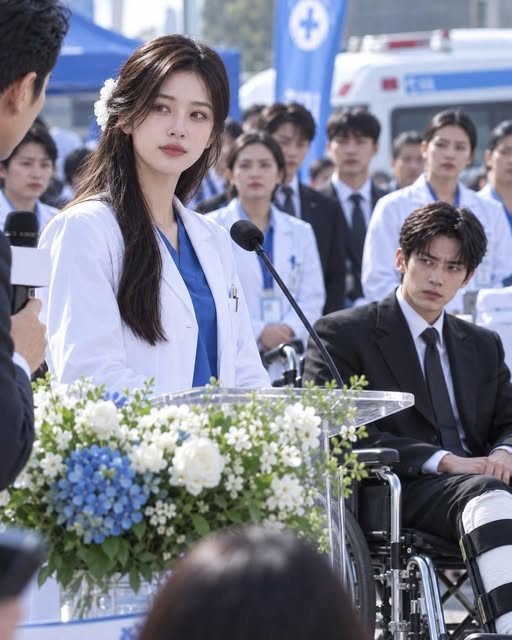
Two days later, I stood at the farewell ceremony with the medical team bound for City Y.
Pho Hanh Chu was there.
I hadn’t expected him.
After I answered the reporter’s question and calmly revealed that I had been the surgeon who saved my husband after he was injured protecting another woman, the entire plaza seemed to fall silent.
Pho Hanh Chu stared at me from several steps away.
For the first time, the composed businessman who could face cameras without changing expression looked completely unprepared.
The reporter lowered his microphone.
I turned away.
“Lam Duong.”
His voice stopped me.
I didn’t look back.
“We need to talk.”
“My team leaves in twenty minutes.”
“Then give me five.”
I finally faced him.
“What can you say in five minutes that you couldn’t say during three years of marriage?”
His jaw tightened.
“That interview wasn’t about Tham Khinh Dao.”
I almost laughed.
“Then who was it about?”
He fell silent.
That was answer enough.
I nodded.
“Exactly.”
His wheelchair moved closer.
“Why didn’t you tell me you were joining the earthquake relief team?”
“Why would I?”
“I’m your husband.”
“Temporarily.”
His expression hardened.
“I haven’t signed.”
“That doesn’t mean I’m staying.”
“Lam Duong.”
His hand tightened around the armrest.
“You can’t disappear into an earthquake zone because you’re angry with me.”
“I am not angry.”
That seemed to disturb him more than anger would have.
I crouched slightly so our eyes were level.
“You asked whether the interview upset me.”
My voice remained quiet.
“It didn’t.”
“I simply understood that the moment you are proudest of is the same moment that destroyed whatever was left of our marriage.”
His face changed.
“You saved my life.”
“Yes.”
“And afterward I spent three years taking care of the injury you received protecting her.”
I straightened.
“I’ve fulfilled every obligation I ever imagined I had.”
The boarding announcement sounded behind me.
“So sign the papers.”
Then I left.
City Y changed everything.
The earthquake had damaged hospitals throughout the region, and our team worked from temporary medical facilities.
There was no time to think about marriage.
Patients arrived.
Doctors needed decisions.
Young residents needed guidance.
For the first time in three years, nobody introduced me as Mrs. Pho.
They called me Doctor Lam.
I had forgotten how much I loved hearing my own name attached to something I’d earned.
At night, I was exhausted.
But strangely, I slept better there than I had in the enormous house I’d shared with Pho Hanh Chu.
He called every day.
I answered none of them.
Then the calls stopped.
A week later, a package arrived.
Inside were the signed divorce papers.
No letter.
Just his signature.
I stared at it for a long time.
Then I signed mine.
I expected pain.
Instead, I felt relief.
Three months later, I returned to City C.
Pho Hanh Chu was waiting outside the hospital.
He looked thinner.
“What are you doing here?”
“I need surgery.”
My expression immediately changed from ex-wife to doctor.
“What happened?”
“The reconstruction in my leg is failing.”
“Your orthopedic team—”
“Recommended another procedure.”
“Then schedule it.”
He looked directly at me.
“I want you involved.”
“No.”
His face tightened.
“You’re the best surgeon I know.”
“I am not the appropriate specialist for your reconstruction.”
“I trust you.”
That almost hurt.
I smiled bitterly.
“You trust me with your life.”
He understood immediately.
“But never with your heart.”
Silence.
“Interesting distinction, isn’t it?”
I walked past him.
He caught my sleeve, then released it almost immediately.
“Khinh Dao is leaving.”
I stopped.
“That has nothing to do with me.”
“She came back because her mother was ill. She never asked me to leave you.”
“Still nothing to do with me.”
His voice became rough.
“I never had an affair with her.”
I turned.
“I know.”
He looked startled.
“You do?”
“Yes.”
That was the part Pho Hanh Chu had never understood.
My marriage hadn’t ended because he secretly slept with another woman.
It ended because when danger came, his instinct chose her.
When cameras asked about it three years later, his pride still chose that memory.
And when his leg hurt, he expected his wife to carry the consequences.
“You didn’t need to betray me physically,” I said.
“You made me spend three years living beside proof that if the world collapsed again, I already knew who you’d reach for first.”
He went completely still.
The divorce became final shortly afterward.
I returned to work.
Pho Hanh Chu underwent surgery with another medical team.
It was successful.
We didn’t speak for almost a year.
Then one afternoon, Tham Khinh Dao appeared at my office.
She placed an old envelope on my desk.
“I think you should have this.”
“What is it?”
“Something Pho Hanh Chu doesn’t know I kept.”
Inside was a statement written three years earlier.
It concerned the accident.
I read slowly.
Then again.
Something was wrong.
According to the official story, Pho Hanh Chu had moved toward Khinh Dao when the structure began collapsing.
Her statement said the opposite.
He had been trying to reach someone else.
Me.
“What is this?”
Khinh Dao’s face was pale.
“You were supposed to attend that event.”
I remembered.
I had canceled at the last moment because of emergency surgery.
She continued.
“When everything happened, Hanh Chu thought you were still inside.”
My fingers tightened around the paper.
“He wasn’t protecting me at first.”
She swallowed.
“He was looking for you.”
I stared at her.
“Then why was he holding your wrist when they found you?”
“Because I fell.”
She looked down.
“He turned back.”
The room became silent.
“He pulled me away from the damaged area, and that’s when he was injured.”
My heartbeat became strangely loud.
For three years, I’d believed one story.
Pho Hanh Chu had chosen Khinh Dao.
Apparently, reality was more complicated.
But then I remembered the interview.
The person I cared about most.
I looked at her.
“Why would he describe you that way?”
Khinh Dao gave me a sad smile.
“He wasn’t.”
That evening, I went to Pho Hanh Chu’s office for the first time since our divorce.
He stared at me.
Then noticed the paper.
His face changed.
“Where did you get that?”
“Khinh Dao.”
He closed his eyes.
I placed it down.
“Explain.”
For once, he didn’t hide behind silence.
“The building was collapsing. I thought you were inside.”
“So you went back.”
“Yes.”
“But I wasn’t there.”
“No.”
“You found Khinh Dao.”
“She was trapped near the exit.”
“And you protected her.”
“Yes.”
I stared at him.
“Then who were you talking about during the interview?”
His eyes met mine.
“You.”
I almost laughed.
“That’s impossible.”
“No.”
He touched his damaged leg.
“The thing I’m proudest of wasn’t protecting Khinh Dao.”
His voice lowered.
“It was going back into that building because I believed you were inside.”
My chest tightened.
“Then why didn’t you answer when the reporter asked whether that person was your wife?”
His silence returned.
This time I understood before he spoke.
“Because our divorce papers were already being prepared.”
I stared at him.
“What?”
He opened a drawer.
Inside was an old envelope.
Dated three years ago.
A divorce agreement.
Prepared before the accident.
Signed by Pho Hanh Chu.
Not by me.
“I was going to leave you,” he said.
The words struck harder than anything else.
“Why?”
“Because I thought you were miserable.”
I couldn’t speak.
“You gave up an overseas surgical fellowship after we married. You reorganized your schedule around my company. My family kept expecting more from you.”
His hands tightened.
“And I kept accepting it.”
“So your solution was divorce?”
“I thought letting you go was kinder than asking you to keep sacrificing.”
I stared at him.
“You decided for me.”
“Yes.”
“Again.”
His face fell.
“Yes.”
That was the real problem.
Not Khinh Dao.
Not the accident.
Not even the interview.
Pho Hanh Chu had spent our entire marriage deciding what I could endure without ever asking what I wanted.
“Why didn’t you divorce me after the accident?”
He looked toward his leg.
“When I woke up, you were there.”
I remembered those months.
Rehabilitation.
Medication.
Sleepless nights.
“You stayed.”
His voice became quieter.
“And I became selfish.”
He had intended to release me.
Then he’d become dependent on me instead.
Three years passed.
Neither of us said what needed to be said.
Until I finally left.
“Does knowing this change anything?” he asked.
I thought carefully.
“Yes.”
Hope appeared in his eyes.
I continued:
“It changes what I believe happened that day.”
The hope weakened.
“But it doesn’t change what happened afterward.”
He looked down.
“I understand.”
“You should have told me.”
“I know.”
“You should have asked whether I wanted the fellowship.”
“I know.”
“You should have asked whether I wanted to stay.”
“I know.”
For once, he wasn’t defending himself.
That mattered.
But not enough to rebuild a marriage.
“I forgive you,” I said.
His head lifted.
“But I’m not coming back.”
His eyes reddened.
Still, he nodded.
“I know.”
Two years later, I accepted the overseas fellowship I’d once abandoned.
When I returned, I became director of a surgical training program.
Pho Hanh Chu recovered enough mobility to walk short distances with assistance, although he still used his wheelchair when necessary.
We occasionally met at charity events.
We became two people who could finally speak honestly because neither of us was asking the other to stay.
Tham Khinh Dao eventually married someone else.
There had never been a grand romance between her and Pho Hanh Chu waiting to begin.
Only an old affection, a dangerous moment and years of assumptions nobody corrected.
At another interview years later, a reporter asked me:
“Doctor Lam, what decision are you proudest of?”
I smiled.
Once, I might have said saving a life.
Or leaving a marriage.
Instead, I answered:
“Learning that saving someone doesn’t mean you must spend your life beside them.”
The reporter seemed surprised.
I continued.
“Sometimes you save someone because you’re a doctor.”
I paused.
“And sometimes you leave because you finally remember you’re a person too.”
Across the ballroom, Pho Hanh Chu heard me.
Our eyes met.
He smiled.
Not sadly.
Not hopefully.
Just knowingly.
I smiled back.
For three years, I had stood behind him.
For three more, I’d tried to understand whether leaving had been a mistake.
Eventually, I learned the truth was more complicated than betrayal and simpler than love.
Pho Hanh Chu had gone into danger believing he was trying to save me.
I had once held a surgical knife and saved him.
We had both saved each other’s lives.
But neither rescue meant we owed the other the rest of them.
So I turned toward the young surgeons waiting for me near the ballroom doors.
And this time, when I walked away from Pho Hanh Chu, neither of us tried to stop the other.
