Adrián read the sentence three times.
“This time don’t come back with roses. Come back with a lawyer.”
Then he turned the photograph over again.
Isabella.
The hotel entrance.
His coat around her shoulders.
The timestamp was printed in the corner.
The night our daughter had a fever.
Adrián’s fingers tightened around the photograph.
“Where is Clara?”
Rosa stood at the bedroom door.
“I don’t know, sir.”
“You helped her leave.”
“I helped her carry the baby downstairs.”
“Where did she go?”
“She didn’t tell me.”
Adrián took out his phone and called me.
The call went directly to voicemail.
Again.
Voicemail.
He opened our messages.
The last one I’d sent him was thirteen days earlier.
Our daughter has a fever. Please call me.
Underneath was the little word:
Delivered.
No reply.
He stared at it.
Then, perhaps for the first time, he checked the date.
That night in Paris, Isabella had posted a photograph of two champagne glasses beside the Seine.
Adrián had been sitting across from her.
While his newborn daughter was sick.
While his wife was calling.
He had turned off his phone.
Rosa spoke quietly behind him.
“The baby cried almost the entire night.”
Adrián didn’t turn.
“What?”
“Madam Clara couldn’t calm her. She was frightened because the baby’s temperature kept rising.”
His face slowly lost color.
“Why didn’t you call me?”
Rosa looked at him in disbelief.
“She did.”
Silence.
“She called you seven times.”
Adrián lowered the phone.
“And the next morning?”
“Mrs. Clara took the baby to the hospital.”
He turned sharply.
“Hospital?”
“She was alone.”
That word landed harder than anything else.
Alone.
Adrián sat on the edge of the bed.
For years, he had convinced himself that providing money was the same as being present.
Clara had a mansion.
Staff.
Cars.
Credit cards.
What could she possibly lack?
Apparently, him.
But by the time he understood that, I no longer did.
Three days later, my lawyer received the first response.
Adrián refused to sign.
Not because he disputed the photograph.
Not because he denied Paris.
His message was simple.
I want to speak to my wife first.
My lawyer called me.
“What should I tell him?”
“That he can speak through you.”
“He says there are things you don’t understand.”
I laughed softly.
“That’s interesting. For years, he thought I understood everything without him having to explain it.”
I looked toward the window.
My daughter was asleep in a bassinet beside me.
“Proceed.”
Adrián started searching.
He called my mother.
My former coworkers.
Friends I hadn’t spoken to in years.
He even contacted the hospital.
Nobody gave him my address.
Then Isabella called me.
I almost ignored it.
Almost.
“Clara.”
Her voice sounded controlled.
“I think we should talk.”
“About what?”
“Adrián.”
“No.”
She paused.
“No?”
“You can have him.”
Her breathing changed.
“That’s not why I’m calling.”
“Then why are you?”
“Because he’s blaming me for everything.”
I actually smiled.
“How inconvenient.”
“Clara, nothing happened in Paris.”
I looked at my daughter.
“Isabella, I don’t care whether you slept with my husband.”
Silence.
“I care that when his seven-day-old daughter was sick, he chose dinner with you over answering his phone.”
“That wasn’t my decision.”
“No. It was his.”
She seemed surprised.
Perhaps she’d expected screaming.
Jealousy.
Competition.
But Isabella had never been the real problem.
She was simply the place Adrián went whenever he wanted to forget that marriage required responsibility.
“He says he loves you,” she whispered.
“I’m sure he believes that now.”
“Then why won’t you see him?”
“Because love that only becomes urgent after someone leaves is often just panic.”
I ended the call.
Two weeks later, Adrián found me anyway.
I opened my front door one morning and saw him standing outside.
No roses.
No driver.
No expensive coat.
Just Adrián.
He looked exhausted.
His eyes moved past me.
He saw the bassinet.
Then our daughter made a tiny sound.
His face broke.
“Can I see her?”
I should have closed the door.
Instead, I stepped aside.
He walked toward the bassinet as if approaching something sacred.
For a long moment, he simply stared.
“She got bigger.”
“Babies do that.”
He flinched.
“What did you name her?”
That question told me everything.
I had sent him three names before he left for Paris.
He had replied:
Whatever you like.
“Amelia.”
His eyes filled.
“Amelia Moreau?”
“Amelia Bennett Moreau.”
He looked at me.
I folded my arms.
“I won’t erase her father. Your relationship with her will depend on what kind of father you choose to become.”
Hope appeared on his face.
“And us?”
“No.”
One syllable destroyed it.
“Clara, please.”
“You wanted to talk. Talk.”
He sat down.
“I made a mistake.”
“No.”
He looked confused.
“A mistake is forgetting an anniversary.”
I remained standing.
“Paris wasn’t a mistake. Fifteen days require fifteen mornings when you wake up and choose to stay.”
His jaw tightened.
“The trip was work.”
“Then why was Isabella in your hotel?”
“She was helping with the project.”
“And the necklace?”
Silence.
I nodded.
“Exactly.”
“It wasn’t what you think.”
“I don’t need to know what it was.”
He stood.
“Then what do you want me to say?”
“Nothing.”
His frustration finally surfaced.
“You left without giving me a chance!”
I stared at him.
“A chance?”
My voice remained quiet.
“I gave birth without you.”
His anger vanished.
“I spent my first night home afraid I was holding Amelia incorrectly. I bled through my clothes while trying to feed her. I slept in forty-minute intervals. When she developed a fever, I called you seven times.”
Adrián looked down.
“You had chances.”
I felt my throat tighten, but I refused to look away.
“You just thought chances lasted forever.”
He sat down again.
For several minutes, neither of us spoke.
Finally, he asked:
“Did you ever love me?”
That almost hurt.
“Enough to stay much longer than I should have.”
He covered his face.
And for the first time since I’d known Adrián Moreau, I watched him cry.
It changed nothing.
The divorce took eight months.
There were arguments over property.
Lawyers.
Financial disclosures.
Custody negotiations.
The joint account revealed every Paris expense.
Hotel suites.
Restaurants.
Jewelry.
A private excursion outside the city.
Adrián eventually stopped trying to explain them.
I didn’t try to prevent him from seeing Amelia.
I wanted something very specific.
If he wanted to be her father, he had to actually become one.
Scheduled visits.
Pediatric appointments.
Emergency contacts.
Real responsibility.
Not photographs.
Not gifts.
Not money.
Presence.
At first, he was terrible at it.
He arrived with designer baby clothes three sizes too large.
He didn’t know how to prepare a bottle.
The first time Amelia vomited on his shirt, he looked genuinely terrified.
But he kept coming.
Months passed.
Then one winter evening, Amelia developed another fever.
This time, my phone rang immediately.
“Clara.”
Adrián sounded frightened.
“She’s at thirty-eight point seven. I’ve already spoken to the pediatrician. I’m taking her in now. I’m sending you the hospital address.”
I arrived twenty minutes later.
He was sitting in a plastic chair with Amelia asleep against his chest.
His expensive shirt was stained with milk.
His hair was a mess.
His phone was beside him.
On.
I stopped for a moment.
He looked up.
“She’s okay.”
I nodded.
“Good.”
That night I realized something.
Adrián had finally learned how to be present.
But learning it did not entitle him to get his marriage back.
Some lessons arrive after the exam is over.
A year after the divorce was finalized, Adrián came to pick Amelia up for the weekend.
She was old enough to run toward him now.
“Papa!”
He crouched and caught her.
His entire face changed.
I watched from the doorway.
I was glad for her.
And strangely, I was glad for him.
As he carried her toward the car, he stopped.
“Clara.”
“Yes?”
“I owe you an apology I never gave correctly.”
I waited.
He looked at Amelia.
“I kept saying Isabella ruined our marriage.”
Then he shook his head.
“She didn’t.”
“No.”
“I did.”
For once, there was no explanation after it.
No excuse.
Just responsibility.
He smiled sadly.
“You know what the stupidest part is?”
“What?”
“I thought you’d always be waiting at home.”
I looked back at my little house.
Sunlight filled the living room.
Amelia’s toys were scattered across the rug.
There were no marble staircases.
No staff moving silently through hallways.
No champagne roses arranged to apologize for another absence.
But it was home.
“I was waiting,” I said.
Adrián looked at me.
“For years.”
His eyes lowered.
“Then one day I stopped.”
He nodded.
He carried Amelia to the car.
Before getting in, she waved at me with both hands.
“Mama!”
I waved back.
Adrián strapped her carefully into the car seat.
He checked the buckle twice.
Then they drove away.
I stood at the door until the car disappeared.
I didn’t feel abandoned.
I didn’t feel victorious.
I felt peaceful.
Once, Adrián believed roses could repair anything.
He brought them after missed dinners.
After lies.
After disappearing.
After choosing someone else.
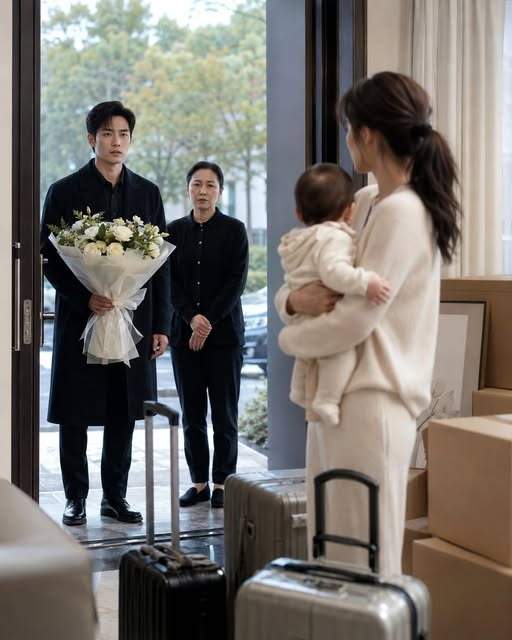
But the last bouquet he ever brought me remained on the marble floor of that mansion until the petals turned brown.
I never saw them.
By then, I had already learned what Adrián understood too late.
A woman doesn’t leave when she packs her suitcase.
She leaves slowly.
During every unanswered call.
Every lonely night.
Every promise broken and forgiven.
Every moment she needs her husband and discovers she is safer depending on herself.
The suitcase is only the final step.
Adrián went to Paris believing he had left a wife waiting for him.
Fifteen days later, he returned with roses.
But by then, the woman who would have accepted them no longer existed.
And this time, when he finally remembered he had a family…
I had already remembered that I had myself.
