The judge returned first.
Behind him came Co An.
My son walked directly toward me, but Co Bac Van remained near the doorway.
His face was terrifyingly pale.
His lawyer rushed over.
“What happened?”
He didn’t answer.
The judge sat down.
“This hearing will take a recess while certain evidence presented by the child is verified.”
Evidence?
I stared at An An.
He climbed onto the chair beside me and quietly took my hand.
“Mom.”
“What did you tell him?”
He lowered his voice.
“Something Dad didn’t want you to know.”
Three weeks earlier, An An had gone downstairs looking for his mathematics workbook.
He passed his father’s study and heard Co Bac Van speaking with Bach Mong.
The door wasn’t completely closed.
“Will she really leave with nothing?” Bach Mong had asked.
“She’ll agree because of the children.”
“And custody?”
Co Bac Van laughed.
“That’s why I’m taking the children too.”
Then came the sentence that changed everything.
“I’ve already prepared records showing she’s emotionally unstable.”
An An didn’t understand everything.
But he understood one thing.
They were talking about me.
So he activated the recorder on his smartwatch.
My nine-year-old son had recorded almost twenty minutes.
Co Bac Van discussed how he intended to portray my years as a stay-at-home mother as proof that I was incapable of supporting the children.
He spoke about statements he expected household staff to make.
He even joked that if I became angry in court, it would make his story more believable.
That explained his confidence.
He hadn’t simply hoped I’d lose control.
He had planned for it.
I couldn’t speak.
“Why didn’t you tell me?”
An An looked down.
“I was afraid you’d cry.”
My heart broke.
“You shouldn’t have had to protect me.”
“But you’re always protecting us.”
I pulled him close.
“No, sweetheart.”
I whispered into his hair.
“Adults are supposed to protect children. Not the other way around.”
Ninh Ninh squeezed into the embrace too.
For the first time since the divorce began, I stopped worrying about winning.
I only wanted my children to never feel responsible for fixing their parents’ mistakes.
The recording did not magically decide the entire case.
It had to be examined.
The circumstances surrounding it had to be reviewed.
Other claims still required evidence.
But Co Bac Van’s perfect story had cracked.
And once people started checking, more cracks appeared.
School records showed who attended nearly every parent meeting.
Me.
Medical records showed who brought the boys to appointments.
Me.
Teachers confirmed who communicated with them.
Me.
The housekeeper whom Co Bac Van expected to support him refused to repeat statements she said were untrue.
And those supposed nights when my children had been “starving and making instant noodles”?
They remembered them clearly.
Twice, we’d made instant noodles together during family movie nights because the boys thought it was exciting.
Co Bac Van had taken ordinary memories and twisted them into accusations.
Then my lawyer found something else.
During ten years of marriage, I hadn’t simply been “unemployed.”
Before marrying, I had worked in product design.
After the twins were born, Co Bac Van repeatedly encouraged me not to return.
“Why exhaust yourself?” he’d said.
“My income is enough.”
Later:
“The boys need their mother.”
Eventually:
“After so many years away, what career could you even return to?”
Every year, the cage became smaller.
I had simply mistaken it for home.
When the hearing resumed, Co Bac Van looked different.
Less confident.
His lawyer no longer described me as unstable.
Instead, she emphasized his financial resources.
The judge asked him directly:
“Mr. Co, did you discuss using your former wife’s emotional reaction in court to strengthen your custody position?”
He hesitated.
That hesitation was devastating.
“I was frustrated.”
“That wasn’t my question.”
Silence.
Finally:
“Yes.”
I closed my eyes.
Ten years.
I had loved this man for ten years.
Yet somehow, hearing one honest yes hurt more than all his lies.
Afterward, he cornered me outside.
“Tri Ha, tell An An to withdraw the recording.”
I stared at him.
“He’s nine.”
“He doesn’t understand what he’s doing.”
“Apparently he understood enough.”
His expression hardened.
“You turned my sons against me.”
“No.”
I stepped closer.
“You did that yourself.”
“They need me.”
“They need a father.”
I nodded.
“But they don’t need a father who teaches them that destroying their mother is how you win.”
His face changed.
I walked away.
The custody decision came weeks later.
The court considered far more than money.
My financial situation mattered.
So did the children’s established routines, caregiving history, schooling, emotional stability, each parent’s conduct and the evidence surrounding the accusations.
The result wasn’t the absolute victory Co Bac Van had expected.
The boys’ primary residence remained with me, while arrangements were made for them to maintain an appropriate relationship with their father.
I didn’t celebrate.
Co Bac Van was still their father.
I never wanted my sons to believe loving him meant betraying me.
But boundaries became firm.
The children would never again be weapons in our divorce.
Then came the part Co Bac Van hadn’t anticipated.
I had offered to leave empty-handed because I was desperate to keep my sons.
My lawyer refused to let me sign away everything without understanding what I was giving up.
The apartment.
Marital savings.
Investments accumulated during the marriage.
Assets whose ownership had to be properly determined.
“You don’t need to punish him,” my lawyer told me.
“But you also don’t need to punish yourself.”
That sentence stayed with me.
So I stopped trying to prove that I was a good mother by accepting poverty.
I requested what I was legally entitled to.
Nothing more.
Nothing less.
Co Bac Van was furious.
“You said you wanted nothing!”
“I changed my mind.”
“Because you heard how much there is?”
“No.”
I looked at him calmly.
“Because I finally realized leaving everything to you doesn’t make me noble.”
Starting again wasn’t easy.
I rented a modest apartment near the boys’ school.
Then I opened my old laptop.
My design software was outdated.
My portfolio looked ancient.
For three nights, I nearly gave up.
On the fourth, An An sat beside me.
“Mom, what’s that?”
“My old work.”
His eyes widened.
“You made these?”
“Yes.”
“That’s so cool.”
I laughed.
Nobody had called my work cool in ten years.
That was enough to keep going.
I took an online refresher course.
Then freelance projects.
Then a part-time position.
A year later, I joined a design firm full-time.
My salary wasn’t close to Co Bac Van’s income.
It didn’t need to be.
It paid our bills.
It paid for groceries.
It bought Ninh Ninh’s ridiculous dinosaur backpack.
And every yuan felt different because it belonged to a life I had rebuilt myself.
Co Bac Van changed too.
Not dramatically.
Not overnight.
At first, he remained angry.
Then the boys began confronting him in ways I never could.
One evening, after returning from his house, An An told me:
“Dad apologized.”
“For what?”
“For making us choose.”
I looked at him carefully.
“And what did you say?”
“I told him not to do it again.”
Apparently nine-year-olds could be terrifying negotiators.
Two years later, Co Bac Van and I attended the boys’ school performance.
Bach Mong was no longer in his life.
I never asked what happened.
It wasn’t my story anymore.
After the performance, Co Bac Van stopped beside me.
“You look different.”
“I am.”
He nodded.
Then he looked toward our sons.
“I thought providing money made me the better parent.”
I said nothing.
“I didn’t understand how much of their life I’d missed.”
“At least you understand now.”
He gave a bitter smile.
“Too late for us.”
“Yes.”
“But maybe not too late for them.”
That answer mattered.
I nodded.
“No. Not for them.”
When the twins turned thirteen, we celebrated at my apartment.
Co Bac Van came.
So did my coworkers.
The boys demolished two cakes and argued over who had received the better headphones.
Normal chaos.
After everyone left, An An helped me clean.
Suddenly he asked:
“Mom, do you remember court?”
“How could I forget?”
“I was scared.”
That surprised me.
“You didn’t look scared.”
“I was.”
He put down a plate.
“I thought if I didn’t tell the judge, Dad would take us away.”
My chest tightened.
I crouched beside him.
“Listen to me.”
He looked at me.
“What happened between your father and me was never your responsibility.”
“But the recording helped.”
“It did.”
I took his hand.
“And I’m grateful you told the truth. But you didn’t save me, An An.”
He frowned.
“You reminded me that I could save myself.”
That night, after the boys went to bed, I found the old shirt I’d worn to court at the back of my wardrobe.
Faded.
Cheap.
The lawyer had once pointed to clothes like those as proof that I couldn’t give my children enough.
I smiled.
Then I folded it carefully instead of throwing it away.
Because that woman deserved to be remembered.
She had walked into court willing to surrender every house, car and bank account she had helped build.
She believed keeping her children required losing herself.
She was wrong.
The greatest secret revealed that day wasn’t the recording on my son’s watch.
It was something I learned afterward.
Being a good mother didn’t mean sacrificing until nothing remained.
My sons didn’t need me empty-handed.
They needed me standing.
And years later, when people asked how I rebuilt my life after my husband tried to take everything from me, I never said my son won the case for me.
I said the truth finally got a chance to speak.
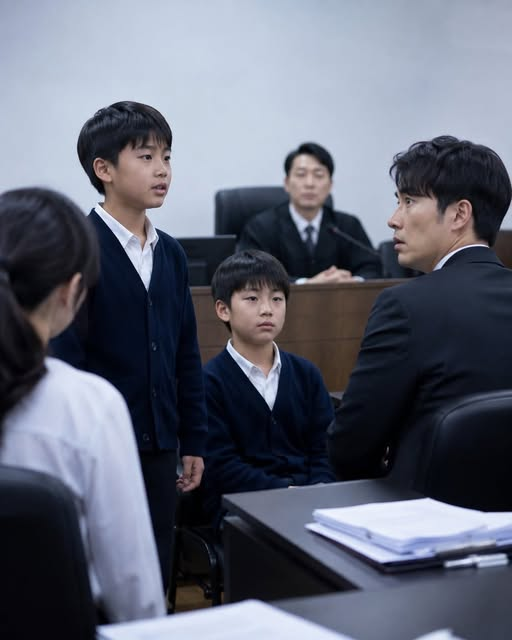
It just happened to begin in the bravest voice in that courtroom—
the voice of a nine-year-old boy who stood up and said:
“Judge, can I tell you a secret?”
