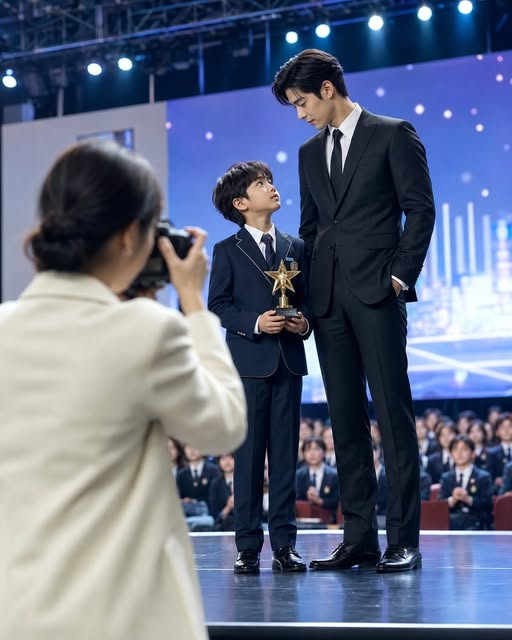
For several seconds, Adrian forgot there were hundreds of people watching him.
Leo stood in front of him, waiting politely for his award.
“Mr. Whitmore?”
Adrian blinked.
“Yes.”
His voice sounded different.
He handed Leo the certificate.
Their fingers briefly touched.
“How old are you?”
Leo looked confused.
“Ten.”
The color drained from Adrian’s face.
Ten.
He slowly turned toward the audience.
His eyes found me immediately.
I lowered my camera.
For the first time in a decade, Natalia Monroe and Adrian Whitmore looked directly at each other.
He understood.
After the ceremony, Adrian intercepted me outside the auditorium.
“Natalia.”
“Hello, Adrian.”
His eyes moved toward Leo, who was taking photographs with his classmates.
“Is he mine?”
I didn’t answer immediately.
“Look at him.”
His jaw tightened.
“Tell me.”
“Yes.”
One word.
That was all it took to break something inside him.
“You were pregnant when we divorced?”
“Three months.”
His expression became almost unrecognizable.
“You knew?”
“Yes.”
“And you didn’t tell me?”
“No.”
“Why?”
I laughed quietly.
“Do you remember that afternoon?”
“Of course.”
“No, Adrian. You remember signing papers.”
I stepped closer.
“I remember everything.”
The clock.
Vanessa’s call.
The black card thrown onto the table.
His impatience.
You take the money, I get my life back. We are even.
“You didn’t even read the agreement.”
His face changed.
“There was a line saying we had no children.”
“I remember.”
“You signed beneath it without asking whether anything had changed.”
“You should have told me.”
“Maybe.”
I didn’t run from that truth.
“But I was twenty-nine, pregnant and sitting across from a husband desperate to catch a flight to another woman.”
His anger collapsed.
“What was I supposed to say? Congratulations, Adrian. Before you go get your life back, here’s one final obligation?”
He couldn’t answer.
Leo approached us.
“Mom?”
I immediately stepped back.
“This is Mr. Whitmore.”
Leo looked between us.
Something in his intelligent little face shifted.
“You know each other.”
“Yes.”
Adrian crouched slightly.
“Leo…”
My son looked at him.
“Why are you looking at me like that?”
Adrian opened his mouth.
Nothing came out.
So I intervened.
“Leo, we’re going home.”
He nodded.
Adrian stood.
“Natalia, please.”
“Not here.”
“When?”
I looked at him.
“When Leo is ready.”
Not Adrian.
Leo.
That distinction mattered.
That evening, I told my son the truth.
Not every painful detail.
A ten-year-old didn’t need to carry the failures of two adults.
I simply explained that Adrian was his biological father and hadn’t known about him.
Leo remained silent for a long time.
Finally he asked:
“Did he not want me?”
My heart tightened.
“No.”
I took his hands.
“He didn’t know you existed.”
“Why?”
“That was a decision I made when you were still inside me.”
“Were you angry?”
“Yes.”
“Are you still angry?”
I thought carefully.
“No.”
That surprised even me.
I wasn’t.
“What are you now?”
“Protective.”
He leaned against me.
“Can I think about it?”
“As long as you need.”
Adrian called eleven times that night.
I answered the twelfth.
“I want to see him.”
“He needs time.”
“He’s my son.”
“He’s also a child who learned today that a stranger is his father.”
Silence.
Then Adrian did something the man I’d divorced would never have done.
He backed down.
“All right.”
Three days later, Leo asked to meet him.
We chose a quiet café.
Adrian arrived twenty minutes early.
No assistant.
No driver hovering nearby.
No expensive gift.
Just Adrian.
Leo sat opposite him.
For several minutes, neither spoke.
Finally Leo asked:
“Do you like photography?”
Adrian glanced at me.
“I’m beginning to.”
“Mom is really good.”
“I know.”
“You know her photographs?”
“I’ve seen them.”
That surprised me.
Apparently Adrian had known about April Light for years.
He just hadn’t known about Leo.
My son continued:
“What were you like when you were ten?”
Adrian smiled faintly.
“Too serious.”
“Mom says I’m too serious.”
“I noticed.”
Leo studied him.
Then:
“Did you love my mom?”
The smile disappeared.
I almost interrupted.
Adrian answered first.
“Yes.”
“Then why did you divorce her?”
He looked at me.
“Because I was selfish.”
No excuses.
No Vanessa.
No complicated adult explanations.
“I thought something I’d wanted when I was younger would make me happier than appreciating the life I already had.”
Leo frowned.
“Did it?”
“No.”
Vanessa and Adrian had lasted less than a year.
I learned that later.
The woman Adrian had remembered wasn’t the woman who returned.
And Adrian wasn’t the young man Vanessa remembered either.
They had spent years loving memories.
Reality couldn’t compete with nostalgia until they finally got what they wanted.
Then nostalgia disappeared.
But I felt no satisfaction hearing that.
Their failure didn’t return my marriage.
And I didn’t want it to.
Adrian began seeing Leo every Saturday.
At first, I remained nearby.
Then Leo became comfortable enough to go alone.
They built model airplanes.
Visited museums.
Played chess.
Adrian attended school events.
He learned that being a father wasn’t about donating five million dollars to a school.
It was remembering that Leo hated raisins.
Knowing when he had mathematics tests.
Waiting outside piano lessons.
Listening to a twenty-minute explanation about why Saturn’s rings were fascinating.
Ordinary things.
Things money couldn’t outsource.
One afternoon, Adrian came to my studio.
I was editing portraits.
He placed something on my desk.
The old divorce agreement.
“What are you doing with this?”
“I found my copy.”
He opened it.
There it was.
There are no children within marriage.
His signature beneath it.
“I’ve spent ten years signing contracts worth billions,” he said.
“And this was the most expensive signature of my life.”
I looked at him.
“You didn’t lose Leo because of a sentence.”
“I know.”
“You lost the chance to know about him because you’d already left our marriage before you signed.”
His eyes lowered.
“Yes.”
Then he said:
“I’m sorry.”
I waited.
No justification followed.
That made the apology different.
Months passed.
Then Adrian asked:
“Why didn’t you use the five million?”
I looked up.
“What?”
“The settlement money.”
“I did.”
His eyebrows rose.
“I used part of it to start April Light.”
He smiled slightly.
“So technically I invested in your company?”
“No.”
I pointed toward the door.
“Leave.”
He laughed.
And unexpectedly, so did I.
That was when I realized healing had happened without my noticing.
I could laugh with him without wanting him back.
On Leo’s eleventh birthday, Adrian gave him a camera.
Not the most expensive model.
The exact beginner camera Leo had mentioned months earlier.
Leo hugged him.
Adrian froze.
Then slowly hugged our son back.
I photographed them.
Click.
When I checked the image, Adrian was crying.
Quietly.
Leo didn’t notice.
I didn’t tell him.
Some photographs belonged to the future.
Later that evening, Adrian found me on the balcony.
“Do you ever think about us?”
“Sometimes.”
“Could we ever…”
“No.”
I answered gently.
He closed his eyes for a moment.
Then nodded.
“I expected that.”
“I forgive you, Adrian.”
He looked at me.
“But forgiveness doesn’t restore a marriage.”
“I know.”
“And Leo loving you doesn’t mean I have to.”
“I know that too.”
He smiled sadly.
“I’m learning.”
Three years later, April Light opened its second studio.
Leo was thirteen.
Tall.
Quiet.
Still obsessed with photography.
Adrian was there for the opening.
So was someone else.
Daniel Reed, an architect I’d met while photographing one of his projects.
Adrian noticed immediately.
He said nothing.
When Daniel put a hand gently on my shoulder, Adrian simply looked away.
Later, he approached me.
“He seems decent.”
“He is.”
“Does Leo like him?”
“Yes.”
Adrian nodded.
That was all.
The man who once believed love meant choosing whatever he wanted had finally learned that loving someone sometimes meant respecting a future that didn’t include him.
At sixteen, Leo won a national youth photography award.
I sat in the front row.
Adrian sat two seats away.
The presenter announced:
“Leo Monroe.”
Our son walked onto the stage.
This time, Adrian wasn’t giving him the award.
He was simply his father.
Applauding harder than anyone.
Leo reached the microphone.
“My mother put a camera in my hands before I could properly hold one.”
Everyone laughed.
“She taught me that photography isn’t about making something look beautiful.”
He found me in the audience.
“It’s about seeing what’s actually there.”
My eyes filled.
Then Leo looked toward Adrian.
“And my father taught me something else.”
Adrian stopped clapping.
“Sometimes people miss important moments.”
A pause.
“But if they’re lucky, they get another chance to show up for the next ones.”
Adrian lowered his head.
I raised my camera.
Click.
I captured the exact second he wiped his eyes.
Afterward, Leo approached me.
“Mom.”
“Yes?”
“Remember what I told you when I was little?”
I smiled.
“One day you’re going to win a prize and I’m going to take your photo.”
He grinned.
“You remembered.”
“I remember everything about you.”
Adrian stood several steps behind him.
Our eyes met.
Ten years earlier, he had signed a divorce agreement without reading it because another life seemed more exciting.
Years later, he’d walked onto a school stage believing he was simply giving an award to an exceptional child.
Instead, fate placed his own son in front of him.
But that wasn’t Adrian’s punishment.
Losing me wasn’t his punishment either.
Life wasn’t that simple.
His consequence was understanding how many ordinary moments could never be recovered.
Leo’s first cry.
His first tooth.
His first steps.
His first word.
Ten birthdays.
Ten years of photographs in which Adrian would forever be absent.
He could never reclaim those pages.
But he could choose what appeared on the pages that remained.
And to his credit, he did.
I lifted my camera.
Leo stood between us.
“Dad, Mom—closer.”
Adrian hesitated.
Then stepped beside me.
Not as my husband.
Not as the man I was waiting to forgive.
Simply as our son’s father.
The timer began counting down.
Ten.
Nine.
Eight.
I looked at Leo’s smile.
Then at the man beside me who had finally learned that being present was worth more than any fortune.
The shutter clicked.
And for the first time, all three of us existed in the same photograph.
Not as the family we could have been.
But as the people we had finally learned to become.
