General Blackwood didn’t answer immediately.
Then he asked:
“Where are you?”
“Training ground three.”
His voice changed.
“Why are you there at this hour?”
I looked down at my soaked uniform.
“Your son ordered me to kneel for twelve hours.”
Silence.
Then:
“Stay where you are.”
I laughed weakly.
“That’s exactly what I’ve been ordered to do.”
The call ended.
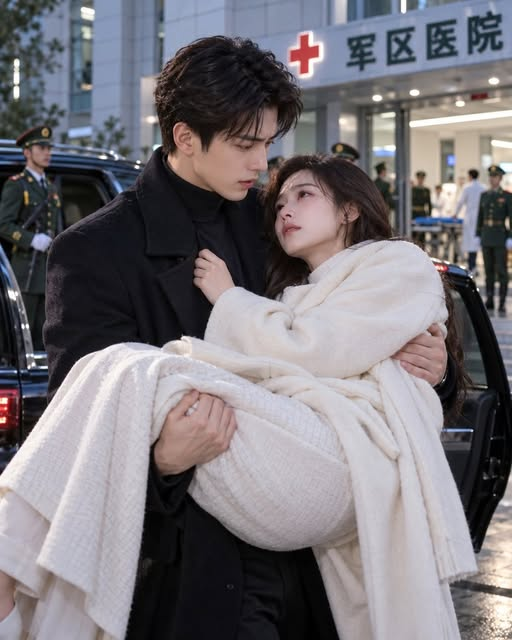
Twenty minutes later, headlights cut through the rain.
Two military vehicles stopped beside the field.
General Blackwood got out.
He was sixty-four, rigid-backed, silver-haired, and still capable of making an entire corridor fall silent simply by entering it.
When he saw me, his face changed.
“Get up.”
I tried.
My legs collapsed.
He caught my arm.
Then his eyes moved to my stomach.
I instinctively covered it.
His expression sharpened.
“Are you pregnant?”
I didn’t answer.
That was enough.
“Hospital. Now.”
“I want the divorce first.”
“Evelyn—”
“I’ve spent years doing what Blackwood men order me to do.”
I looked directly at him.
“Not anymore.”
He was silent.
Then he nodded.
“You’ll have it.”
I woke several hours later with an IV in my arm.
The first thing I did was touch my belly.
A doctor noticed.
“The baby still has a heartbeat.”
My eyes closed.
“But you’ve had severe cold exposure and you’re showing signs of significant physical stress. You need rest and monitoring.”
I began crying.
Quietly.
Not because Adrian had nearly cost me another child.
Because despite everything, there was still a heartbeat.
General Blackwood stood outside my room.
When the doctor left, he entered.
He placed a folder on the table.
“Your medical leave is approved.”
I looked at him.
“And Adrian?”
“He doesn’t know you’re here.”
“Good.”
The general frowned.
“You intend to hide the pregnancy?”
“I intend to stop giving your son information he can use to hurt me.”
For once, he didn’t defend Adrian.
Instead he asked:
“Why didn’t you tell anyone?”
“Who would I have told?”
He had no answer.
Three days later, Adrian came home.
I was already gone.
My clothes were gone.
My documents were gone.
My wedding ring sat on the table.
Beside it were divorce papers.
He called seventeen times.
I answered the eighteenth.
“Where are you?”
His voice was furious.
I remembered how that voice used to frighten me.
It didn’t anymore.
“On medical leave.”
“What happened to you?”
“You happened.”
Silence.
“Evelyn, come home.”
“No.”
“We need to talk.”
“No. You need to sign.”
His breathing became heavy.
“This is because I punished you?”
Punished.
As if I were one of his soldiers.
As if I hadn’t been his wife.
“You made me kneel in freezing rain for twelve hours for something you never proved.”
“You frightened a child.”
“I never touched him.”
“Clara said—”
I laughed.
That stopped him.
“Of course she did.”
Then I hung up.
But Adrian didn’t sign.
Instead, he started investigating.
Perhaps he wanted evidence against me.
Perhaps some part of him finally wondered whether he had made a mistake.
What he found destroyed the story he’d chosen to believe.
The corridor camera hadn’t malfunctioned accidentally.
Its power had been disconnected manually.
A maintenance technician had reported it.
The report had never reached Adrian.
One of Clara’s acquaintances had intercepted it.
Then a medic from the kindergarten came forward.
The boy’s fever had started hours before I ever entered the command building.
There was more.
The romantic “volcano” Adrian had organized with military equipment had been reported by another officer.
The canceled training session had created scheduling problems across two units.
The favors Adrian considered personal kindness had begun crossing professional boundaries.
His judgment had become a subject of formal concern.
The truth finally reached him.
I wasn’t there to watch his face.
General Blackwood told me later.
“He asked where you were.”
“I hope you didn’t tell him.”
“I didn’t.”
That surprised me.
He looked uncomfortable.
“I owe you an apology.”
I stared at him.
This was the man who had once considered me an embarrassment to his family.
“I thought you were the reason Adrian was throwing away his future,” he said.
“And now?”
“Now I think Adrian nearly threw away his future all by himself.”
It wasn’t affection.
But it was accountability.
For the first time, that was enough.
Two weeks later, Clara came to see me.
I almost refused.
Then she said she wanted to confess something.
We met in a café far from the base.
She looked smaller without Adrian beside her.
“My son never said you hurt him.”
I already knew.
“He had a fever,” she continued. “He was crying. Adrian asked whether you had frightened him.”
“And?”
“I said I didn’t know.”
I waited.
Her hands trembled.
“Then I told him you had confronted us before. I said perhaps seeing you had upset him.”
“You knew what Adrian would hear.”
Tears appeared in her eyes.
“Yes.”
“Why?”
She looked down.
“Because every time you were angry with him, he came to me.”
There it was.
Not innocence.
Not some grand conspiracy.
Something smaller and uglier.
She liked being chosen.
“I thought if you left…”
“You could have him?”
She nodded.
I almost felt sorry for her.
Almost.
“Then take him.”
She looked up.
“I don’t want him anymore.”
I smiled without humor.
“Neither do I.”
Adrian learned about the pregnancy a month later.
Not from me.
From the medical paperwork connected to the inquiry into what happened on the training ground.
He appeared at General Blackwood’s house that evening.
I heard him shouting before I saw him.
“You knew?”
His father answered:
“Yes.”
“And you didn’t tell me?”
“She asked me not to.”
“She’s my wife!”
I stepped into the hallway.
“No, Adrian.”
He turned.
The moment he saw my stomach, something inside his face collapsed.
“You’re pregnant.”
“Twenty weeks.”
His lips trembled.
“In the rain…”
“Yes.”
He looked physically ill.
“You were carrying our baby?”
“Yes.”
“Why didn’t you tell me?”
I stared at him.
“I tried to tell you many things that night.”
His eyes filled.
“Evelyn…”
“You had the last word, remember?”
He flinched.
I continued.
“So you used it.”
He stepped toward me.
I stepped back.
That hurt him more than shouting would have.
“I didn’t know.”
“You didn’t know whether I was pregnant.”
“No.”
“You also didn’t know whether I’d harmed Clara’s son.”
Silence.
“You punished me anyway.”
He lowered his head.
“I was wrong.”
“Yes.”
“I’ll fix it.”
“You can’t.”
“I’ll resign if that’s what you want.”
“This isn’t about your rank.”
“I’ll never see Clara again.”
“This isn’t about Clara.”
“Then tell me what to do!”
His voice broke.
And for the first time, Commander Adrian Blackwood looked completely powerless.
I answered quietly.
“Sign the divorce.”
He stared at me.
“No.”
“You asked me once to have our child and promised you’d build a life with me.”
I touched my stomach.
“I believed you.”
Tears rolled down his face.
“I still love you.”
“I know.”
That seemed to shock him.
I continued:
“But love isn’t the question anymore.”
“What is?”
“Whether I am safe beside you.”
He stopped breathing.
“And I’m not.”
Adrian signed eleven days later.
There was no dramatic reunion.
No last-minute forgiveness.
He faced an internal disciplinary review over his misuse of authority and the irregularities surrounding the punishment order. I gave my statement and nothing more.
Clara left the military neighborhood with her son.
I never saw her again.
General Blackwood surprised everyone by respecting the divorce.
More surprisingly, he respected my boundaries after the baby was born.
A girl.
I named her Hope.
Adrian saw her under arrangements we established carefully.
I never told my children to hate their father.
His failures as my husband belonged to us.
What kind of father he became afterward would depend on what he chose to do with the consequences.
A year later, I returned to work.
Not at Adrian’s base.
I transferred to another administrative division.
On my first morning, rain tapped softly against the office windows.
For a moment, my knees remembered that night.
The cold.
The mud.
Adrian walking away while answering Clara’s call.
Then my daughter laughed from the photograph on my desk.
I touched the frame.
For years, I had believed the greatest proof of Adrian’s love was that he married me when everyone said he shouldn’t.
I was wrong.
Marriage wasn’t proof.
A ring wasn’t proof.
Even ten years wasn’t proof.
The proof of love was what someone did when believing you was inconvenient.
When defending you cost them something.
When another person was crying louder.
That was the night Adrian failed me.
And dawn was the moment I finally stopped failing myself.
He had ordered me to kneel for twelve hours.
I stayed until sunrise.
Then I stood up.
And I never knelt for him again.
