Ethan stared at me as if I had spoken in another language.
“What did you just say?”
“I think one of the babies was switched at the hospital.”
For several seconds, he didn’t move.
Then he laughed.
Not because it was funny.
Because sometimes people laugh when the alternative is panic.
“Claire, that’s insane.”
“I already did a test.”
The laugh disappeared.
His eyes dropped to the phone in my hand.
“What test?”
“A private paternity test.”
His face went completely still.
I opened the report and held it out.
He read Noah’s result first.
Biological paternity excluded.
Then Leo’s.
Highly compatible parent-child relationship.
Ethan’s fingers tightened around my phone.
“No.”
He read it again.
“No. This is wrong.”
“That’s why we’re doing an official test tomorrow.”
He looked toward the cribs.
Noah was still sleeping peacefully.
Leo had opened his eyes.
For five months Ethan had crossed the room for Noah first.
That night, for the first time, he looked at Leo.
Really looked at him.
Then he whispered:
“If Noah isn’t mine…”
“He may not be mine either.”
Ethan’s head snapped toward me.
I swallowed.
“I never cheated on you. You know that.”
He didn’t answer immediately.
And that hesitation hurt more than I expected.
“Say it,” I whispered.
“I know.”
“No. Say you believe me.”
His jaw tightened.
“I believe you.”
The next morning we went to an accredited laboratory.
They collected samples from Ethan, me, Noah and Leo.
The technician explained that the results would take several days.
I thought waiting would be the worst part.
I was wrong.
The worst part happened in the parking lot.
Ethan’s mother was standing beside our car.
Margaret Cole had never appeared anywhere without calling first.
That morning she had.
Her face was pale.
“What are you doing here?” Ethan asked.
She looked at the babies.
Then at me.
“You had them tested, didn’t you?”
Every hair on my arms rose.
Ethan stepped toward her.
“How do you know?”
Margaret said nothing.
And suddenly I remembered the hospital corridor.
Her examining the discharge documents.
Her pulling Ethan aside.
Don’t tell him anything yet.
I pushed the stroller closer to myself.
“What did you know?”
Margaret shook her head.
“Claire—”
“What did you know?”
Her eyes filled with tears.
That frightened me more than any answer could have.
“At the hospital,” she finally said, “I noticed something was wrong with one of the identification numbers.”
Ethan went rigid.
“What?”
“The bracelet number on one discharge form didn’t match the number I remembered seeing in the nursery.”
My stomach turned.
“And you said nothing?”
“I asked a nurse.”
“What did she say?”
“That I was mistaken. She checked the computer and said everything was correct.”
“So why did you tell Ethan not to tell me anything yet?”
Margaret looked at her son.
Ethan frowned.
“You told me not to tell Claire what?”
She covered her mouth.
And Ethan’s expression changed.
As if a forgotten conversation had suddenly returned.
“The blood type,” he said.
I stared at him.
Margaret closed her eyes.
Ethan looked sick.
“After the delivery, Mom saw Noah’s blood type written on one of the papers. She said she didn’t think it made sense with ours.”
“And you knew?”
“I asked a doctor. He told me preliminary records sometimes contained errors and that the official discharge file was correct.”
“You never told me.”
“You had just had surgery. You were exhausted. The doctor said there was no problem.”
Margaret whispered, “I told him not to upset you until we knew.”
I felt as though the ground had shifted beneath me.
“You both saw warning signs.”
“Claire—”
“And for five months, neither of you said anything.”
Ethan looked at Noah.
The anger left my body almost instantly.
Because none of this was Noah’s fault.
He was five months old.
He knew my voice.
He slept against my chest.
He smiled when I sang badly.
Whatever a laboratory said, he was already part of me.
Three days later, the official results arrived.
The genetic counselor asked us to sit down.
That was when I knew.
She placed four reports on the table.
“Mr. Cole is the biological father of Leo.”
Ethan squeezed my hand.
“And I’m Leo’s mother?”
“Yes.”
I exhaled shakily.
Then she turned another page.
“Noah is not biologically related to Mr. Cole.”
I already knew that.
Still, hearing it officially hurt.
Then she looked directly at me.
“And Noah is not biologically related to you either.”
Silence.
I looked down at the baby in my arms.
Noah was chewing the corner of his blanket.
Five months.
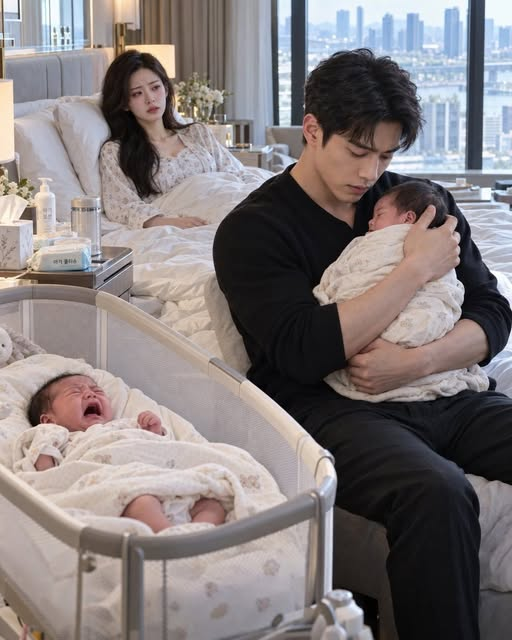
For five months, another woman’s child had called my body home.
“Then where is my baby?”
The counselor could not answer.
But the hospital could.
Or at least, it was supposed to.
We went there that afternoon with an attorney.
Once the hospital administrator saw the accredited reports, the atmosphere changed immediately.
Doors closed.
Phone calls were made.
People who had initially told us we needed an appointment suddenly became available.
They pulled the delivery records from December 29.
Four boys had been born within ninety minutes.
Two had briefly been placed in the same observation nursery after delivery.
Our twins were among them.
So was another baby.
Mateo Rivera.
The fourth child had been transferred to neonatal intensive care and never entered the regular nursery.
Our attorney leaned over the records.
“Who are Mateo Rivera’s parents?”
The administrator hesitated.
“We cannot disclose another family’s private information without authorization.”
My hands started shaking.
“Then call them.”
“Mrs. Cole—”
“Call them.”
Ethan stood beside me.
For once, his voice was colder than mine.
“You have a five-month-old infant in our home who does not belong to us biologically, and somewhere there may be a five-month-old infant who does. Call the other family.”
The hospital contacted them.
We waited almost three hours.
At 6:17 p.m., the administrator returned.
Her face told me everything.
“The Rivera family has agreed to come in tomorrow morning.”
I barely slept.
At nine the next day, we sat in a private conference room.
Noah was in my arms.
Leo was asleep against Ethan’s chest.
I noticed it immediately.
It was the first time I had ever seen Ethan carry Leo for more than a few minutes.
He kept looking down at him.
Touching his tiny fingers.
As though trying to recover five lost months in one morning.
Then the door opened.
A woman stepped inside.
She looked about my age.
Dark hair.
Tired eyes.
A baby boy rested against her shoulder.
She saw Noah.
And stopped breathing.
I saw the baby in her arms.
And my entire body knew before my mind did.
He had Ethan’s eyes.
Leo’s chin.
And the same small crescent-shaped birthmark behind his left ear that Leo had behind his right.
The woman tightened her arms around him.
“No,” she whispered.
I stood slowly.
Her husband came in behind her.
Nobody knew what to say.
Finally, the woman looked at me.
“My name is Sofia.”
“Claire.”
Her eyes moved to Noah.
“What do you call him?”
I could barely make my voice work.
“Noah.”
She started crying.
She looked down at the baby she had brought.
“We call him Gabriel.”
The hospital arranged immediate genetic testing.
There was nothing else to do but wait.
But while the adults argued with attorneys and administrators, Noah reached toward Sofia from my arms.
She froze.
Then Gabriel began crying.
Without thinking, I stepped closer.
He looked at me.
And stopped.
The room went silent.
Twenty-four hours later, the results confirmed it.
Noah Rivera was Sofia and Daniel Rivera’s biological son.
Gabriel Rivera was ours.
Our missing twin.
The hospital called it a “newborn identification error.”
I called it five stolen months.
But the worst part was still waiting for me.
Because after the results were read, everyone looked at the babies.
Four parents.
Three infants.
And one impossible question.
Who was supposed to go home with whom?
