“Do you still have this father in your eyes?”
My voice echoed through the living room.
On the other end, Tri Ha was silent.
Then she said:
“Mr. Khuong, if you called just to ask that, I’m working.”
Mr. Khuong.
Not Dad.
My chest tightened.
“What did you call me?”
“I’m hanging up.”
“Wait!”
Perhaps the desperation in my voice surprised even me.
I gripped the phone.
“My arthritis has gotten worse. I called your sisters back to discuss who will take care of me.”
Tri Ha finally paused.
Then she asked:
“Didn’t you already arrange your retirement with the 10.5 million?”
My face stiffened.
Tri Thu immediately looked up.
“How did you know?”
A faint laugh came through the phone.
“So it’s true.”
I suddenly understood.
“You didn’t know?”
“No.”
Her voice remained calm.
“But Aunt Liu called last month asking whether I was really going to accept being excluded from the inheritance without making trouble.”
I couldn’t speak.
Tri Ha continued:
“Don’t worry. I won’t.”
I felt strangely irritated.
“Of course you won’t. You haven’t contributed anything to this family for ten years. What right would you have?”
The rustling on the other end stopped.
Completely.
Then she asked:
“Nothing?”
“Did I say something wrong?”
“Dad.”
For the first time, she called me that.
But there was no warmth in it.
“Go to the cabinet in Mom’s old bedroom.”
I frowned.
“What?”
“Bottom drawer. There’s a blue folder.”
My heart inexplicably started beating faster.
“Why?”
“Open it.”
Then she hung up.
I nearly threw the phone.
Tri Thu scoffed.
“She’s just trying to make things mysterious.”
Tri Xuan, however, had already stood.
“I’ll get it.”
Several minutes later, she returned carrying an old blue folder.
Dust covered its edges.
I recognized it.
It had belonged to my late wife.
Inside were bank receipts.
Hospital invoices.
Transfer records.
At first, I didn’t understand.
Then I saw a name.
Khuong Tri Ha.
Thirty thousand yuan.
Fifty thousand.
Twelve thousand.
Eighty thousand.
Again.
Again.
Again.
All transferred to my wife’s medical account during the last four years of her life.
My hands began shaking.
“What is this?”
Tri Xuan took one receipt.
Her expression changed.
“Dad…”
“What?”
“Second Sister paid Mom’s medical bills.”
“Nonsense.”
I snatched the paper.
“When your mother was sick, I paid everything.”
Tri Xuan looked at me strangely.
“Did you?”
Of course I had.
I remembered paying.
Or at least…
I remembered believing I had paid.
During my wife’s cancer treatment, expenses had swallowed money faster than I could calculate. I sold investments. Borrowed from relatives. Used savings.
Whenever there was a shortage, somehow the hospital account was replenished.
My wife always said:
“Don’t worry. I handled it.”
I thought she meant insurance.
I never asked.
I turned page after page.
Tri Ha.
Tri Ha.
Tri Ha.
Over four years, the transfers totaled more than 860,000 yuan.
My mouth went dry.
“She earned almost nothing.”
Tri Thu suddenly said:
“Maybe Mom gave her the money first.”
Tri Xuan shook her head.
“Look.”
She held up another document.
Loan agreement.
Tri Ha had borrowed money.
Not once.
Three times.
There were repayment schedules stretching over years.
At the bottom was another paper.
A handwritten letter from my wife.
Chan Quoc,
If you find these papers someday, don’t scold Ha.
She made me promise not to tell you.
She said you already hated her career enough and that if you learned she was borrowing money for my treatment, you’d force her to come home.
She doesn’t want your praise.
She only wants me to live longer.
My vision blurred.
For several seconds, I couldn’t read anymore.
Tri Xuan quietly took the letter from my hand.
There was another line.
After I’m gone, don’t blame her if she doesn’t come home often.
Every time she sees this house, she remembers the night you told her that choosing those “dead books” meant she was no longer your daughter.
I sat down.
I remembered that night.
Of course I did.
I had been furious.
She had rejected a finance program.
Rejected the future I had chosen.
I pointed toward the door and shouted:
“If you walk out to study that useless thing, don’t come asking this family for anything.”
She had stared at me.
Then asked:
“Does that include being your daughter?”
I didn’t answer.
She left the next morning.
For years, I told everyone she had abandoned us.
It had never occurred to me that perhaps I had been the first one to close the door.
Tri Thu reached for the folder.
“Even if she helped Mom, that was years ago. What about now?”
Tri Xuan looked at her.
“What have we done?”
Tri Thu stiffened.
“What do you mean?”
“Dad gave us more than ten million.”
“So?”
Tri Xuan suddenly looked uncomfortable.
“Dad, you called us here to discuss your care.”
“Yes.”
“What exactly do you expect?”
The question irritated me.
“You’re my daughters.”
“I know.”
“But I work in another county. My husband is there. My grandson starts school this year.”
I stared at her.
“What are you saying?”
“I can contribute money.”
My heart sank.
Then I looked at Tri Thu.
She immediately avoided my eyes.
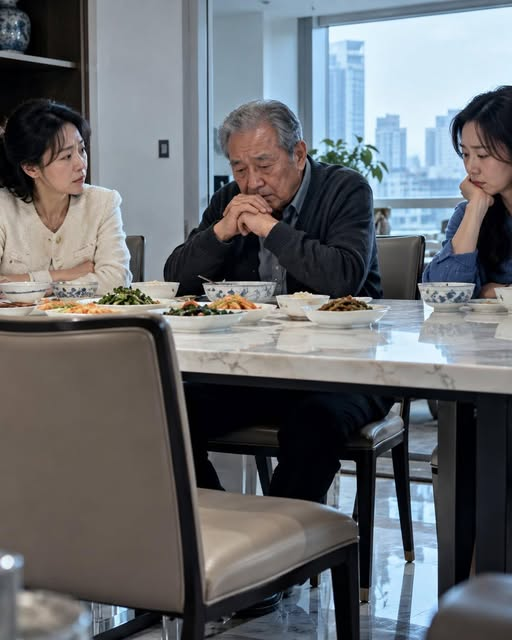
“Dad, you know my husband’s business hasn’t been good recently.”
“You received 5.3 million.”
“That money has already been invested.”
“All of it?”
She became defensive.
“You gave it to me. Surely you’re not asking for it back?”
I looked at my two daughters.
One offered money but no time.
The other wanted neither responsibility nor expense.
Suddenly, the twelve dishes on the table looked ridiculous.
That night, after they left, I sat alone until midnight.
Then I called Tri Ha again.
Once.
Twice.
She didn’t answer.
I didn’t call fifteen times.
For the first time in my life, I wondered whether another person’s silence might be a boundary rather than an insult.
Three days later, I bought a train ticket to Nanjing.
The research institute was nothing like I imagined.
I expected dusty rooms and old people repairing rotten books.
Instead, I saw laboratories.
Specialized imaging equipment.
Researchers in white coats.
Glass rooms with carefully controlled temperature and humidity.
On one wall was a newspaper clipping.
A restoration team had recovered more than a thousand damaged manuscripts from an ancient tomb.
In the center of the photograph stood my daughter.
Khuong Tri Ha.
Below her name were several words:
Lead Restoration Specialist.
I read them three times.
A young researcher approached.
“Are you looking for Professor Khuong?”
Professor?
I nearly thought he meant someone else.
“Tri Ha.”
“Yes. Professor Khuong is giving a lecture.”
My throat tightened.
I had spent ten years telling relatives that my second daughter repaired torn books for a miserable salary.
I never once asked what she had actually accomplished.
I waited outside the lecture hall.
When the doors opened, students surrounded her.
Some asked questions.
Others carried her books.
She laughed with them.
I hadn’t heard my daughter laugh like that since she was eighteen.
Then she saw me.
Her smile disappeared.
“Why are you here?”
I had rehearsed dozens of sentences on the train.
None came out.
Finally, I said:
“I found the blue folder.”
Her expression changed slightly.
“Oh.”
“Why didn’t you tell me?”
“Would it have changed anything?”
“Yes.”
She looked at me.
That one look made me ashamed of my answer.
I corrected myself.
“I don’t know.”
She nodded.
“At least that’s true.”
We sat in a small café near the institute.
I asked about the 860,000 yuan.
She corrected me.
“923,000.”
“What?”
“The folder doesn’t include the last treatments.”
My hands tightened around the cup.
“How long did it take you to repay the loans?”
“Seven years.”
“And during those seven years, you never asked me for help.”
“You told me not to.”
Another sentence returned from the past.
Don’t come asking this family for anything.
I lowered my head.
“I was angry.”
“I know.”
“I didn’t mean it.”
“You meant it when you said it.”
I couldn’t argue.
After a long silence, I said:
“I didn’t leave you anything.”
“I know.”
“Your sisters received everything.”
“I know.”
“Are you angry?”
Tri Ha thought about it.
“No.”
That hurt more than anger.
“Why?”
“Because I stopped expecting anything from you years ago.”
I looked away.
Then I finally told her why I’d come.
“My legs are getting worse.”
“I heard.”
“I wanted to discuss retirement.”
She waited.
I forced myself to continue.
“But that’s not why I came here.”
Her eyes lifted.
“I came because I realized I know nothing about my own daughter.”
For the first time, her expression softened.
Barely.
I didn’t ask her to forgive me.
I didn’t ask her to take care of me.
Instead I asked:
“Could you show me what you do?”
She stared at me for a long time.
Then stood.
“Come.”
She took me into the restoration laboratory.
Behind glass lay a manuscript more than a thousand years old.
Its pages were blackened and fragmented.
Tri Ha explained how they stabilized fibers, identified pigments and reconstructed damaged text without destroying the original material.
I understood perhaps twenty percent.
But this time, I listened.
Really listened.
At one point, she placed a restored fragment beneath a light.
Words slowly appeared where I had seen only stains.
Something inside my chest collapsed.
For thirty years, I had believed being a father meant telling my children which road was correct.
At seventy-three, standing beside something my daughter had brought back from near destruction, I finally understood that loving a child sometimes meant respecting the road you couldn’t understand.
I did not change my will.
There was nothing left to redistribute.
The money had already been transferred.
I also didn’t demand that Tri Xuan or Tri Thu return it.
A gift given with open eyes shouldn’t become a chain merely because the giver later regrets his judgment.
Instead, I sold my remaining investments, moved into a retirement community near a rehabilitation hospital, and hired professional care.
Tri Xuan visited when she could.
Tri Thu visited less.
Tri Ha did not suddenly become the devoted daughter from some sentimental story.
For the first few months, she called once every two weeks.
Then sometimes once a week.
One autumn afternoon, she came carrying a small wooden box.
Inside was an old photograph.
My wife and I on our wedding day.
The photograph had been torn and badly stained.
Now it was almost whole.
“Where did you find this?”
“Mom gave it to me before she died.”
My fingers trembled.
“You restored it?”
Tri Ha nodded.
I stared at my wife’s young face.
Then at my daughter.
“I was wrong.”
She didn’t say it was okay.
Because it wasn’t.
So I said something harder.
“I was wrong about your career. About your mother. About you.”
Her eyes reddened.
“I spent ten years calling you unfilial because you didn’t come home.”
I swallowed.
“But I never asked whether I had made home a place you wanted to return to.”
Tri Ha looked out the window.
After a long time, she quietly said:
“Dad.”
Just that.
Dad.
Not Mr. Khuong.
My eyes filled immediately.
At seventy-three, I finally understood something 10.5 million yuan had failed to teach me.
Inheritance is not a reward for obedience.
Money is not proof of love.
And children do not owe their parents affection simply because they were raised.
I gave 5.2 million to my eldest daughter.
5.3 million to my youngest.
To my second daughter, I gave nothing.
Yet when I finally looked back carefully, I discovered she had been the one giving all along.
Money to save her mother.
Years to repay the debt.
Silence to preserve my pride.
And, eventually, something worth far more than the millions I had already given away.
One last chance to learn how to be her father.
