I left before sunrise.
No argument.
No tears.
No hundredth proposal.
I packed two uniforms, my certificates, a few clothes, and the photograph of my parents that had followed me from one military residence to another.
Everything else stayed.
Including the cheap silver ring I had bought after graduation.
I placed it beside Julián’s wedding certificate.
Then I submitted my transfer request.
Three weeks earlier, a multinational training program in Europe had offered me a position as an instructor. I had rejected it because accepting meant leaving Julián for at least four years.
At six that morning, I called them back.
—I changed my mind. If the position is still available, I accept.
It was.
By noon, my orders were being processed.
Julián called at 2:13 p.m.
I didn’t answer.
At 2:16, he sent a message.
“Camila says you aren’t home. Where are you?”
At 3:02:
“Elena, stop being childish. We can discuss this tonight.”
And finally:
“Buy groceries on your way back. Camila can’t eat spicy food.”
I stared at that message for several seconds.
Then I blocked his number.
Seven years later, sitting beside him in that meeting room, I remembered it with almost frightening clarity.
The briefing ended at noon.
Chairs scraped against the floor, officers gathered their documents, and conversations resumed.
I stood.
Julián caught my wrist.
—Wait.
I looked down at his hand.
He released me immediately.
—We need to talk.
—About the exercise?
—About us.
There was no “us,” but curiosity made me stay.
We walked into an empty corridor.
Julián faced me.
—Why did you disappear?
For a moment, I genuinely thought I had misunderstood him.
—Disappear?
—I came home and you were gone. Your things were gone. Your number didn’t work. Your transfer had already been approved.
—Yes.
—You didn’t even say goodbye.
I looked at him.
—Neither did our seven hundred thousand yuan.
His jaw tightened.
—So this was about the money?
I laughed softly.
Seven years, and he still didn’t understand.
—No, Julián. The money simply made everything impossible to pretend anymore.
He stared at me.
—Camila and I divorced eleven months after you left.
My expression didn’t change.
—Congratulations.
His brows drew together.
—She received an independent assignment. Her family couldn’t control her anymore. I ended the marriage immediately.
—Good for her.
—And I never touched her.
—That stopped mattering the moment you married her.
His face hardened.
—You know why I did it.
—Yes. To save her.
—Exactly.
—And you sacrificed me to do it.
That silenced him.
I continued.
—You didn’t sacrifice yourself, Julián. You didn’t use only your savings. You didn’t lose your place in someone’s life. You took our money, our home, our future, and my dignity, then called me unreasonable when I objected.
—Elena—
—You even moved your wife into our house and asked me to cook for her.
For the first time, shame crossed his face.
—I handled things badly.
—No. You handled them exactly the way you wanted. You just assumed I’d still be there afterward.
He looked away.
Then he said quietly:
—I waited for you.
There it was.
The sentence everyone apparently found romantic.
I felt nothing.
—No, Julián. You expected me to come back. That’s different.
His eyes returned to mine.
—I never had another relationship.
—That was your choice.
—I thought once you calmed down—
I actually smiled.
—Seven years, and you still think I left because I was angry.
—Weren’t you?
—Of course I was. But anger passes.
I stepped closer.
—Self-respect doesn’t.
Before he could answer, an officer approached us.
—Colonel Marshall?
Julián’s eyes flickered at the title.
The officer handed me a folder.
—Command confirmed the final appointments. Congratulations, Colonel. You’ll be leading the joint airborne operations division.
I thanked him.
When he left, Julián stared at the folder.
—You’re leading the exercise?
—Half of it.
—They didn’t tell me.
—Apparently not everything requires your permission.
His expression changed.
For eight years, I had lived beside his career.
Now he was discovering I had built one of my own.
Over the next two weeks, we worked together.
Professionally.
Nothing more.
Julián tried several times to speak about the past.
I refused.
Then, on the final evening, after the closing ceremony, he found me outside headquarters.
He wasn’t wearing his cap.
In his hand was a small box.
My stomach tightened—not from love, but from memory.
He opened it.
Inside was the cheap silver ring I had left behind seven years earlier.
—I kept it.
I said nothing.
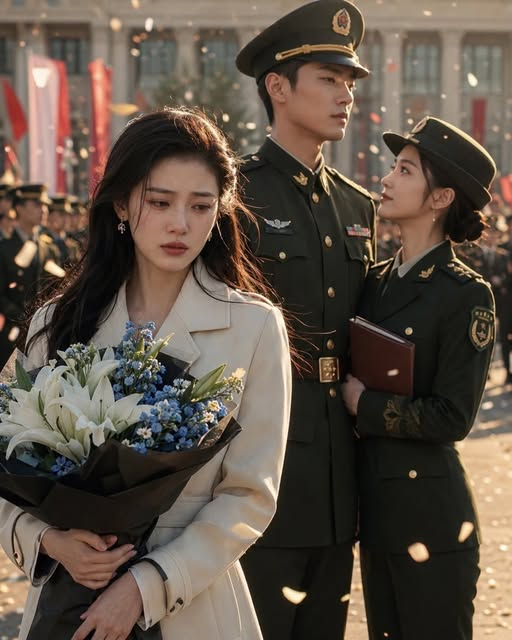
He took a breath.
—You asked me ninety-nine times.
I already knew what was coming.
Perhaps once, this moment would have been everything I wanted.
He lowered himself onto one knee.
Several officers nearby stopped walking.
Someone gasped.
Julián looked up at me.
For once, there was no command in his voice.
—Elena Marshall, will you marry me?
The hundredth proposal.
Except this time, it came from him.
Seven years ago, I would have cried.
Eight years before that, I would have screamed yes before he finished the sentence.
But the woman standing there wasn’t either of those women anymore.
I looked at the ring.
Then at him.
—No.
His face went still.
I spoke gently because I no longer needed cruelty to prove I had survived him.
—I’m not ready yet.
His eyes closed.
He understood immediately.
Those were the words he had given me ninety-nine times.
But I wasn’t returning them for revenge.
So I added:
—And I won’t be later either.
He slowly stood.
—Is there someone else?
I almost felt sorry for him.
He still needed another man to explain why he could no longer have me.
—There doesn’t have to be.
—Then why?
—Because I loved you for eight years, Julián. And during those eight years, I kept asking you to choose me.
My voice remained steady.
—Then one day, another woman needed saving, and you gave her in an afternoon what you told me you couldn’t give me in eight years.
—It wasn’t love.
—I know.
That was the tragedy he had never understood.
—If you had loved her, perhaps I could have accepted that your heart changed. But you didn’t. You married someone you didn’t love while asking the woman you supposedly did love to wait.
He had no answer.
I reached into the box and touched the silver ring one last time.
—Keep it.
—Why?
—Because it belongs to the girl who kept asking.
I closed the box in his hand.
—She doesn’t exist anymore.
The following morning, our units assembled on the airfield before departure.
Julián stood with the senior command staff.
I walked past him toward the transport aircraft.
He called my name.
—Elena.
I stopped.
He didn’t ask me to stay.
Maybe he had finally learned.
Instead, he saluted.
Not as the man I had once loved.
Not as the man who had expected me to wait.
As one officer acknowledging another.
I returned the salute.
Then I boarded.
Months later, I heard Camila had become a decorated officer herself.
She sent me a letter.
She apologized for accepting the money, for moving into our home, and for never asking what her rescue had cost another woman.
I answered only once.
“You don’t owe me my past. Build something worthy with your future.”
As for Julián, people continued telling me that he remained single.
For years, they treated that fact as evidence of some extraordinary love story.
Perhaps it was.
But it was his story.
Not mine.
My story ended differently.
At twenty-three, I believed love meant asking until someone finally said yes.
At thirty-one, I believed love meant enduring.
At forty, I understood something simpler.
The person who wants a life with you should not require ninety-nine proposals, eight years of patience, and seven years of absence to realize your value.
Julián finally asked me the question I had spent my youth begging to hear.
He was simply seven years too late.
And when I walked away after his hundredth proposal, I didn’t feel victorious.
I felt free.
