Santiago stared at Valeria.
“What instructions?”
The competition director hesitated.
“We should discuss this privately.”
“No.”
Santiago’s voice was cold.
“You said the account was linked to my wife’s office. Explain it here.”
Hundreds of people were watching.
So were the cameras.
The director opened the red folder.
“Forty-eight hours before the final, someone attempted to access the scoring system using credentials belonging to an executive assistant in Mrs. Solórzano’s office.”
Valeria laughed.
“That proves nothing.”
“Correct,” the director said. “So we investigated further.”
She removed several pages.
“The account requested that Mateo Ríos and Daniel Ríos be flagged for an eligibility review. When that failed, someone attempted to modify their preliminary scores.”
My blood went cold.
Mateo stepped closer to me.
Daniel’s smile disappeared.
Santiago’s expression became terrifyingly calm.
“Why my—”
He stopped himself.
He wasn’t allowed to call them his children.
Not yet.
“Why those two?”
The director looked uncomfortable.
“Because they were Patricio’s strongest competitors.”
Valeria exploded.
“This is absurd!”
She grabbed Santiago’s arm.
“Do you really believe I would manipulate a national competition?”
Santiago pulled away.
“I don’t know what to believe anymore.”
Then the director said:
“There is something else.”
She opened a sealed section of the folder.
“The audit uncovered archived correspondence associated with the same family office.”
Valeria froze.
That was the first moment I knew.
Whatever was inside had nothing to do with the Olympiad.
The director lowered her voice.
“It concerns Mrs. Ríos.”
Me.
Santiago turned.
“What about Elena?”
One document was thirteen years old.
An email.
Printed beneath it was an authorization record.
I recognized the hospital name immediately.
My legs nearly gave way.
Thirteen years earlier, while I was hospitalized, someone had contacted Santiago’s family office claiming to act on my behalf.
The message said my pregnancy was unstable.
That doctors believed neither baby was likely to survive.
And that I wanted Santiago released from “all unnecessary obligations.”
Another document followed.
A medical summary.
Except it wasn’t my medical summary.
Some numbers were real.
Others had been altered.
The fetal survival prognosis had been changed.
My condition had been described as nearly hopeless.
And beside it was another message.
Supposedly from me.
“I don’t want Santiago to ruin his future for children who may never live.”
My hands started shaking.
“I never wrote that.”
Santiago looked at me.
“I never wrote any of it.”
His face drained of color.
Valeria backed away.
Santiago noticed.
Slowly.
“Valeria.”
She said nothing.
“Did you know about this?”
“That was thirteen years ago.”
It wasn’t a denial.
Santiago stared at her.
The auditorium seemed to disappear around us.
“You told me Elena didn’t want me at the hospital.”
Valeria’s lips tightened.
“You were destroying yourself.”
“You told me the doctors said the twins probably wouldn’t survive.”
“That was what everyone believed.”
“No.”
My voice cut between them.
I stepped forward.
“The doctors told me they had a chance.”
Santiago looked at me.
“You knew where I was,” I said.
His face twisted.
“I came to the hospital.”
I froze.
“What?”
“The night before I gave you the divorce papers.”
My heartbeat stopped.
“No.”
“Yes.”
He looked toward Valeria.
“She met me downstairs.”
Valeria closed her eyes.
Santiago continued.
“She said you’d asked her to come because you couldn’t face me. She gave me copies of the medical report.”
The altered report.
For thirteen years, I had believed Santiago had looked at his unborn children and simply walked away.
For thirteen years, Santiago had apparently believed I had already given up on us.
Neither truth excused what he had done.
But suddenly the past was no longer shaped the way either of us remembered it.
“You still came upstairs,” I whispered.
“Yes.”
“You still put the divorce agreement on my bed.”
His eyes reddened.
“Yes.”
“You still said you couldn’t sacrifice your future for a sick woman and children who might not survive.”
He closed his eyes.
“Yes.”
“Then don’t use her lies to erase your choice.”
His eyes opened.
I pointed toward Mateo and Daniel.
“Valeria may have prepared the lie.”
My voice shook.
“But you signed your name beneath it.”
Santiago said nothing.
That was the difference between explanation and absolution.
He was entitled to the first.
Not the second.
The competition ceremony ended in chaos.
The twins’ scores were independently verified.
Perfect.
No manipulation had benefited them.
Their medals remained theirs.
Patricio’s result also remained unchanged.
And I refused every interview.
That night, I finally told Mateo and Daniel the truth.
Everything.
Their father’s name.
The divorce.
The hospital.
His thirteen-year absence.
And what we’d learned that afternoon.
Mateo listened without moving.
Daniel cried.
Then Mateo asked:
“Did he know we survived?”
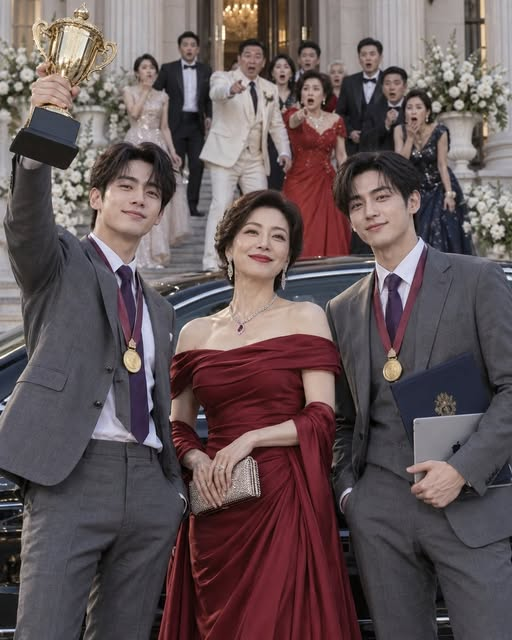
I swallowed.
“I don’t know.”
We found out the next morning.
Santiago had sent me an email.
Not a request for forgiveness.
Records.
Every one of them.
For the first two years after our divorce, annual payments had been transferred from a Montero family account to an intermediary company.
The payment descriptions said:
“Support for E.R. and dependents.”
I had never received a cent.
Santiago had believed the money reached me.
Someone had diverted it.
The intermediary company was controlled by a former employee of the Solórzano family.
Valeria.
Again.
But then the transfers stopped.
That part mattered.
Santiago came to my apartment three days later.
He looked exhausted.
“I thought you were taking the money.”
“I wasn’t.”
“I know.”
“And after two years?”
He lowered his head.
“I stopped sending it.”
“Why?”
His answer was quiet.
“Because I convinced myself that if you wanted me involved, you would contact me.”
I laughed once.
Not because it was funny.
“So eventually you stopped checking whether your children were alive because I didn’t call?”
His eyes filled.
“Yes.”
At least he didn’t lie.
“I was a coward.”
“Yes.”
“I let resentment become an excuse.”
“Yes.”
He looked at the twins’ photographs on the wall.
“I can’t get thirteen years back.”
“No.”
“Can I meet them?”
“That isn’t my decision.”
He looked surprised.
“They’re thirteen, Santiago. They have voices.”
Mateo refused.
Daniel agreed.
So Santiago met one son first.
He and Daniel spent forty minutes together in a café.
Daniel returned quiet.
Two weeks later, he went again.
Mateo held out for nearly three months.
Then one evening he said:
“I want to ask him one question.”
When they met, Mateo didn’t sit down.
He looked directly at Santiago.
“Why didn’t you search for us?”
Santiago could have blamed Valeria.
The fake records.
The stolen payments.
The lies.
Instead, he said:
“Because I was selfish.”
Mateo stared at him.
“I was angry with your mother. Then I became successful, and it became easier to tell myself that the past was finished than to find out whether two children needed me.”
Mateo’s jaw tightened.
“So she lied to you.”
“Yes.”
“But you abandoned us yourself.”
“Yes.”
That answer changed something.
Not forgiveness.
Not yet.
But perhaps the possibility of truth.
The investigation into the Olympiad continued.
Evidence showed that Valeria’s office had indeed been used in attempts to interfere with the scoring review. The archived financial and communications records also triggered a wider legal dispute over the diverted support payments and forged documents from thirteen years earlier.
Santiago separated from Valeria.
But I didn’t celebrate.
Patricio was fifteen.
Whatever his mother had done, he was still a child watching his family collapse publicly.
When Mateo made a cruel joke about beating “the fake genius,” I stopped him immediately.
“Patricio is not responsible.”
Mateo looked away.
“He humiliated us before the final.”
“Then you know how humiliation feels.”
He went quiet.
A week later, Mateo sent Patricio a message.
Not friendship.
Just:
“What happened wasn’t your fault.”
That made me prouder than the gold medal.
Santiago entered the twins’ lives slowly.
No grand gifts.
I refused those.
No cars waiting for their sixteenth birthdays.
No elite schools purchased overnight.
He attended Daniel’s robotics exhibition.
He sat in the back.
He came to Mateo’s mathematics final.
No cameras.
No speeches.
Sometimes the twins called him Santiago.
Eventually Daniel called him Dad.
Mateo didn’t.
Santiago never demanded it.
Three years later, after a competition, Santiago and I stood outside while the boys argued over where to eat.
He looked older.
So did I.
“Elena.”
“Yes?”
“If Valeria hadn’t interfered…”
I knew the question.
Would we still be married?
I shook my head.
“Don’t do that.”
“Why?”
“Because it gives one lie too much power.”
He looked at me.
“She helped destroy us,” I said. “But she didn’t create every crack.”
He was silent.
“You believed the worst of me without asking me.”
“I know.”
“You abandoned two children because you were afraid they wouldn’t survive. Then when you believed they had survived, you still didn’t make sure they were okay.”
“I know.”
“And I spent thirteen years hating you so completely that sometimes I forgot I had once loved you.”
His eyes lowered.
“We can’t rewrite that.”
“No.”
He nodded.
“Do you think you’ll ever forgive me?”
I looked through the restaurant window.
Mateo was stealing fries from Daniel’s plate.
Daniel was complaining.
Santiago watched them with a tenderness that had arrived thirteen years too late but, perhaps, not too late to matter entirely.
“I already have.”
His head turned sharply.
“But forgiveness isn’t the same as going back.”
He smiled sadly.
“I know.”
That was the last time he asked.
Years later, Mateo and Daniel both received university offers.
The old computer from our kitchen had stopped working long before, but neither boy allowed me to throw it away.
They kept it on a shelf.
A reminder.
Not of poverty.
Of beginnings.
At their graduation, Santiago sat three seats away from me.
Not beside me.
Not because we hated each other.
Because some distances are healthy.
Patricio came too.
He had rebuilt his relationship with the twins slowly, separately from the adults’ mistakes.
When Mateo and Daniel walked across the stage, Santiago cried.
I did too.
For thirteen years, I had thought the worst thing Santiago ever did was leave us.
Later, I learned there had been lies behind that decision.
Forged documents.
Stolen money.
Manipulation.
But none of those discoveries changed the lesson.
Other people can deceive you.
They can poison your judgment.
They can even rewrite pieces of your past.
But there comes a moment when your choices become your own.
Valeria had lied to Santiago.
Santiago had chosen not to look back.
And I had chosen to keep moving forward.
Thirteen years later, he finally found the sons he’d abandoned.
But I had found something much earlier.
Standing beside two incubators, terrified and alone, I discovered that being left behind did not mean my life had stopped.
My sons grew.
I grew.
And when Santiago finally returned, there was no empty place waiting for him.
There was only a door.
Whether Mateo and Daniel opened it was their choice.
As for me?
I had stopped waiting on the other side years ago.
