Adrian called before I reached the parking lot.
I declined.
He called again.
Then Maya.
Then Human Resources.
By the time I put the box in the trunk of my car, I had nine missed calls.
I turned off my phone.
For three years, NovaTech had treated Project Starfall as if it belonged to the company.
It didn’t.
Not entirely.
The first Starfall prototype had existed before I joined NovaTech.
I had developed the original architecture during graduate research, long before Adrian became CTO.
When NovaTech hired me, they wanted the technology.
I agreed to license three patents to them under one condition:
The license remained active while I remained employed by the company.
Adrian knew the patents existed.
What he apparently didn’t know—or had never bothered to check—was how the licensing agreement worked.
That didn’t surprise me.
During our marriage, Adrian had developed a habit of assuming anything connected to me was automatically available to him.
My time.
My ideas.
My patience.
Apparently, my intellectual property too.
I drove home.
Not our home.
Mine.
Adrian and I had been living separately for four months, although neither of us had said the word divorce yet.
He slept in the penthouse near NovaTech headquarters because, according to him, commuting wasted productive hours.
I had stayed in our old townhouse.
That arrangement had told me everything our marriage hadn’t.
At 6:12 p.m., someone began pounding on my door.
I didn’t need to look through the peephole.
“Clara!”
Adrian.
I opened the door but didn’t invite him inside.
He looked nothing like the executive I’d seen that morning.
His tie was loose.
His hair was disordered.
“Turn your phone on.”
“Why?”
“We have a crisis.”
“You have a crisis.”
His jaw tightened.
“Don’t do this.”
“Do what?”
“Play with words.”
I folded my arms.
“You came to my house, Adrian.”
“Our house.”
“You haven’t slept here in four months.”
That stopped him.
Only briefly.
Then business returned to his face.
“Legal says the patent licenses terminated when HR processed your separation.”
“Yes.”
“Stellar’s attorneys discovered it during final verification.”
“Good attorneys.”
“This isn’t funny.”
“I agree.”
He lowered his voice.
“Reauthorize the patents.”
“No.”
His expression hardened.
“Clara, ten billion dollars is on the line.”
“Then perhaps firing the patent holder on signing day wasn’t an efficient restructuring decision.”
“Maya didn’t understand.”
“And apparently neither did you.”
“I didn’t approve your termination personally.”
I stared at him.
That sentence was supposed to absolve him.
Instead, it made everything worse.
“You’re the CTO.”
“Yes.”
“I’m one of the principal engineers on your most important project.”
“Yes.”
“And your assistant could remove me without you even knowing?”
Silence.
I nodded.
“That’s not the defense you think it is.”
He rubbed his forehead.
“Fine. It was a mistake.”
“No. A typo is a mistake. This required meetings, paperwork and signatures.”
“I’ll reverse it.”
“You can’t.”
“I can have HR reinstate you tonight.”
“I don’t want my job back.”
For the first time, Adrian looked genuinely confused.
As if those words belonged to a language he didn’t speak.
“Then what do you want?”
There it was.
Not: Are you okay?
Not: Why didn’t you tell me you were unhappy?
A negotiation.
I almost smiled.
“Nothing.”
I started closing the door.
His hand stopped it.
“Clara, Stellar gave us forty-eight hours to resolve the licensing issue.”
“That sounds generous.”
“They can walk away.”
“Yes.”
“Thousands of jobs could be affected.”
That one hurt.
Because unlike Adrian, I knew the names behind those jobs.
The junior engineers.
The testing teams.
The technicians who had spent nights beside me fixing failures.
But guilt was exactly what NovaTech had relied on for years.
So I said quietly:
“Then your board should ask why its ten-billion-dollar project depended on three patents it didn’t own and one engineer it considered redundant.”
I closed the door.
The next morning, I woke to thirty-seven messages.
One caught my attention.
It wasn’t from Adrian.
It was from Maya.
Please don’t blame me. Director Cheng’s office authorized the restructuring framework. I was following instructions.
Interesting.
I saved it.
At ten, NovaTech’s CEO called.
At eleven, the chairman called.
At noon, three board members requested a meeting.
I agreed to one condition.
My attorney would attend.
That afternoon, I walked back into NovaTech.
Nobody whispered this time.
Maya wasn’t at her desk.
Adrian was already in the conference room.
So were the CEO, general counsel, head of HR and four board members.
My former employee badge no longer worked.
Security issued me a visitor pass.
I placed it on the table.
The irony was beautiful.
NovaTech’s general counsel began.
“Ms. Ji, we’d like to discuss restoring the Starfall licenses.”
“My attorney has prepared terms.”
Adrian looked at me.
“Clara, don’t turn this into a hostile negotiation.”
My attorney opened his folder.
“It became a negotiation when NovaTech terminated the underlying agreement.”
The chairman raised a hand.
“What would you require?”
I had thought about that question all night.
“NovaTech can license the patents commercially.”
Adrian relaxed slightly.
Then I continued.
“But not under the old terms.”
His expression changed.
“The new license will be independent of my employment. I will not return as an employee. There will be an upfront licensing fee, continuing royalties, and written recognition of my patent ownership.”
The CFO shifted uncomfortably.
The chairman asked:
“How much?”
My attorney slid the proposal across the table.
Nobody spoke for several seconds.
Then Adrian looked at me.
“This is outrageous.”
I met his eyes.
“No. This is market value.”
“You’re exploiting the deadline.”
“And NovaTech exploited my work while treating me as disposable.”
The CEO turned toward Adrian.
“Why was she on the layoff list?”
Adrian looked toward HR.
HR looked toward the empty chair where Maya should have been.
Finally, the head of HR cleared his throat.
“The recommendation originated from the CTO’s administrative office.”
Adrian went still.
“My office?”
A document appeared on the screen.
The restructuring recommendation.
My name.
My salary.
My position.
And beside it:
Role assessed as nonessential after knowledge transfer.
Recommended by: Maya Lin, Executive Assistant, Office of the CTO.
Approved electronically through Adrian’s executive authorization account.
Adrian stared at it.
“I never approved this.”
The room became silent.
The general counsel asked carefully:
“Who has access to your authorization credentials?”
Adrian’s face changed.
Everyone knew the answer.
Maya.
An internal investigation began that afternoon.
What they discovered was worse than incompetence.
Maya had been systematically removing senior technical staff she considered obstacles to a reorganization she hoped would place her allies in key positions.
She had used delegated administrative permissions far beyond their intended scope.
But she had made one fatal assumption about me.
She thought I was simply Adrian’s wife who had been given a comfortable engineering position.
She had never read my original contract.
She didn’t know Starfall had started with me.
By Friday, Maya was gone.
But I wasn’t coming back.
NovaTech accepted a temporary license extension while negotiations continued.
Stellar did not cancel the contract.
Three weeks later, we signed a new licensing agreement.
For the first time, NovaTech wasn’t paying me a salary for access to my inventions.
It was paying for the inventions themselves.
And the difference was substantial.
Adrian came to see me after the signing.
He waited outside the law firm’s conference room.
“Congratulations,” he said.
“Thank you.”
He looked tired.
“We saved Starfall.”
I shook my head.
“You saved your contract.”
His expression tightened.
“Do you really hate me that much?”
“I don’t hate you.”
“Then why does everything feel like punishment?”
That question surprised me.
I studied the man I had married.
For years, I had thought Adrian’s greatest flaw was that work always came first.
Now I understood something else.
He had stopped seeing the people behind the work.
Including me.
“This isn’t punishment,” I said.
“Then what is it?”
“Consequences.”
He looked away.
After a moment, he said:
“I should have known about the patents.”
“Yes.”
“I should have known you were being fired.”
“Yes.”
His voice became quieter.
“And I should have noticed we’d been living apart for four months.”
That one hurt.
Because finally, he was speaking as my husband.
Just months too late.
I took an envelope from my bag.
Adrian stared at it.
“What is that?”
“The last thing we need to separate.”
He opened it.
Divorce papers.
His face went completely still.
“Clara.”
“I didn’t decide this because Maya fired me.”
“Then why?”
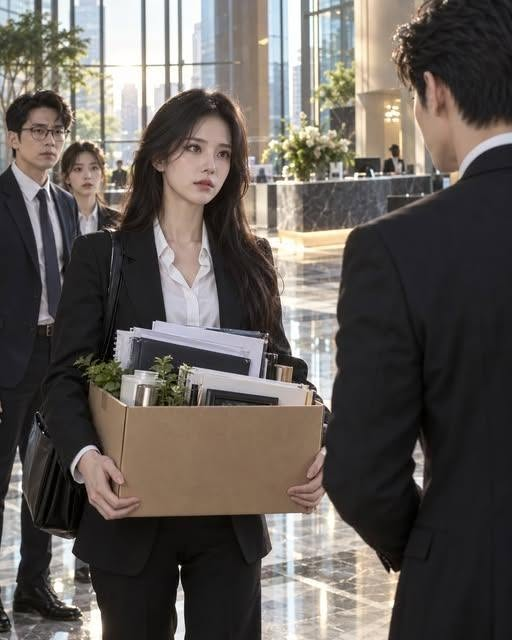
“Because when you saw your wife leaving your company carrying her belongings in a cardboard box, your first concern was your meeting.”
He closed his eyes.
I continued.
“When you discovered I’d lost my job, you told me not to be impulsive.”
His fingers tightened around the papers.
“And when you came to my door, you didn’t ask whether I was hurt. You asked me to restore your patents.”
“Clara, I can change.”
“Maybe you can.”
I meant it.
“But you don’t need me waiting around while you learn how.”
Six months later, I opened my own engineering consultancy.
My first office was small.
Twelve employees.
One conference room.
Terrible coffee.
On the wall behind my desk hung three framed patent certificates.
Not because they made me wealthy.
Not because they had once held a ten-billion-dollar contract hostage.
But because every time I looked at them, I remembered the day someone decided I was unnecessary.
NovaTech remained one of my clients.
Adrian remained its CTO.
Our conversations became professional, brief and strangely respectful.
One afternoon, during a licensing review, a young engineer from NovaTech stared at the patents on my wall.
“Dr. Ji, is it true they fired you without realizing these belonged to you?”
I smiled.
“Something like that.”
He laughed.
“That must have been the most expensive layoff in company history.”
I looked through the glass wall at my own team working outside.
“No.”
He seemed confused.
I picked up my coffee.
“The expensive mistake wasn’t firing me.”
I looked at the three patents bearing my name.
“It was believing my value disappeared the moment my name disappeared from their payroll.”
