I returned to the bridal room and closed the door.
Outside, three hundred guests were still whispering.
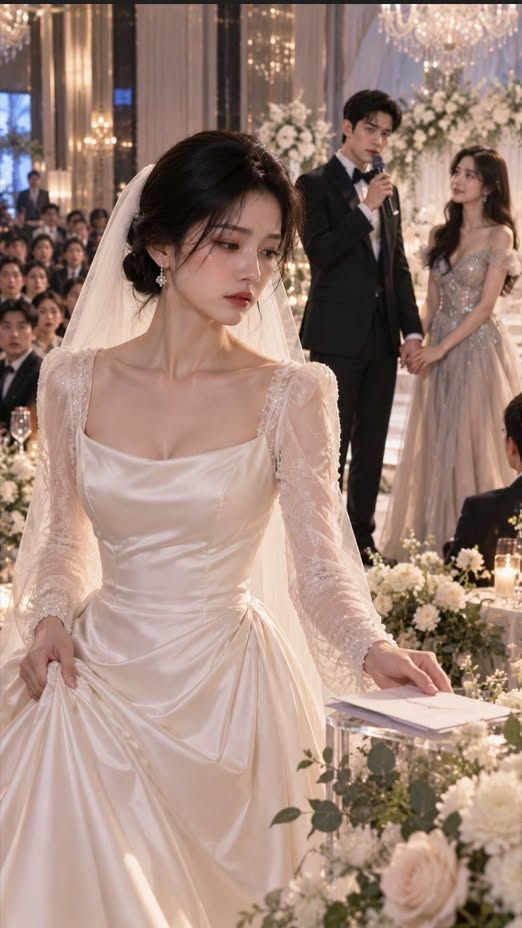
Inside, I stood before the mirror and removed my veil.
Ten minutes earlier, Luc Dien Tu had adjusted it himself and promised:
“Nien Niem, if you follow me, I won’t let you suffer.”
Then, in front of everyone, he held Tong Thanh Van’s hand and announced that she was the person he had wronged most in his life. Pasted text
I didn’t understand why.
And suddenly, I no longer wanted to.
I changed out of the wedding dress.
My mother found me while I was putting on my coat.
She stared at me.
“Nien Niem?”
“Mom, we’re going home.”
“What happened?”
I looked at the woman whose hands had worked themselves raw to raise me.
All my life, she had feared one thing: that I would marry a good man and still become the person who suffered. Pasted text
Perhaps mothers really could see farther than daughters.
“I don’t want to marry him anymore.”
She was silent for several seconds.
Then she picked up my bag.
“Then we won’t.”
That was all.
No lecture.
No shame about the guests.
No demand that I endure humiliation because the invitations had already been sent.
Just:
Then we won’t.
—
My phone began ringing before our taxi left the hotel.
Luc Dien Tu.
I declined it.
Again.
Declined.
On the seventh call, my mother took the phone from me and switched it off.
“Enough.”
I leaned my head against her shoulder.
Only then did I cry.
Not because of the wedding.
Because I remembered an electric scooter in the snow.
A clean scarf smelling faintly of citrus.
A hot lunch box beside scaffolding.
A man drowning in debt who had still borrowed from his credit card to pay my overtime. Pasted text Pasted text
I had loved that man.
I didn’t know when he had become someone who could humiliate me and call my pain “spoiling the fun.”
—
Luc arrived at my mother’s apartment that night.
He stood outside for nearly an hour.
Finally, I opened the door.
“Nien Niem, listen to me.”
“I’m listening.”
“Thanh Van is sick.”
I waited.
He seemed surprised that I wasn’t shouting.
“She had a serious heart condition two years ago. I didn’t know. When we were young, she gave up an opportunity abroad because of me. Later, when my father’s company collapsed, she helped me without telling anyone.”
“And?”
His eyebrows tightened.
“I owe her.”
“I heard you say that at the wedding.”
“She might be leaving the country permanently. I wanted to acknowledge what she’d done.”
“While holding her hand?”
Silence.
“At our wedding?”
“Nien Niem—”
“In front of my mother?”
He rubbed his forehead.
“I handled it badly.”
“No.”
I looked at him.
“You handled it exactly how you wanted. You just didn’t expect me to leave.”
That silenced him.
He reached for me.
I stepped back.
His hand remained suspended between us.
“I love you.”
“I believe you.”
He looked stunned.
“Then why are you doing this?”
“Because loving me doesn’t give you permission to humiliate me.”
—
The wedding was canceled.
Not postponed.
Canceled.
That distinction mattered.
For two weeks, Luc came every day.
Flowers.
Messages.
Apologies.
He even brought the old scarf he’d given me during that first winter.
I didn’t take it.
On the fifteenth day, Tong Thanh Van came instead.
She was beautiful.
Not arrogantly beautiful.
Tired beautiful.
The kind that made people instinctively soften toward her.
“I came to apologize.”
“Sit.”
She didn’t.
“Dien Tu shouldn’t have said those things at the wedding.”
“No.”
“But please don’t misunderstand. Nothing happened between us.”
I almost smiled.
Everyone kept telling me what hadn’t happened.
No affair.
No kiss.
No secret relationship.
As if betrayal only counted when clothes came off.
“Did you know he planned to say it?”
Her silence lasted too long.
“Yes.”
“Did you tell him not to?”
Another silence.
“No.”
That was enough.
Thanh Van’s eyes reddened.
“I thought… after everything between us, I deserved acknowledgment.”
“You did.”
She looked surprised.
“Just not at my wedding.”
Her face crumpled.
I opened the door.
“I don’t hate you, Thanh Van. But I won’t compete with you either.”
—
A month later, I left the design office where I’d worked for years.
Not because of Luc.
Because I finally understood something.
I had spent years helping build other people’s projects while treating my own ambitions as optional.
With my savings and a small loan, I opened a design studio.
Three desks.
One secondhand printer.
One leaking window.
When my mother saw it, she frowned.
“This place is terrible.”
I laughed.
“You should have seen Dien Tu’s first office.”
She looked at me carefully.
“Do you still miss him?”
“Yes.”
“Then why not go back?”
I thought about it.
“Because missing someone tells you what you feel.”
I looked around my tiny studio.
“It doesn’t tell you what you should accept.”
My mother smiled.
“Good.”
—
Six months later, Luc appeared at my office.
Not with flowers.
Not with the scarf.
He carried a project folder.
“I need an architect.”
“We’re expensive.”
“I know.”
“You could hire a larger firm.”
“I could.”
I looked at him.
“Don’t use business as an excuse to see me.”
His expression changed.
Then he placed the folder back into his bag.
“You’re right.”
For the first time, he didn’t push.
At the door, he stopped.
“I ended things with Thanh Van.”
“There was nothing to end, remember?”
He closed his eyes.
“You’re still cruel.”
“No. I’m finally precise.”
He almost smiled.
Then he said:
“I realized something.”
“What?”
“I kept calling what I felt for her guilt. But guilt became an excuse to give her privileges that belonged inside our relationship.”
I said nothing.
“I thought because you had been beside me through everything, you would understand.”
“I always understood.”
That was the tragedy.
When he had two employees and less than two hundred thousand yuan left in his company, I’d understood. Pasted text
When he worked beside me at construction sites, I’d understood.
When he had debts, I’d brought him ginger tea.
When he had nothing, I never made him feel small.
“I understood you until understanding you became the same thing as abandoning myself.”
His eyes filled.
“Nien Niem…”
“You once told me that when you paid your debts, you’d officially pursue me.”
He remembered.
So did I. Pasted text
“You paid those debts years ago, Dien Tu.”
I smiled sadly.
“But somewhere along the way, you started creating new ones.”
—
Two years passed.
My studio grew from three people to twenty-seven.
Then we won a public cultural-center project.
My mother attended the opening wearing the same old scarf she’d knitted years ago.
Luc came too.
He stayed at the back.
After the ceremony, he congratulated me.
No pleading.
No attempt to turn my success into a conversation about us.
He had changed.
I could see that.
And perhaps some part of me would always love the young man who had carried materials himself because he couldn’t afford enough workers.
But I had changed too.
That mattered just as much.
“Are you happy?” he asked.
“Yes.”
He nodded.
“Good.”
He turned to leave.
“Dien Tu.”
He stopped.
I walked toward him.
“For what it’s worth, I forgive you.”
His eyes reddened.
“Is there really no chance?”
I thought about the question for a long moment.
Then shook my head.
“No.”
He smiled painfully.
“Thank you for not lying.”
—
Years later, my mother asked whether I regretted walking out of the wedding.
I told her the truth.
I regretted that it had been necessary.
I regretted the years that couldn’t be separated cleanly into happiness and pain.
I regretted that the man who once waited beneath my apartment until he saw my light turn on eventually became the man who expected me to stand quietly while he honored another woman at our wedding.
But I never regretted leaving.
Because marriage would not have repaired that moment.
It would only have taught Luc that I could be humiliated publicly and still remain beside him.
That wasn’t the marriage I wanted.
And it wasn’t the daughter my mother had raised.
She had spent her whole life teaching me that love could exist even when money didn’t.
I had to learn the second lesson myself:
Love can exist and still not be enough.
That day, Luc Dien Tu told three hundred people that Tong Thanh Van was the person he had wronged most.
Maybe he believed it.
But he was wrong.
The person he wronged most was standing three steps away in a wedding dress, still waiting for him to remember whose hand he was supposed to be holding.
This time, I didn’t wait.
I took off the dress.
I took my mother’s hand.
And I walked out.
Not because I had stopped loving him.
Because I had finally remembered to love myself too.
