The first toy appeared on a Monday morning.
It was a small yellow dinosaur with one missing eye and a bite mark on its tail, lying in the exact center of the living room rug as if someone had placed it there with care.
For three months, that room had been silent.
For three months, my husband, Daniel, and I had moved through our house like ghosts who had forgotten they were alive. We spoke only when necessary. We ate standing up at the kitchen counter. We avoided the hallway upstairs because the last door on the left still had a wooden sign hanging from it.
MILO’S KINGDOM.
Our son had painted those words himself in crooked blue letters.
Milo had been eight years old when he died.
Eight years old, with freckles across his nose, a laugh too big for his small chest, and a habit of running everywhere as if life was something he had to catch before it escaped.
Then one rainy afternoon, it did.
A truck ran a red light.
Daniel had been driving him home from piano lessons.
My husband survived with a broken wrist and a scar over his eyebrow.
Milo did not.
After the funeral, we closed his bedroom door and never opened it again.
I couldn’t bear the smell of his shampoo on the pillow. Daniel couldn’t bear the row of sneakers by the bed. Even our dog, Scout, a golden retriever Milo had begged us to adopt two years earlier, stopped sleeping outside his door after the first week.
Or so we thought.
That Monday morning, I stared at the dinosaur and felt my heart turn cold.
“Daniel?” I called.
He came in wearing the gray robe he had practically lived in since the accident. His beard had grown rough. His eyes looked older than his thirty-nine years.
Then he saw the dinosaur.
Neither of us moved.
“Did you go in his room?” I whispered.
His face tightened. “No.”
“I didn’t either.”
Scout sat near the stairs, watching us with dark, patient eyes.
Daniel picked up the dinosaur with trembling fingers.
Milo had named it Captain Roar.
A ridiculous name. A perfect name.
Daniel pressed the toy against his chest and made a sound I had never heard from him before, half sob and half gasp.
I wanted to comfort him, but my own grief rose like water in my throat.
That night, Daniel returned the dinosaur to Milo’s room without turning on the light. He came back downstairs pale and silent.
The next morning, a red toy truck sat in the same place on the rug.
The morning after that, a stuffed teddy bear.
Then a blue race car.
Then a plastic astronaut.
Always one toy.
Always in the center of the living room.
Always before sunrise.
At first, I wondered if grief had finally broken us. Maybe Daniel was sleepwalking. Maybe I was. Maybe one of us was wandering into Milo’s room at night and bringing pieces of him downstairs because our waking hearts were too afraid to do it.
But on Friday morning, when I saw Milo’s little wooden train on the rug, Daniel whispered, “We need to know.”
So that night, we waited.
We sat on the sofa without turning on the television. Rain tapped against the windows. The house creaked in the way old houses do when they want to sound alive.
Scout lay at the foot of the stairs, pretending to sleep.
Daniel held my hand for the first time in weeks.
Neither of us spoke.
At 12:07 a.m., Scout lifted his head.
My breath stopped.
He rose slowly, quietly, and walked up the stairs.
Daniel and I followed.
At the top of the hallway, Scout stopped in front of Milo’s door.
The door was closed.
It had been closed since Daniel returned the dinosaur.
Scout nudged the handle with his nose.
Nothing happened.
He nudged it again.
Then he raised one paw and pressed down.
The handle clicked.
The door opened.
Daniel covered his mouth.
Scout slipped inside.
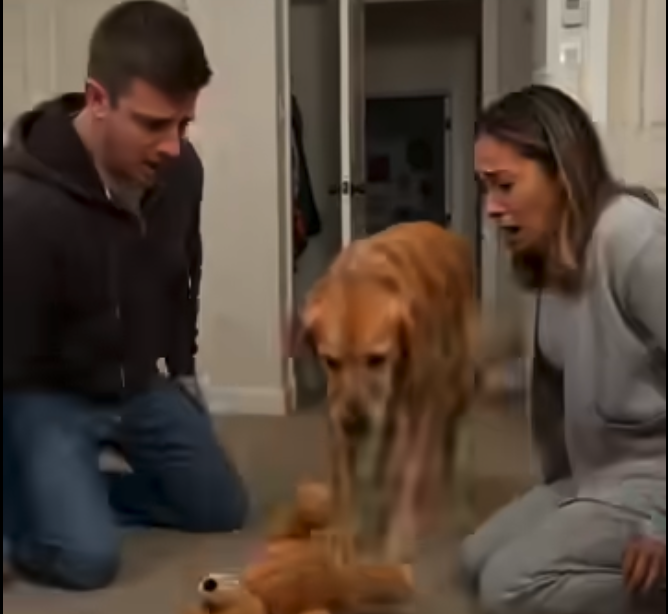
A few moments later, he came out carrying Milo’s stuffed giraffe in his mouth. He walked past us down the stairs and placed it in the center of the living room rug.
Then he went back.
Again and again.
A toy robot.
A baseball glove.
A small plastic dragon.
Each time, he carried them gently, as if they were sleeping.
Daniel sank onto the bottom step, crying openly now.
“Why is he doing this?” he whispered.
I had no answer.
Scout made one final trip upstairs.
This time, he stayed in Milo’s room longer.
When he came back, he wasn’t carrying a toy.
He held a notebook.
It was old, blue, and bent at the corners. I had never seen it before.
Scout walked straight to me and dropped it at my feet.
My hands shook as I picked it up.
On the front, in Milo’s uneven handwriting, were five words:
FOR MOM AND DAD LATER.
Daniel stared at it as if it might disappear.
I opened the first page.
There was a drawing of our family: me with wild orange hair, Daniel with huge glasses he didn’t wear, Milo in the middle, and Scout drawn almost as large as the house.
Underneath, Milo had written:
When I am scared, Scout knows first.
I pressed my hand to my mouth.
Daniel leaned closer.
I turned to the second page.
The sentence there shattered us completely.
Daddy didn’t make the accident happen, but he thinks he did.
Daniel stopped breathing.
The notebook nearly slipped from my hands.
For three months, I had known my husband was drowning in guilt. He had barely looked me in the eye since the funeral. He flinched whenever someone mentioned the car. He had apologized so many times in his sleep that I sometimes woke up crying before I remembered why.
But I had never seen the truth written in our son’s hand.
Daniel stood abruptly and stumbled backward.
“No,” he whispered. “No, he couldn’t have known that.”
I looked up at him. “Daniel.”
“He couldn’t have known.”
He turned and walked into the kitchen, gripping the edge of the counter so hard his knuckles went white.
I followed him with the notebook pressed to my chest.
He shook his head. “I was driving, Rachel. I should’ve seen the truck sooner. I should’ve stopped. I should’ve—”
“You had a green light.”
“I should’ve done something.”
“You survived.”
His face twisted. “Exactly.”
The word hung between us like a blade.
I had not realized until that moment how deeply he believed survival was a crime.
Behind us, Scout whined softly.
I looked down at the notebook.
There were dozens of pages.
“Daniel,” I said. “There’s more.”
He didn’t turn.
So I began to read.
The next pages were filled with strange, sweet entries. Milo had called it his “brave book.” He had written about things he noticed but didn’t understand.
Mom cries in the laundry room because she thinks the dryer is loud enough to hide it.
Dad sits in the car after work and doesn’t come inside for a long time.
Scout puts his head on people when their hearts are too heavy.
Grandma says heaven is far away, but I think love is a secret tunnel.
I cried so hard I could barely see the words.
Daniel finally turned around.
His face had crumpled.
We read until sunrise.
Some pages made us laugh through tears. Milo had written complaints about broccoli, theories about clouds, and a detailed plan to train Scout to become “the first dog mayor.”
But other pages were different.
They were careful.
Thoughtful.
Too thoughtful for a child who was supposed to have nothing heavier on his mind than homework and cartoons.
One entry made Daniel go still.
If Dad ever feels sad about the rainy road, tell him I was not scared in the car. We were singing the dinosaur song. I was happy.
Daniel’s knees buckled.
I caught him before he hit the floor, and for the first time since Milo died, he let me hold him.
After that night, the house changed.
Not healed.
Not suddenly bright.
But changed.
We opened Milo’s room.
The first time we walked in together, the air smelled faintly of dust, crayons, and the lavender detergent I used on his sheets. Sunlight fell across his bed. His sneakers were still lined up under the chair. His books leaned messily on the shelf, just as he had left them.
Daniel picked up the pillow and pressed his face into it.
I sat on the floor and pulled Scout into my arms.
For days, we read the notebook slowly, one page at a time, as if rushing would be disrespectful.
Then we found the envelope.
It was taped behind the last page.
Inside was a folded drawing of Scout sitting beside Milo’s bed. Beneath it, Milo had written:
Scout knows where the secret is.
Daniel frowned.
“What secret?”
I turned the paper over.
There was a drawing of a tree.
Our backyard maple.
At its roots, Milo had drawn a small red X.
Daniel looked at me.
Neither of us spoke.
Ten minutes later, we were outside in the cold morning air, standing beneath the maple tree. Scout circled the trunk, sniffed once, then began digging.
Daniel grabbed a small garden shovel from the shed.
Six inches down, metal struck metal.
He froze.
I knelt beside him and brushed away the dirt.
It was a small tin box, the kind cookies came in at Christmas.
Milo had covered it in stickers.
Stars.
Dinosaurs.
One crooked sticker that said GOOD JOB.
Daniel opened it with shaking hands.
Inside were letters.
Dozens of them.
Each one folded and labeled.
For Mom when she forgets to eat.
For Dad when he stops singing.
For Scout when he is a good boy.
For both of you when the house gets too quiet.
My tears fell into the dirt.
Daniel lifted one envelope with his name on it.
His fingers trembled so badly he couldn’t open it.
I opened mine first.
Dear Mom,
If you found this, Scout did a good job. Please give him cheese.
I laughed and sobbed at once.
The letter continued:
I made these because Mrs. Keller said writing helps when feelings are too big. I know everybody dies someday, but I don’t like that sentence because someday sounds sneaky. So I wanted to make sure if something bad happened, you still had some of my words.
Mom, please don’t live only in the sad part. I am in the pancakes too. I am in the songs. I am in the yellow flowers. I am in Scout’s ears when they flop.
Please be happy again. Not instead of loving me. Because you love me.
Daniel opened his letter next.
He read silently.
Then he handed it to me.
Dear Dad,
You always say heroes save people. But I think heroes also stay after the bad thing happens.
If something bad happens to me, don’t go away inside your head.
I know you think everything is your job to fix. But not everything is a broken shelf.
Some things are just storms.
You are still my dad.
You are still my hero.
Please sing the dinosaur song even if your voice sounds like a frog.
Love,
Milo
Daniel folded over the letter like a man finally allowed to collapse.
I wrapped my arms around him beneath the maple tree, and this time, he held on.
For weeks, the letters became our lifeline.
We opened them only when we needed them most.
On the day I found myself standing in front of the fridge without knowing why, Daniel handed me the envelope labeled For Mom when she forgets to eat. Inside was a drawing of me holding a sandwich bigger than my head.
On the day Daniel sat in the garage staring at the car keys, I gave him For Dad when he gets stuck in the before. Milo had written, The before was good, but the after needs you too.
Each letter was a candle.
Small.
Impossible.
Enough.
But there was one envelope we did not open.
It was thicker than the others.
On the front, Milo had written:
OPEN LAST, WHEN YOU CAN BOTH SMILE WITHOUT FEELING BAD.
For a long time, we were not ready.
Then spring came.
The maple tree grew new leaves.
Daniel shaved.
I started baking again.
Scout brought us his leash every morning like a demanding little old man.
One Saturday, six months after the accident, Daniel laughed.
Really laughed.
Scout had stolen a pancake from the counter and then tried to look innocent with syrup on his nose.
The sound of Daniel’s laugh filled the kitchen.
I froze.
So did he.
For one terrible second, guilt entered the room.
Then Daniel looked at me and whispered, “I think he would’ve liked that.”
I nodded.
“He would’ve said Scout was doing research.”
Daniel smiled again, smaller this time, but real.
That evening, we opened the last envelope.
Inside was a key.
A small silver key taped to a page.
There was also a letter.
Dear Mom and Dad,
If you opened this, it means you smiled. Good job. That is very brave.
The key is for the little lockbox in the attic behind the Christmas stuff. I know I am not supposed to go in the attic, but I did. Sorry. Please don’t ground me if I am dead.
Daniel choked on a laugh.
The letter continued:
I made something important. But you have to promise not to be mad. I asked Mrs. Keller to help because she said sometimes grown-ups need surprises to remember good things.
We climbed into the attic with flashlights.
Behind boxes of ornaments and old coats, we found the lockbox.
Inside was a USB drive, a stack of drawings, and a letter from Milo’s teacher, Mrs. Keller.
Dear Mr. and Mrs. Bennett,
Milo asked me to help him with a project he called “The After Plan.” I thought it was a creative writing exercise at first. He told me he worried about how sad people became when someone died, because his class had recently lost a student’s grandparent. He wanted to make something that could “help love keep talking.”
I helped him record a few short videos during lunch periods with your written media permission form already on file. I did not realize the depth of what he was creating until he gave me this drive and asked me to return it to him at the end of the school year.
I am heartbroken that I never got the chance.
When you are ready, I hope these bring comfort.
With love,
Claire Keller
Daniel inserted the USB drive into his laptop with trembling hands.
A folder appeared.
Twenty-one videos.
The first file was titled START HERE.
Milo appeared on the screen, sitting in his classroom library corner, wearing his blue hoodie and missing one front tooth.
“Hi, Mom. Hi, Dad,” he said, waving too close to the camera. “If you are watching this, then either I am very famous, or something sad happened. I hope it is famous.”
I covered my mouth.
Daniel gripped my hand.
Milo leaned closer.
“Mrs. Keller says I should say what this is. This is my After Plan. Not because I think I am dying. I am not. I just think people should have plans for love, like fire drills.”
He looked very serious.
“If I am gone, you have to remember three rules. Number one, feed Scout cheese, but not too much because he gets fart clouds. Number two, don’t stop talking about me. That makes me feel disappeared. Number three…”
He paused and looked down at his hands.
“Number three, don’t let the sad story be the only story.”
Daniel made a broken sound beside me.
The videos became part of our lives after that.
We watched one every Sunday night.
In one, Milo performed a puppet show about a dragon who opened a bakery.
In another, he sang the dinosaur song with exaggerated seriousness.
In another, he said, “Dad, you are probably crying. That’s okay. Mom, please hug him because he pretends he does not need it.”
So I did.
Every time.
The final video was different.
It was titled FOR THE BIG QUESTION.
For some reason, neither of us clicked it for weeks.
Maybe we were afraid there would be nothing after it.
Maybe grief makes even comfort feel dangerous.
Then, on Milo’s ninth birthday, we sat on the sofa with Scout between us and opened the file.
Milo appeared on screen in the same classroom corner.
But this time, Mrs. Keller sat beside him.
Milo looked nervous.
“Okay,” he said. “This one is important. Mom, Dad, I know you said maybe someday you wanted more kids, but then Mom got sick before I was born and the doctor said it could be hard.”
I went still.
Daniel looked at me sharply.
We had never told Milo the full story. Years before his birth, I had survived a complicated illness that left pregnancy risky. Milo had been our miracle. We had quietly accepted that he would be our only child.
Milo smiled shyly at the camera.
“I asked Mrs. Keller if love can be adopted, and she said yes, obviously, because Scout is adopted and he is mostly love except when he eats socks.”
Mrs. Keller laughed softly.
Milo held up a drawing.
It showed our house, our maple tree, Scout, Daniel, me, and a small child with curly hair standing between us.
“I think there is a kid somewhere who needs you,” Milo said. “Not to replace me. That is not allowed. I am not a broken toy. But maybe your hearts are big and there is an empty chair at pancakes.”
My vision blurred.
Daniel whispered, “Oh my God.”
Then Milo looked straight into the camera.
“And I think it should be Lily.”
The room went silent.
The video kept playing.
Milo turned to Mrs. Keller. “Can I say her last name?”
Mrs. Keller nodded gently.
“Lily Parker,” Milo said. “She is in the grade under me. She sits alone a lot. Her foster mom forgot pickup twice. She likes yellow flowers and she gave me half her cookie when I dropped mine. She said nobody keeps her very long.”
My heart pounded.
Mrs. Keller looked into the camera now.
“I debated including this,” she said. “But Milo was very clear. Lily is a real child in the foster system. I cannot promise anything. I can only tell you that your son noticed her. He worried about her. He asked me once whether families can find each other late.”
Milo nodded hard.
“If you can’t, it’s okay. I won’t be mad. But if you can, tell Lily I said she gets the window seat.”
The video ended.
For a long time, neither Daniel nor I moved.
Then Scout stood, walked to the pile of toys still gathered near the rug, and picked up the yellow dinosaur.
Captain Roar.
He placed it in my lap.
The same toy that had started everything.
On the bottom of its plastic foot, in faded marker, was a name I had never noticed.
LILY.
I looked at Daniel.
His eyes were wide.
“He knew her,” I whispered.
Daniel picked up the dinosaur.
“He brought this one first.”
Scout rested his head on my knee.
For the first time since Milo died, the silence in our house did not feel empty.
It felt like a door.
Finding Lily was not simple.
Life rarely honors miracles by making them convenient.
Mrs. Keller helped us contact the proper agency. There were interviews, background checks, training sessions, home visits, paperwork thick enough to break a table, and nights when I wondered if opening our hearts again was bravery or madness.
Daniel struggled the most.
“What if I fail her?” he asked one night.
We were standing in Milo’s room, which had slowly become less of a shrine and more of a place where love could breathe.
I touched his scar.
“You won’t.”
“You don’t know that.”
“No,” I said. “But Milo did.”
That was enough to make him cry.
Three months later, we met Lily.
She was seven, small for her age, with serious brown eyes and curls tied back with a yellow ribbon. She entered our house holding Mrs. Keller’s hand and looking ready to run.
Scout greeted her first.
He walked up slowly, as if he understood this was sacred, and dropped Captain Roar at her feet.
Lily stared.
“That was mine,” she whispered.
I knelt. “Milo kept it safe.”
Her eyes filled with tears. “He said he would give it back.”
Daniel crouched beside me. “He found a way.”
Lily looked around the living room, at the rug where Scout had placed every toy, at the photos on the mantel, at the maple tree visible through the window.
Then she looked at Scout.
“Does the dog live here?”
“Yes,” I said.
She nodded solemnly. “Then I can visit.”
Visits became weekends.
Weekends became longer stays.
Lily was not Milo. No one wanted her to be.
She hated broccoli too, but for different reasons. She liked drawing birds, not dinosaurs. She sang off-key with confidence. She asked difficult questions at bedtime and hid crackers under her pillow because hunger had once been more reliable than adults.
Daniel became gentle in ways I had never seen.
He learned to announce himself before entering rooms. He learned that Lily hated sudden noises. He learned that trust was not given; it was built, one pancake, one school pickup, one bedtime story at a time.
One evening, I found him in the kitchen teaching Lily the dinosaur song.
He sounded terrible.
Absolutely terrible.
Lily laughed so hard she fell off the chair.
Daniel laughed too.
And I stood in the doorway crying quietly, not because my grief had vanished, but because it had made room.
A year after Milo’s death, under the maple tree, Lily officially became our daughter.
The judge asked her if she understood what adoption meant.
Lily thought carefully.
“It means they keep me,” she said.
Daniel’s face broke open with emotion.
I squeezed her hand. “Forever.”
After the hearing, we went home and ate pancakes for dinner because Milo had once declared birthday rules could apply to any important day if voted on by the dog.
That night, Lily asked to see the notebook.
We hesitated, then showed her.
She traced Milo’s handwriting with one finger.
“He really wrote about me?”
“He did,” Daniel said.
Lily leaned against him, trusting his shoulder with the full weight of her small body.
“I used to think nobody saw me,” she whispered.
I kissed the top of her head.
“Milo did.”
Scout sighed from the rug, surrounded by toys from two childhoods.
Later, after Lily fell asleep in the room next to Milo’s, Daniel and I sat together in the quiet house.
The door to Milo’s room was open.
So was Lily’s.
A soft hallway light connected them.
Daniel took my hand.
“For months,” he said, “I thought the accident was the end of our family.”
I rested my head on his shoulder.
“It was the end of one story.”
From upstairs came a small sleepy voice.
“Mom?”
My heart stopped for half a second, the old pain and new joy colliding.
I stood and went to Lily’s room.
She was sitting up in bed, curls wild, Captain Roar tucked under one arm.
“Can Scout sleep here?” she asked.
Scout was already halfway onto her bed.
I smiled.
“I think he’s decided.”
Lily settled back against her pillow.
Before I turned off the light, she said, “Do you think Milo is happy?”
I looked toward the open door across the hall, where moonlight spilled over the wooden sign that still read MILO’S KINGDOM.
Then I looked at Scout, curled protectively beside Lily, his golden head resting near the dinosaur he had carried back from the dark.
“Yes,” I whispered. “I think he had a plan.”
Downstairs, the living room rug was empty for the first time in months.
No toys.
No notebook.
No message waiting in the center.
Because the message had finally been delivered.
And somewhere in the house we thought grief had ruined forever, love had learned a new way to stay.
