PART 2 — THE CALL THAT CHANGED EVERYTHING
“Marianne,” I said again, gripping the edge of Ethan’s mahogany desk as another wave of pain tightened around my body, “it’s time.”
There was no hesitation on the other end of the line.
“Nora, listen carefully,” my attorney said. “Are you safe?”
I looked toward the front door, where the deadbolts gleamed in a neat, silent row. Outside, the last trace of Ethan’s Uber had vanished down the street. Inside, the nursery mobile turned slowly from the air conditioner, soft clouds drifting over an empty crib.
“For the first time in months,” I whispered, “yes.”
Marianne exhaled. “Good. Then we move today.”
Those three words unlocked something inside me.
For eight months, I had lived like a guest in my own marriage. Ethan monitored my spending, questioned my appointments, mocked my cravings, and let his mother walk into our home whenever she wanted. Diane rearranged my kitchen, criticized my body, and once told me that mothers who needed help were “weak women raising weak children.”
But Ethan’s biggest mistake wasn’t cruelty.
It was assuming I was stupid because I was kind.
I opened the folder with trembling fingers. Every page inside was a piece of the trap he had built around himself: loans taken in my name, signatures that looked like mine but weren’t, transfers from the inheritance my father had left me before he died.
My father, who had once told me, “Never confuse love with surrender, Nora.”
I had confused them for too long.
“Photograph everything,” Marianne instructed. “Then email it to the secure address I gave you. I’ve already prepared the emergency filings. We’ll request a freeze on joint accounts, a protective financial order, and immediate separation of assets.”
“What about the house?”
“The house is yours,” she said firmly. “Your father bought it before the marriage. Ethan’s name was never added to the deed.”
I closed my eyes.
That was the second lie Ethan had told me—that I lived there because of him.
Another pain pulled through me, stronger this time. I sucked in a breath.
“Nora?” Marianne’s voice sharpened.
“I think…” I placed a hand over my belly. “I think labor is starting.”
“Call your doctor now.”
I almost laughed. Not because it was funny, but because the timing was so painfully perfect. Ethan had left me to give birth alone.
But he had also left me alone with the truth.
Within twenty minutes, Marianne had contacted the bank, my doctor had told me to come in, and my neighbor, Mrs. Alvarez, was pounding at my front door with a hospital bag in one hand and fury in the other.
“I knew that man was useless,” she snapped the moment I opened the door. “But leaving you like this? Ay, no. I should have put salt in his coffee years ago.”
Despite everything, I laughed.
Then I cried.
Mrs. Alvarez wrapped one arm around me and held me like my mother would have, if she were still alive.
“You are not alone,” she said. “Not today.”
As she helped me to the car, my phone buzzed again.
A photo appeared.
Ethan and Diane at the airport lounge, holding two glasses of champagne.
Diane had captioned it:
Freedom for five days!
I stared at the image until the letters blurred.
Then I blocked both of them.
By the time their plane lifted into the sky, mine had already begun to land.
Not in fear.
Not in dependence.
But in the life I should have chosen long ago.
PART 3 — THE CHILD THEY THOUGHT THEY COULD ABANDON
The hospital room smelled like clean sheets, antiseptic, and rain.
A storm had rolled in by evening, rattling the windows as if the sky itself was angry on my behalf. Mrs. Alvarez sat beside me, knitting something pink with the speed of a woman waging war through yarn.
Every nurse who entered asked the same question in careful voices.
“Is your husband coming?”
At first, I said, “He’s out of town.”
Then, after midnight, when exhaustion stripped the shame from me, I said the truth.
“No. He chose not to.”
The nurse’s expression changed. Not pity. Something stronger.
Respect.
“Then we’ll be your people tonight,” she said.
And they were.
They held my hand. They cooled my forehead. They told me when to breathe. Mrs. Alvarez prayed softly in Spanish, and I gripped her fingers so tightly I was sure I’d bruised them.
Hours stretched and blurred.
Then, just before dawn, as pale light spilled across the room, my daughter arrived with a cry so fierce it seemed to split my old life in two.
They placed her against me, warm and tiny, wrapped in a soft blanket.
And the moment I saw her face, every humiliation I had swallowed became unforgivable.
She had Ethan’s dark hair.
She had my father’s dimple.
She had hands so small they curled around my finger like she already knew she belonged to me and no one else.
“What’s her name?” the nurse asked.
I had once agreed to name her Diane Elise, because Ethan had insisted his mother deserved “a legacy.”
But looking at my daughter, I felt my father’s voice rise in me again.
Never confuse love with surrender.
“Lena Grace,” I said.
Mrs. Alvarez smiled through tears. “Beautiful.”
“Lena,” I whispered, kissing my daughter’s forehead. “Because she is light.”
By noon, Marianne arrived with a navy folder and a look on her face that told me the world outside my hospital room had shifted.
“The accounts are frozen,” she said. “Your cards are protected. Ethan’s access to your trust has been blocked. The bank has flagged the suspicious withdrawals. I also filed notice with the court.”
I looked down at Lena, sleeping against my chest.
“Does he know?”
“Not yet,” Marianne said. “He’s in the air. But he will.”
A strange calm settled over me.
For years, I had feared Ethan’s anger. The slammed doors. The icy silence. The way he could make me apologize for wounds he caused.
But now, his anger felt far away. Small. Almost childish.
“What happens when he comes back?” I asked.
Marianne’s mouth tightened. “He’ll find out that abandonment has consequences. Fraud has consequences. And threatening a pregnant wife while draining her inheritance has consequences.”
I should have been terrified.
Instead, I felt powerful.
That evening, I opened my phone and saw dozens of missed notifications blocked into silence. Ethan couldn’t reach me. Diane couldn’t poison me with words.
But Marianne could still receive everything.
“She forwarded me a message from Ethan,” Marianne said.
I nodded once.
She read it aloud.
Why are my cards declining? Call me now.
Another message came minutes later.
Nora, this isn’t funny.
Then Diane:
Tell that ungrateful girl to fix this. She is embarrassing us at the resort.
I held Lena closer.
For the first time in years, Ethan was uncomfortable.
For the first time in years, Diane was not in control.
And for the first time in my marriage, I did not rush to save them from the consequences of their own choices.
PART 4 — PARADISE STARTED TO BURN
In Cancún, the sun was bright, the water was blue, and Ethan’s smile began to crack before he had even unpacked.
I learned the details later from Marianne, from bank alerts, and eventually from Ethan himself when panic made him careless.
The first card declined at the resort check-in desk.
The second declined at the boutique where Diane had selected a silk beach cover-up she called “a recovery gift” for herself.
The third failed when Ethan tried to pay for dinner.
By sunset, paradise had become a cage with palm trees.
Ethan sent twenty-seven messages in two hours.
Nora, answer me.
What did you do?
You can’t cut me off.
My mother is upset.
You’re acting unstable.
Fix this before I get home.
I read none of them until Marianne showed me the copies for legal records. When she did, I laughed once, softly.
“My mother is upset,” I repeated.
Marianne raised an eyebrow. “Apparently that was his emergency.”
Not his wife.
Not his child.
His mother’s mood.
The next morning, Ethan discovered that his business account had also been restricted pending investigation. His luxury car dealership, which he had bragged was “expanding,” was actually collapsing under unpaid loans and hidden obligations.
I had funded it without knowing.
My father had funded it without being alive to object.
And Ethan had called it providing for me.
By the fourth day, Diane was leaving furious voicemails with Marianne.
“This is elder abuse,” she snapped in one recording. “That house belongs to my son. Nora is hormonal and vindictive. She has
always been jealous of our bond.”
Marianne stopped the recording and looked at me over her glasses.
“Jealous of what, exactly? The emotional leash?”
I burst into laughter so sudden that Lena startled in her bassinet. I scooped her up, apologizing between giggles and tears.
It felt strange to laugh.
It felt strange to breathe without asking permission.
The hospital discharged me on the third day. Mrs. Alvarez drove us home, and my heart pounded as we pulled into the driveway.
The house looked the same.
White shutters. Blue hydrangeas. The porch swing my father had installed for my mother years before I ever married Ethan.
But inside, everything had changed.
Marianne had arranged for a locksmith. Every exterior lock had been replaced. The alarm code was new. Ethan’s garage remote no longer worked. His office had been inventoried. His files were secured.
In the nursery, above Lena’s crib, the wooden letters still spelled the name Ethan had chosen.
DIANE ELISE.
I stood beneath them for a long time.
Then Mrs. Alvarez climbed a step stool, removed each letter, and handed them down to me.
D.
I.
A.
N.
E.
One by one, the old future came apart in my hands.
That night, I rocked Lena in the nursery under a blank wall and told her the first promise of her life.
“You will never have to earn love by disappearing.”
Outside, rain tapped gently against the window.
Inside, my daughter slept.
And somewhere over the ocean, Ethan and Diane were flying home toward a life that no longer existed.
PART 5 — THE RETURN OF THE KING WHO HAD LOST HIS CASTLE
They returned on a Sunday afternoon.
Tanned skin. Designer sunglasses. Matching white linen outfits.
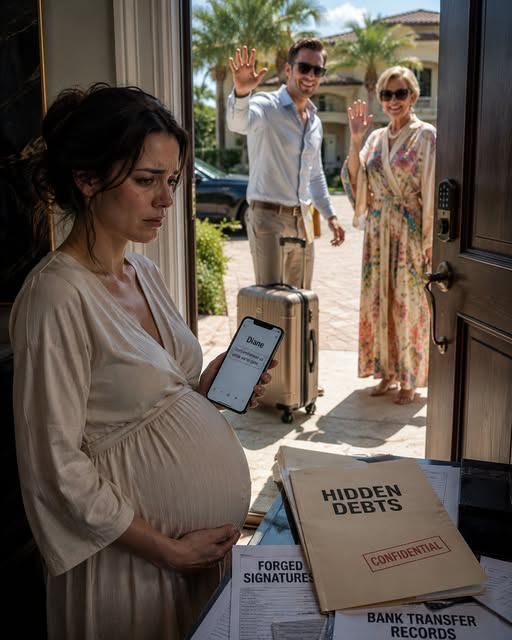
Ethan stepped out of the rideshare first, dragging his champagne-colored suitcase behind him. Diane followed, face tight with outrage, as if the vacation had been ruined by poor service instead of consequences.
I watched from the upstairs window, Lena sleeping in my arms.
Ethan reached the front door and tried his key.
It didn’t turn.
He tried again.
Then again.
Diane said something sharp, waving her hand toward the lock.
Ethan pounded on the door.
“Nora!” he shouted. “Open up!”
My body reacted before my mind did. For a second, fear moved through me, old and familiar.
Then Lena sighed in her sleep.
And I remembered who I was now.
I walked downstairs slowly, not to open the door, but to stand behind it.
“You need to leave,” I said through the wood.
Silence.
Then Ethan laughed in disbelief. “Excuse me?”
“You don’t live here anymore.”
Diane shrieked, “How dare you speak to my son that way?”
I looked at the framed photo beside the door—my parents on their wedding day, smiling in this very house.
“I dare because this is my home.”
Ethan’s voice dropped. “Open the door, Nora.”
“No.”
“You’re my wife.”
“Not for long.”
That silenced him.
Then came the sound of his palm striking the door.
“You changed the locks?”
“Yes.”
“You blocked the cards?”
“Yes.”
“You froze my accounts?”
“No,” I said. “The bank did that after seeing the documents.”
A pause.
“What documents?”
I could almost see his face losing color.
“The debts,” I said. “The transfers. The signatures. The business records. All of it.”
Diane’s voice rose, brittle and furious. “You sneaky little—”
“Careful,” I interrupted. “There is a doorbell camera recording everything.”
Another silence.
It was delicious.
Ethan tried a different voice then. Softer. The one he used when cruelty failed and charm took its place.
“Nora, sweetheart. You’re tired. You just had a baby. Let me in and we’ll talk.”
I opened the small side window beside the door just enough to slide out a sealed envelope.
He stared at it.
“What is this?”
“Temporary protective order. Notice of separation. Financial injunction. And a copy of the birth certificate.”
His hand froze.
“Birth certificate?”
“Yes.”
His voice changed. “The baby came?”
I waited for emotion. Joy. Regret. Shock. Anything human.
Instead, he said, “And you didn’t tell me?”
Something inside me went completely still.
“You told me to call an ambulance,” I said. “So I called people who cared.”
Diane snatched the paper from him. “Lena Grace?” she spat. “Where is my name?”
“Nowhere near my daughter.”
“She is my grandchild!”
“No,” I said, and my voice was calm enough to frighten even me. “She is the child you left behind.”
Ethan stepped closer to the door, lowering his voice.
“You’ll regret humiliating me.”
I looked into the camera lens above him and smiled sadly.
“No, Ethan. I already regret marrying you. This is me correcting it.”
Behind him, a black sedan pulled up.
Marianne stepped out first.
Then two officers.
Ethan turned, confusion flashing across his face.
Marianne adjusted her blazer and said, “Mr. Cole, we need to discuss the documents your wife found.”
And just like that, the king who had left for paradise came home to find his castle had learned his real name.
PART 6 — DIANE’S LAST PERFORMANCE
Diane did not go quietly.
Women like Diane never do.
She clutched her chest. She cried without tears. She told the officers she was “a devoted grandmother” being abused by a cruel daughter-in-law. She claimed I had always been unstable, jealous, selfish, dramatic.
The words floated through the open window like smoke.
Once, they would have choked me.
Now, they only proved my point.
Ethan tried to stay calm, but panic kept slipping through the cracks.
“This is a misunderstanding,” he told Marianne. “Nora gave me permission.”
Marianne opened her folder. “Then you’ll have written authorization for the trust transfers?”
His jaw tightened.
“And proof she signed the loan documents?”
He looked away.
“And an explanation for why one signature was dated while she was hospitalized for pregnancy complications?”
That was the moment Diane stopped crying.
Ethan looked up sharply. “What?”
Marianne’s face gave away nothing. “Your mother’s name appears on several communications with the broker.”
Diane’s mouth opened.
For the first time, Ethan looked at her not as his queen, not as his protector, but as a liability.
“Mom?” he said.
Diane lifted her chin. “I did what was necessary.”
The air changed.
Even from inside the house, I felt it.
Ethan’s entire life had been built on letting Diane control the room. She had chosen his clothes, criticized his girlfriends, managed his moods, and treated our marriage like a hostile takeover.
But now, under the eyes of officers and an attorney, their perfect alliance began to fracture.
“What does that mean?” Ethan demanded.
“It means,” Diane snapped, “that you were too weak to secure your future. That girl’s family had money, and you were wasting time pretending love mattered.”
My hand tightened around the curtain.
There it was.
The truth, standing naked in daylight.
Ethan stared at his mother. “You told me the transfers were legal.”
“They should have been!” Diane said. “She was your wife. What belonged to her belonged to you.”
“No,” Marianne said. “Legally, that is not how inheritance trusts work.”
Diane whirled toward the house. “Nora! Come out here and stop this nonsense!”
I opened the door only as far as the chain allowed.
Lena was upstairs with Mrs. Alvarez. I would not bring my daughter near that storm.
Diane’s face twisted when she saw me. “You ruined this family.”
I looked at Ethan.
For one brief second, he seemed smaller than I remembered. Not innocent. Never innocent. But stripped of the arrogance that had made him seem untouchable.
“No,” I said. “I stopped letting you ruin mine.”
Diane pointed a shaking finger at me. “That baby needs a father.”
“She needs safety first.”
Ethan flinched.
Good.
Some truths should hurt.
He stepped forward. “Nora, please. I made mistakes.”
“You abandoned me at thirty-eight weeks pregnant.”
“I was overwhelmed.”
“You stole from me.”
“I was going to pay it back.”
“You let your mother mock the possibility of me giving birth alone.”
He said nothing.
I leaned closer to the opening.
“And then, when you found out your daughter was born, your first concern was that I hadn’t informed you.”
His eyes filled, but I no longer trusted tears that arrived after consequences.
“I want to see her,” he whispered.
“No,” I said.
Diane gasped. “You can’t deny him!”
Marianne stepped in. “All visitation will be handled through the court.”
Diane’s mask shattered completely. “You think you’ve won?” she hissed at me. “You think men like Ethan stay alone? He’ll replace you.”
I smiled then, not because it didn’t hurt, but because it finally didn’t matter.
“Maybe,” I said. “But he’ll never replace what he lost.”
The officers asked Ethan to come with them for formal questioning. Diane shouted until her voice cracked. Neighbors peeked through curtains. The whole quiet street witnessed the ending of the lie.
As Ethan was led toward the sedan, he looked back at me.
Not at the house.
Not at his mother.
At me.
And for once, I did not look away first.
PART 7 — THE SECRET MY FATHER LEFT BEHIND
Three weeks later, I sat in Marianne’s office with Lena asleep against my shoulder and sunlight spilling across the conference table.
The world had become both harder and softer.
Harder because lawyers called. Banks investigated. Ethan sent apologies through approved channels, each one polished and useless.
Softer because Lena existed.
Her tiny yawns. Her warm cheek against my neck. The way her fingers curled into my shirt as though she trusted me completely.
I had never been trusted like that before.
Marianne entered carrying a box.
It was old, gray, and sealed with my father’s handwriting.
NORA — WHEN YOU ARE READY.
My throat tightened instantly.
“Where did this come from?”
“Your father’s estate archive,” Marianne said. “He instructed it to be held until you either turned thirty-five, had a child, or requested a full trust review.”
I stared at the box.
“I didn’t know.”
“He wanted you to live first,” she said gently. “But he also wanted you protected.”
Inside were letters.
Not one.
Dozens.
Some addressed to me. Some to any future child I might have. Some to the trustee. One to “the person who mistakes my daughter’s kindness for weakness.”
My hands trembled as I opened that one.
The letter was brief.
To whoever has reached for what belongs to Nora:
You have misunderstood her silence. That is unwise.
My daughter was raised to give, but not to be emptied. She was raised to forgive, but not to be used. Every structure around her inheritance exists because I knew the world would see her heart before it saw her strength.
By the time you read this, she has likely discovered yours.
That will be your loss.
—Thomas Vale
I pressed the paper to my mouth and cried so hard Lena stirred.
My father had protected me even from beyond the grave.
But the shock was not finished.
Marianne removed one final document.
“There’s something else,” she said.
I wiped my face. “What?”
“Your father created a secondary trust. It was never accessible to Ethan. It becomes active upon the birth of your first child.”
“For Lena?”
Marianne smiled. “For Lena. And for you, if you choose to use it for housing, education, medical care, or rebuilding your life.”
I blinked.
“How much?”
She slid the paper toward me.
For a moment, I couldn’t understand the numbers.
Then I did.
The amount was enough to pay every legal fee, secure Lena’s future, and open the community childcare center I had dreamed about before Ethan convinced me motherhood would make me “too distracted” to work.
I laughed through tears.
Marianne leaned back. “Your father also left one instruction attached to the trust.”
I looked up.
“He wrote: ‘Tell Nora she was never trapped. Only waiting for the door to appear.’”
That night, I took Lena home and stood in the nursery.
The wall above her crib was still blank.
I picked up the new wooden letters I had ordered.
LENA GRACE.
Beneath them, I hung my father’s words in a small gold frame.
SHE WAS NEVER TRAPPED.
For the first time since Ethan had left for Cancún, I allowed myself to imagine the future without bracing for pain.
A future with mornings full of baby laughter.
A future with work that mattered.
A future where love did not arrive with conditions.
I thought the greatest surprise had already happened.
I was wrong.
PART 8 — THE END: THE DOOR THAT OPENED
Six months later, the courtroom was packed.
Not because my divorce was famous, but because Diane had made the mistake of trying to make it dramatic.
She had posted vague messages online about “grandparent alienation” and “gold-digging daughters-in-law.” She had called relatives, neighbors, old friends, even members of my church.
But people remembered things Diane had forgotten.
They remembered Ethan missing appointments.
They remembered me carrying grocery bags alone while heavily pregnant.
They remembered Diane joking at a baby shower that “Nora needed toughening up before motherhood.”
And then Marianne presented the messages.
Let her give birth alone.
Maybe pain will finally teach her respect.
The courtroom went silent.
Diane’s face turned gray.
Ethan stared at the table.
The judge read everything. The forged documents. The bank reports. The trust protections. The timeline of abandonment. The attempts to access funds after Lena’s birth.
When Ethan finally spoke, his voice was barely audible.
“I was wrong.”
Diane snapped her head toward him.
He did not look at her.
“I was cruel,” he continued. “I let my mother influence me. But I chose it. Nora didn’t deserve it.”
It was the first honest thing I had ever heard him say.
And it changed nothing.
That was the strangest part of healing. Sometimes the apology comes. Sometimes it is even real.
But it still arrives too late to be a key.
The judge granted the divorce, confirmed the house as my separate property, restricted Ethan’s access to Lena until he completed counseling and met court requirements, and referred the financial matter for further action.
Diane was warned to stop contacting me.
She tried to argue.
The judge silenced her with one look.
Outside the courthouse, Ethan approached me carefully. He looked older. Thinner. Less polished.
For a heartbeat, I saw the man I had once loved.
Then Lena laughed in Mrs. Alvarez’s arms, and the spell broke.
“Nora,” Ethan said, “can I say goodbye?”
I studied him.
Not with hatred.
Hatred would have kept a thread between us.
I felt something cleaner.
Distance.
“You can say goodbye from there,” I said.
He nodded, tears in his eyes.
“Goodbye, Lena,” he whispered.
Lena only reached for me.
I took my daughter into my arms, and she buried her face against my shoulder.
Ethan stepped back.
Diane waited near the curb, furious and defeated. Her kingdom had collapsed. Her prince had failed. And the woman she had tried to break was walking away with the only treasure that mattered.
But the shocking ending—the one no one expected—came two weeks later.
A letter arrived.
Not from Ethan.
From Diane.
Marianne advised me not to open it, but something in me wanted to see the final shape of the monster.
Inside was one page.
Nora,
I hated you because Thomas Vale once chose your mother over me.
I read the sentence three times.
My breath stopped.
The letter continued.
Before he married your mother, I knew him. I thought he would choose me. He didn’t. When Ethan brought you home years later, I recognized the name Vale and saw your mother’s face in yours. I convinced myself your family had taken something from me. So I tried to take something back.
I am not asking forgiveness. I do not deserve it.
Diane
I sat very still.
The room seemed to tilt.
All those years, I had thought Diane hated me because I was not good enough for her son.
But the truth was stranger, smaller, and sadder.
She had been punishing a dead woman through her daughter.
I thought I would feel rage.
Instead, I felt the final chain fall away.
Diane’s cruelty had never been proof of my failure. Ethan’s betrayal had never been proof I was unlovable. Their abandonment had never been the end of my story.
It had been the beginning of my escape.
One year after Lena’s birth, I opened the doors to Vale House, a childcare and support center for mothers rebuilding their lives. Mrs. Alvarez ran the kitchen. Marianne joined the board. Nurses from the hospital volunteered on weekends.
Above the entrance, in gold letters, were my father’s words:
SHE WAS NEVER TRAPPED.
On opening day, I stood on the porch with Lena on my hip, watching women arrive with babies, toddlers, diaper bags, tired eyes, and cautious hope.
One young mother paused in front of me.
“I don’t know where to start,” she whispered.
I looked at her the way I wished someone had looked at me sooner.
“Start inside,” I said. “You are not alone here.”
Lena clapped her tiny hands, delighted by the sunlight, the voices, the bright blue sky.
And as the doors opened wide, I finally understood.
Ethan had left me at thirty-eight weeks pregnant and told me to give birth alone.
But I had not given birth alone.
I had given birth surrounded by truth, courage, and the women who refused to let me disappear.
He returned from paradise with tanned skin and a suitcase full of dirty clothes.
I returned from pain with a daughter, a future, and a name that was finally mine again.
Nora Vale.
Not abandoned.
Not broken.
Not trapped.
Free.
