Walter Briggs had survived a war.
He had survived losing friends.
He had survived injuries that still ached every winter morning.
But somehow, a muddy Labrador sitting outside a grocery store managed to test his patience more than any battlefield ever had.
For nearly six months, the dog had been there.
Every morning when Walter unlocked the doors at seven, the Labrador sat outside.
Every afternoon when customers flowed in and out carrying bags of groceries, the Labrador sat outside.
Every evening when the sun dipped below the rooftops and the parking lot emptied, the Labrador sat outside.
Always in the same place.
Always facing the same road.
Always waiting.
At first, people felt sorry for him.
They left scraps of food.
Bowls of water.
Old blankets.
The dog accepted the water.
Ignored most of the food.
And never touched the blankets.
He simply waited.
Eventually sympathy turned into irritation.
Customers complained that he blocked the entrance.
Parents worried he might be dangerous.
Store managers discussed calling animal control.
But every time officers arrived, the dog would disappear for a few hours before quietly returning.
As if he understood exactly where he was supposed to be.
Walter hated it.
Or at least he told himself he did.
“Stubborn mutt,” he muttered nearly every day.
The Labrador never reacted.
Never barked.
Never growled.
Never begged.
He just sat there staring toward the road.
Waiting.
It drove Walter crazy.
Because something about the dog reminded him of himself.
And Walter spent most of his life trying not to think about the things he waited for.
The friends who never came home.
The wife he’d buried fifteen years ago.
The son who hadn’t spoken to him in nearly a decade after a bitter argument neither of them seemed willing to forget.
Waiting hurt.
Walter knew that better than anyone.
Maybe that was why the dog irritated him so much.
One rainy afternoon, after a miserable shift and an even worse morning, Walter finally snapped.
The Labrador was sitting directly beside the entrance.
Again.
Customers were stepping around him.
Again.
Walter emerged carrying a bucket of filthy mop water.
“That’s enough.”
The dog didn’t move.
Walter marched forward.
“You hear me?”
Nothing.
Anger surged through him.
Without thinking, he dumped the entire bucket over the Labrador.
Dirty gray water cascaded across the dog’s fur.
Gasps erupted nearby.
A woman covered her mouth.
Two teenagers stared in shock.
The Labrador became drenched from head to tail.
But he didn’t run.
Didn’t bark.
Didn’t growl.
Didn’t even shake himself dry.
He simply looked toward the road.
Waiting.
The sight unsettled Walter immediately.
For some reason, he had expected anger.
Fear.
Anything.
Instead, the dog acted as though the humiliation meant nothing.
As though whatever he was waiting for mattered far more.
Walter turned away.
Yet all afternoon he couldn’t stop thinking about it.
When closing time arrived, he glanced outside.
The Labrador was still there.
Motionless.
Watching the road.
The same road.
The same direction.
The same endless hope.
Something twisted painfully inside Walter’s chest.
Without fully understanding why, he walked outside and sat beside the dog.
For several minutes neither moved.
Traffic rolled past.
Streetlights flickered on.
The evening air cooled.
Finally Walter sighed.
“Who are you waiting for?”
The Labrador immediately stood.
Walter blinked.
The dog wagged his tail once.
Only once.
Then he began walking across the street.
Walter followed.
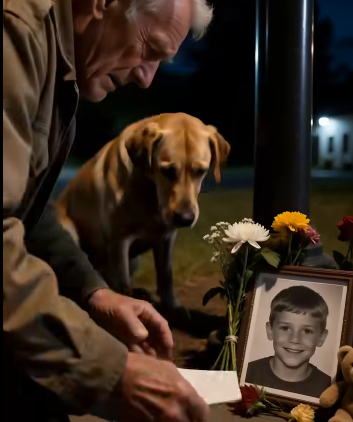
The Labrador stopped beside a lamppost.
Flowers surrounded its base.
Candles.
Stuffed animals.
Photographs.
A memorial.
Walter felt his stomach tighten.
His eyes landed on a picture.
A smiling boy.
Dark hair.
Bright eyes.
Twelve years old at most.
And suddenly Walter recognized him.
Ethan.
The kid who used to visit the store almost every day.
The kid who always bought pastries.
The kid who disappeared months ago.
Walter remembered wondering where he’d gone.
A woman arranging flowers nearby noticed his expression.
“You knew him?”
Walter nodded slowly.
“What happened?”
The woman looked down.
“Cancer.”
The word hit like a hammer.
“He fought for years.”
Walter stared at the photograph.
“He always seemed happy.”
“He tried to be.”
The woman smiled sadly.
“Especially when he came here.”
Walter looked at the Labrador.
The woman followed his gaze.
“Oh.”
Understanding filled her eyes.
“You don’t know.”
“Know what?”
She knelt beside the dog.
“Ethan fed him every day.”
Walter frowned.
“Every day?”
“For almost two years.”
The woman stroked the Labrador’s head.
“After treatments, after doctor’s appointments, after bad news, after good news.”
Her voice softened.
“He always stopped by the bakery section inside your store.”
Walter remembered.
The pastries.
Every afternoon.
Every single day.
“He bought one for the dog?”
She nodded.
“Rain or shine.”
Walter looked at the Labrador.
The pieces suddenly fell into place.
The waiting.
The road.
The exact location.
The endless patience.
The dog wasn’t waiting for food.
Or shelter.
Or kindness.
He was waiting for Ethan.
Waiting for his friend to come back.
The realization hit Walter harder than he expected.
Because dogs didn’t understand death the way people did.
The Labrador didn’t know Ethan was gone.
He only knew Ethan had always come.
Until one day he didn’t.
And so the dog kept waiting.
Every day.
Month after month.
Believing tomorrow might finally be the day.
Walter’s throat tightened.
Then he noticed something beneath the flowers.
A folded envelope.
The front contained a simple message.
For Buddy.
The Labrador’s ears instantly lifted.
The woman smiled sadly.
“Ethan wrote it before he passed.”
Walter stared.
“You’ve never opened it?”
She shook her head.
“His mother couldn’t bring herself to.”
Walter carefully picked up the envelope.
His hands trembled.
The Labrador sat beside him.
Watching.
Almost expectantly.
Walter slowly unfolded the letter.
The handwriting was shaky.
Uneven.
The handwriting of a child who had been very sick.
Yet every word was clear.
Dear Buddy,
If someone is reading this, it means I’m probably not coming back.
I’m sorry.
I wanted to tell you myself.
You waited for me every day, so I didn’t want to disappear without saying goodbye.
The doctors tried really hard. Mom says they’re heroes. I think they’re heroes too.
But sometimes heroes can’t fix everything.
That’s okay.
Because I got a lot of good days.
And most of those good days had you in them.
You probably don’t understand these words.
Dogs aren’t supposed to read letters.
But maybe somebody kind will read it for you.
If they do, tell them thank you.
And tell them I wasn’t lonely.
A lot of people felt sorry for me because I was sick.
But they didn’t know I had a best friend waiting outside every day.
That was you.
You never cared if my hair fell out.
You never cared if I looked tired.
You were always happy to see me.
That made me brave.
So please don’t wait forever.
Find somebody else who needs a friend.
There are lots of lonely people.
Maybe one of them needs you as much as I did.
Love,
Ethan
Silence filled the street.
Walter couldn’t breathe.
The words blurred.
Not because the handwriting was difficult.
Because tears had filled his eyes.
Beside him, the Labrador rested his head against Walter’s knee.
The old veteran closed his eyes.
Something inside him cracked.
Not painfully.
Not completely.
Just enough to let something through.
For years Walter had carried his own loneliness like armor.
After his wife died, he pushed people away.
After his argument with his son, he stopped trying.
After retirement, he lived alone.
Worked alone.
Grieved alone.
Waiting had become easier than reaching out.
And suddenly he realized he and the dog had been doing the exact same thing.
Both sitting in the same place.
Waiting for someone who wasn’t coming back.
The Labrador nudged his hand.
Walter looked down.
The dog’s brown eyes seemed impossibly gentle.
The same eyes Ethan must have looked into every day.
The same eyes that had waited through rain, snow, and heartbreak.
Walter swallowed hard.
“You’re a stubborn fool.”
The Labrador wagged his tail.
Walter laughed through tears.
“So am I.”
The next morning, customers arriving at the store noticed something unusual.
The Labrador was still there.
But he wasn’t alone.
Beside him sat Walter.
Holding a paper bag.
Inside were two pastries.
One for himself.
One for the dog.
The routine continued the following day.
And the day after that.
Weeks passed.
The pair became inseparable.
Customers smiled when they saw them together.
Children stopped to pet the Labrador.
Walter actually smiled now.
Something many people had never witnessed before.
Then one Saturday afternoon, a familiar voice spoke behind him.
“Dad?”
Walter froze.
Slowly he turned.
His son stood there.
Older.
A little grayer.
A little heavier.
But unmistakably his son.
For a moment neither knew what to say.
Then the Labrador stood.
Walked directly between them.
And sat.
Tail wagging.
Walter laughed softly.
His son laughed too.
The tension broke.
Just enough.
“Want coffee?” his son asked.
Walter looked down at the dog.
The dog looked back.
Almost as if Ethan’s words still echoed somewhere.
Find somebody else who needs a friend.
Walter nodded.
“I’d like that.”
Months later, the memorial remained beneath the lamppost.
Fresh flowers always appeared.
People still visited.
But now another tradition existed.
Every afternoon, Walter and the Labrador sat nearby.
Greeting people.
Sharing stories.
Making sure nobody felt alone for long.
Eventually Walter adopted the dog officially.
The paperwork listed his name as Buddy.
Just as Ethan had called him.
And every year on Ethan’s birthday, Walter placed a fresh pastry beside the memorial.
Then he sat with Buddy and read the letter aloud.
Not because the dog understood every word.
But because some promises deserved to be kept.
And because a lonely Labrador waiting outside a grocery store had taught an old veteran something he should have learned years earlier:
The people we lose never truly leave us.
Sometimes they simply leave behind enough love to guide us toward the people who still need us.
And in the end, that love saved two lonely souls sitting outside a grocery store—one with four legs, one with two—both waiting for a reason to hope again.
