Based on the provided story premise.
The first time the dog stole from me, I hated him.
Not disliked him. Not feared him. Hated him with the sudden, blinding rage only a terrified mother can feel when the world tilts too quickly and her child is somewhere behind her in a crowd.
The town square was packed that afternoon, swollen with summer heat and Saturday noise. Vendors shouted over one another from striped tents. Children chased pigeons between the fountain and the bakery. A violinist played near the statue of the town founder, his bow skipping through a cheerful tune that felt, even then, too bright for what was coming.
I had one hand wrapped around my purse strap and the other around my phone.
That was the part I would later confess to myself in the darkest, quietest hours.
I had been looking down.
Not at my son.
Not at the uneven stones beneath our feet.
Not at the world around us.
Just my phone.
“Mom,” Ethan said beside me, his small voice almost swallowed by the market noise.
“One second, sweetheart,” I murmured.
It was never one second.
There were messages from work. A missed call from my sister. A reminder from the pharmacy. A grocery list I kept forgetting to finish. Dinner still had to be made. Laundry sat wet in the machine. Life had become a series of small emergencies stacked so high that I had stopped noticing the real ones.
Ethan tugged gently on the sleeve of my cardigan.
“Mom, my chest feels weird.”
That should have stopped me.
Those words should have cracked the sky open.
Ethan was eight years old, thin as a reed, with thoughtful brown eyes and curls that never stayed flat no matter how much water I pressed into them. He had severe asthma. Not the occasional cough kind. Not the “carry an inhaler just in case” kind. The kind that turned every cold into a battle, every dusty room into a risk, every breath into something I learned never to take for granted.
His emergency inhaler was always supposed to be within reach.
Always.
I patted my coat pocket without looking.
“Your inhaler is right here,” I said automatically.
Only it wasn’t.
I had moved it that morning.
It was in my purse.
And my purse was about to disappear.
The Labrador came from nowhere.
At first he was only a flash of dirty yellow near the butcher’s stall, ribs faint beneath his muddy coat, one ear folded strangely, as if it had healed wrong after some old injury. He stood still in the middle of the chaos, too still for a stray. His eyes were fixed on me.
No.
Not me.
My purse.
I slowed, confused. His head lowered. His nose twitched. He took one step forward.
“Shoo,” I said, waving my hand.
The dog didn’t shoo.
He stared at the bag as if something inside it had called his name.
Then he lunged.
His teeth clamped around the strap before I could even scream. The pull nearly spun me off my feet. My phone flew from my hand and clattered across the stones.
“Hey!” I shouted.
The Labrador yanked again, powerful and desperate, and the purse ripped from my shoulder.
For one frozen second, the dog and I stared at each other.
His eyes were amber.
Human, I thought wildly.
Then he ran.
My anger exploded.
“Stop him!” I screamed. “That dog stole my purse!”
Heads turned. Someone gasped. Someone laughed, thinking it was some absurd market accident. Then the Labrador cut between two stalls with my purse swinging from his mouth, and the whole square seemed to surge after him.
“Thief!” a man shouted, as if the dog understood criminal law.
A teenager kicked aside an empty crate to chase him. A woman selling flowers lifted her skirts and ran. Two boys cheered as though it were a race.
I ran too.
I ran harder than I had run in years, my sandals slapping against the stones, breath burning in my throat. Shame and fury blurred everything. My purse held my wallet, my keys, my phone charger, receipts, cash, medicine, Ethan’s inhaler—
Ethan.
I glanced back once.
He was behind me, several yards away, moving slower than the crowd, one hand hovering near his chest.
“Ethan, stay where I can see you!” I shouted.
But the crowd closed between us.
The dog looked back.
That was what I remembered later.
Not the theft. Not the running. The look.
He glanced over his shoulder again and again, not like an animal fleeing punishment, but like someone making sure we were following.
At the time, I saw only a filthy stray dragging my life through the square.
He darted past the fountain, splashing muddy water across the hem of a woman’s white dress. He veered left toward the old playground at the edge of the square, where the iron fence leaned in places and the swings squeaked even when no one touched them.
“Corner him!” someone yelled.
The Labrador slowed near the playground gate.
My lungs ached. My pulse thundered. I bent down without thinking and grabbed a small stone from the ground.
“Drop it!” I screamed.
The dog turned, purse still clenched in his teeth.
I threw the stone.
The moment it left my hand, regret flashed through me, but it was already flying.
It struck the pavement beside him with a sharp crack.
The Labrador flinched.
He flinched so hard his whole body lowered, as if he expected more than a stone. For half a heartbeat, I saw not a thief, but a creature that had learned the shape of human anger too well.
Then he did the strangest thing.
He did not run.
He set the purse down between his paws and began clawing at the zipper.
“No!” I shouted. “Stop!”
The crowd surrounded us in a ragged circle.
“Call animal control,” someone said.
“Dangerous dog.”
“He could have bitten her.”
The Labrador barked.
Once.
Twice.
Again and again, loud and sharp, not at us but past us.
Toward the fence.
I stepped forward, shaking with rage.
Then I heard it.
A thin, terrible sound.
A child gasping for air.
The world narrowed.
“Ethan?”
My son lay beside the playground fence, one hand gripping the metal bars, the other pressed against his chest. His face had gone pale. His lips trembled. His eyes were wide with panic.
Every sound in the square vanished.
There was only Ethan trying to breathe.
I ran to him and dropped to my knees so hard pain shot up my legs.
“Ethan, baby, look at me. Look at me.”
His mouth opened, but almost no sound came out.
I shoved my hand into my coat pocket.
Empty.
Other pocket.
Empty.
Back pocket.
Nothing.
And then I remembered.
The purse.
The dog.
I turned.
The Labrador stood over my bag. The zipper had been worked open. The contents spilled across the stones: tissues, keys, a granola bar, a folded pharmacy receipt, a small blue inhaler.
It was sticking halfway out, as if someone had placed it there for me.
As if the dog had dragged my purse across the square not to steal it, but to bring it closer to where my son would fall.
My hands shook so violently I nearly dropped it.
“Breathe in, sweetheart,” I whispered, pressing the inhaler to Ethan’s mouth. “That’s it. Again. Please, again.”
The first breath was shallow.
The second came easier.
The third was the most beautiful sound I had ever heard.
Ethan leaned against me, trembling, his small fingers gripping my sleeve.
The crowd went silent.
No one cursed the dog now.
No one moved.
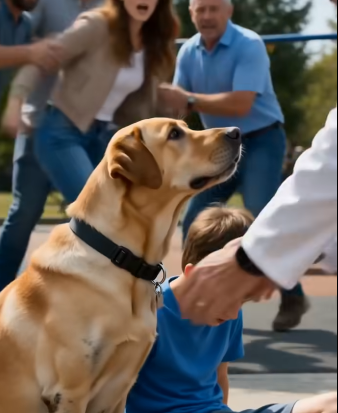
The Labrador sat beside my son, tail sweeping slowly over the pavement, amber eyes watching Ethan’s chest rise and fall.
I looked at the animal through a blur of tears.
“I’m sorry,” I whispered.
The dog blinked.
Then an elderly voice cut through the hush.
“Mercy?”
The word was so soft I almost missed it.
An old man pushed through the crowd, leaning heavily on a cane. He wore a brown tweed jacket despite the heat, and his white hair stuck out in wisps beneath a faded cap. I recognized him vaguely as Dr. Alden Reed, the retired veterinarian who still opened his little clinic twice a week for people who couldn’t afford full prices.
He stopped when he saw the Labrador.
His face changed.
It did not brighten. It broke.
“Mercy,” he said again.
The Labrador’s ears lifted.
The old veterinarian covered his mouth with one trembling hand.
“My God,” he whispered. “You’re alive.”
Everyone stared at him.
“What did you call him?” I asked, still holding Ethan against me.
Dr. Reed took one step closer, then another, as if approaching a ghost.
“That dog’s name is Mercy,” he said. “At least, it was. She belonged to a search-and-rescue trainer named Daniel Hale.”
My heart stumbled.
Daniel Hale.
The name struck something deep and sealed inside me.
“Daniel?” I repeated.
Dr. Reed looked at me then, truly looked, and his eyes sharpened with recognition.
“Anna Mercer,” he said quietly.
My maiden name.
I had not heard it in years.
The crowd around us became a ring of strangers listening to a story I suddenly feared was mine.
“You knew Daniel?” Dr. Reed asked.
I could not answer.
Because Daniel Hale had been the boy I loved before grief made me a different person.
Before I married Ethan’s father.
Before the hospital. Before the fire. Before the silence.
Before the night Daniel vanished from my life after saving someone else’s.
I had been nineteen when I met him, a veterinary student with a crooked smile and an impossible tenderness toward broken things. He trained dogs on weekends with his father, teaching them to find lost hikers, missing children, and people buried after storms. He used to say dogs could hear fear in a heartbeat.
Mercy had been his dog.
A yellow Labrador puppy with feet too big for her body, always chewing Daniel’s shoelaces, always pressing her nose into my pocket because she knew I carried treats. Daniel had named her Mercy because, he said, “Everyone deserves to be found.”
The last time I saw Daniel was nine years ago.
He had come to the hospital after my younger brother’s accident. He had held me while I cried in the stairwell. Then, weeks later, he left for a rescue call in the mountains after a landslide trapped two children and their father.
One child survived.
Daniel did not come home.
That was what everyone told me.
His truck was found near the washed-out road. His jacket was found downstream. Mercy disappeared too.
No bodies were ever recovered.
For years, I told myself not knowing was worse.
Then I married Mark, had Ethan, built a life from the pieces that remained, and learned that grief does not disappear. It simply becomes a room you stop entering.
Now that room had opened.
And the dog sitting beside my son had walked out of it.
“That’s impossible,” I whispered.
Dr. Reed’s eyes were wet.
“I treated Mercy from the time she was eight weeks old,” he said. “That ear. That white mark on her chest. I’d know her anywhere.”
Mercy lifted one paw and placed it gently on Ethan’s shoe.
Ethan, still pale but breathing, looked at her with wonder.
“She saved me,” he whispered.
I pressed my lips to his hair.
“Yes,” I said. “She did.”
The square erupted slowly, as if people were waking from a spell. Someone brought water. Someone retrieved my phone. A woman apologized for calling animal control. The flower seller knelt near Mercy and offered a trembling hand.
Mercy ignored them all.
Her eyes stayed on me.
No, not on me.
On my purse again.
Then she rose, walked to the scattered contents, and nudged the folded pharmacy receipt with her nose.
At first I thought she wanted food.
Then Dr. Reed bent down and picked up the receipt.
His face tightened.
“What is it?” I asked.
He turned the paper over.
On the back, written in faded blue ink, were three numbers.
I froze.
I knew those numbers.
Not because I had written them.
Because Daniel had.
17-4-9.
He used to write codes that way when we were young. A silly habit from childhood treasure hunts with his rescue dogs. Numbers for letters. Seventeen was Q. Four was D. Nine was I. Meaningless alone.
But Daniel never used numbers alone.
Dr. Reed unfolded the receipt completely. There were more markings, so faded I had never noticed them among the wrinkles.
17-4-9 / WEST / BELL / DO NOT TRUST M.
My blood turned cold.
“M?” I whispered.
Mark.
My husband.
Ethan’s father.
The man who had left us two years ago with nothing but a note saying he “couldn’t keep living in a house full of ghosts.”
I had believed that was cruelty.
Maybe it had been fear.
Dr. Reed’s jaw clenched.
“Anna,” he said carefully, “where did this purse come from?”
I looked down at it.
The brown leather purse had been mine for years. A birthday gift from Mark after Ethan was born. I had hated it at first because it was too large, too practical, too much like something a mother was supposed to carry. Over time, it became part of me. I carried groceries in it, bills, toys, medicine, half my life.
“Mark gave it to me,” I said.
Mercy barked once.
Dr. Reed went pale.
He reached for the purse, then stopped. “May I?”
I nodded.
His old hands searched the lining. Mercy stood rigid beside him, nose pointed toward the inner seam.
“There’s something here,” he said.
A man from the crowd offered a pocketknife. Dr. Reed carefully cut a small slit in the lining.
Something black slipped into his palm.
A tiny memory card.
No bigger than a fingernail.
The square had gone silent again, but this silence was different.
Heavier.
“What is that?” I asked, though I already knew it was the kind of thing that changes lives.
Dr. Reed looked toward the old bell tower beyond the playground, its cracked bronze bell visible through the open stone arch.
“West Bell,” he murmured.
Mercy whined.
That was when I understood.
She had not just found Ethan.
She had found me.
The police came because half the square had called them.
So did paramedics, who checked Ethan and told me he needed rest, fluids, and follow-up care but would be all right. I should have gone home. Any sensible mother would have.
Instead, I sat in Dr. Reed’s clinic an hour later with Ethan asleep on a cot, Mercy at his feet, and Officer Lena Brooks plugging the memory card into a dusty laptop.
“I need to warn you,” Officer Brooks said. “Whatever is on here may be nothing.”
But her voice said she did not believe that.
The first file opened with a burst of static.
Then Daniel’s face appeared.
Older than I remembered. Dirt streaked his cheek. Blood darkened one eyebrow, though the injury itself was not clear. Mercy barked somewhere off-screen.
My hand flew to my mouth.
“Anna,” Daniel said in the video, breathless. “If this reaches you, I’m sorry. I tried to come back.”
I made a sound I did not recognize.
Dr. Reed gripped the back of a chair.
Daniel looked over his shoulder, then back at the camera.
“The landslide wasn’t an accident,” he said. “I found evidence near the ridge. Someone had been cutting illegally above the road. Not just trees. They were moving equipment through restricted land at night. I recorded everything. Names. Payments. Routes.”
Officer Brooks leaned closer.
Daniel swallowed.
“Mark Mercer was there.”
The room tilted.
“No,” I whispered.
Daniel’s voice cracked.
“He saw me. He tried to explain. Said he was only transporting equipment, said he didn’t know the ridge was unstable. But when I told him children were missing below, he panicked. He begged me not to report him.”
The video shook.
“I sent Mercy away with the evidence. She knew the old command. Find Anna. But the storm hit before she could reach town.”
Mercy lifted her head at the sound of Daniel’s voice.
On the screen, he smiled suddenly, and for one impossible second he was nineteen again, holding a muddy puppy in the rain.
“Anna, if Mercy finds you, trust her. She doesn’t leave people lost.”
The file ended.
I sat without breathing.
Officer Brooks opened the next file. Then the next.
Photos. Documents. Recordings.
Mark’s voice. Other voices. Men discussing roads, bribes, warnings ignored. A plan to blame the landslide on weather. Proof that Daniel had survived the first collapse long enough to hide the evidence.
Proof that Mark had lied to me for years.
But the final video was the one that broke me completely.
It was dark. Daniel’s face was lit only by a small flashlight.
“I can hear the rescue team,” he whispered. “I don’t know if they can hear me.”
He coughed, then steadied the camera.
“Mercy went after Anna. Good girl.”
A pause.
“If I don’t make it, tell Anna something for me.”
He looked directly into the lens.
“Tell her I was never the one who left.”
I covered my face and sobbed.
Mercy rose from Ethan’s cot and came to me. Slowly, gently, she pressed her head into my lap.
Her fur smelled of dust, rain, and the square.
I wrapped my arms around her neck.
“I’m sorry,” I whispered again, but this time I was not apologizing for the stone.
I was apologizing for nine years of not knowing she had tried.
Officer Brooks took the evidence that night. By morning, Mark Mercer was no longer a vanished husband with a sad story. He was a wanted man.
Two days later, they found him.
Not far away. That was the strangest part. He had not fled across the country or built a new life under another name. He had been living in a town less than an hour away, working under the table at a repair shop, hiding in the ordinary way guilty men sometimes do, not with brilliance but with cowardice.
When they arrested him, he denied everything.
Then they played Daniel’s recording.
Mark stopped talking.
The investigation widened. Other men were arrested. Families who had lost people in that landslide finally learned the truth. The town held its breath through weeks of hearings, statements, news vans, and whispered conversations in grocery aisles.
But our life became smaller.
Quieter.
Mercy moved into our house as if she had always known the way.
The first night, she refused the soft bed I bought her and slept outside Ethan’s door.
The second night, Ethan wheezed in his sleep, and Mercy woke me before the attack could worsen.
The third morning, I found her sitting in front of the old hall closet, staring at a dusty cardboard box I had not opened in years.
Daniel’s letters were inside.
I sat on the floor and read them with Mercy’s head on my knee.
Ethan joined me halfway through, still in pajamas.
“Was he your friend?” he asked.
I held a photograph of Daniel at twenty, laughing as Mercy tried to climb into his lap.
“Yes,” I said. “He was my best friend.”
Ethan studied the picture.
“He looks nice.”
“He was.”
“Did he love Mercy?”
“Very much.”
Ethan leaned against me.
“Then she must have missed him for a long time.”
I looked at the dog who had crossed years, storms, hunger, and human cruelty carrying a promise none of us understood.
“Yes,” I whispered. “She did.”
A month later, Dr. Reed called me to his clinic.
“There’s something I didn’t tell you,” he said.
I stiffened. After everything, those words still frightened me.
He led me to the back room, where Mercy sat calmly on the examination table while he scanned the old microchip beneath her skin.
“I checked her chip again,” he said. “The registry was corrupted years ago, but the backup came through this morning.”
He turned the monitor toward me.
Owner: Daniel Hale.
Secondary emergency contact: Anna Mercer.
I stared at my old name.
Below it was a note Daniel had added when Mercy was still a puppy.
In case of emergency, Mercy goes to Anna. She already knows the way home.
My eyes burned.
Dr. Reed smiled gently.
“There’s more.”
He clicked another file.
It was a legal document, short but unmistakable. Daniel had signed it before joining the mountain rescue team full time. If anything happened to him, Mercy was to be placed with me.
Not his parents.
Not the rescue unit.
Me.
“He left her to you,” Dr. Reed said.
I could barely speak. “I thought I lost everything from that part of my life.”
“No,” he said. “Some of it was just finding its way back.”
That evening, I took Mercy and Ethan to the town square.
The same vendors were there. The same fountain. The same playground fence where my son had collapsed and survived. But everything felt altered, as if the square had become both the place I nearly lost my child and the place the past returned to save him.
Ethan held Mercy’s leash, though she needed no leash.
People recognized her now. Children waved. The flower seller brought a yellow ribbon and tied it loosely around Mercy’s collar.
“For the hero,” she said.
Mercy endured the attention with noble patience, then sneezed directly into a basket of daisies.
Ethan laughed so hard he had to lean on me.
That laugh was the sound of the happy ending I had stopped believing life owed anyone.
Near sunset, we walked to the old bell tower west of the playground. For years, the bell had been cracked and silent. The town council had voted to restore it after the truth about the landslide came out, using money seized from the men responsible.
A small crowd gathered as workers prepared to ring it for the first time in decades.
Dr. Reed stood beside us, cane planted firmly on the ground.
Officer Brooks was there too.
So were families from the mountain rescue case. People who had carried questions for nine years. People who deserved answers and had finally received them.
When the bell rang, the sound was imperfect.
Cracked.
Deep.
Beautiful.
Mercy lifted her head.
For a moment, I imagined Daniel standing on the other side of the square, hands in his pockets, smiling that crooked smile.
Everyone deserves to be found.
I knelt beside Mercy and pressed my forehead to hers.
“You did it,” I whispered.
She wagged her tail once, solemnly, as if she had known that all along.
Then Ethan tugged my sleeve.
“Mom,” he said, “can we go home now?”
Home.
The word no longer felt like a place built from what was missing.
It felt warm. Crowded. Alive.
I stood, took my son’s hand, and looked down at the muddy Labrador who had stolen my purse, saved my child, exposed a crime, carried a dead man’s promise, and returned a piece of my heart I thought grief had buried forever.
“Yes,” I said.
Mercy picked up my purse strap gently in her mouth.
For one wild second, the crowd gasped.
Then she trotted ahead of us, tail high, carrying the bag carefully like a sacred duty.
Ethan burst into laughter.
Dr. Reed laughed too.
And this time, I did not chase her.
I followed.
Because at last, I understood.
Mercy had never stolen anything from me.
She had only been bringing everything back.
