PART 2
The entire auditorium seemed to stop breathing.
The coordinator stared at the final entry on the page.
Then she slowly lifted her eyes.
The silence became unbearable.
Students leaned forward.
Teachers froze.
Even the reporters from the local student media team lowered their cameras for a moment.
The coordinator cleared her throat.
Her voice echoed through the microphone.
“According to this access log, someone attempted to remove Rania Osman’s name from the official file at 8:13 this morning.”
A murmur spread through the room.
Brielle Whitmore’s face lost all color.
The coordinator continued.
“The login credentials used belonged to Brielle Whitmore.”
A collective gasp exploded from the audience.
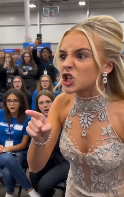
For a moment, Brielle looked completely stunned.
Then she snapped.
“That’s impossible!”
She pointed at me.
“She forged it!”
The accusation sounded weak.
Desperate.
And everyone knew it.
The coordinator calmly turned the screen toward the audience.
The digital timestamp appeared clearly.
The login record.
The access location.
The confirmation code.
Every detail pointed to one person.
Brielle.
The girl who had spent years acting untouchable.
The girl whose family money seemed to solve every problem.
The girl who had just kicked me in front of hundreds of witnesses.
A teacher stepped forward.
“Brielle, is this true?”
Her mouth opened.
Closed.
Opened again.
No answer came.
Because there wasn’t one.
The proof was sitting right there.
And for the first time in her life, money couldn’t erase it.
I slowly stood upright.
My ankle still hurt from where she’d kicked me.
But suddenly the pain felt distant.
Because everyone was finally seeing what had really happened.
Not just today.
But for years.
PART 3
The ceremony collapsed into chaos.
Phones were everywhere.
Students recorded every second.
Social media exploded before the event even ended.
Videos of Brielle kicking me spread across Louisville within hours.
The captions varied.
But the message stayed the same.
The sponsor princess had finally been caught.
Meanwhile, I sat quietly in the journalism lab after school.
I wanted to avoid the attention.
I hated attention.
That’s why journalism had always felt comfortable.
I preferred being behind the camera.
Behind the stories.
Behind the headlines.
Not inside them.
Mrs. Reynolds, the journalism advisor, entered the room carrying a large archive box.
She placed it on the table.
“You should see this.”
I frowned.
“What is it?”
“Old project records.”
I opened the box.
Inside were photographs.
Thousands of photographs.
Decades of student journalism projects.
Photo exhibitions.
Historical displays.
Community reports.
Then I noticed something strange.
One photograph had a yellow sticker attached.
Written across it were three words.
For Rania Only.
My heartbeat accelerated.
“Who left this?”
Mrs. Reynolds shook her head.
“We don’t know.”
I carefully turned over the photo.
The image showed a young woman standing beside Louisville’s old courthouse.
She had dark hair.
Bronze skin.
Deep brown eyes.
She looked so much like me that my stomach tightened.
Then I noticed the caption.
Handwritten beneath the photograph.
Nadia Osman, Student Journalist of the Year, 2007.
Osman.
My last name.
My hands started trembling.
Because I had never heard that name before.
PART 4
That night I couldn’t sleep.
The photograph sat beside my bed.
I kept staring at it.
The resemblance was impossible to ignore.
The next morning, I showed it to my mother.
The second she saw the picture, tears filled her eyes.
I froze.
“Mom?”
She sat down heavily.
For several seconds she couldn’t speak.
Then she whispered a name.
“Nadia.”
I felt my pulse racing.
“You know her?”
My mother’s hands shook.
“She was my sister.”
The room spun.
“What?”
My mother nodded.
Tears streamed down her face.
“You were only a baby when she disappeared.”
I stared at her.
Disappeared?
Nobody had ever told me this.
Not once.
Not ever.
My mother looked toward the photograph.
“Nadia loved journalism more than anything.”
She smiled sadly.
“She believed stories could change the world.”
I swallowed hard.
“What happened to her?”
The answer came softly.
“We never found out.”
A chill ran through me.
For seventeen years, my family had carried this secret.
A missing journalist.
A vanished aunt.
A mystery nobody had solved.
Then my mother pointed at the photograph.
“That picture was taken weeks before she disappeared.”
Suddenly the strange note attached to the photo felt far more important.
Someone had deliberately left it for me.
Someone wanted me to find it.
The question was why.
PART 5
Three days later, another surprise arrived.
A package appeared in the journalism office.
No return address.
No sender.
Only my name.
Inside was an old memory card.
Along with a handwritten message.
If you want the truth about Nadia Osman, follow the captions.
The room went silent.
Mrs. Reynolds stared at me.
I stared back.
Neither of us knew what to say.
Finally she inserted the card into a computer.
Hundreds of photographs appeared.
Old journalism projects.
Community events.
Political gatherings.
School functions.
At first they seemed random.
Then we noticed something strange.
Certain captions contained highlighted letters.
Single letters.
Scattered throughout dozens of photographs.
Mrs. Reynolds grabbed a notebook.
Together we copied them down.
Hours passed.
Letter after letter.
Word after word.
Finally the message emerged.
Both of us stared in disbelief.
STORAGE ROOM C. OLD COURTHOUSE BASEMENT.
I looked at Mrs. Reynolds.
She looked at me.
Neither of us could believe it.
The message had been hidden for years.
Possibly decades.
And somehow it had survived.
The next afternoon we obtained permission to access the courthouse archives.
The basement smelled of dust and age.
Storage Room C sat at the far end of a narrow hallway.
Locked.
Forgotten.
Untouched.
A maintenance worker opened the door.
Inside stood rows of filing cabinets.
Stacks of boxes.
Old newspaper records.
And one metal locker.
A faded label sat on its door.
N. OSMAN
My heart nearly stopped.
PART 6
The locker contained journals.
Research notebooks.
Audio tapes.
Photo negatives.
And one sealed envelope.
Addressed to my family.
The date written across the front was seventeen years old.
My hands trembled as I opened it.
Inside was a letter.
Written by Nadia herself.
The first sentence made me gasp.
“If you are reading this, someone finally found the evidence.”
Mrs. Reynolds sat beside me.
We read every word.
Nadia had uncovered corruption involving several wealthy community sponsors years ago.
Not criminal corruption.
Historical corruption.
She discovered that multiple public projects had been falsely credited to wealthy donors.
The real creators had been erased.
Volunteers.
Teachers.
Students.
Immigrant families.
Community workers.
Their names vanished while others claimed recognition.
Nadia planned to publish the investigation.
Then suddenly she disappeared from journalism.
Not because she vanished physically.
But because she left Louisville.
Threats.
Pressure.
Fear.
Eventually she chose silence.
Yet before leaving, she hid everything.
Every document.
Every photograph.
Every interview.
Every piece of proof.
And she left clues behind.
Waiting for someone she trusted.
Waiting for family.
Waiting for me.
At the bottom of the letter, one final sentence appeared.
“Rania, if you inherited anything from me, I hope it’s courage.”
I couldn’t stop crying.
Neither could Mrs. Reynolds.
Because after seventeen years, Nadia’s voice had finally been heard.
PART 7
The discovery made headlines across Kentucky.
Historical organizations reviewed the evidence.
Journalism associations examined the archives.
Community leaders verified the records.
The results stunned everyone.
Nadia Osman had been right.
Dozens of forgotten contributors had never received proper recognition.
The city organized a public restoration ceremony.
Families came from everywhere.
Former volunteers.
Retired teachers.
Community workers.
Students whose names had disappeared from history.
One by one, their contributions were officially restored.
The event felt bigger than any award ceremony.
Bigger than any journalism competition.
Because this wasn’t about fame.
It was about truth.
Then something unexpected happened.
Brielle Whitmore appeared.
The crowd immediately noticed.
Whispers spread through the audience.
She looked completely different.
No designer outfit.
No expensive jewelry.
No superior smile.
Just a nervous eighteen-year-old standing alone.
She walked toward me.
Slowly.
Carefully.
Then she stopped.
“I was horrible to you.”
The words surprised everyone.
Including me.
“I know.”
Her eyes filled with tears.
“My family spent years teaching me that status mattered more than character.”
I remained silent.
She looked down.
“But watching everything that happened made me realize how empty that thinking is.”
For the first time, Brielle sounded genuine.
Not entitled.
Not arrogant.
Just human.
Then she handed me a folder.
Inside were additional historical records her family had stored for decades.
Documents that could help identify even more forgotten contributors.
I looked up.
“Why give me these?”
She smiled weakly.
“Because they belong to the truth.”
For a moment, neither of us spoke.
Then I nodded.
And accepted them.
PART 8 (THE END)
One year later.
Louisville gathered again for School Journalism Day.
But this ceremony felt completely different.
The honorary photo wall stood at the center of the courtyard.
Hundreds of restored photographs covered its surface.
Every image carried the correct caption.
Every contributor carried the correct credit.
Every story carried the correct name.
No one had been erased.
The announcer stepped to the microphone.
The crowd quieted.
I stood near the front.
Now eighteen.
Still volunteering.
Still repairing photo displays.
Still preferring the background.
But no longer invisible.
The announcer smiled.
“Today we dedicate this wall to someone whose work reminded us why journalism matters.”
A large cloth covering the center panel was removed.
Gasps spread through the crowd.
There, displayed prominently, was Nadia Osman’s photograph.
The same picture that had started everything.
Beneath it appeared a new caption.
NADIA OSMAN — JOURNALIST, TRUTH SEEKER, AND THE WOMAN WHO REFUSED TO LET HISTORY BE ERASED.
Tears filled my eyes.
My mother cried openly beside me.
Mrs. Reynolds squeezed my shoulder.
And then something extraordinary happened.
The announcer revealed a second plaque.
My name.
RANIA OSMAN — STUDENT JOURNALIST WHO FINISHED THE STORY.
The applause thundered across the courtyard.
I could barely breathe.
Not because of the recognition.
But because I understood what it truly meant.
The original photo caption hadn’t simply ruined Brielle Whitmore’s perfect image.
It had uncovered a hidden investigation.
Restored forgotten histories.
Reunited families with lost recognition.
And solved a seventeen-year mystery no one expected.
As the ceremony ended, students gathered around the photo wall.
Reading captions.
Learning stories.
Remembering names.
The sun reflected across hundreds of photographs.
And for the first time, every single person in those images had exactly what they deserved.
Their truth.
Their history.
And their name.
Because sometimes a single caption can change everything.
Sometimes the smallest line beneath a photograph becomes the most powerful story of all.
And sometimes the truth waits patiently for years…
Until the right person finally turns the page.
THE END
