Part 2: The Recording That Turned Every Camera Around
The event director connected a small audio device to the main speakers.
Nobody in the hall moved.
Lauren Westwick folded her arms tightly.
“This is ridiculous,” she said.
The director ignored her.
A soft electronic hum filled the room.
Then another sound emerged.
Careful adjustments.
Wire testing.
Signal calibration.
A girl’s voice speaking quietly to herself.
Ana froze.
It was her.
For weeks, she had recorded every stage of the theremin’s construction as part of the troubleshooting process.
The director pressed play again.
Date after date rolled through the speakers.
Signal checks.
Frequency corrections.
Component replacements.
Every recording carried digital timestamps.
Every recording carried Ana’s voice.
The audience listened in complete silence.
Then came the final entry.
The one recorded three nights before the ceremony.
The hall filled with Ana’s tired voice.
“If this capacitor fails again, the whole instrument won’t work during the demonstration.”
Several engineers exchanged surprised looks.
Then another voice entered the recording.
The supervising technician.
“You’re the only student who noticed the fault.”
Murmurs swept through the crowd.
The director stopped the recording.
“This proves Ana Petrova completed the wiring work.”
Applause erupted.
Lauren’s expression hardened.
“No recording proves ownership.”
The director calmly lifted another page.
“Actually, it does.”
The attached metadata showed every recording originated from Ana’s student account.
Every modification matched her laboratory access records.
Every repair matched project logs.
There was no room for argument.
For the first time all day, Lauren looked uncertain.
But then the director reached the final page.
His face changed.
The room instantly noticed.
And suddenly the evidence wasn’t only about Ana anymore.
Part 3: The Name Hidden Inside The Morning Request
The director adjusted the paper in his hands.
His voice became noticeably colder.
“This document was submitted at 8:11 this morning.”
The crowd leaned forward.
Lauren’s breathing quickened.
The director continued.
“It requests removal of Ana Petrova’s name from all project materials.”
Gasps echoed through the hall.
Several reporters immediately began taking notes.
Lauren stepped forward.
“That doesn’t prove anything.”
The director lifted another page.
“It does when accompanied by this authorization.”
The signature sat clearly at the bottom.
Margaret Westwick.
Lauren’s mother.
A major sponsor.
The audience exploded with whispers.
Phones rose into the air.
Cameras focused directly on Lauren.
The director continued reading.
The request claimed Ana’s contribution was “administrative assistance.”
The room reacted immediately.
Everyone now knew that description was absurd.
The recordings had just proven otherwise.
Then he read one final sentence.
“Public recognition should instead be assigned to the sponsor family representative.”
A collective groan swept across the hall.
Lauren’s face flushed crimson.
For years, people had obeyed her family without question.
Now every microphone in the room was broadcasting the truth.
But the worst revelation arrived seconds later.
The director pulled a folded sheet from the back of the folder.
His eyes widened.
“Well.”
The room fell silent.
“What is it?” someone asked.
The director looked directly at Lauren.
“It appears your family didn’t only try to remove Ana’s name.”
He slowly lifted the page.
“Someone also tried to sabotage the instrument.”
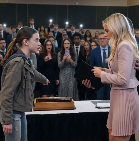
Part 4: The Wire Nobody Expected To Find
The hall erupted.
Sabotage?
Lauren immediately shook her head.
“No.”
But her voice lacked confidence.
The director revealed a maintenance inspection report.
The document described a damaged internal connection discovered during final testing.
Without repair, the theremin would have failed during the ceremony.
The crowd listened carefully.
Then the supervising technician stepped forward.
His name was Erik Lindholm.
Most students knew him only as the quiet electronics specialist.
Today he carried a small evidence bag.
Inside rested a short piece of cut wire.
The room stared.
Erik held it up.
“This was removed from the instrument.”
The reporters surged closer.
“It wasn’t an accident,” he continued.
“It was intentionally clipped.”
Shock spread through the audience.
Then Erik displayed security images.
The timestamp showed someone entering the workshop after hours.
The image quality wasn’t perfect.
But one detail stood out immediately.
The designer pink blazer.
Lauren’s blazer.
Gasps echoed around the hall.
Lauren looked ready to faint.
“I only went inside to look around.”
The technician nodded.
“Then perhaps you can explain why the damaged wire was discovered minutes after your visit.”
Lauren had no answer.
The silence became unbearable.
For Ana, something strange happened.
The fear she had carried for weeks suddenly disappeared.
Because the truth no longer needed her defense.
It was defending itself.
But Erik wasn’t finished.
He reached into his pocket and removed an old notebook.
A notebook that would reveal something far bigger than sabotage.
Part 5: The Notebook Filled With Impossible Frequencies
The notebook looked ancient.
Its pages were yellow with age.
Handwritten equations covered every sheet.
Ana frowned.
“What is that?”
Erik smiled.
“The reason this theremin project existed.”
The room quieted.
He opened the notebook.
Inside were frequency studies dating back nearly thirty years.
Research conducted by a forgotten electronic music group in Portland.
The project had been abandoned before completion.
Most people assumed the notes were useless.
Then Ana stepped closer.
Her eyes widened.
Several calculations looked familiar.
Very familiar.
Because she had independently developed similar solutions while repairing the theremin.
Erik noticed immediately.
“You recognize them.”
Ana nodded slowly.
“Some of these match my circuit corrections.”
The technician smiled.
“Exactly.”
The audience watched in confusion.
Erik continued.
“For three decades nobody could stabilize this design.”
He pointed toward the theremin.
“Until Ana solved problems researchers never finished.”
The crowd grew silent again.
This wasn’t just a school project anymore.
This was real engineering.
Real innovation.
The reporters began asking questions.
University representatives exchanged business cards.
Sponsors suddenly became interested for very different reasons.
Then Erik revealed one final page.
At the bottom sat a note written decades earlier.
‘If anyone completes this design, the instrument may reveal harmonic patterns we have never heard before.’
Nobody knew exactly what that meant.
Not yet.
But within weeks, Ana would find out.
And the discovery would attract attention from across Europe.
Part 6: The Sound That Nobody Could Explain
Months later, Ana stood inside a research center in Vienna.
Scientists.
Audio engineers.
Musicians.
Physicists.
Everyone wanted to understand the unusual results emerging from her theremin design.
The instrument sat beneath bright laboratory lights.
Ana activated it carefully.
The familiar electronic tone filled the room.
Then something changed.
A second harmonic emerged.
Then a third.
The sound expanded in ways nobody expected.
Several researchers stared at their monitors.
One physicist stood up abruptly.
“Run that sequence again.”
Ana repeated the test.
The same result appeared.
The harmonic structure formed an unusually stable pattern rarely observed in electronic instruments.
Hours of testing followed.
Every result confirmed the same thing.
The modified design produced acoustic behavior researchers hadn’t predicted.
By the end of the week, scientific journals requested papers.
Music conservatories requested demonstrations.
Technology companies offered partnerships.
Ana suddenly found herself at the center of an international breakthrough.
Yet none of that surprised her as much as the letter waiting at her hotel.
The sender’s name made her hands shake.
It came from Bulgaria.
Part 7: The Letter Her Grandfather Never Sent
The package contained a journal.
Old photographs.
Several handwritten pages.
And one name.
Georgi Petrov.
Ana’s grandfather.
A man she had never met.
The journal revealed an astonishing truth.
Decades earlier, Georgi had worked with experimental electronic instruments across Eastern Europe.
His research focused on harmonic resonance.
The same subject now appearing inside Ana’s work.
Page after page described theories remarkably similar to her discoveries.
Ana read until sunrise.
Then she found a final note tucked between the pages.
The paper trembled in her hands.
“If my family ever continues this work, I hope they do it for curiosity, not recognition.”
Tears filled her eyes.
For years she had felt invisible.
Now she understood something profound.
The desire to build.
To solve.
To keep working when nobody noticed.
It hadn’t started with her.
It ran through generations.
When she later shared the journal with researchers, they confirmed its historical significance.
Her grandfather’s forgotten work helped explain the unusual harmonics.
Together, the past and present completed a puzzle nobody realized existed.
But one final surprise still waited back in Portland.
Part 8: The Music Hall Named After An Unknown Builder
One year later, the city hosted a celebration honoring innovation in music technology.
Ana arrived expecting to attend quietly.
Nothing more.
Instead, she found hundreds of people gathered outside a newly renovated performance hall.
Students filled the plaza.
Researchers stood alongside musicians.
Reporters crowded the entrance.
Ana immediately sensed something unusual.
Then the mayor stepped onto the stage.
“We are here today to honor a student whose work reminded us that real achievement does not need wealth or influence.”
The crowd applauded.
Ana looked confused.
A large curtain covered a bronze plaque mounted beside the entrance.
The mayor smiled.
“Many people wanted the spotlight.”
He paused.
“Only one person earned it.”
The curtain dropped.
Ana gasped.
The plaque read:
The Petrova Center for Electronic Music and Innovation
Tears blurred her vision.
The audience erupted.
Students cheered.
Musicians applauded.
Researchers smiled proudly.
Then Ana noticed someone standing quietly near the back.
Lauren Westwick.
No entourage.
No cameras.
No arrogance.
She approached slowly.
“I came to apologize.”
Ana studied her.
Lauren looked completely different.
Not defeated.
Changed.
“I was wrong,” Lauren said softly.
Ana nodded.
“I know.”
For a moment neither spoke.
Then Lauren smiled faintly.
“You built something extraordinary.”
As the crowd gathered around the new center, Ana looked up at the building bearing her family name.
A year earlier she had been a poor student in patched jeans standing alone after a public slap.
Now her work connected generations of forgotten creators across continents.
And as music drifted from the hall behind her, she realized the greatest achievement was never proving Lauren wrong—it was discovering that the quiet work nobody noticed could echo far enough to change the future.
