Part 2: The Page Helena Could Not Silence
The director’s hand trembled as he held the paper near the microphone.
Helena’s eyes darted from the folder to the cameras, then back to me. For the first time since I had known her, her perfect posture faltered. One glossy boot scraped against the polished floor as if her body wanted to run before her pride allowed it.
The director read slowly.
“Borrowed garment: historic folk dance dress from the Lisbon Conservatory Collection. Assigned maintenance and bead restoration: Rosana Ferreira. After-school sessions logged: forty-two.”
A whisper went through the room.
Forty-two.
Not two. Not three. Not some pretty photograph beside a finished project.
Forty-two nights of me sitting under bad fluorescent lights with a needle between my fingers while everyone else went home.
Helena’s face drained of color, but she forced out a laugh.
“That proves nothing,” she said. “Anyone could sign a log.”
The director did not look at her. He turned the page.
“Supervisor initials beside each session. Materials issued. Repairs completed. Missing bead rows replaced. Hem stabilizing work completed. Shoulder seam reinforced.”
A reporter lifted her camera higher.
My throat tightened so sharply that breathing hurt. I remembered every line he read. The tiny pearls that rolled beneath the table. The gold thread that kept snapping. The bloodless pinch in my fingertips after hours of stitching.
Helena stepped forward. “My family funded this exhibit.”
The director finally looked at her.
“And Rosana saved it.”
The room shifted.
Not loudly. Not dramatically. But I felt it. People who had been staring at me like I was a problem now looked at Helena as if she had dragged something ugly into the light.
Helena’s mother, Margarethe Norcross, rose from the sponsor table. Her pearls rested against her throat like a warning.
“Director Moreau,” she said coldly, “I suggest you handle this privately.”
He closed the folder.
“No,” he said. “This became public when your daughter pushed a student to the floor.”
A sound escaped Helena’s mouth. Not a sob. Not anger. Something smaller.
Then the director turned to me.
“Rosana,” he said, voice softer now, “are you able to stand?”
My knees burned. My palms stung. My pride hurt worst of all. But I pushed myself up before anyone could help me.
Helena leaned close enough that only I could hear her.
“You think this is over?” she whispered. “You just made my family your enemy.”
I looked at the sealed folder in the director’s hands.
Then I looked at every camera pointed at us.
“No,” I whispered back. “You did.”
And that was when an old woman at the front table stood so suddenly her chair struck the floor behind her.
She was small, silver-haired, and dressed entirely in black.
I had seen her earlier, silent beside the dress display.
Now her eyes were fixed on the log.
“Director,” she said, her voice cutting through the hall, “turn to the final borrowing entry.”
The director froze.
Helena froze too.
Because whatever was on that final page, she already knew.
Part 3: The Name Written Beneath Mine
Director Moreau opened the folder again, but this time his movements were slower.
The old woman did not sit down. Her thin hands gripped the back of the chair in front of her, and the room seemed to bend around her silence. Even Margarethe Norcross looked unsettled.
“Madame Alard,” the director said carefully, “perhaps we should—”
“Read it,” she said.
The microphone caught the words. Every guest heard them.
Helena’s chin lifted. “This is absurd.”
But her hands told the truth. They had curled into fists at her sides, tight enough to whiten her knuckles.
Director Moreau turned the page.
His brow creased.
He read the first line, then stopped.
Madame Alard’s eyes narrowed. “Aloud.”
He swallowed.
“Special access request. Dress removed from storage outside scheduled hours. Requested by Helena Norcross.”
The room seemed to inhale at once.
Helena snapped, “That was for inspection.”
Madame Alard did not blink.
The director continued, voice lower now.
“Date: April 18. Time: 7:40 p.m. Reason listed: private sponsor viewing.”
My stomach twisted.
April 18.
I remembered that date because I had arrived the next morning and found the dress strange. One sleeve had been turned inside out. A section of beadwork near the collar had looked disturbed. I had blamed myself for being tired.
Director Moreau read the next line.
“Returned: April 19, 6:10 a.m.”
A murmur spread fast this time.
“Impossible,” someone said.
“Overnight?”
“Why would she have it overnight?”
Helena’s mother stood taller. “This is a misunderstanding.”
Madame Alard stepped away from her chair.
“No. It is theft dressed as privilege.”
The word theft cracked through the ceremony.
Helena’s polished mask shattered.
“How dare you?” she said. “Do you know who my grandfather was?”
Madame Alard smiled sadly. “Yes. That is exactly why I came.”
For the first time, I noticed the pin on her black jacket: a tiny silver dancer holding a thread.
She turned toward the audience.
“My name is Élodie Alard,” she said. “My sister, Mireille, wore that dress in Porto in 1968, the night she disappeared from the stage and never danced again.”
The hall went silent in a different way now. Not scandal silence. Grief silence.
Madame Alard pointed toward the old dance dress glittering beneath the lights.
“That dress is not a costume,” she said. “It is evidence of a promise my family thought had died.”
I looked at the dress.
The beads I had stitched suddenly seemed less decorative. The patterns curved oddly near the bodice, like waves, stars, and broken roads.
Madame Alard turned to me.
“When you repaired it,” she asked, “did you notice the missing blue beads near the inner lining?”
I nodded before I understood why. “There were empty stitch marks. I replaced them with matching beads from the material tray.”
Her face changed.
Hope can be frightening when it arrives too late.
“Then you restored the message,” she whispered.
Helena backed away.
Her mother grabbed her wrist.
But the reporters had already heard.
Director Moreau lifted the dress from its stand, careful as if holding a sleeping child.
Inside the lining, where nobody had thought to look, the new beads shimmered in a hidden row.
Madame Alard covered her mouth.
And I saw it then.
The beadwork was not just decoration.
It spelled a name.
Part 4: The Hidden Message In Blue Glass
No one moved while Director Moreau angled the dress under the lights.
The blue beads caught the glow one by one. At first they looked like scattered decoration, tiny drops of sea-colored glass sewn beneath the lining. Then Madame Alard stepped closer, eyes shining, and touched the air above them without letting her fingers disturb the fabric.
“Mireille,” she breathed.
The name appeared like a secret rising from water.
MIREILLE ALARD.
Below it, in smaller beads, was another line I had never understood while working.
“Porto. Archive Room. Not lost.”
Madame Alard made a sound that nearly broke me.
Not a scream. Not a cry. A lifetime collapsing into one breath.
Helena said quickly, “That could have been added recently.”
I turned toward her. “I added the missing beads where old stitch holes already were. I followed the pattern.”
“You expect us to believe you accidentally restored some mysterious message?” she snapped.
“No,” Madame Alard said. “I expect you to explain why your family requested private access before those beads were disturbed.”
Margarethe Norcross stepped in front of her daughter.
“My family has supported European arts preservation for decades,” she said. “We will not be insulted by sentimental speculation.”
A tall man near the back raised his hand. He had a museum badge clipped to his jacket.
“I am Pieter Voss from the Rotterdam Textile Institute,” he said. “The original stitch holes can be examined. If the pattern predates Rosana’s repair, then the message is authentic.”
Helena’s eyes flashed at him with pure hatred.
The director nodded. “We will arrange that.”
“No,” Madame Alard said. “Arrange it now.”
The guests began shifting, crowding closer. Security tried to keep people back, but curiosity had become stronger than manners.
I stood near the stage with my arms wrapped around myself, suddenly colder than I had been all morning.
An old dance dress. A hidden name. A missing dancer.
And somehow, Helena’s family stood in the middle of it.
Director Moreau asked for gloves. A staff member brought a magnifying lamp from the display table. Pieter Voss examined the lining while cameras hovered behind him.
Helena whispered urgently to her mother.
Margarethe’s face hardened.
Then she did something that made my skin prickle.
She took out her phone and sent one message.
Seconds later, two men in dark suits entered through the side doors.
They did not look like guests.
They moved toward the dress.
Director Moreau saw them and stepped in front of the table. “This area is closed.”
One of the men held up a document. “The Norcross Foundation is withdrawing loan permissions for all sponsored garments.”
Madame Alard’s face went pale.
Margarethe smiled.
“The exhibit is over,” she said.
But Pieter Voss did not step away from the lamp.
Instead, he looked up at me.
“Rosana,” he said, voice urgent, “when you replaced the blue beads, did you photograph your repair stages?”
My heart stopped.
Because I had.
Not for glory. Not for proof. Just because I was afraid of making mistakes.
My phone felt heavy in my pocket.
Helena saw my hand move.
Her eyes widened.
Then she lunged.
Part 5: The Photos She Tried To Destroy
Helena moved faster than anyone expected.
Her hand clamped around my wrist, nails biting skin, and she tried to twist the phone from my fingers. The shock of it froze me for half a second. Then all the humiliation, every shove, every sneer, every time she had looked through me like poverty made me transparent, burned through my chest.
I pulled back.
“Let go.”
She tightened her grip.
“Give it to me.”
The cameras surged closer.
Director Moreau shouted for security. Margarethe Norcross stepped forward as if she could turn assault into elegance by standing straight enough.
I did not scream. I did not cry.
I held the phone against my chest and said, “You already took enough.”
Helena’s face twisted.
Security reached us before she could grab again. One guard pulled her back. She stumbled, hair falling across her face, and for one wild second she looked nothing like the girl everyone obeyed. She looked scared.
My fingers shook so badly I nearly dropped the phone myself.
Pieter Voss came to my side. “May I see the photographs?”
I opened the repair folder.
There they were.
Late-night pictures under yellow classroom light. The dress turned inside out on a worktable. Close-ups of missing stitch holes. Blue beads placed in tiny trays. My own handwritten notes beside them.
Photo after photo.
The hidden name before completion.
The hidden name after restoration.
The room watched the images appear on the projector screen.
MIREILLE ALARD.
Porto. Archive Room. Not lost.
Madame Alard sank into a chair and pressed both hands to her chest.
A reporter whispered, “This changes everything.”
Helena shouted, “She fabricated it!”
Pieter Voss turned sharply. “These images contain metadata.”
Helena stopped.
He continued, “Dates. Times. Location stamps. They can be verified.”
Margarethe Norcross’s smile vanished completely.
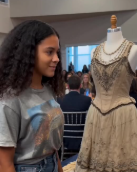
Director Moreau looked at me with something like apology. “Rosana, did anyone else know about these photos?”
“No,” I said. “I only took them for my repair journal.”
At the words repair journal, Helena’s face changed again.
Too quickly.
Pieter noticed it. So did I.
Director Moreau asked, “What repair journal?”
“My notebook,” I said. “The one I used every session. Measurements, bead counts, sketches.”
“Where is it?”
I opened my bag.
Then my blood went cold.
The notebook was gone.
My hands searched every pocket, every folded sleeve, every corner. Nothing.
“It was here,” I whispered.
Helena’s breathing slowed.
Not relieved. Calculating.
Madame Alard stood again, grief replaced by steel. “Who had access to the preparation room?”
Director Moreau answered, “Staff, student workers, sponsors with passes.”
The old woman looked directly at Helena.
Helena lifted her chin. “You cannot search me.”
A quiet voice spoke from behind the sponsor table.
“No,” said a young man in a catering uniform. “But they can search the flower cabinet.”
Everyone turned.
The caterer looked terrified, but he pointed toward a white cabinet beside the entrance.
“I saw Miss Norcross put something there before the ceremony.”
Helena’s mouth opened.
No sound came out.
Security crossed the room.
Margarethe said, “Do not touch that cabinet.”
But the director was already there.
He opened it.
Inside, beneath folded linen and white roses, lay my notebook.
And tucked inside the cover was something that did not belong to me.
A faded black-and-white photograph of Mireille Alard standing beside a young Norcross man.
Part 6: The Photograph Beneath The Roses
Madame Alard took one step toward the photograph, then stopped as if the floor had vanished beneath her.
Director Moreau lifted it carefully.
The image was old, edges softened by time. Mireille Alard stood outside a stone building, her dance dress folded over one arm. Beside her was a young man with pale hair, a proud smile, and one hand resting possessively near her shoulder.
Pieter Voss leaned closer.
“That is Otto Norcross,” he said.
Margarethe’s voice turned sharp. “That photograph is private family property.”
Madame Alard whispered, “My sister never mentioned him.”
Helena looked at her mother. “Mum…”
One word. Small. Cracked.
For the first time, Helena did not sound cruel. She sounded like a girl who had opened a door and found a storm behind it.
Margarethe snatched for the photograph, but Director Moreau stepped back.
“This is now part of an active inquiry,” he said.
“My lawyers will ruin you.”
“Perhaps,” he replied, “but not before every camera in this room finishes recording.”
The threat landed. Margarethe’s gaze moved across the reporters, the guests, the glowing phones. Her power had always lived in private rooms, behind donations and polite dinners. Here, in the open, it looked smaller.
Madame Alard reached for the photograph with trembling fingers.
“Please,” she said.
Director Moreau gave it to her.
She stared at Otto Norcross’s face.
“My mother said Mireille left for a better life,” she whispered. “Then letters stopped. We thought she abandoned us. We were angry at her for years.”
Her eyes filled.
“And all this time, she may have been asking to be found.”
A reporter asked carefully, “What is the Porto archive room?”
Pieter Voss answered before anyone else could.
“In the late 1960s, many private collections and performance records were stored in municipal archives across Portugal. If Mireille left a record there, it may still exist.”
Margarethe laughed once. “A childish fantasy.”
But it was too late.
The story had escaped her.
Director Moreau turned to me. “Rosana, your repair restored a location.”
My cheeks burned under everyone’s attention. “I didn’t know.”
Madame Alard took my hands.
Her fingers were cold and fragile, but her grip was fierce.
“Sometimes,” she said, “people do not know they are carrying someone else’s last chance.”
The words entered me quietly and stayed.
Then Helena spoke.
“I only wanted the notebook.”
Everyone turned.
Margarethe’s head snapped toward her. “Be silent.”
But Helena kept staring at the photograph.
“I wasn’t trying to expose anything,” she said, voice shaking. “I thought if the journal disappeared, Rosana would look unprepared. The opening would go to me.”
My stomach turned.
There it was. Not mystery. Not misunderstanding.
Just plain cruelty.
Helena swallowed. “But I didn’t know about the photograph. I found it inside the old storage envelope this morning.”
Margarethe’s face became terrifyingly still.
“Helena,” she said, “enough.”
Helena stepped away from her mother.
That tiny movement changed the air.
“I asked you why Grandfather Otto’s name was on the old loan papers,” Helena said. “You told me not to ask again.”
Margarethe whispered, “You foolish girl.”
Helena’s eyes filled with tears she seemed furious to have.
“What did he do?”
Madame Alard looked at Margarethe.
The old woman’s voice was barely above a whisper.
“What did your father do to my sister?”
For one moment, Margarethe said nothing.
Then her phone rang.
She looked at the screen.
Her expression collapsed.
And in that collapse, I saw the truth before she spoke.
Part 7: The Archive That Remembered Everything
Margarethe declined the call, but another came immediately.
Then another.
Phones began ringing across the room. Reporters looked down, then up. A low wave of shock moved through the guests.
Pieter Voss checked his own phone and went pale.
“What is it?” Director Moreau asked.
Pieter looked at Madame Alard.
“The Porto Municipal Archive just posted a public notice last week,” he said. “They digitized several sealed performance files from 1968.”
Madame Alard’s hand flew to her mouth.
He continued, “One file is titled with Mireille’s name.”
Margarethe whispered, “No.”
That single word confirmed everything.
Pieter connected his phone to the projector. The screen flickered. A search page appeared, then a scanned document with official stamps and faded type.
The room stopped breathing.
MIREILLE ALARD — PRIVATE STATEMENT, PORTO, 1968.
Pieter did not read it all aloud. He did not need to.
The first lines were enough.
Mireille had written that Otto Norcross promised sponsorship, travel, and a career. Then he tried to force her family’s dress collection into his private ownership. When she refused, he accused her of theft, destroyed her reputation, and arranged for her to be blacklisted from major stages.
Madame Alard bent forward as if struck.
Helena covered her mouth.
Pieter scrolled lower.
There was another document.
A signed storage request. Mireille had placed the dress in protection, asking that its beadwork never be altered, because she had hidden a message in it for her sister.
But the dress had vanished from the archive months later.
Transferred through private sponsorship channels.
To the Norcross Collection.
Director Moreau’s voice was rough. “Your family had the dress.”
Margarethe did not answer.
Helena turned on her. “You knew.”
Margarethe’s eyes hardened again, but now the hardness looked desperate.
“I knew my father protected this family from scandal.”
“He ruined a woman,” Helena said.
“He built everything you enjoy.”
Helena flinched.
That was the real inheritance, I realized. Not money. Not jackets, cameras, polished tables, or names on sponsor walls.
It was silence.
Madame Alard straightened slowly.
“My sister died believing nobody heard her,” she said.
Pieter shook his head. “Not necessarily.”
He scrolled to the final page.
A handwritten note appeared, scanned in pale blue ink.
My dearest Élodie,
If this dress reaches you, know that I did not leave because I stopped loving you. I left because powerful men can make truth look like shame. One day someone patient will repair what was broken. Trust the hands that find the missing beads.
Madame Alard began to cry.
Not quietly this time.
The whole room let her cry.
I felt tears run down my own face before I knew they had fallen. I thought of all the evenings I had worked alone, thinking I was just fixing a dress nobody cared about. I had been threading a dead woman’s voice back into the world.
Helena stared at me through tears.
“I’m sorry,” she said.
I wanted to hate her forever.
Part of me still did.
But her apology did not erase the floor against my knees. It did not erase the way she had called me a thief. It did not erase the years of people like her taking space and calling it destiny.
So I said the only honest thing I could.
“Then prove it.”
Helena looked at me.
The cameras waited.
Her mother’s eyes warned her.
And Helena Norcross made the first brave decision I had ever seen from her.
She stepped to the microphone.
“My family lied,” she said. “And I helped them today.”
Margarethe gasped.
Helena’s voice broke, but she kept going.
“Rosana Ferreira restored the dress. Rosana found the message. Rosana is the reason Mireille Alard’s name is being heard.”
Then she turned toward me.
“And I tried to steal that from her.”
The room erupted.
But above the noise, Madame Alard clutched the old photograph and whispered something that changed everything again.
“Mireille had a child.”
Part 8: The Girl Who Inherited The Forgotten Dress
The noise died unevenly, like a storm moving away from windows.
Madame Alard stared at the archive page, her lips parted, eyes searching the lines again as if afraid they would disappear.
“A child?” Director Moreau asked.
Pieter scrolled carefully.
Near the bottom of Mireille’s statement, beneath the official stamp, was a note from an archive clerk. It mentioned an infant daughter placed temporarily with a family in Coimbra after Mireille’s career was destroyed and her health failed.
The child’s name had been partially smudged.
Only one thing remained clear.
Ferreira.
My body went cold.
Not fear cold. Not shock cold.
Recognition, before understanding.
I heard my own breathing. I heard a camera click. I heard Madame Alard whisper my surname like it was a door opening after fifty-eight years.
“Rosana Ferreira,” she said.
I stepped back. “No. That’s just a common name.”
Pieter enlarged the scan.
The clerk’s note sharpened.
Infant registered under guardianship of António and Sofia Ferreira.
My grandparents’ names.
The hall blurred.
My grandmother Sofia, who kept a cracked music box on her kitchen shelf but never explained why the melody made her cry. My grandfather António, who told me our family had once carried a story too heavy to tell before changing the subject. My mother, who always said our blood came from dancers, seamstresses, and women who survived by making beauty with tired hands.
Madame Alard walked toward me like she was afraid I might vanish.
“What was your grandmother’s full name?” she asked.
“Sofia Alard Ferreira,” I whispered.
She closed her eyes.
A sound moved through the room, soft and stunned.
Then Madame Alard reached into her jacket and removed a small silver pendant. The same dancer-and-thread symbol from her pin, but older, worn smooth by decades of touch.
“My mother gave one to each daughter,” she said. “Mireille’s was never found.”
My hand went to my throat before I could stop it.
Under my old T-shirt, against my skin, hung a cheap-looking silver pendant my grandmother had given me when I was twelve. I had worn it every day because she told me it was for girls who repaired what others broke.
I pulled it free.
Madame Alard’s pendant and mine matched exactly.
The room disappeared.
There was only an old woman crying in front of me and a silver thread connecting two halves of a family nobody had known how to find.
“You are Mireille’s granddaughter,” she said.
My knees nearly failed again, but this time I did not hit the floor.
Madame Alard caught me.
Not like a sponsor posing for kindness. Not like someone helping the poor girl because cameras were watching.
Like family.
Helena stood several feet away, crying silently now. Her mother had gone rigid, defeated by a truth no donation could bury.
Director Moreau returned to the microphone, his voice thick.
“The ceremonial opening will proceed,” he said. “But not as planned.”
He looked at me.
“Rosana Ferreira will open this exhibit not as a student worker, but as the living heir of the woman whose voice she restored.”
Madame Alard squeezed my hand.
The old dress was placed before us.
I touched the beadwork I had repaired, every blue bead suddenly alive with meaning. I had thought my hands were only tired. I had thought my work was invisible. But my hands had followed a path my great-grandmother left before I was born.
Helena stepped forward and removed the Norcross sponsor badge from her jacket.
She placed it on the table.
Then she turned to the reporters.
“The Norcross Foundation will return every garment connected to Mireille Alard’s collection,” she said. “And I will testify to what happened here.”
Margarethe whispered her name like a threat.
Helena did not look back.
I lifted the dress with Madame Alard’s help.
The beads shimmered beneath the lights.
For the first time all day, nobody looked at my worn sneakers.
Nobody looked at my old T-shirt.
They looked at my hands.
The same hands Helena had tried to shame.
The same hands that had restored a message.
The same hands that now held my family’s lost history in front of the world.
Madame Alard leaned close and whispered, “Mireille was right. Someone patient repaired what was broken.”
I looked at the hidden blue letters one last time.
Then I faced the audience.
“My great-grandmother was not lost,” I said. “She was waiting for someone to believe the stitches.”
And when the applause finally rose, it did not feel like noise.
It felt like every bead in the old dress had begun to sing.
