Part 2: The Timestamp That Ended The Argument
The moderator enlarged the original submission record on the giant screen.
Every eye in the auditorium followed.
Scientists leaned forward.
Reporters stopped typing.
Even the sponsors fell silent.
The report displayed a precise sequence of events.
Observation time.
Verification time.
Transmission time.
The meteor shower had first appeared on a cold autumn night.
The audience watched as the moderator highlighted the first entry.
A name appeared beside it.
Grace Mitchell.
My name.
The timestamp followed.
10:14:32 PM.
The moderator clicked another page.
A second submission appeared.
Victoria Sinclair.
10:41:07 PM.
The room reacted immediately.
A murmur swept through the crowd.
Victoria’s face tightened.
The moderator calmly continued.
“The first verified observation arrived twenty-six minutes before any other report.”
He pointed toward another section.
The original telescope images appeared.
Then the raw coordinate data.
Then the verification records.
Every step carried the same conclusion.
The discovery originated from a single observatory.
A small volunteer station.
My observatory.
Several astronomers exchanged impressed looks.
The evidence seemed overwhelming.
Then the moderator revealed one final detail.
“The second submission was not an independent discovery.”
The room became silent.
Victoria stared at the screen.
The moderator highlighted a data field.
The coordinates matched mine exactly.
Not approximately.
Exactly.
Gasps echoed throughout the auditorium.
The implication was devastating.
Victoria hadn’t independently found the meteor shower.
She had submitted data that had already been reported.
But that wasn’t what made her face go pale.
The next page was much worse.
Part 3: The Email Hidden Inside The Investigation
Months earlier, the National Astronomy Verification Board had quietly opened a review.
The audience didn’t know that.
Neither did most reporters.
The moderator opened the file.
An internal investigation appeared.
Email records.
Communication logs.
Submission histories.
Then he clicked a message sent just hours before Victoria’s report.
The sender belonged to her family’s telescope company.
The audience leaned forward.
The message requested advance access to observatory findings associated with sponsored research programs.
Several scientists frowned immediately.
Then the moderator displayed the response.
Request denied.
The room remained silent.
Another email appeared.
Then another.
Each showed growing pressure to obtain information before public release.
Nothing illegal.
But certainly inappropriate.
Victoria looked ready to disappear.
Then came the final email.
The one that changed everything.
“If our name isn’t attached to this discovery, we’ve missed a major opportunity.”
The crowd reacted instantly.
Reporters began recording every word.
Victoria shook her head.
“I never saw that email.”
For the first time, she sounded frightened rather than arrogant.
The moderator nodded.
“We believe you.”
The audience blinked.
That wasn’t the response anyone expected.
Then the moderator looked toward the sponsor section.
Directly at Victoria’s father.
And suddenly everyone understood who the investigation was actually about.
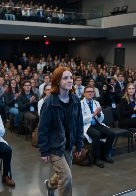
Part 4: The Director Who Refused To Stay Quiet
Dr. Stefan Novak had directed the observatory network for nearly twenty years.
Most people considered him impossible to intimidate.
Now he stepped onto the stage.
His expression remained calm.
But his eyes carried disappointment.
Not anger.
Disappointment.
He addressed the audience.
“Victoria was never the target of this investigation.”
The room fell silent.
“She benefited from assumptions made by adults.”
Victoria lowered her gaze.
Dr. Novak continued.
“For months, people assumed discovery belonged to influence rather than observation.”
The words hit harder than accusations.
Then he revealed another document.
A recommendation letter.
Written long before the controversy.
The letter praised Grace Mitchell’s dedication.
Late-night observations.
Meticulous record keeping.
Consistent accuracy.
The audience listened carefully.
Then Dr. Novak smiled slightly.
“The truth is simple.”
He pointed toward me.
“She found something remarkable because she was there doing the work.”
The applause began immediately.
Scientists stood.
Students followed.
Soon the entire auditorium erupted.
For the first time all day, nobody was looking at sponsors.
Nobody was looking at family names.
They were looking at the data.
And the person who discovered it.
Yet Dr. Novak wasn’t finished.
Because another file had surfaced during the investigation.
One nobody expected.
Part 5: The Forgotten Notebook Beneath The Observatory
After the conference session ended, several astronomers invited me into a private archive room.
An old metal cabinet sat in the corner.
Inside rested notebooks dating back decades.
The observatory’s history.
Dr. Novak carefully removed one.
Its pages were yellow with age.
“This belonged to Elena Petrova.”
I frowned.
The name sounded familiar.
She had been one of the observatory’s earliest volunteers.
A teenager who later became a respected astronomer.
The notebook opened.
Observation sketches filled every page.
Meteor trajectories.
Star maps.
Handwritten calculations.
Then I froze.
Several tracking methods looked almost identical to techniques I had developed myself.
Dr. Novak noticed.
“You recognize them.”
I nodded slowly.
The similarities were undeniable.
Not copied.
Discovered independently.
The astronomer smiled.
“Elena solved many of the same problems you did.”
Then he revealed something astonishing.
Elena had spent years searching for the very meteor stream I eventually discovered.
But she never located it.
Funding ended before her research could continue.
The room became silent.
Somehow our work had become connected across generations.
Then Dr. Novak handed me a folded letter hidden between the pages.
Part 6: The Letter Written Fifty Years Earlier
The letter was addressed to whoever continued Elena’s research.
Not a specific person.
Just whoever came next.
My hands trembled as I unfolded it.
The handwriting flowed across the page.
Elegant.
Careful.
Hopeful.
Elena described the joy of observation.
The patience required for discovery.
The loneliness of searching for something nobody else believed existed.
Then I reached the final paragraph.
“If someone eventually finds what I could not, I hope they remember that discovery belongs to curiosity, not status.”
Tears filled my eyes.
The words felt impossibly relevant.
As if they had crossed decades to arrive at exactly the right moment.
Dr. Novak smiled gently.
“That’s why I wanted you to read it.”
News of the meteor shower continued spreading.
Universities requested interviews.
Research institutes made offers.
Scientific organizations invited presentations.
But the biggest invitation arrived from Europe.
And nobody saw it coming.
Part 7: The Observatory Waiting In The Mountains
Six months later, I traveled to a historic observatory in the Swiss Alps.
Researchers from across Europe gathered there.
Many had followed the meteor shower discovery.
Some had studied Elena Petrova’s unfinished work.
Together they analyzed the meteor stream.
New observations emerged.
New trajectories.
New insights.
Then one evening, the research team revealed something astonishing.
The meteor shower wasn’t isolated.
It belonged to a much larger celestial structure.
One that had gone unnoticed for generations.
The discovery expanded scientific understanding dramatically.
The conference director stepped onto the stage.
“We would not be discussing this today without the original observation.”
The audience applauded.
Then he announced something unexpected.
A new international scholarship program would support young observers from underfunded communities.
The scholarship would carry a specific name.
My name.
I sat frozen.
Unable to speak.
The applause lasted nearly a minute.
Yet the greatest surprise still waited back home.
Part 8: The Meteor Shower Named For The Wrong Person
One year after the controversy, astronomers gathered again.
This time, nobody questioned who made the discovery.
The evidence had long since settled that debate.
Scientists.
Students.
Researchers.
They filled the auditorium once more.
The official naming ceremony finally began.
I expected a technical designation.
A catalog number.
Something scientific and forgettable.
Instead, the naming committee chairman stepped forward.
“The discoverer originally requested that the meteor shower not carry her own name.”
The audience looked surprised.
I had.
Because discovery should belong to everyone.
The chairman smiled.
“After careful consideration, we honored that request.”
A large image appeared on the screen.
Then the name.
The Petrova Stream.
I blinked.
The room erupted into applause.
The chairman continued.
“The meteor shower will honor Elena Petrova, whose decades-old research helped make this discovery possible.”
Tears filled my eyes.
Across generations.
Across decades.
A forgotten volunteer had finally received recognition.
And somehow, that felt more meaningful than having my own name attached to the sky.
As applause thundered around the auditorium, I looked at the image of countless meteors streaking across the darkness.
A year earlier, I had been an unnoticed volunteer recording coordinates after school.
Now students around the world would study a celestial phenomenon connected to both a forgotten astronomer and a discovery made by someone who simply kept showing up.
And as the stars appeared beyond the conference center windows, I realized that the greatest discoveries are never really about who gets credit—they are about making sure the light reaches someone else long after you’re gone.
