The first thing I heard that night was not a scream.
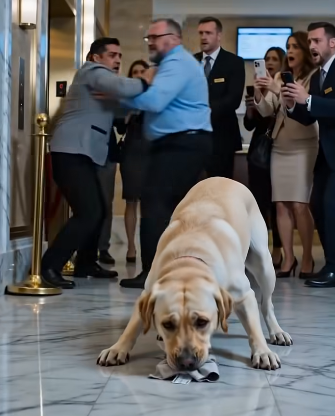
It was the sound of Buddy’s nails scraping against the marble floor of the Grand Aurelia Hotel as he tried to pull me toward the VIP elevator with every ounce of strength in his body.
“Buddy, stop,” I hissed, tightening both hands around his leash.
He did not stop.
The lobby around us glittered like a palace pretending nothing bad could ever happen inside it. Crystal chandeliers hung from the ceiling in golden tiers. Fresh white lilies perfumed the air. A pianist in a black tuxedo played something soft near the bar, his fingers moving gracefully over the keys while wealthy guests drifted past with suitcases worth more than my monthly rent.
Everything looked calm.
Elegant.
Perfect.
But Buddy was trembling.
Not with fear.
With certainty.
His yellow fur bristled along his spine, his ears pressed forward, and his whole body leaned toward the private elevator tucked beside the marble staircase. That elevator was reserved for penthouse guests, celebrities, hotel owners, and anyone rich enough to make the rules bend.
Buddy hated it.
Or rather, he hated whatever was behind its closed bronze doors.
“Ma’am,” a deep voice said behind me, “you need to control your dog.”
I turned and saw Marcus Vale, the hotel’s head of security, walking toward us with two guards behind him. He wore a perfect navy suit, polished shoes, and an expression that made apologies feel like crimes.
“I’m sorry,” I said quickly. “He’s usually very calm.”
That was true. Buddy was a therapy Labrador, trained to sit quietly beside anxious guests, guide elderly visitors through crowds, and comfort children who cried in the lobby. He had once stayed perfectly still while a toddler smeared chocolate across his ear. He had rested his head in the lap of a grieving widower for two hours without moving.
Buddy did not lunge.
Buddy did not growl at strangers.
Buddy did not make scenes.
But now he was barking at the VIP elevator like death itself was trapped inside.
“Buddy,” I whispered, crouching beside him. “What is it?”
He barked again, sharp and desperate, then scratched at the seam between the elevator doors.
The guests began staring.
A woman in pearls pulled her coat tighter around her. A businessman frowned over his phone. The pianist missed a note.
Marcus’s jaw tightened.
“This animal is disturbing our guests,” he said. “Remove him from the lobby.”
I felt heat rush to my face. I had worked at the Grand Aurelia for almost three years as the guest services coordinator. I was not important. Not like Marcus, not like the hotel manager, not like the owners who arrived twice a year in black cars. I was the person who smiled, solved problems, carried bags when the bell staff was short, and said yes until my throat hurt.
I needed this job.
My mother’s medical bills were stacked on my kitchen table. Rent was due in nine days. My younger brother had just started college, and I had promised him I could help with books.
So I pulled Buddy back.
He dug his paws into the marble and refused.
A ripple of laughter moved through a cluster of guests near the concierge desk.
“Looks like the dog knows something we don’t,” one man joked.
Marcus did not laugh.
“Now,” he said.
I swallowed my humiliation. “Come on, Buddy.”
But then the dog did something that made every sound in the lobby seem to fall away.
He stopped barking.
He froze.
His head lowered. His nose pressed against the thin gap at the bottom of the elevator doors.
Then he whimpered.
It was small.
Broken.
Human enough to turn my blood cold.
I had heard that sound once before, six months earlier, when Buddy found an elderly guest collapsed in a hallway after everyone else assumed the man was sleeping off too much wine. Buddy had made that same sound then, soft and urgent, as if he understood how close someone was to disappearing.
My grip loosened.
“Marcus,” I said slowly, “when did this elevator last open?”
He blinked, irritated. “That is not your concern.”
“The dog smells something.”
“He smells cleaning chemicals. The elevator is out of service.”
I looked at the polished bronze doors.
There was no sign.
No red light.
No maintenance rope.
No engineer nearby.
Just Marcus and his two guards standing between us and the elevator as if they had been expecting this moment.
“Out of service?” I repeated.
Marcus smiled without warmth. “Yes.”
Buddy barked again, louder this time.
The sound cracked through the lobby.
People turned fully now. Phones lowered. Conversations died.
From behind me, a voice called, “Is someone in there?”
It was Clara, one of the front desk clerks. She stood half behind the reception counter, pale, her dark hair slipping loose from its bun.
Marcus shot her a look. “Return to your station.”
Clara flinched.
And suddenly I noticed something I should have noticed earlier.
The housekeeping cart near the staff corridor had been abandoned.
A gray towel hung over one side. A spray bottle lay on the floor beneath it. On the lower shelf sat a paper cup with lipstick on the rim.
I knew that cup.
Green tea. No sugar. Always from the staff cafeteria.
Elena Ruiz’s cup.
Elena was one of the night housekeepers. Fifty-four years old, tiny, sharp-eyed, and kinder than anyone in that building deserved. She always gave Buddy a biscuit from her apron pocket and told him in Spanish that he was the only gentleman in the hotel.
She had cleaned the penthouse floors for years.
She was supposed to finish by eight.
I glanced at the lobby clock.
Nine thirty-seven.
“Where’s Elena?” I asked.
Marcus’s face changed.
Only for a second.
But I saw it.
The tiny collapse behind his eyes.
Then the mask returned.
“Elena clocked out early,” he said.
Clara whispered, “No, she didn’t.”
Everyone heard her.
Marcus turned very slowly.
Clara looked like she wished she could swallow the words back, but she lifted her chin. “Her coat is still in the break room.”
Buddy barked and slammed his paw against the elevator.
Something inside the doors answered.
Not a voice.
Not exactly.
A faint metallic thud.
So soft I almost thought I imagined it.
The lobby went silent.
Then it came again.
Thud.
A woman gasped.
My heart began hammering.
“There’s someone inside,” I said.
Marcus stepped closer. “Move away from the elevator.”
“No.”
The word left my mouth before fear could stop it.
His eyes narrowed. “You are making a serious mistake.”
Buddy placed himself between Marcus and me.
The dog’s growl was low, steady, and full of warning.
For the first time since I had known him, Marcus Vale looked uncertain.
Then the private elevator’s emergency panel flickered.
Once.
Twice.
The digital display above the doors showed nothing but a dark blank square.
I reached for the call button.
Marcus grabbed my wrist.
His fingers closed hard enough to hurt.
“Don’t,” he said.
And the entire lobby saw him do it.
The guests were no longer amused. The man who had joked earlier now held his phone up, recording. The woman in pearls pressed a hand to her mouth. Clara stepped out from behind the front desk.
“Let go of her,” Clara said.
Marcus released me, but his voice dropped so low only I could hear him.
“You have no idea what you are interfering with.”
I stared at him, skin prickling.
Then Buddy lunged past me and struck the elevator doors with both front paws.
A louder knock came from inside.
Three times.
Weak.
Desperate.
Alive.
I stabbed the call button.
Nothing.
“Get engineering,” I shouted.
“No one leaves their post,” Marcus snapped.
But he was too late.
Clara had already grabbed the desk phone.
“Maintenance to lobby,” she said, her voice shaking. “Now. Emergency at VIP elevator.”
Marcus spun toward one of his guards. “Stop her.”
The guard hesitated.
That hesitation saved us.
Because at that exact moment, the hotel manager stepped out of the lounge.
Vivian Hart was the kind of woman who could silence a room without raising her voice. She was silver-haired, elegant, and terrifying in a way that made even angry billionaires become polite. Her eyes moved from Buddy, to me, to Marcus, to the closed elevator.
“What,” she said, “is happening?”
Marcus straightened. “A false alarm. The employee’s dog is causing a disturbance.”
Buddy barked at him.
Vivian looked at the elevator. “Open it.”
Marcus’s mouth tightened. “The system is locked down. Engineering is handling it.”
“I said open it.”
For the first time, I saw sweat on Marcus’s temple.
The maintenance chief arrived running with two technicians behind him. Mr. Han was sixty, broad-shouldered, and usually calm enough to repair a burst pipe while humming. Tonight, he took one look at the elevator panel and cursed under his breath.
“This isn’t a normal stop,” he said.
Vivian’s eyes sharpened. “Explain.”
“The emergency override was disabled from the service room.”
Marcus said quickly, “That is impossible.”
Mr. Han looked at him. “No, Mr. Vale. It’s not.”
The lobby shifted.
A whisper became a wave.
Vivian said, “How long would someone last inside?”
Mr. Han did not answer immediately, and that silence was worse than any number.
“The cab is between floors,” he said. “Ventilation should still work unless the auxiliary fan was shut down too.”
Clara covered her mouth.
Buddy whined again.
My chest tightened so painfully I could barely breathe. Elena was small, but she had a weak heart. She had once told me that during the summer heat, she avoided the laundry room because the humidity made her dizzy.
I dropped to my knees beside the elevator.
“Elena!” I shouted. “Elena, can you hear me?”
Nothing.
Then, faintly, from somewhere behind the doors, came a sound.
A woman’s voice.
Not a scream now.
A whisper.
“Help.”
My hands began shaking.
“We’re here!” I shouted. “We’re getting you out!”
Buddy pressed his body against mine as if to keep me from falling apart.
Mr. Han and the technicians pried open the outer elevator doors just enough to reveal a dark shaft and the top edge of the elevator cab below. It was stuck between the lobby and basement level.
“Elena!” Mr. Han called. “Stay still!”
From inside came another faint thump.
Vivian turned to Marcus.
“Who locked down the VIP elevator?”
Marcus lifted both hands. “I don’t know.”
But his voice was thinner now.
Less certain.
And then I noticed the thing that made my stomach drop.
His cuff was torn.
A small triangle of navy fabric hung loose near his wrist, and on the silver cufflink beneath it was a smear of white powder.
Not dust.
Not plaster.
Laundry starch.
Elena used it when pressing the penthouse linens.
Buddy noticed too.
He sniffed the air, then turned his head toward Marcus and growled.
Marcus looked down at the dog.
The color drained from his face.
Vivian saw it.
So did everyone else.
“Mr. Vale,” she said quietly, “come with me.”
He stepped back.
A terrible stillness entered the room.
Then he ran.
For half a second, nobody moved. It was too strange, too sudden, too impossible to believe. Marcus Vale, the trusted head of security, the man who checked every employee badge and escorted drunk guests out with professional calm, bolted across the marble lobby toward the side exit.
Buddy moved first.
He tore the leash from my hand and launched after him.
“Buddy!” I screamed.
Marcus shoved through a group of guests, knocked over a luggage cart, and sprinted toward the staff corridor. Buddy stayed low and fast, his paws skidding on the polished floor.
Two guards chased after them.
I wanted to follow, but Elena’s voice came again from the elevator shaft.
“Please…”
I turned back, torn in half.
Buddy could handle Marcus.
Elena could not handle another minute alone.
Mr. Han was lowering himself toward the cab with a harness while the technicians held the doors open. Clara grabbed my hand so tightly our fingers hurt.
“She’s going to be okay,” Clara whispered, though she sounded like she was begging the universe.
I leaned into the gap. “Elena, it’s me. It’s Mia. Buddy found you.”
A pause.
Then Elena whispered, “Good boy.”
I burst into tears.
The rescue took eight minutes.
It felt like an entire lifetime squeezed into the space between heartbeats.
When they finally lifted Elena through the opening, the lobby erupted into motion. Paramedics pushed through the front entrance, called by one of the guests before anyone had permission to call. Elena was conscious, but barely. Her gray uniform was wrinkled, her face damp with sweat, and her hand was clenched around something so tightly the paramedic had to gently pry her fingers open.
It was a small brass key.
Old.
Not hotel-issued.
Vivian stared at it.
Mr. Han did too.
“What is that?” I asked.
Elena’s eyes fluttered toward me.
“Behind…” she whispered.
The paramedic leaned closer. “Don’t speak yet.”
But Elena forced the words out.
“Behind the mirror.”
Then her eyes closed.
For one awful second, I thought we had lost her.
But the paramedic checked her pulse and said, “She’s with us. We need to move.”
They wheeled her out past the guests, past the lilies, past the piano that no one had touched for twenty minutes.
The lobby doors opened.
Cold night air swept in.
Buddy was not there.
Neither was Marcus.
I ran.
Clara called after me, but I was already through the staff corridor, past the laundry room, past the break room where Elena’s coat still hung on its hook. The hallway lights flickered overhead. Somewhere ahead, a door banged open.
Then I heard Buddy bark.
Once.
Twice.
Not frightened.
Commanding.
I followed the sound down the basement stairs.
The Grand Aurelia’s basement looked nothing like the lobby. No chandeliers. No lilies. Just concrete walls, buzzing lights, humming pipes, and doors labeled with things guests never thought about: electrical, linen storage, staff lockers, service elevator control.
The last door stood open.
Inside, Marcus was pinned against a metal cabinet by two guards.
Buddy stood three feet away, teeth bared, blocking the only exit.
On the floor lay a black leather folder, its contents scattered across the concrete.
Photographs.
Receipts.
A small velvet pouch.
And a hotel master keycard.
Marcus looked at me with pure hatred.
“You stupid girl,” he breathed.
I flinched, but Buddy growled louder.
One of the guards said, “He was trying to burn these.”
A metal trash bin stood near the cabinet. Inside it, several papers had curled black edges.
I crouched and picked up one of the unburned photographs.
It showed the VIP elevator control panel.
Another showed the penthouse hallway mirror.
Behind the mirror was a wall safe.
My heart pounded.
Elena’s whisper returned to me.
Behind the mirror.
Vivian arrived moments later, still composed but pale beneath her makeup. She looked at the photographs, then at Marcus.
“What did Elena find?”
Marcus laughed once, bitter and empty. “You people really think this is about stolen jewelry?”
Vivian’s expression did not change.
“You locked a woman in an elevator,” she said. “Choose your next words carefully.”
He stared at her.
Then something in him cracked.
“She should have kept cleaning,” he said. “That’s all. She should have kept her head down like everyone else.”
I felt sick.
Vivian took the brass key from my shaking hand. “What does this open?”
Marcus smiled.
And for some reason, that smile frightened me more than his running had.
“The past,” he said.
Police arrived seven minutes later.
By then, the hotel had changed forever.
The lobby was no longer a glittering stage. It was a crime scene. Guests sat in stunned clusters. Officers took statements. Cameras watched everything. Vivian shut down the VIP wing, moved angry penthouse guests to another luxury hotel, and handed over every security file without blinking.
Buddy remained beside me, panting softly, his head pressed against my leg.
I wanted to collapse on the floor and hold him.
But the night was not finished.
At 11:18 p.m., Vivian asked me to come upstairs.
“I don’t think I should,” I said. My voice sounded far away. “I’m not management.”
“No,” she said, looking at Buddy. “But Elena trusted you. And he found her.”
So we went.
The penthouse floor was silent when we stepped out of the service elevator with two police officers, Mr. Han, Vivian, Clara, and Buddy. The hallway smelled faintly of lemon polish and expensive flowers. Everything was too clean.
The mirror Elena had mentioned hung at the end of the corridor.
Tall.
Gold-framed.
Heavy enough that it took Mr. Han and one officer to remove it from the wall.
Behind it was a small safe.
The brass key fit.
Vivian turned it.
The door clicked open.
Inside was not jewelry.
Not cash.
Not anything I expected.
Inside was a stack of old documents wrapped in oilcloth, a silver baby bracelet, and a photograph of a woman standing outside the Grand Aurelia thirty years earlier with a newborn in her arms.
Vivian stopped breathing.
The photograph slipped from her hand.
Clara caught it before it hit the floor.
“Vivian?” I asked.
But the hotel manager was staring at the baby bracelet as if the world had vanished.
On the bracelet, engraved in tiny letters, was a name.
MIA.
My name.
At first, I thought it was a coincidence.
My mind rejected everything else.
There were thousands of Mias. Maybe millions. Maybe the bracelet had belonged to a guest’s child. Maybe Elena had found it while cleaning. Maybe Marcus had hidden it for some strange reason that had nothing to do with me.
Then Vivian lifted the photograph with trembling fingers and turned it over.
On the back, written in faded blue ink, were five words.
For my daughter, when safe.
My knees weakened.
Buddy leaned into me hard enough to keep me upright.
“That’s not possible,” I whispered.
Vivian looked at me, and there was such grief in her face that suddenly I understood she had known something long before I did.
Not everything.
But enough to fear the truth.
“Mia,” she said softly, “what was your mother’s name?”
“Grace,” I said automatically. “Grace Nolan.”
Vivian closed her eyes.
The hallway seemed to tilt.
“My sister’s name was Grace Hart,” she whispered.
No one spoke.
The police officer lowered his notebook.
Clara’s lips parted.
I shook my head. “No. My mother was Grace Nolan. She raised me. She—”
“She may have raised you,” Vivian said carefully, each word breaking something open, “but my sister disappeared from this hotel thirty years ago with her newborn daughter.”
I stepped back.
“No.”
Buddy whined.
“No,” I said again, louder. “My mother would have told me.”
But even as I said it, memories flickered like broken film.
My mother refusing to walk past the Grand Aurelia, even from across the street.
My mother crying once when I came home excited about getting hired there.
Her hand tightening around mine when I asked why I had no baby pictures from the hospital.
The way she used to say, “Some doors stay closed because opening them would bury us.”
I had thought she meant grief.
I had never imagined she meant me.
Vivian touched the baby bracelet with one finger.
“We believed Grace ran away,” she said. “My father insisted she had shamed the family. He forbade us from speaking her name. Years later, after he died, I searched, but there was nothing. No records. No body. No child.”
Marcus’s voice echoed from memory.
The past.
I looked at the safe.
“What does this have to do with Elena?”
One officer unfolded the documents.
His expression hardened as he read.
“These appear to be payments,” he said. “Old ones. Made to someone named Arthur Nolan.”
My breath stopped.
Nolan.
My mother’s last name.
No, not my mother.
The man I had called my grandfather.
Vivian’s face went gray.
The officer continued. “There are also letters. Threats. Instructions to keep the child hidden.”
I could barely hear him over the roaring in my ears.
The child.
Me.
Clara reached for my hand, but I stepped away.
“Where is Marcus?” I asked.
The officer looked up.
“Being questioned.”
“He knows more.”
Vivian’s jaw tightened. “Yes.”
But the final truth did not come from Marcus.
It came from Elena.
She woke in the hospital just before dawn.
Vivian drove me there herself. Buddy sat across my feet in the back seat, his head on my knee. None of us spoke during the ride. The city outside the windows looked strange and soft in the early light, as if the night had peeled away one world and revealed another underneath.
Elena was pale but awake when we entered her room. Her daughter sat beside her, crying quietly.
When Elena saw Buddy, she smiled.
“Mi héroe,” she whispered.
Buddy rested his chin on the edge of her bed.
I tried to speak, but my throat closed.
Elena looked at Vivian, then at me.
“You found the safe,” she said.
Vivian nodded. “Why didn’t you tell me?”
Elena’s eyes filled with tears. “Because I was afraid. And because I was not sure until tonight.”
“Sure of what?” I asked.
Elena took a shaky breath.
“I worked here thirty years ago,” she said. “I was young then. A laundry girl. Your mother, Grace, was kind to me when no one else was. She had a baby. A little girl.” Her eyes moved to me. “You.”
My hands curled into the blanket.
Elena continued. “Grace was going to leave the hotel. She said she had discovered something terrible about her father and the men he protected. She had documents. She said if anything happened, the truth was hidden where only someone with the old key could find it.”
“The safe,” Vivian whispered.
Elena nodded. “That night, I saw Grace arguing with her father near the VIP elevator. There was another man with them. Arthur Nolan. He was a driver. He took the baby.”
I could not breathe.
“Did he steal me?” I asked.
Elena’s tears spilled over.
“No, niña. Grace gave you to him.”
The room went still.
“She gave me away?”
“To save you,” Elena said. “She begged him to take you far from the hotel. She said her father would use you to keep her silent. Arthur loved Grace. Not like a husband. Like family. He promised to protect you.”
I thought of my grandfather, stern and quiet, teaching me to ride a bicycle, fixing the roof in the rain, crying only once at my mother’s funeral.
He had protected me.
All my life.
“And Grace?” Vivian asked, her voice barely there.
Elena closed her eyes.
“I don’t know. I heard shouting. Then nothing. The next day, everyone said she had left. I was warned never to speak. Arthur disappeared with the baby. Years later, I saw Mia working at the hotel, and I knew. Same eyes. Same way of standing when frightened.”
A broken laugh escaped me. “Why didn’t you tell me?”
“Because Marcus saw me watching you,” Elena said. “He warned me. He said old stories destroy families. I thought he only wanted to protect the hotel.”
Vivian’s expression turned cold. “Marcus was a child thirty years ago.”
“Yes,” Elena said. “But his father was not.”
The name landed before she said it.
“Vale,” Elena whispered. “Marcus’s father was your grandfather’s security chief. He helped cover it up. Marcus inherited more than a job. He inherited the secret.”
The officers later confirmed it.
Marcus had spent years quietly protecting the remains of the old scandal because it protected his family, his position, and the powerful men who had built fortunes on the Grand Aurelia’s spotless reputation. When Elena found the safe while cleaning behind the loosened mirror, she removed the brass key but did not have time to open it. Marcus caught her. He demanded the key. She refused.
So he trapped her in the VIP elevator, disabled the emergency systems, and planned to move her after the lobby cleared.
He thought no one would notice an older housekeeper missing for a few hours.
He had not counted on Buddy.
But there was one more twist none of us saw coming.
Police searched Marcus’s office after sunrise.
Inside a locked drawer, they found an envelope addressed to Vivian Hart.
It contained a recent photograph of a woman in a seaside town three hours north of the city.
An older woman.
Silver-streaked hair.
Thin face.
Eyes like mine.
Grace.
Alive.
For a long moment after Vivian showed me the photograph, I simply stared.
I had spent the night discovering that my life had been built over secrets, fear, and sacrifice. I had accepted, in some shattered corner of my heart, that my birth mother was gone. That the best I could hope for was truth, justice, and a few faded pieces of her love.
But she was alive.
Hidden.
Waiting.
Marcus had known.
His father had not killed Grace. He had forced her into silence by threatening the child she had saved. For thirty years, she had believed coming back would put me in danger. For thirty years, Arthur Nolan had raised me under another name, while Grace lived like a ghost at the edge of the sea, sending letters that were intercepted before they ever reached us.
Letters Marcus had kept.
Vivian drove me to her two days later.
Buddy came too.
I remember standing outside a small blue house with chipped paint and wind chimes made of shells. The ocean moved beyond the dunes, gray and endless. My hands were so cold I could barely lift them to knock.
Buddy did it for me.
He scratched once at the door.
Footsteps approached.
The door opened.
And the woman from the photograph stood there.
Older.
Smaller.
Real.
She looked at me for one heartbeat.
Then another.
Her hand flew to her mouth.
“Mia,” she whispered.
I had imagined anger. Questions. A dramatic collapse into tears.
Instead, I stepped forward, and she reached for me like a person reaching through fire.
When my mother held me, something ancient and aching inside me finally stopped running.
Buddy sat beside us on the porch, tail sweeping softly against the boards, as Vivian wept behind me and Grace whispered my name over and over into my hair.
There were trials after that.
Headlines.
Investigations.
Men who had believed money could bury anything found themselves dragged into daylight. Marcus went to prison. The Grand Aurelia changed ownership. Vivian resigned, then reopened part of the hotel as a foundation for workers who had been silenced, exploited, or forgotten.
Elena recovered fully and became the foundation’s first director.
Clara became hotel manager.
And Buddy?
Buddy became famous, which he handled with the dignity of a dog who still preferred biscuits to applause.
As for me, I did not lose one mother and gain another. Life is not that simple. Grace Nolan, the woman who raised me, remained my mother in every way that mattered. Grace Hart, the woman who gave me away to save my life, became my mother too. Love, I learned, does not divide cleanly. Sometimes it doubles. Sometimes it arrives late, carrying grief in one hand and a miracle in the other.
Months later, I returned to the Grand Aurelia for the first time after everything changed.
The lobby still had chandeliers.
Still had marble floors.
Still smelled faintly of lilies.
But it no longer felt perfect.
It felt honest.
A small brass plaque had been placed beside the VIP elevator.
It read:
For Elena Ruiz, who refused to surrender the truth.
And beneath that:
For Buddy, who heard what everyone else ignored.
I stood before it with Buddy at my side, my hand resting on his warm head.
The elevator doors opened smoothly.
Empty.
Safe.
Just doors now.
Not a tomb for secrets.
Not a hiding place for powerful men.
Not a wall between mothers and daughters.
Buddy looked up at me, his brown eyes calm.
“You knew, didn’t you?” I whispered.
He wagged his tail once.
Maybe he had smelled Elena’s fear. Maybe he had heard her fading voice through steel. Maybe all dogs are better at truth than humans because they do not waste time pretending not to notice pain.
Or maybe, in some mysterious way I would never fully understand, Buddy had not only found a trapped housekeeper that night.
He had found the first loose thread in the lie that had stolen thirty years from my family.
I crouched beside him and pressed my forehead to his.
“Good boy,” I said.
Buddy licked my cheek.
And for the first time in my life, the sound of an elevator opening did not frighten me.
It sounded like coming home.
