Max stole the first pair of sunglasses at sunrise.
By noon, he had stolen three silk scarves, a pearl-studded hair clip, two wallets, one passport sleeve, a child’s beach hat, and a diamond tennis bracelet that made the resort manager nearly faint when she saw it dangling from his mouth.
At any other hotel, that might have been funny.
At the Palmera Azul Resort, where rooms cost more per night than most people paid in rent and guests expected silence, service, and chilled towels before they knew they were hot, it became a disaster.
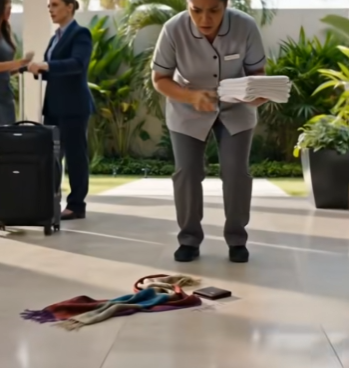
The lobby smelled of sunscreen, white orchids, and expensive perfume. Sunlight poured through the glass walls and shattered into gold across the polished floor. Outside, infinity pools spilled toward a private beach so blue it looked unreal. Bellhops glided past with luggage carts. Receptionists smiled with practiced calm. Wealthy families arrived wearing linen, diamonds, and impatience.
And through all of it, Max moved like a criminal with a mission.
“Drop it,” I hissed for the fourth time that morning.
Max stared up at me, his golden face completely innocent except for the designer wallet clamped between his teeth.
A woman in a white sundress stood barefoot on the lobby rug, shaking with fury. Her husband had one arm around her shoulders and the other raised toward me as if he were about to demand my arrest.
“That is my wallet,” she said.
“Yes, ma’am,” I said, cheeks burning. “I’m so sorry.”
Max wagged his tail once.
Not playfully.
Proudly.
I crouched and held out my hand. “Max.”
He released the wallet into my palm, then immediately turned his head toward the north wing hallway.
His ears lifted.
His body went still.
That was the part no one else noticed.
Everyone saw the stealing.
No one saw the staring.
No one saw the way Max’s whole posture changed whenever he looked toward the north stairwell, as if something invisible had passed through the air and whispered his name.
The woman snatched back her wallet. “That dog should be locked up.”
Several guests murmured agreement.
“He was in our room,” another man said. “We came back from breakfast and found him under the table with my wife’s scarf.”
“My daughter’s hat was taken from our balcony,” someone else added.
“He’s dangerous.”
“He’s filthy.”
“He’s a thief.”
Max sat beside me, calm and unmoved by public opinion.
I wished I could be half as composed.
My name was Lila Hart, and I had been working at Palmera Azul for exactly twenty-three days. I was seasonal security support, which was a polite title for doing whatever the actual security team did not want to do. Most of my job involved checking pool gates, escorting lost children back to parents, and apologizing for things I had not caused.
Max was supposed to help.
He was a retired search-and-rescue Labrador, older now, with a white muzzle and one slightly crooked ear. The resort had adopted him after a hurricane rescue team disbanded, partly because guests loved a friendly dog and partly because the owner thought it made the place look warm and humane.
Max spent most days greeting children, napping behind the concierge desk, and walking the property with me at dusk.
Until that morning.
That morning, he became obsessed.
He slipped out of the staff office before breakfast and vanished into the north wing. I found him ten minutes later trotting out of Room 314 with a pair of black sunglasses in his mouth while a honeymooning couple screamed from the bathroom.
After that, it only got worse.
He did not chew anything.
He did not damage anything.
He simply entered certain rooms, took one item, and carried it to the central courtyard, where he dropped everything beneath the old fountain.
By lunch, the courtyard looked like a lost-and-found table after a hurricane.
The manager, Celeste Moreau, stood over the pile with both hands pressed to her temples.
“This is not charming,” she said.
“No,” I admitted.
“This is not a quirky guest experience.”
“No.”
“This is a five-star resort being terrorized by a dog.”
Max sneezed.
Celeste glared at him.
She was elegant in a terrifying way, all sharp cheekbones, red lipstick, and linen suits that never wrinkled despite the heat. She had managed luxury resorts in Monaco, Dubai, and Singapore. I was fairly certain she could make a grown man apologize simply by looking at him.
That afternoon, she looked at me.
I wished the floor would open.
“Lila,” she said, dangerously calm, “explain.”
“I can’t yet.”
Her eyebrow rose. “Yet?”
“Max doesn’t steal. Not like this.”
“Apparently he does.”
“I mean, he doesn’t do random things.” I swallowed. “He’s taking items from specific rooms.”
Celeste looked down at the pile. “He has taken items from fourteen guests.”
“Exactly.”
“That is not helping your argument.”
Before I could answer, a cleaner named Rosa appeared at the edge of the courtyard holding a folded towel against her chest. She was small, sun-browned, and usually so quiet people forgot she was in the room until she had already fixed whatever they were complaining about.
Now her eyes were locked on the sunglasses lying beside the fountain.
“Miss Celeste,” she said softly.
Celeste turned. “Not now, Rosa.”
Rosa did not leave.
She stepped closer, then knelt beside the pile.
“What is it?” I asked.
Rosa picked up the sunglasses and turned them over.
On the inside of the left arm, almost hidden near the hinge, was a tiny pale streak.
At first, I thought it was sand.
Then Rosa rubbed it with her thumb.
White powder smeared across her skin.
“Chalk,” she whispered.
Celeste frowned. “What?”
Rosa grabbed the scarf Max had taken from Room 318. She unfolded the corner and pointed.
There it was again.
A faint white mark, no larger than a grain of rice.
She checked the wallet.
Another mark.
The passport sleeve.
Another.
The beach hat.
Another.
Every stolen item had one.
My skin prickled.
Max watched us with solemn brown eyes.
I knelt beside the pile and searched faster, heart picking up speed with each discovery. The marks were tiny, almost careless, hidden near seams, straps, corners, hinges. The sort of mark no guest would notice. The sort of mark someone could place quickly with a fingertip.
“Every item,” I said.
Celeste’s face lost some color. “That is impossible.”
Rosa looked toward the north wing.
“No,” she said. “It is not.”
Her voice had changed.
It was still quiet, but now there was fear in it.
I followed her gaze.
“What are you thinking?”
Rosa hesitated.
Then she said, “All these rooms are near the north stairwell.”
The courtyard seemed to tilt around me.
The north stairwell.
The place Max had been staring at all morning.
I turned to Celeste. “We need security footage.”
Her jaw tightened. “Now.”
The resort’s security office was tucked behind the spa, far from anything guests were meant to see. It smelled of stale coffee, printer paper, and air conditioning that worked too hard. Four monitors showed different areas of the resort: lobby, pool deck, service corridor, delivery gate.
The head of security, Daniel Reyes, was already angry when we arrived.
He was a thick-shouldered man with tired eyes and a military haircut, and he had never liked me. He disliked seasonal staff, emotional explanations, and anyone who brought trouble into his office before he finished lunch.
“A chalk mark?” he repeated.
“Yes,” I said.
“And your theory is what? A secret chalk bandit is framing the dog?”
Max sat at my feet and yawned.
Celeste crossed her arms. “Pull the north wing hall footage.”
Daniel looked at her, then at Max, then at the pile of marked items we had brought in a laundry basket.
His annoyance faded just enough to become professional.
“What time?”
“This morning,” I said. “Start before sunrise.”
Daniel rewound the footage.
The monitor flickered into grainy black-and-white images of the third-floor hallway. Empty carpet. Closed doors. Dim wall lights. The decorative table near the elevator. The framed painting of sailboats opposite the north stairwell.
Time scrolled backward.
5:42 a.m.
Nothing.
5:36.
Nothing.
5:28.
A cleaner passed with towels.
Rosa leaned forward. “That is Maribel. She starts south wing first. Not these rooms.”
5:19.
A man entered from the north stairwell.
Not staff.
Not a guest I recognized.
He wore beige resort trousers, a loose blue shirt, a straw hat pulled low, and sunglasses despite being indoors before sunrise. In one hand, he carried a rolled newspaper. In the other, nothing visible.
He moved slowly down the corridor, pausing near each door.
Room 312.
Room 314.
Room 316.
Room 318.
Each time, he touched the handle.
Not trying to open it.
Just brushing it with two fingers.
Daniel stopped the video.
No one spoke.
He zoomed in.
The image blurred, then sharpened slightly.
The man’s fingers were pale with chalk.
My stomach turned.
“Play it,” Celeste said.
Daniel hit the button.
The man continued down the corridor.
At Room 320, he paused longer.
He glanced toward the camera.
For one awful second, even through the grainy footage, it felt like he was looking directly at us.
Then he smiled.
A thin, private smile.
He touched the handle and disappeared into the stairwell.
Rosa whispered something under her breath.
Celeste asked, “Who is he?”
Daniel rewound and checked the lobby camera.
The man had never entered through the main entrance.
He had come up from the service level.
“How?” I asked. “Guests need keycards.”
“So do staff,” Daniel said grimly.
He opened another camera angle from the delivery gate.
At 4:57 a.m., the man appeared near the employee entrance carrying a crate of flowers. He walked behind a legitimate vendor, waited for the door to be held open, and slipped inside like he belonged.
Daniel cursed.
Celeste went very still.
I looked down at Max.
He was no longer sitting.
He was standing with his nose pointed toward the door.
A low growl gathered in his chest.
“Max?” I whispered.
He barked once.
Not at the monitor.
At the hallway outside the security office.
The footage on the screen showed the stranger touching Room 322’s door handle.
Max barked again.
In the video, the man had not yet looked up.
But Max was already barking.
In real life.
At something behind us.
A soft chime sounded.
The elevator outside the security office opened.
Daniel reached for his radio.
Celeste turned toward the glass window beside the office door.
The same man from the footage stepped out into the hallway.
Blue shirt.
Straw hat.
Sunglasses.
And in his right hand, held casually between two fingers, was a fresh stick of white chalk.
For half a second, none of us moved.
The man smiled.
Then he raised one chalk-dusted finger to his lips.
“Shhh.”
Max exploded.
He lunged so hard the chair beside him toppled over. I grabbed his collar with both hands, but he dragged me forward, barking with a fury that shook the room.
The man turned and walked away.
Not ran.
Walked.
That was somehow worse.
He wanted us to follow.
“Lock the exits,” Celeste snapped.
Daniel hit the radio. “All units, possible intruder near spa service elevator. Male, blue shirt, straw hat. Do not engage alone.”
The radio crackled.
No answer.
Daniel tried again.
Static.
His face darkened.
“He’s jamming us.”
Rosa clutched the laundry basket. “Why would he come here?”
I looked at the chalk marks.
The rooms.
The stairwell.
The stolen objects.
“He’s choosing guests,” I said.
Daniel stared at me. “For what?”
Max whined and pawed at the door.
And suddenly I remembered something my father had taught me years before, back when he still worked as a police dispatcher and came home with worry tucked into every line of his face.
Burglars sometimes marked houses.
One symbol for dogs.
One for elderly residents.
One for empty.
One for wealthy.
One for vulnerable.
Chalk washed away easily.
A code that could vanish with rain.
“These aren’t random marks,” I said. “They’re instructions.”
Celeste’s lips parted. “To rob the rooms?”
“Maybe.” I looked at the list of guests. “But why mark personal items too?”
Rosa slowly lifted the pearl hair clip. “Because people carry personal items.”
Daniel understood before I finished.
“To identify them outside the room.”
The office went cold despite the air conditioning.
Marked guests.
Marked rooms.
North stairwell.
Someone touching handles, testing access, tagging belongings that Max later dragged away.
Max had not been stealing.
He had been removing targets.
The diamond bracelet belonged to Mrs. Voss in Room 320, who had arrived with two bodyguards but sent them away to the casino after dinner.
The child’s beach hat belonged to a seven-year-old boy in Room 316, whose parents let him run ahead through hallways.
The passport sleeve belonged to a retired judge in Room 322.
The wallets belonged to guests who paid cash tips large enough to be noticed.
And the scarf belonged to a woman traveling alone.
My mouth went dry.
“This is bigger than theft,” I said.
The lights flickered.
Once.
Twice.
Then the monitors went black.
Rosa gasped.
Daniel pulled open a drawer and took out a flashlight and a heavy ring of keys. “Stay here.”
“No,” Celeste said.
He turned. “This is not a guest complaint anymore.”
“Exactly,” she replied. “This is my resort.”
Before they could argue, Max jerked free from my grip.
He bolted out the office door.
I ran after him without thinking.
“Lila!” Daniel shouted.
But Max was already around the corner, paws skidding on the tiled floor, nose low, tail stiff.
He was not chasing the man’s footsteps.
He was following the chalk.
The service corridor twisted behind the spa and into the staff-only heart of the resort. The walls were plain here, painted a tired beige. Pipes hummed overhead. The scent of orchids vanished, replaced by bleach, laundry detergent, and warm machinery.
Max moved fast but not wildly. He checked doorways, paused at corners, sniffed the floor, then surged ahead.
I followed with Daniel, Celeste, and Rosa behind me.
The emergency lights glowed red.
Every shadow looked human.
A service door stood open near the laundry room.
Max stopped.
On the metal handle was a fresh chalk mark.
A circle with a line through it.
Daniel whispered, “What does that mean?”
Rosa answered before I could. Her voice trembled.
“It means done.”
We entered the laundry room.
Rows of industrial machines sat silent in the dim red light. White sheets hung from rolling racks like ghosts. At the far end, near the linen chute, something scraped.
Daniel raised the flashlight.
A staff member lay on the floor.
Maribel.
The cleaner from the footage.
Her hands were tied with a robe belt, and a strip of towel had been knotted around her mouth. Her eyes were wide with terror.
Rosa cried out and ran to her.
Daniel cut her free with a pocketknife.
Maribel sobbed once the gag came off. “He took my badge.”
Celeste crouched beside her. “Are you hurt?”
Maribel shook her head, trembling. “He said if I screamed, he would go to my daughter’s room.”
My blood turned cold.
“Your daughter is here?”
“She works kids’ club.” Maribel grabbed Rosa’s arm. “He knew her name.”
Max barked sharply toward the linen chute.
Daniel lifted the flashlight.
On the wall above the chute, written in chalk, was a list of room numbers.
Then beneath them:
NORTH 9:00.
I checked my phone.
8:47 p.m.
Thirteen minutes.
“What’s north?” I asked.
Celeste’s face changed.
“The old cliff path.”
Daniel swore.
The north stairwell did not just connect the guest floors. It led to an emergency exit behind the old garden wall, where a narrow path wound down toward the staff parking lot and, beyond that, the cliffs above the marina.
A perfect place to move unseen.
A perfect place to separate marked guests from the resort.
A perfect place to make someone disappear.
“We need police,” I said.
Daniel held up his dead radio. “Jammer’s still active.”
Celeste pulled out her phone. No signal.
The stranger had not just marked rooms.
He had cut the resort off.
For the first time since I had met her, Celeste looked afraid.
Then Max sniffed Maribel’s stolen badge clip, barked once, and ran.
We followed him up the north stairwell.
The air inside was hot and close, smelling of concrete and salt. Max climbed three flights without slowing, then stopped at the landing between the second and third floors.
His nose went to the edge of the door.
Room level three.
Daniel reached for the handle.
Celeste grabbed his arm. “Wait.”
From the other side came voices.
A woman laughing nervously.
A man speaking softly.
Not the stranger’s voice.
A staff voice.
Daniel opened the door an inch.
Through the crack, I saw the hallway.
A young bellhop stood outside Room 316 with the seven-year-old boy in the beach hat. The boy was smiling uncertainly, holding a tablet against his chest.
The bellhop said, “Your parents asked me to bring you downstairs. They’re waiting near the north garden.”
My stomach dropped.
The boy stepped forward.
Max burst through the door.
The bellhop startled, and the boy screamed as Max rushed between them. He did not bite. He shoved his body against the child’s legs and backed him into the wall.
The bellhop’s face twisted.
He reached into his pocket.
Daniel slammed him against the door.
A white piece of chalk fell from the bellhop’s hand.
Rosa gasped. “Tomas?”
The bellhop’s eyes darted wildly. “I didn’t know. He said it was a prank. He said rich guests wouldn’t miss anything.”
Daniel pinned his arms. “Where is he?”
Tomas shook his head.
Celeste stepped close. “Where?”
The boy began crying.
Max stayed pressed against him, trembling.
Tomas broke.
“North stairwell exit. Nine o’clock. He said bring the kid first.”
Daniel handed Tomas to Rosa and told her to take the boy to the lobby. Then he looked at me.
“Stay with them.”
But Max had already gone stiff again.
Down the hall, the elevator dinged.
The doors opened.
Mrs. Voss from Room 320 stepped out alone, dressed for dinner, diamond necklace shining at her throat. She looked irritated and confused.
“Why are the lights out?” she demanded.
Behind her stood the man in the straw hat.
One hand rested lightly on her shoulder.
The other held something small against her side.
Not a gun.
A syringe.
The hallway froze.
“Everyone calm,” the man said.
His voice was smooth, almost pleasant.
Max growled.
The man smiled at him. “Ah. The clever dog.”
Mrs. Voss looked from us to him. “What is this?”
“Insurance,” he said.
Daniel’s hand moved slowly toward his flashlight.
The man pressed the syringe closer.
“I would not.”
Celeste lifted both hands. “Tell us what you want.”
The man laughed softly. “You people always ask that too late.”
His sunglasses were gone now. His eyes were pale gray and empty in a way that made my skin crawl.
“I want what was promised,” he said. “And since someone’s dog ruined the first collection, I have to improvise.”
“Collection?” I whispered.
He looked at me. “The marked ones were not all for me. Some were valuables. Some were leverage. Some were messages.”
“Messages to who?”
His smile widened.
“To the man who built this place.”
Celeste went rigid.
The owner.
Eduardo Marin.
A billionaire developer who rarely appeared in public but whose portrait hung in the executive hall. He had built Palmera Azul fifteen years earlier on land locals still argued about. Fishermen had been pushed out. Families relocated. Rumors buried beneath landscaping and luxury villas.
The stranger saw recognition on Celeste’s face.
“There it is,” he said. “You know.”
Celeste’s voice was careful. “Know what?”
“That paradise has foundations.”
He shifted his grip on Mrs. Voss.
“And foundations are full of bones.”
The word bones moved through the hallway like a cold wind.
Max took one step forward.
The man’s eyes dropped to him.
“You were the problem,” he said. “I marked them so my people could move cleanly. Then you took the marks away.”
“Your people?” Daniel asked.
The man’s smile disappeared.
“They were supposed to be here.”
“No one is coming,” Celeste said.
That was when we heard sirens.
Distant.
Faint.
But real.
Rosa must have reached a working phone.
The man heard them too.
For the first time, panic flashed across his face.
He shoved Mrs. Voss toward us and ran for the stairwell.
Max followed.
So did I.
The chase blurred into pounding feet, echoing concrete, and Max’s barking ricocheting off the walls. The stranger was fast, but he had made one mistake.
He still had chalk on his hands.
And Max could follow him through darkness, stairs, and fear.
We burst through the emergency exit into humid night air. The north garden stretched ahead, lit only by moonlight and the faint glow from the resort windows. Beyond the palms, the cliff path twisted downward toward the marina.
The stranger sprinted along it.
Max raced after him.
“Max!” I shouted.
The dog ignored me.
I ran harder than I had ever run in my life.
The cliff path was narrow, slick with sea mist. Waves crashed below. Wind whipped my hair across my face. The stranger looked back once and stumbled.
Max caught him by the sleeve.
The man swung hard.
Something flashed in his hand.
A knife.
I screamed.
Max yelped and fell back.
The sound tore through me.
I lunged without thinking, grabbed a fallen branch, and swung it at the man’s wrist. The knife flew into the scrub. He turned on me, eyes wild, chalk smeared across his sleeve like bone dust.
“You don’t even know what you’re protecting,” he spat.
I raised the branch with both hands.
“I’m protecting him.”
Max rose behind him.
Not badly hurt.
Just grazed.
Furious.
The man stepped backward.
His heel slipped on the edge of the path.
For one terrible second, he windmilled over empty darkness.
I dropped the branch and grabbed his shirt.
I did not know why.
Maybe because I could not let him die with the answers.
Maybe because Max had spent the whole day saving people, and I could not end it by letting a man fall.
Daniel arrived behind me and seized the stranger’s arm.
Together, we dragged him back from the cliff.
He collapsed on the path, laughing breathlessly.
“Marin will bury you,” he said.
Celeste appeared, winded, pale, but steady.
“No,” she said. “He won’t.”
In her hand was a phone.
Recording.
The man looked at her.
His smile vanished.
Police reached us minutes later.
The resort became a storm of flashing lights, statements, blankets, and whispered revelations. Guests huddled in the lobby while officers searched rooms, stairwells, service areas, and the north garden. Tomas, the bellhop, confessed first. Two other temporary workers were arrested before midnight, both carrying chalk, stolen keycards, and lists of guest routines.
But the stranger refused to give his name.
He sat in the security office with his wrists cuffed, face bruised, eyes cold, and said nothing.
Max lay on a towel beside me while a resort doctor cleaned the shallow cut near his shoulder. I held his head in my lap and tried not to cry.
“You brave, stupid dog,” I whispered.
He licked my wrist.
Celeste stood by the dark monitors, watching the police question Tomas in the next room.
Daniel came in holding a folder taken from the stranger’s backpack.
His face looked hollow.
“What is it?” Celeste asked.
Daniel opened the folder.
Inside were old land deeds, photographs, handwritten maps, and newspaper clippings from fifteen years earlier.
Families protesting.
Bulldozers near fishing houses.
A fire at the old north settlement.
Three people missing.
One child presumed dead.
My eyes moved across the photographs until one made my breath stop.
A boy stood in front of a blue wooden house, holding a puppy.
A yellow Labrador puppy with one crooked ear.
Max.
I looked down at him.
He was awake now.
Staring at the photograph.
A low whine rose in his throat.
“Where did the resort get Max?” I asked.
Celeste looked at me. “From a rescue agency after the hurricane. Why?”
Daniel turned the photo over.
On the back was written:
Mateo and Sol, North Cove, before the fire.
Sol.
The dog’s original name.
Max pushed himself up despite the bandage.
His nose touched the photograph.
Then he looked toward the north stairwell.
The truth came slowly after that, piece by piece, each one worse than the last.
Fifteen years earlier, the land beneath Palmera Azul had been a fishing settlement called North Cove. Eduardo Marin bought the rights through companies and political favors, but several families refused to leave. Then one night, a fire destroyed the remaining homes.
The official story blamed faulty wiring.
The resort was built two years later.
Most of the displaced families vanished into other towns.
But one boy, Mateo Rivera, was never found.
Neither was his dog.
The stranger with the chalk was not Mateo.
He was Mateo’s older brother, Gabriel.
He had returned to Palmera Azul not just to steal from guests, but to stage a public scandal, expose Marin, and force the world to look at North Cove again. But revenge had twisted him. He had recruited desperate workers, planned kidnappings disguised as robberies, and marked guests as leverage.
He believed hurting the resort’s wealthy visitors would make people care about the poor families who had been erased.
He was wrong.
But he had not been wrong about the bones.
At dawn, guided by Gabriel’s maps and Max’s restless pacing, police searched the old north garden wall.
Max led them to a place beneath a cluster of palms where the grass grew unevenly.
There, under stone and soil, they found a rusted metal box.
Inside were documents proving Marin’s companies had known about the unsafe fire risk before the settlement burned. There were payment records. Threats. False inspection reports. And one small leather collar with a brass tag.
SOL.
Max pressed his nose to the collar and closed his eyes.
I sat beside him in the grass, tears running down my face.
“You remembered,” I whispered.
Maybe not everything.
Maybe not names or dates or why the world had changed from a boy and a blue house to hurricanes and shelters and a new name at a resort.
But he remembered chalk.
He remembered strangers marking doors.
He remembered fear moving through a hallway before disaster.
He remembered enough.
The happy ending did not come quickly.
Real happy endings rarely do.
They came through arrests, trials, testimonies, and headlines that made powerful men suddenly unavailable for comment. Eduardo Marin denied everything until the documents, recordings, and recovered records left him nowhere to hide. The resort was seized during the investigation, then sold under court order.
Celeste stayed long enough to help the workers keep their jobs.
Daniel resigned from private security and joined the investigation as a witness.
Rosa became housekeeping director.
Tomas went to prison, but his sentence was lighter because he testified against the people Gabriel had recruited.
Gabriel went to prison too. I visited him once, months later. Not because I forgave him for threatening guests or using a child as bait, but because Max stood outside the visiting room and refused to leave.
Gabriel looked thinner without his hat and sunglasses. Younger somehow. Grief had carved him hollow.
When Max entered, Gabriel’s face broke.
“Sol,” he whispered.
Max walked to him slowly.
For a long moment, the dog only stared.
Then he rested his head on Gabriel’s knee.
Gabriel covered his face and sobbed.
I looked away, giving them what privacy a prison visiting room could offer.
Later, Gabriel told investigators where the remaining North Cove records were hidden. The families who had been displaced received settlements. A memorial was built near the cliff path, not glossy or grand, just stone, names, flowers, and wind from the sea.
As for Max, he stopped stealing.
Mostly.
One year after the night of the chalk marks, Palmera Azul reopened under a new name: North Cove Sanctuary. Half hotel, half community trust, with public beach access restored and profits funding housing for the families who had lost everything.
On opening day, children ran through the courtyard where Max had once dropped sunglasses, scarves, wallets, and secrets. The old fountain had been restored. Beside it stood a bronze statue of a Labrador carrying a scarf in his mouth.
The plaque read:
For Max, once called Sol, who knew the marks were warnings.
I stood beside him in the sunlight, my hand resting on his scarred shoulder.
Guests laughed nearby. Rosa shouted instructions at new cleaners. Celeste, now director of the trust, argued with a florist about using local flowers instead of imported orchids. Daniel helped hang photographs of North Cove families along the entrance wall.
And in the place where management had once called Max a nightmare, people now bent down to thank him.
A little boy offered him a pair of sunglasses.
Max sniffed them.
Then, with great dignity, he took them gently in his mouth and carried them to the fountain.
Everyone burst out laughing.
I knelt beside him, smiling through tears.
“Not again,” I said.
Max wagged his tail.
But when I checked the sunglasses, there was no chalk mark.
No warning.
No ghost.
Just a dog who had saved a resort from becoming a beautiful lie forever.
Just a dog who had found his way back to the place he lost.
Just a dog who taught us that sometimes what looks like stealing is actually rescue, and sometimes the truth comes running through a luxury lobby with a wallet in its mouth.
Max dropped the sunglasses by the fountain, looked up at me, and sneezed.
The ocean wind moved through the courtyard.
For the first time, North Cove did not smell like sunscreen and expensive perfume.
It smelled like salt, flowers, fresh paint, and home.
