Part 2: The Message That Made Him Stop Breathing
Owen did not move.
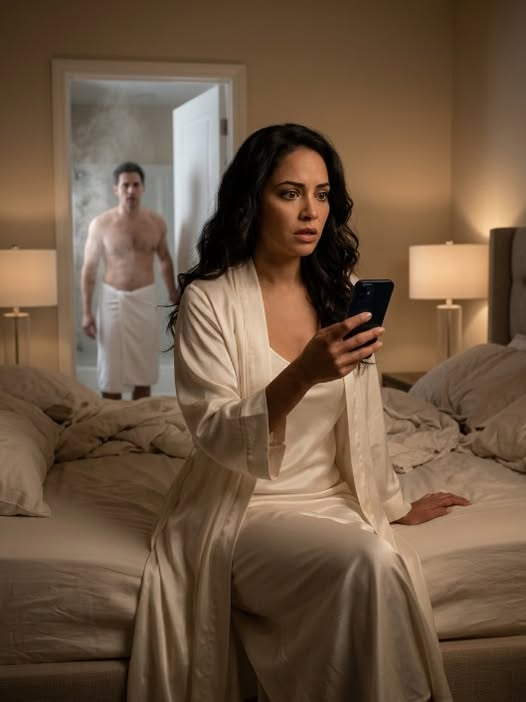
Water dripped from his hair onto the floorboards of our flat in Prague, each drop sounding too loud in the terrible silence. His towel was clenched at his waist. His eyes kept flicking between my face and the phone in my hand, as if one of us might disappear if he stared hard enough.
“What are you doing with my phone, Elise?”
His voice was careful.
That hurt.
A guilty man does not ask what happened. A guilty man asks how much you know.
I held the phone up and turned the screen toward him.
The archived chat was open.
M.
Not Marissa’s name. Not a heart. Not anything obvious.
Just one letter, like a secret door.
“I answered because I thought it was work,” I said.
His lips parted.
“She laughed, Owen.”
The color drained from his face so completely that he looked ill.
“She said I didn’t suspect a thing.”
He swallowed hard and reached for the phone. I pulled it back before his wet fingers touched it.
“Don’t.”
“Elise, please. Let me explain.”
That sentence almost made me laugh. Not because it was funny, but because it was so small compared to the damage in the room.
“You can explain after you read what I sent her.”
His eyes sharpened.
“What did you send?”
I looked down at the screen. My thumb had not shaken when I typed it. That was the strange part. Something inside me had gone cold and steady.
I had written:
Come tomorrow at ten. Same café by Charles Bridge. Tell Owen I know everything. And bring the silver envelope, unless you want Uncle Laurent to see the photographs first.
Owen stared at the words.
Then he stopped breathing.
Not metaphorically. His chest froze. His hands dropped to his sides. The steam behind him thinned around his shoulders like smoke after a fire.
“What silver envelope?” I asked softly.
He said nothing.
I stood.
“You know what I thought would happen? I thought you’d beg. I thought you’d say she meant nothing. I thought you’d lie badly and insult me with it.” I stepped closer, still holding his phone. “But you’re not afraid because I found out about the affair.”
His jaw tightened.
“You’re afraid because I mentioned the envelope.”
The bathroom mirror behind him was fogged white. My reflection in it looked blurred, almost ghostly, but my voice was sharp enough to cut.
“What did Marissa give you?”
Owen finally whispered, “You shouldn’t have sent that.”
The sentence landed like a warning.
For the first time that night, fear moved through me—not fear of losing him, not fear of being betrayed.
Fear that my marriage had been hiding something much darker than infidelity.
The phone vibrated in my hand.
Marissa had replied.
You stupid woman. You have no idea what you just opened.
Part 3: Marissa Arrived Wearing My Mother’s Pearls
I did not sleep.
Owen spent the night on the sofa, though neither of us called it that. He sat there in yesterday’s clothes, his elbows on his knees, staring at the floor while Prague’s winter rain scratched at the windows. Twice he tried to speak. Twice I lifted one hand, and he stopped.
At dawn, I packed a small leather folder.
Marriage certificate. Bank statements. Screenshots. The archived chat. Marissa’s message. Photographs I had found buried between invoices and business receipts.
Not intimate photographs.
Worse.
Photographs of documents.
My father’s signature.
My mother’s maiden name.
A deed to a vineyard outside Bordeaux that I had been told was sold years before I was born.
By nine-thirty, I was walking toward the café near Charles Bridge, wrapped in a dark wool coat, my hair pinned tight enough to hurt. The city looked painfully beautiful. Wet stones gleamed beneath pale morning light. Tourists drifted past with cameras and scarves, unaware that my family was about to split open at a corner table.
Marissa arrived at exactly ten.
She wore cream.
Of course she did.
A soft belted coat, polished boots, gold earrings, and around her throat—my mother’s pearls.
I knew them instantly.
My mother had worn those pearls in every photograph from her youth in Lyon. After she died, my aunt Claudine told me they had been lost during a move.
Marissa saw me looking at them and smiled.
That smile removed the last childlike piece of me that had ever loved her.
“Don’t make a scene,” she said, sliding into the chair across from me.
“I wasn’t planning to.”
“No. You planned to threaten me with Uncle Laurent.”
“Did it work?”
Her smile tightened.
I placed Owen’s phone between us.
“Why were you calling my husband from a hidden number?”
She leaned back. “Because he answers when I call.”
I did not flinch. I would not give her that gift.
“Why do you have my mother’s pearls?”
Her fingers touched them.
For one second, something dark passed through her eyes. Possession. Resentment. Triumph.
“Your mother had many things she didn’t deserve.”
My breath caught.
Marissa noticed. Her smile returned.
“There it is,” she whispered. “That face. The orphaned princess realizing the castle was never hers.”
I opened the folder and pushed one photograph across the table.
It showed the vineyard deed.
Her expression changed.
Only a fraction.
But enough.
“Where did you get this?” she asked.
“From Owen’s files.”
She looked past me toward the street.
I turned.
Owen was standing across the road.
He had followed me.
And beside him stood my uncle Laurent, his silver hair damp from the rain, his face carved with grief.
Marissa went rigid.
Laurent looked directly at her pearls and whispered loud enough for all of us to hear:
“Those were buried with my sister.”
Part 4: The Grave Was Empty Beneath The Snow
The café became too small for the truth.
Marissa stood so quickly her chair scraped across the floor, drawing startled glances from two waiters and a German couple near the window. Her hand went to the pearls as though she could push them back into her skin.
“You’re mistaken,” she said.
Laurent stepped inside, rain shining on the shoulders of his black coat.
“I fastened them around Amélie’s neck myself.”
My mother’s name struck the air like a bell.
Amélie.
No one said it often. In my family, grief had always been treated like fine china—kept behind glass, admired from a distance, never touched.
Owen came in behind Laurent, pale and silent.
I looked at him. “You knew?”
His mouth tightened.
“Owen,” I said. “Did you know?”
Marissa laughed once, sharp and ugly. “Of course he knew. He helped.”
Something in me buckled, but I stayed standing.
Laurent’s eyes moved from Marissa to Owen. “Helped with what?”
Owen finally spoke.
“I didn’t know at first.”
“At first?” I repeated.
He closed his eyes.
Marissa grabbed her handbag. Laurent moved before she could pass him. He did not touch her. He only stood in front of the door with the quiet authority of a man who had spent his life controlling rooms.
“Sit down,” he said.
Marissa’s nostrils flared.
“No.”
“Then I will call the police and explain why you are wearing jewelry from a sealed coffin.”
That did it.
She sat.
Outside, snow began to mix with rain, soft white flecks dissolving against the café glass.
Owen dragged a hand down his face. “Six months ago, Marissa came to me in Vienna. She said she had proof your mother’s estate had been mishandled. She said your aunt Claudine stole from you.”
“My aunt raised me.”
“Yes,” he said quietly. “And Marissa hated her for it.”
Marissa’s face twisted. “Claudine raised you because everyone pitied you. Poor Elise. Poor motherless Elise. While my father lost everything paying debts your family pretended didn’t exist.”
Laurent’s voice hardened. “Your father gambled away his own fortune.”
Marissa leaned forward. “And Amélie hid hers.”
Silence.
The snow thickened outside.
I looked at Laurent. His face had gone gray.
“What is she talking about?”
He did not answer quickly enough.
Marissa smiled through her anger.
“Ask him about the Geneva account. Ask him about the Bordeaux vineyard. Ask him why your mother’s death certificate was signed before the doctor arrived.”
My ears rang.
Owen whispered, “Elise, please.”
I stepped back from all of them.
Then Laurent said the words that changed every memory I had.
“Your mother may not have died that night.”
Part 5: The Train To Vienna Carried Three Liars
I should have cried.
Instead, I bought a train ticket.
Prague to Vienna.
Four hours and twenty minutes of steel tracks, gray fields, frozen villages, and three people sitting around me with different versions of guilt in their pockets.
Laurent came because he said the answers were in Austria.
Owen came because I refused to let him vanish.
Marissa came because Laurent had quietly photographed the pearls, sent the image to a retired magistrate in Lyon, and told her that running would make her look exactly as guilty as she was.
We sat in a private compartment that smelled faintly of coffee and old upholstery.
Nobody trusted anybody enough to sleep.
I kept the folder on my lap.
Owen sat opposite me, his wedding ring still on his finger. I hated that I noticed. I hated more that part of me remembered the day I put it there, in a small stone church outside Bruges, believing the tremor in his hand meant love.
Now I wondered if it had meant fear.
“Start talking,” I said.
The train slid out of Prague.
Owen stared at the countryside.
“My firm handled a private acquisition in Vienna. Old land records. Dormant accounts. Marissa’s name came up because she had been making inquiries about your mother’s estate.”
“You were already involved with her?”
His jaw worked.
“Yes.”
The word was quiet. Not dressed up. Not softened.
It still cut.
Marissa smirked at the window.
I turned on her. “Don’t.”
Her smirk disappeared.
Owen continued. “She told me your mother had left assets hidden under another name. She said if I helped recover them, Elise would benefit.”
“You betrayed me for my benefit?”
“No.” He looked at me then, and his eyes were wet. “I betrayed you because I was weak. Then I kept going because I became afraid of what I had helped uncover.”
Laurent spoke for the first time since we boarded. “What did you uncover?”
Owen reached into his coat and removed a folded paper.
Marissa lunged.
Laurent caught her wrist.
Her bracelet snapped, scattering tiny gold links across the floor.
Owen handed me the paper.
It was a hospital intake form from Vienna.
Date: three days after my mother’s supposed death.
Patient name: Amélie Moreau.
Condition: alive, unidentified trauma, transferred under protective order.
The compartment tilted around me.
I pressed my fingers to the page.
Alive.
My mother had been alive.
And at the bottom of the form, under emergency contact, was a name I did not recognize.
Matthias Adler.
Laurent stared at it and whispered, “No.”
Marissa’s face had gone white.
The train roared into a tunnel, plunging us into darkness.
In the black reflection of the window, I saw Owen looking not at me, but at Laurent.
And I understood.
My uncle knew exactly who Matthias Adler was.
Part 6: The Woman In Room Fourteen Remembered Everything
Vienna greeted us with cold sunlight and streets that looked too elegant for betrayal.
Laurent led us through the Innere Stadt without speaking, past cafés glowing gold behind glass, past tram lines humming over wet pavement, past tourists carrying paper bags from shops I could not see. My body moved, but my mind remained trapped on that form.
Alive.
Transferred.
Protective order.
Matthias Adler.
We stopped before a narrow private clinic near Alsergrund, its brass plaque polished but discreet. Laurent pressed the bell. A nurse opened the door, looked at him, then at me, and her expression changed.
Recognition.
Not of Laurent.
Of me.
“You have her eyes,” she said in German-accented English.
My skin prickled.
“Whose eyes?”
The nurse hesitated. Laurent stepped forward. “We need to see Sister Helena.”
Minutes later, we were led through a corridor smelling of antiseptic and lavender. At the end sat an elderly woman in a wheelchair beside a tall window, a knitted blanket over her knees. Her face was thin, but her gaze was frighteningly alive.
Laurent bowed his head.
“Sister Helena.”
She ignored him and looked at me.
“Oh,” she whispered. “Amélie’s girl.”
Something inside my chest broke open.
I knelt before her chair.
“My mother was here?”
Sister Helena lifted a trembling hand and touched my cheek.
“For seventeen days.”
I could barely speak. “Was she alive when she left?”
“Yes.”
Behind me, Marissa made a small sound.
Sister Helena’s eyes hardened when she saw the pearls around Marissa’s throat.
“Thief,” she said.
Marissa stepped back.
Laurent gripped the back of a chair. “Helena, please. We need the truth.”
“No,” she said. “You need forgiveness. The truth was always here.”
Laurent flinched.
The old woman turned back to me. “Your mother came under guard. She had been attacked on the road outside Lyon. Everyone was told she died because someone powerful needed her estate frozen before she could sign the new will.”
“My father?” I whispered.
“No.” Sister Helena’s mouth tightened. “Your father was already dead by then.”
The room went silent.
I looked at Laurent.
He would not meet my eyes.
“My father died when I was four,” I said.
Sister Helena shook her head. “Your father died before you were born.”
The sentence left no air in the room.
She reached into the pocket of her cardigan and pulled out an old envelope, yellowed at the corners.
“Amélie made me keep this. She said one day her daughter would come with eyes full of questions.”
My hands shook as I opened it.
Inside was a photograph.
My mother, younger than I had ever seen her, standing beside a dark-haired man in Salzburg.
On the back, in blue ink, she had written:
Matthias Adler, Elise’s father.
Part 7: My Husband Confessed At The Funeral Chapel
I carried the photograph through Vienna like a wound.
Matthias Adler was not a name in family stories. Not a portrait in a hall. Not a man anyone had allowed me to mourn.
He was my father.
And everyone around me had helped bury him before I ever learned he existed.
Sister Helena gave us one final address: a funeral chapel near the Zentralfriedhof, closed years ago but still owned by the Adler family. Matthias, she said, had hidden documents there after Amélie disappeared from the clinic.
The city darkened as we drove.
Owen sat beside me in the taxi. His hand moved once toward mine, then stopped halfway and curled into a fist against his knee.
Good.
Some distances deserved to remain untouched.
The chapel stood behind iron gates, its stone angels blackened by weather. Laurent had a key. That disturbed me almost as much as everything else.
Inside, dust floated in the beam of his torch. The air smelled of cold wax and old wood. Rows of empty pews faced a small altar where faded flowers had hardened in a cracked vase.
Marissa refused to enter until Laurent said, “You wanted the inheritance. Come look at what greed costs.”
Her face burned, but she followed.
In the sacristy, behind a loose panel, we found a metal box.
Inside were letters.
Bank records.
A second will.
And a sealed statement signed by my mother.
I unfolded it beneath the torchlight.
My mother’s handwriting curved across the page, elegant and urgent.
She had discovered that Claudine and Laurent were moving assets out of her name “for protection,” but Matthias believed they were being pressured by creditors tied to Marissa’s father. Amélie planned to move the estate into a trust for me.
Then came the line that made Laurent sink into a pew.
If anything happens to me, do not let my brother decide what my daughter is allowed to know.
I looked at him.
“Did you hide her?”
Laurent covered his face.
“I thought I was saving you.”
“No,” I said. “You were saving yourself from explaining.”
Marissa suddenly laughed, but it cracked halfway. “Perfect. Saint Laurent was a liar too.”
Owen stepped forward. “Enough.”
She turned on him. “Don’t pretend you’re noble now.”
“I’m not.” His voice shook. “But I know what you did.”
Marissa froze.
Owen looked at me.
“The affair wasn’t the beginning,” he said. “Marissa approached me because she needed access to your files. But after I found the hospital form, I tried to stop. That’s when she showed me the recording.”
“What recording?”
He reached into his pocket and handed me a small drive.
His eyes were destroyed.
“Your mother’s last message,” he whispered. “Marissa has been using it to blackmail everyone.”
Part 8: The Last Voice Saved My Future
We played the recording in the chapel.
Not on a grand screen. Not before a courtroom. Just from Owen’s phone, balanced on the edge of a dusty altar while four ruined people stood in the cold and listened to a dead woman breathe.
Except she had not been dead.
Not then.
My mother’s voice emerged softly, broken by pain but unmistakably alive.
“Elise, my darling little star… if this reaches you, then too many people have lied.”
I pressed both hands over my mouth.
Her accent was French, gentle, musical. A voice from dreams I had never known were memories.
She spoke of Matthias. Of love hidden because her family disapproved. Of debts, threats, forged papers, and fear. She said Laurent had promised to protect me but had always believed secrets were safer than truth.
Then her voice changed.
Stronger.
“The vineyard is not the inheritance. The money is not the inheritance. You are.”
Marissa made a strangled sound.
The recording continued.
My mother explained that she had created a trust, not for luxury, but for something no one in the family had ever valued: independence. If I came looking, the trust would release only after I heard the recording in the presence of someone who had betrayed me and someone who had protected me badly.
I almost laughed through my tears.
Even dying, my mother had understood people too well.
Then came the final shock.
“The trustee is Matthias Adler,” she said. “If he survived Salzburg, he will find you. If he did not, his sister Helena will know where to send you.”
Sister Helena.
Not just a nurse.
My aunt.
Owen turned away, ashamed.
Laurent wept without sound.
Marissa ripped the pearls from her neck and threw them onto the floor. “All this for her?” she shouted. “Always her?”
I bent, picked up the pearls, and placed them in Laurent’s hand.
“Return them to my mother’s grave,” I said.
His face crumpled. “Elise—”
“No. Not forgiveness. Not yet.”
Then I looked at Owen.
He stood very still.
“I loved you,” I said.
“I know.”
“No,” I whispered. “You knew I loved the man you pretended to be.”
His eyes filled.
I took off my wedding ring and set it on the altar beside the phone still holding my mother’s voice.
“I’m keeping the truth. You can keep the ruins.”
Six months later, I stood in Bordeaux beneath rows of vines silvered by morning mist.
The trust had not made me rich in the way Marissa imagined. My mother had left the vineyard to be turned into a refuge for women rebuilding their lives after betrayal, coercion, and family abandonment. I named it Maison Amélie.
Laurent came once a week to repair stone walls without asking to come inside.
Owen signed the divorce papers without contest.
Marissa disappeared from every family table she had once ruled.
And Sister Helena—my aunt, my impossible miracle—sat beside me on the terrace every Sunday, telling me stories about the parents I had been denied.
On the first harvest day, she placed a faded photograph in my hand.
Matthias and Amélie, laughing in Salzburg.
On the back was one more line I had never seen.
Find joy loudly, so the liars know they failed.
So I did.
I opened the gates, welcomed the first women home, and for the first time in my life, I did not feel like someone’s abandoned daughter, betrayed wife, or stolen secret.
I felt like the beginning my mother had fought to leave behind.
