Part 2: The Call That Froze The Mansion Lights
Marcus did not ask whether I was safe first.
That was why I trusted him.
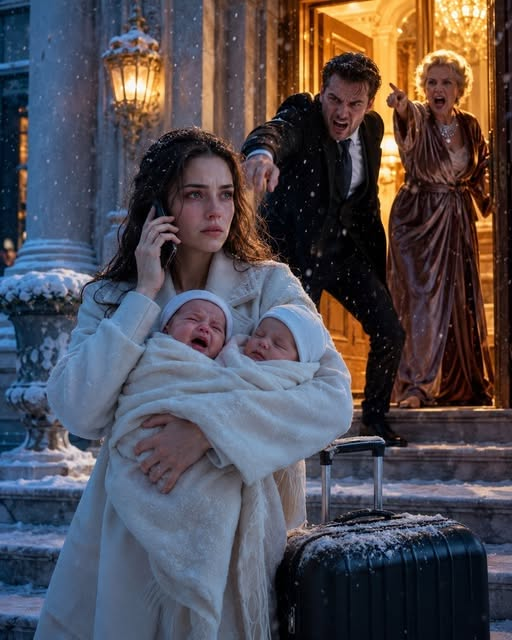
He knew I would not have called unless I had already calculated the danger, the witnesses, the leverage, and the timing. Behind me, the mansion door slammed so hard the iron lantern beside it trembled.
“Full freeze confirmed,” Marcus said. “Do you want domestic security dispatched?”
“No,” I whispered, shifting both babies higher against my chest. “Send Ada.”
A silence. Then, carefully, “Your sister?”
“Yes. And tell her to come through the east gate. I don’t want the Harringtons seeing her until it’s too late.”
One of my sons began to cry. A thin, hungry, fragile sound that cut through all the money, all the betrayal, all the snow.
That sound nearly broke me.
Not Graham’s cruelty.
Not Vivian’s spit on my cheek.
My child crying in the cold while the house I owned glowed warmly behind strangers who thought they had won.
Marcus’s voice sharpened. “Evelyn.”
“I’m here.”
“The board packet will reach Harrington Luxe executives in eight minutes. Bank notices in twelve. Property access revocation in fifteen.”
I looked toward the upstairs window. Vivian’s silhouette moved behind the curtain.
“Make it ten.”
“Done.”
I ended the call.
For one moment, I stood alone on the long gravel drive outside the Harrington mansion in Surrey, with snow gathering in my hair and my newborns pressed against my heart. I had built companies across London, Milan, Zurich, and Paris. I had negotiated acquisitions while men twice my age mistook me for an assistant. I had survived boardrooms designed to humiliate women who looked too young, too soft, too quiet.
But nothing had prepared me for the sound of my husband laughing inside while his sons shivered outside.
A black car appeared beyond the gate.
Ada Vale stepped out before it fully stopped, red coat flying open in the wind, dark hair loose around her face. My older sister had never looked frightened in her life.
Until she saw the babies.
Then her expression changed into something lethal.
“Who touched you?” she asked.
“Graham pushed the suitcase into me.”
Ada’s eyes went to the mansion.
“Vivian spat.”
Her jaw tightened.
“And he called them bastards.”
Ada took one sleeping baby from my arms with hands gentler than her face. “Good,” she said softly.
I blinked. “Good?”
Her smile was cold.
“Now nobody can say we overreacted.”
Behind us, the mansion lights flickered once.
Then the front gates locked with a heavy metallic sound.
Inside, the first scream came from Vivian.
Part 3: Vivian Discovered The Doors No Longer Opened
The east gate opened for us because my fingerprint owned it.
The front gate stayed locked because Graham’s no longer did.
Ada ushered me and the twins into the heated car, wrapping a cashmere blanket around my shoulders while her driver placed my suitcase in the boot. I should have climbed in. I should have let warmth swallow me.
Instead, I turned back.
The mansion doors flew open.
Graham appeared barefoot on the marble steps, still wearing the expensive navy sweater I had bought him in Florence. His face was flushed with anger, not fear yet. Fear would come later, after the lawyers finished introducing themselves.
“What did you do?” he shouted.
I did not answer.
Vivian shoved past him, robe belted tight, diamonds shaking at her throat. “The gate won’t open! The security panel says access denied!”
Ada laughed once under her breath. “That panel has taste.”
Graham’s eyes moved to her. Recognition flickered. Not full recognition. He had seen Ada once in a business magazine, standing beside the prime minister of Luxembourg after a private investment summit. He had called her “some finance woman” while flipping the page.
Now that finance woman was holding his son.
“Evelyn,” he said, voice lowering. “Open the gate.”
I wiped Vivian’s spit from my cheek with the back of my glove.
“No.”
His face hardened. “Don’t start this drama. The babies are cold. Bring them inside.”
Something inside me went quiet.
“You threw them out.”
“My mother was upset.”
“Your mother called them bastards.”
Vivian lifted her chin. “Because we all know what you are.”
Ada took one step forward. “Say it again.”
Vivian looked at her properly for the first time.
Ada Vale had a talent for silence. She could make entire rooms confess just by waiting.
Vivian swallowed.
Graham pointed at me. “This is marital property. You can’t lock me inside my own house.”
“It isn’t your house,” I said.
He laughed. “What?”
“The house belongs to Vale International Holdings through a residential trust. You have lived here under a family occupancy license signed by me.”
He stared.
Vivian’s mouth opened, but no sound came out.
I continued, each word calm enough to terrify them. “The cars are leased through Vale Mobility. The art is insured under my collection. The staff contracts are with my household office. The company card you used to buy Vivian’s diamonds was flagged six months ago.”
Graham’s face changed.
There it was.
The first crack.
“You’re lying,” he whispered.
Ada shifted the baby in her arms. “She really isn’t.”
His phone began ringing. Then Vivian’s. Then, from inside the house, another phone. And another.
A chorus of panic.
Graham looked down at his screen.
I already knew the name flashing there.
Harrington Luxe Board Office.
He answered with trembling fingers.
I watched the exact moment my husband learned his salary, title, accounts, and reputation had been hanging from a thread I had just cut.
His knees almost gave way before he said my name.
Part 4: The Boardroom Learned His Real Last Mistake
By sunrise, Graham was no longer shouting.
Men like him were loud only when they believed the room belonged to them.
At six-thirty, Marcus arranged a secure video call from my penthouse in London. I sat in a cream armchair near the nursery window while the twins slept in matching bassinets beside me. Ada stood behind my chair with coffee she had made too strong on purpose.
On the screen, twelve directors of Harrington Luxe waited in separate boxes.
All pale.
All silent.
Graham appeared in the smallest square, trapped in the mansion study, hair uncombed, sweater wrinkled, arrogance draining out of him by the second. Vivian hovered behind him like a ghost wearing diamonds she could no longer afford.
Marcus began.
“At 1:14 this morning, Mr. Graham Harrington expelled Ms. Evelyn Vale and her ten-day-old children from a Vale-owned residential property during freezing weather.”
Graham flinched. “That’s not—”
Marcus lifted one hand. “Please wait. Evidence includes exterior cameras, interior audio from the entrance hall, security lock logs, and witness testimony.”
Vivian snapped, “You recorded inside our home?”
I leaned toward the camera. “My home.”
The board chair, Sir Roland Beck, looked like he wanted to disappear into his own tie.
“Ms. Vale,” he said, “none of us were aware of your personal connection to Mr. Harrington.”
“I made sure of that,” I replied. “I wanted Graham promoted or dismissed on merit.”
Graham’s jaw tightened.
Marcus opened the disclosure packet.
Page after page appeared.
Unauthorized luxury expenses.
Private transfers hidden under design consultant fees.
Graham’s emails calling me “useful until the children arrive.”
Vivian’s messages to a tabloid contact.
Then came the line that made even Ada inhale sharply.
A draft custody petition.
Prepared three weeks before the twins were born.
It accused me of instability, financial deception, and abandonment.
Graham had planned to force me out, take the children publicly, and use my supposed poverty to erase me.
My hands closed around the armrests.
Not from shock.
From fury so clean it almost glowed.
“You were going to steal my sons,” I said.
Graham’s face crumpled into panic. “Evelyn, listen to me. That was my mother’s idea.”
Vivian recoiled. “Graham!”
The board watched them turn on each other in real time.
Sir Roland removed his glasses. “Mr. Harrington, pending investigation, you are suspended from all executive duties.”
Marcus corrected him smoothly. “Terminated. The parent company has authority under emergency moral conduct and fiduciary breach provisions.”
Graham stared at the screen.
“Parent company?”
I lifted my son gently from the bassinet as he stirred.
“Yes,” I said. “Mine.”
Vivian gripped the back of Graham’s chair.
Then Marcus added the final document.
A hospital security report from the night I gave birth.
Graham went still.
Ada leaned closer to the screen.
I saw the filename.
And for the first time that morning, I did not know what Marcus had found.
Twin Identification Irregularity — St. Catherine’s Hospital, London.
Part 5: The Hospital Bracelet Changed Everything
The room narrowed to the glow of the screen.
Marcus did not look surprised. That meant he had read the report already and chosen not to warn me until witnesses were present.
I respected him for it.
I hated him for it.
“What irregularity?” I asked.
Graham’s face had gone gray.
Vivian whispered, “Don’t.”
Ada’s hand landed on my shoulder.
Marcus opened the file.
“During the post-delivery transfer from theatre to recovery, a nurse reported that Mrs. Harrington’s infants were approached by an unauthorized visitor.”
My grip tightened around my son.
“Who?”
Marcus looked directly at Vivian’s camera square.
“Mrs. Vivian Harrington.”
Vivian lifted her chin. “They are my grandchildren.”
“No,” Marcus said. “At that time, you were not listed as an approved visitor.”
Graham covered his face.
I stared at him. “You knew?”
He shook his head too fast. “Not then.”
“Not then?” Ada repeated.
The hospital report continued. A bracelet had been removed. A temporary ankle tag replaced. A private lab test requested under Graham’s account two days later.
My heart began pounding so violently that the room seemed to pulse with it.
“Why?” I whispered.
Vivian’s polished mask finally cracked.
“Because I had to know.”
“Know what?”
Her eyes flashed. “Whether they were really Harringtons.”
Ada’s voice dropped. “They were newborns.”
“They looked nothing like Graham!”
“They were ten days old,” Ada said.
Vivian ignored her. “And she lied about everything else!”
I stood so suddenly the baby startled, and Ada reached for him. I let her take him because my hands had begun to shake.
“Graham,” I said.
He looked up slowly.
“What did the test say?”
His mouth opened.
Closed.
Marcus answered instead.
“The lab reported a conclusive paternal match.”
The silence afterward was brutal.
My sons were Graham’s.
He had known.
He had let Vivian spit at me anyway.
He had let her call them bastards anyway.
He had shoved them into the snow anyway.
I looked at the man I had married, and whatever love remained did not shatter dramatically. It simply went out, like a lamp starved of oil.
Graham began to cry.
Not beautifully. Not remorsefully. Messily, selfishly, because consequences had finally learned his address.
“I was scared,” he said. “Mother said if you were hiding money, you could be hiding men. She said you’d take everything.”
“I would have given you everything,” I said.
He looked at me with sudden hope.
I finished, “Before tonight.”
Vivian stepped forward, trembling with rage. “You think money makes you untouchable?”
“No,” I said. “My sons do.”
Marcus cleared his throat. “There is one more matter.”
I closed my eyes briefly.
Of course there was.
Marcus’s voice lowered.
“Vivian attempted to change the beneficiaries on Graham’s family trust yesterday afternoon. The new primary beneficiary was neither Graham nor the twins.”
Graham turned toward his mother.
Vivian’s diamonds trembled at her throat.
“Mother,” he whispered, “who did you name?”
Part 6: The Daughter Vivian Pretended Was Dead
Vivian sat down.
That frightened Graham more than her shouting ever had.
His mother did not sit during war. She stood, commanded, pointed, and destroyed. But now she lowered herself into the leather chair behind him as if her bones had turned hollow.
Marcus read from the filing.
“Primary beneficiary: Clara Whitcombe.”
Graham frowned. “Who is Clara Whitcombe?”
Vivian said nothing.
The board members looked at one another.
Sir Roland’s face changed first.
He knew.
“Vivian,” he said carefully, “is Clara alive?”
Graham turned slowly. “Alive?”
I held the edge of the desk to steady myself.
Marcus continued, “Clara Whitcombe Harrington. Born in Edinburgh. Recorded as deceased at age six. No death certificate located in the national index.”
Graham backed away from his mother.
“What is this?”
Vivian’s lips pressed together.
For the first time since I had met her, she looked old.
Not elegant-old. Not powerful-old.
Guilty-old.
Sir Roland spoke softly. “Your father had a daughter before you, Graham.”
“No.”
Vivian stared at the carpet.
“He had an embarrassment,” she said.
The word chilled the room.
Ada moved closer to me. The twins slept through it all, their tiny faces peaceful beneath knitted blankets, as if innocence had its own shield.
Marcus opened another file.
A photograph appeared.
A little girl in a tartan dress, dark curls, serious eyes.
Beside it, a recent passport photo of a woman around forty, living in Copenhagen under the name Clara Whitcombe.
Graham stared.
“That’s my sister?”
Vivian slapped the desk. “She is nobody.”
Sir Roland’s voice hardened. “She was sent away after your father died because Vivian wanted sole control of the Harrington trust.”
“No,” Graham whispered.
“Yes,” Marcus said. “And yesterday, after realizing Ms. Vale’s internal audit was closing around her personal accounts, Mrs. Harrington attempted to move remaining protected funds to Clara. Not out of love. As a shield.”
Vivian looked up sharply. “You have no right.”
“I have every right,” I said. “You used my company, my home, my husband, and nearly my children to protect a lie you buried decades ago.”
Graham stumbled toward the wall.
I should have felt satisfaction watching his world turn on him.
Instead, I felt something stranger.
Pity.
Not forgiveness.
Never that.
But pity for the boy who had been raised by a woman capable of deleting a child and calling it order.
Then Marcus said, “Ms. Vale, Clara is on the line.”
Vivian lunged for the laptop.
Ada stopped her with one hand.
The screen shifted.
A woman appeared in a modest Copenhagen apartment, silver beginning at her temples, eyes steady and wounded.
She looked at Vivian.
Then at Graham.
Then at me.
“I heard what happened to the babies,” Clara said quietly. “So I’ll tell you what nobody told me when I was thrown out.”
Her voice did not shake.
“Take the house. Take the money. Take everything before she teaches them to become him.”
Part 7: Graham Begged In The House He Never Owned
By noon, the Harrington mansion no longer belonged to the Harringtons in any way they could pretend mattered.
Staff left through the service entrance with full severance guarantees from me. The cars were collected by Vale Mobility. The art handlers arrived with white gloves and silent efficiency. Vivian stood in the entrance hall watching paintings vanish from walls she had once used to intimidate guests.
Graham called me seventeen times.
I answered the eighteenth.
Not because I cared what he wanted.
Because Clara asked me to.
His face appeared on video from the mansion staircase. Behind him, men in dark coats carried away a bronze sculpture Vivian loved to claim had belonged to an Italian count.
It had belonged to a hotel in Florence. I had the receipt.
“Evelyn,” he said, voice raw. “Please come back. Not for me. For the boys. We can fix this.”
I looked across the nursery at my sons sleeping in soft morning light.
“You pushed them into snow.”
“I panicked.”
“You threatened to take them.”
“I was confused.”
“You knew they were yours.”
He began crying again.
This time I felt nothing.
That was a mercy.
“Evelyn, my mother poisoned everything. She told me you were using me. She said you would humiliate me if I didn’t strike first.”
“You believed her because it protected your ego.”
He flinched.
I continued, “You did not fear losing your family. You feared discovering your wife was more powerful than you.”
His mouth trembled. “I loved you.”
“No. You loved feeling superior to me.”
The truth sat between us, clean and undeniable.
Behind him, Vivian appeared at the top of the stairs.
Her hair was unpinned. Her diamonds were gone from her throat. Without them, she looked smaller, but not softer.
“She ruined us,” Vivian hissed.
I smiled faintly. “No. I documented you.”
Vivian leaned toward the phone. “Those children will carry Harrington blood. You cannot erase us.”
Clara’s voice came from beside me.
“She can protect them from you.”
Graham froze. “Clara?”
I turned the phone slightly.
Clara stood in my nursery holding a mug of tea, wearing a borrowed cardigan from Ada. She had flown from Copenhagen that morning with one small suitcase and forty years of silence behind her.
Vivian’s face twisted.
“You should have stayed dead.”
Clara did not blink.
“And you should have stayed childless.”
For once, Vivian had no answer.
Graham looked between us, terrified by the family he had never known and the wife he had never respected.
“What happens to me now?” he whispered.
I thought of the freezing steps. The suitcase. The babies crying. Vivian’s spit drying on my cheek.
Then I thought of my sons someday asking who their father was.
I would not build their childhood from revenge.
But I would build it from truth.
“You get supervised visitation after court approval, medical clearance, and parenting assessment,” I said. “You get no access to my homes, my companies, or my accounts. You get the chance to become better somewhere far away from your mother.”
Vivian screamed, “You cannot separate my son from me!”
Graham looked at her.
For the first time, really looked.
Then he whispered, “You already did.”
Part 8: The Fortune She Kept Was Not Money
The newspapers called it the Harrington Collapse.
They loved the mansion photographs, the corporate scandal, the secret sister, the billionaire wife nobody had recognized beneath her quiet dresses and tired hospital smile. They printed Graham’s termination, Vivian’s fraud investigation, Clara’s return, and my emergency custody order in careful legal language that could not capture the cold of that night.
But I remembered the small things.
The weight of two newborns against my chest.
Ada’s red coat in the snow.
Clara’s hands trembling the first time she touched her nephews.
Marcus standing in my kitchen at midnight, pretending he had only come to discuss litigation while quietly assembling bottles, sterilizers, and three kinds of formula because billionaires also forget how to function when babies cry.
Three months passed.
The mansion was sold privately.
Not to punish Vivian.
To erase the stage on which she had performed power for too long.
I used the proceeds to open the Whitcombe House in Edinburgh, a legal and financial refuge for mothers and children pushed out by wealthy families who believed cruelty could be hidden behind gates.
Clara chose the name.
“I want the name they buried to shelter someone,” she told me.
Graham moved to Bristol under court conditions. He sent handwritten letters to the twins every Sunday. I kept them unopened in a blue box. One day, when my sons were old enough, they could decide whether those words deserved reading.
Vivian fought everything until the fraud charges became real.
Then she did what cowards always do.
She blamed everyone.
Graham.
Clara.
Me.
Even the babies.
The last time I saw her was outside the High Court in London. She wore black, no diamonds, one glove missing. Snow had begun again, soft and indifferent.
“You think you won,” she said.
I adjusted the blanket over the twins’ pram.
“No, Vivian. Winning suggests we were playing the same game.”
Her mouth tightened.
“You took my house.”
“I owned it.”
“You took my son.”
“You broke him.”
“You took my name.”
I looked at Clara, waiting beside the car with Ada.
“No,” I said. “I gave it back to the daughter you stole it from.”
Vivian’s face collapsed for one naked second.
Then she turned away.
That evening, Whitcombe House opened its doors.
No cameras. No gala. No speeches from politicians who wanted photographs with suffering they had never touched.
Just women arriving with children, bags, bruised dignity, and eyes that still expected doors to close.
I stood in the entrance hall holding my sons while Clara unlocked the first room.
Ada leaned close and whispered, “Eight billion dollars, and this is the richest you’ve ever looked.”
I laughed then.
A real laugh.
One of my sons woke and blinked up at me, solemn and perfect. His brother yawned against my shoulder.
For the first time since the night Graham threw us out, I thought about the mansion without pain.
That door had closed behind me in cruelty.
But this door opened because of it.
And as the first mother stepped inside from the cold, I finally understood that the fortune Vivian tried to shame out of me had never been money at all—it was the power to make sure no woman carrying a child in her arms ever had to beg monsters for warmth again.
