Part 2: The Page That Made Odette Step Back
The director’s hand trembled only once before he flattened the page against the microphone stand.
“On March 4,” he read, “Khadija Amin stayed after closing to correct forty-three misprinted reader codes before the pilot shipment left for Antwerp.”
The room went still in a way applause never could.
Odette’s face tightened.
The director turned the page. “On March 7, she returned during lunch to restick the damaged batch for the mobile library cards.”
A woman from the city council leaned forward. “How many?”
The director looked at me, then back at the paper.
“One hundred and twelve.”
A whisper moved through the sponsor row.
My leg throbbed where Odette’s heel had struck me, but the pain felt far away now. All I could see was that folder in the director’s hands, the one nobody had noticed while I had been kneeling over tables with peeling stickers and aching fingers.
Odette laughed, but it cracked halfway through.
“That proves she did busywork.”
The director’s eyes lifted.
“No. It proves she prevented the entire reader card launch from failing.”
He held up another page.
“These are test scans from the morning the system failed in Brussels. Every batch rejected except the corrected cards Khadija processed manually.”
The equipment hum suddenly sounded louder.
Odette’s father, Laurent Cranston, rose from the sponsor table. His suit looked too perfect for a room turning against him.
“Director, I suggest you choose your words carefully.”
The director did not lower the page.
“I am.”
Odette reached for her father’s arm, but he pulled away slightly, just enough for the cameras to catch it.
Then the director read the sentence that changed the air.
“The log also shows Odette Cranston submitted a complaint accusing Khadija Amin of tampering with cards she had already repaired.”
Odette’s eyes flashed. “Because she did.”
The director turned toward her.
“Then why is your signature on the approval sheet thanking her for those same repairs?”
The silence hit harder than the fall.
My breath caught.
Odette’s lips parted.
For the first time since she had walked toward me, she looked less like a queen and more like a girl trapped inside her own performance.
The director placed the approval sheet under the document camera.
Her signature appeared on the screen behind us.
Odette Cranston.
Below it, typed neatly, was the line:
Student correction work completed by Khadija Amin. Verified and accepted.
The cameras swung toward Odette.
Her friends lowered their phones.
The director said, “You knew exactly who saved this project before you accused her.”
Odette looked at me with a hatred so clean it almost felt polished.
“You do not know what you have done,” she whispered.
I gripped the edge of the display table and forced myself upright.
“No,” I said, my voice shaking. “I know exactly what I did. I kept the cards working.”
And before anyone could answer, the reader terminal beside us beeped by itself.
Once.
Twice.
Then the screen turned red.
Part 3: The Red Screen No One Expected
Every head turned toward the terminal.
The red warning reflected across the polished display tables like a warning light in a locked room.
The director stepped toward it. “That should not be active.”
A technician hurried over, tapping the keyboard with stiff fingers. “It is reading an administrative override.”
Odette went pale.
Laurent Cranston’s face did not move, but his eyes did.
He looked at Odette.
Then at the terminal.
Then at me.
The technician swallowed. “Someone just tried to erase today’s scan history.”
A gasp broke through the audience.
My stomach dropped.
The reader log was not just paper. It was connected to the system. Every card I had corrected, every scan I had tested, every failed batch, every restored code—it all existed in the digital audit trail.
And someone was trying to make it disappear.
The director snapped, “Lock the network.”
“I am trying,” the technician said. “The override has sponsor-level access.”
Sponsor-level.
The words settled over the room like dust from a collapsed ceiling.
Odette stepped backward.
Her father said quietly, “Stay still.”
That made everyone look at him.
He realized it too late.
The councilwoman stood. Her name badge read Marta Leclerc. Her voice had the cold steadiness of someone who had heard enough excuses in public halls.
“Mr. Cranston, why would you tell your daughter to stay still?”
Laurent smiled without warmth. “Because she is being harassed by a mob.”
The director’s face hardened. “She knocked a student to the floor.”
“It was an accident.”
My leg pulsed.
I looked at Odette. “Was it?”
She said nothing.
The terminal beeped again.
The technician cursed under his breath. “I need the archive key.”
“The sealed one?” the director asked.
“Yes.”
The director hesitated.
Laurent Cranston stepped forward. “That archive contains sponsor materials.”
Marta Leclerc turned on him. “It contains public project records.”
“It contains proprietary development notes.”
“It contains evidence.”
The word hung there.
Evidence.
Odette’s breath grew shallow.
Then a quiet voice came from the back of the room.
“I have the archive key.”
Everyone turned.
An older librarian stood near the entrance, wrapped in a gray wool cardigan, her silver hair pinned loosely at the back of her head. She had been invisible all morning, arranging chairs, replacing pens, moving around powerful people like furniture.
Her name was Helena Varga.
I knew her because she was the only adult who had ever brought me tea when I stayed late.
She walked forward holding a small blue envelope.
Laurent’s expression sharpened. “You were not authorized to remove that.”
Helena did not stop.
“No,” she said. “I was authorized to protect it.”
She handed the envelope to the technician.
He tore it open and entered the archive key.
The terminal flashed.
The red screen vanished.
A folder opened on the projection screen.
Inside were scan logs, correction lists, approval notes, and a file named:
CRANSTON PRIVATE REQUEST — REMOVE AMIN FROM CEREMONY
Odette made a small sound.
The director looked at Helena.
Helena’s eyes were wet, but her voice was steady.
“I made a copy last night,” she said. “Because this was not the first time they tried to erase a student.”
Part 4: The Librarian Who Remembered Every Erased Name
Helena Varga placed both hands on the display table, as if the wood beneath her was the only thing keeping old anger from shaking loose.
“I worked the first reader-card pilot in Vienna eleven years ago,” she said.
The room did not breathe.
Laurent Cranston’s smile disappeared.
“That is irrelevant,” he said.
Helena looked at him. “Not to the children whose names vanished from the records.”
Marta Leclerc walked slowly toward her. “Explain.”
Helena opened her handbag and removed a narrow black notebook, the kind librarians used for small inventory corrections. Its corners were soft from years of being carried, hidden, touched.
“I wrote down what the official reports left out,” she said. “Not because I was brave. Because I was ashamed that I stayed quiet.”
The director lowered the microphone toward her.
Helena looked at me first.
“I am sorry, Khadija.”
Those four words went straight through me.
I did not know why yet, but my throat tightened.
She opened the notebook.
“In Vienna, a student named Elise Bauer corrected the first batch of reader codes. Her name was replaced by a sponsor’s niece. In Lyon, Tomas Berger repaired the damaged cards before shipment. His work was credited to a donor committee. In Prague, Anika Weiss rebuilt the tracking sheet, then disappeared from the ceremony program entirely.”
The room shifted with every name.
Not one mistake.
A pattern.
Odette’s eyes darted toward her father.
Laurent spoke through clenched teeth. “This is sentimental nonsense.”
Helena turned a page.
“Then why did the same Cranston administrative account approve every replacement?”
A reporter near the front whispered, “Did you get that?”
Several cameras adjusted.
Laurent lifted a hand. “I will not have my family defamed by a bitter librarian.”
Helena flinched.
I hated that she flinched.
So I stepped forward.
“She kept records,” I said. “That is not bitterness.”
Odette snapped, “You think this makes you important?”
I looked at her.
“No. I think it makes you scared.”
Her face changed.
Not enough for everyone else to notice, maybe, but enough for me.
The director clicked open the private request file.
The projection filled with a message chain.
At the top: Laurent Cranston.
Below: Odette Cranston.
The newest message had been sent that morning.
If Amin is announced, disrupt before first swipe. We cannot allow public credit to drift outside sponsor control.
A sound like a wave moved through the room.
Odette whispered, “Father.”
Laurent’s face became stone.
Marta Leclerc turned to him. “You instructed your daughter to cause a disruption?”
“No.”
The director pointed at the screen. “Your name is on it.”
“My account was used.”
“By whom?”
Laurent did not answer.
Odette stared at the message chain as if it had betrayed her too.
That was the first time I wondered whether she had known all of it—or only enough to be dangerous.
Helena turned another page in her notebook.
“There is one more name,” she said.
Laurent’s head snapped toward her.
“Do not,” he said.
Helena’s hand shook.
But she read anyway.
“Clara Amin.”
My heart stopped.
The room blurred.
My mother’s name sounded impossible in that place, under those lights, in that ceremony where I had already been humiliated.
I gripped the table.
“What did you say?”
Helena looked at me with tears in her eyes.
“Your mother was part of the original Vienna pilot.”
Part 5: The Name My Mother Never Spoke
I heard people around me, but their voices had gone underwater.
My mother.
Vienna.
Reader cards.
None of it fit with the life I knew.
My mother worked long shifts folding hotel linen until her wrists swelled. She kept receipts in a biscuit tin. She called every bill “a mountain” and every small discount “a miracle.” She had never once told me she had worked on anything important enough to be buried.
Helena closed the notebook gently.
“Clara Amin corrected the first code alignment system,” she said. “Before Elise, before Tomas, before all of them. She was brilliant.”
My voice came out thin. “No.”
Helena’s face softened. “Yes.”
I shook my head. “She would have told me.”
“Maybe she wanted to protect you from knowing what they took.”
Laurent laughed once.
Everyone turned toward him.
“You people make theft sound dramatic,” he said. “These were schoolchildren sticking labels. Sponsors built the program. Sponsors carried the risk.”
Marta Leclerc’s voice cut in. “Public libraries carried the children. Students carried the work.”
Laurent ignored her.
His eyes locked on me.
“Your mother was offered a settlement.”
The floor seemed to move.
“What settlement?”
Helena whispered, “Khadija—”
Laurent smiled then, a small cruel thing.
“She signed away her claim. Took the money. Disappeared.”
The words struck harder than Odette’s shoe.
I wanted to reject them immediately.
But I remembered my mother’s silence whenever library ceremonies appeared on local news. I remembered the way she once turned off a documentary about student inventors and stood at the sink too long, not washing anything.
Odette looked shaken now.
Not triumphant.
Shaken.
She whispered to Laurent, “You said they were all lying.”
He snapped, “Be quiet.”
That was when I saw it.
Odette had been cruel, yes. Proud, yes. Willing to hurt me, yes.
But her father had built the room she stood in.
And now the walls were falling on both of us.
The director touched my shoulder carefully. “Khadija, do you want to sit?”
I did not.
If I sat, I might never stand again.
“Call my mother,” I said.
The director hesitated. “Now?”
“Yes.”
My hands shook as I gave him the number.
The call connected to the speakers because the microphone was still live.
It rang four times.
Then my mother answered, tired and breathless.
“Khadija? Are you all right?”
Her voice nearly broke me.
I swallowed. “Mum, did you work on the Vienna reader-card pilot?”
Silence.
Not confusion.
Silence.
That was answer enough.
“Mum?”
On the speaker, I heard her breathing change.
“Who told you?”
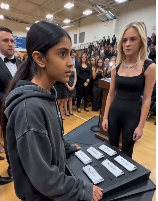
The room listened.
My eyes burned.
“Helena Varga.”
Another silence.
Then my mother whispered, “Helena kept the notebook?”
Helena covered her mouth.
I stared at the phone.
“So it is true.”
My mother’s voice trembled. “I was seventeen.”
The same age as me.
My knees weakened.
She continued, each word pulled from a place she had locked for years.
“I built the first alignment sheet. Cranston took it. They said nobody would believe a poor girl over a foundation. They offered money only after threatening my scholarship.”
Laurent said sharply, “That is enough.”
My mother heard him.
Her voice changed.
“Is Laurent Cranston there?”
No one answered.
Then she said, clear and cold:
“Tell him I kept the original contract.”
Laurent’s face drained of color.
Part 6: The Contract Hidden In A Biscuit Tin
The room seemed to lean toward the phone.
Laurent Cranston looked suddenly older, as if my mother’s voice had reached through the speaker and stripped varnish off him.
The director spoke first. “Mrs. Amin, what contract?”
My mother took a shaky breath.
“The settlement agreement they forced me to sign after Vienna.”
Laurent recovered enough to sneer. “A legally binding document.”
“No,” my mother said. “A document signed under threat.”
Marta Leclerc stepped closer to the microphone. “What threat?”
My mother paused.
I could hear the faint clatter of dishes in the background, the ordinary sounds of our kitchen colliding with this impossible room.
“They told me my father’s work permit renewal could be complicated. They told me my school recommendation could disappear. They told me I should be grateful for a small payment because girls like me did not own ideas.”
My hands curled into fists.
Helena was crying now.
Odette stared at her father as if every polished story he had told her was peeling apart.
Laurent pointed toward the phone. “This is hearsay.”
My mother said, “Then you will enjoy the recording.”
Nobody moved.
Even the display equipment seemed to quiet.
Laurent’s voice dropped. “What recording?”
“The one your father made by accident during the settlement meeting. He left the office dictation device on. A secretary copied it for me because she was tired of watching men smile while they ruined children.”
Marta Leclerc looked at the director. “Can she send it?”
My mother said, “I already am.”
My phone vibrated.
A file appeared.
My thumb hovered over it.
For one second, I was not in the ceremony anymore. I was eight years old, sitting at the kitchen table, watching my mother stretch soup with extra water and tell me we were lucky because we still had spices. I was twelve, seeing her hide a letter behind flour. I was sixteen, hearing her cry once behind the bathroom door and pretend she had dropped shampoo.
She had carried this alone.
For years.
Because they had taught her silence was survival.
I pressed play.
The old audio crackled through the speakers.
A man’s voice, older than Laurent’s but with the same smooth cruelty, filled the hall.
“Take the payment, Clara. No one will believe your little labels matter.”
Then a younger voice.
My mother’s.
Small, furious, terrified.
“They were not labels. They were the system.”
Another male voice said, “Systems belong to whoever can fund them.”
The recording stopped.
No one spoke.
Then Odette whispered, “Father, did you know?”
Laurent looked away.
That was enough.
Odette stepped back from him as if he had become something unclean.
The director opened the newly received file packet. More documents appeared: the settlement, the original alignment diagrams, the student work sheet with my mother’s name, the Cranston transfer order.
Marta Leclerc’s face hardened.
“This ceremony is now suspended pending formal inquiry.”
Laurent exploded.
“You cannot do that!”
“I can,” she said. “And I am.”
Odette suddenly looked at me.
Her eyes were wet, but there was still pride inside them, fighting to survive.
“I did not know about your mother,” she said.
I stared at her.
“But you knew about me.”
She flinched.
That mattered.
Not enough to forgive her.
Enough to make the truth sharper.
The director retrieved the ceremonial reader card from the display.
It still bore the first code I had placed.
He held it out to me.
“Khadija,” he said softly, “the first swipe is yours, if you want it.”
My leg hurt. My mother was crying through the phone. Helena was holding her notebook like a rescued child. Odette stood broken beside the father who had trained her.
I took the card.
Then the terminal flashed another message.
ADMINISTRATIVE LOCKDOWN INITIATED — ALL CARDS DISABLED
Laurent Cranston smiled.
Part 7: The Swipe That Should Have Failed
For a moment, nobody understood.
Then the technician lunged toward the keyboard. “He killed the system.”
Laurent’s smile widened just enough.
“If the program cannot be verified,” he said, “there is no ceremony, no proof of function, no public launch.”
Marta Leclerc turned on him. “You would destroy a library access project to protect yourself?”
He adjusted his cuff.
“I would prevent a corrupted demonstration from misleading the public.”
Odette stared at him. “Children need those cards.”
Laurent did not even look at her. “Children can wait.”
Something in her face collapsed.
Maybe that was the first honest pain she had felt all day.
Not for herself.
For the sudden discovery that her father’s beautiful language—legacy, standards, excellence—had always meant control.
The technician typed frantically. “He used master credentials. I cannot restore from here.”
The director looked sick. “The mobile libraries begin distribution tomorrow.”
“All cards?” Marta asked.
“All pilot cards,” the technician said. “If we cannot restore the index, none of them will scan.”
My fingers tightened around the ceremonial card.
Weeks of work. Hundreds of cards. Children in small towns waiting to borrow books without fees, without forms their parents could not understand, without being treated like visitors in public places that belonged to them too.
Laurent had not kicked my leg.
But this was the same violence in a cleaner suit.
Helena moved toward me.
“Khadija,” she whispered, “your manual sheet.”
I looked at her.
“What?”
“The one you made when the printer jammed. You said the system kept shifting digits, so you copied the corrected sequence by hand.”
I blinked.
The blue notebook.
My ugly little backup notebook with smudged ink, crossed-out lines, and every corrected code matched to every reader card batch.
Odette looked between us.
“You made a second log?”
I said, “I did not trust the printer.”
For the first time, Helena smiled.
“Good.”
My backpack was still beside the fallen display.
I limped toward it. Every step sent pain up my leg, but nobody tried to stop me now. The crowd parted, not with pity, but with something heavier.
Respect.
I pulled out the notebook.
Its cover was bent. One corner had a tea stain. Half the pages were wrinkled from the night rain that leaked through my old bag.
Laurent laughed.
“That is your rescue? A child’s scribbles?”
I opened to the first page.
“No,” I said. “It is the index.”
The technician’s head snapped up.
I handed it to him.
He scanned the page, then the next. His breathing changed.
“These are batch anchors,” he said. “You wrote the corrected root codes.”
“I wrote everything.”
He looked at the director. “If these match the physical card strips, I can rebuild the index locally.”
Laurent’s smile vanished.
Odette stepped toward the terminal. “Can I help?”
I turned on her.
“No.”
The word came out before I could soften it.
She stopped.
Good.
The technician worked fast. The projection shifted from red warnings to lines of restored code. One by one, the batches returned.
Antwerp.
Brussels.
Lyon.
Prague.
Vienna.
Springfield disappeared from the project banner as the original European archive names loaded beneath the system skin.
The whole launch had been dressed in false sponsor branding, but the bones were older, wider, public.
The technician inserted the ceremonial reader.
“Try it,” he said.
The director gestured to me.
My hand shook as I lifted the card.
I thought of my mother at seventeen. Of Helena writing names no one wanted remembered. Of every student who had stayed after closing while somebody richer rehearsed a speech.
I swiped.
For one awful second, nothing happened.
Then the terminal chimed.
Green light filled the screen.
ACCESS APPROVED — STUDENT WORK VERIFIED: KHADIJA AMIN
The room erupted.
But over the applause, my mother’s voice came through the phone, broken and proud.
“That sound,” she whispered, “is what they stole from me.”
Part 8: The Library Card With Two Names
The applause did not heal everything.
It could not.
It did not erase the pain in my leg, or the way Odette’s shoe had knocked me down, or the years my mother spent folding hotel sheets with an invention buried inside her.
But it did something.
It made silence impossible.
Marta Leclerc ordered the doors closed—not to trap anyone, but to preserve the records before another Cranston account could touch them. The technician copied the restored index to three public drives. The director signed the reader log in front of the cameras. Helena placed her old notebook beside it.
Laurent Cranston tried to leave with two lawyers and no apology.
Security stopped him at the door.
Odette stood alone near the display table, mascara smudged beneath one eye, diamond chain still shining against her black jumpsuit like a decoration from another life.
She looked smaller without people orbiting her.
Not harmless.
Just smaller.
My mother arrived forty minutes later.
She came still wearing her work shoes.
Her hair was pinned badly, her coat buttoned wrong, and her face looked like she had aged and become young again at the same time.
The second she saw me, she crossed the room and pulled me into her arms.
I tried not to cry.
I failed.
She held me carefully, avoiding my hurt leg, and whispered, “I am sorry I never told you.”
I pressed my face into her shoulder.
“I thought you were ashamed.”
She pulled back, eyes fierce.
“Never of you.”
Helena approached slowly.
For a moment, the two women only looked at each other.
Then my mother said, “You kept the notebook.”
Helena nodded. “I should have done more.”
My mother’s mouth trembled. “You remembered my name.”
Helena reached for her hand.
Sometimes justice begins there. Not in court. Not under cameras. In one person saying, after years of erasure, I remembered.
Odette walked toward us.
The room tensed.
My mother’s hand tightened around mine.
Odette stopped several steps away.
“I am not asking you to forgive me,” she said.
“Good,” I replied.
She swallowed.
“I want to make a statement.”
Marta Leclerc narrowed her eyes. “Why?”
Odette looked at her father, then at the reader terminal.
“Because if I do not say it now, I will become him.”
Laurent shouted from near the door, “Odette!”
She flinched.
Then she faced the cameras.
“My father told me Khadija Amin was trying to steal sponsor credit. I believed him because it was easier than questioning why every important name sounded like ours.” Her voice shook, but she kept going. “I attacked her. I lied. I tried to humiliate her. That was my choice.”
The room stayed silent.
She turned toward me.
“Khadija Amin earned the first swipe. Her mother, Clara Amin, built the work our family buried. The Cranston name should be removed from this project.”
Laurent roared something I could not make out.
Odette did not look back.
Marta Leclerc stepped forward. “Then what name should replace it?”
Everyone looked at me.
I looked at my mother.
She shook her head slightly, overwhelmed.
But I knew.
“The Reader Card Trust,” I said. “No family name. No sponsor name. Every card carries the name of the student who made or repaired it.”
The director smiled through tears. “That can be done.”
My mother touched the ceremonial card.
“No,” she said softly. “This one needs two names.”
I looked down.
The card was still warm from my hand.
Later, they printed a new one while the cameras waited. Not glossy. Not gold-edged. Just a simple library card with a corrected code and two lines beneath it.
Clara Amin — Original Alignment System
Khadija Amin — Reader Log Restoration
When my mother held it, her fingers shook.
Not from fear this time.
The inquiry that followed lasted months. Laurent Cranston lost control of the foundation. Old student records from Vienna, Lyon, Prague, Brussels, and Antwerp were reopened. Elise Bauer, Tomas Berger, Anika Weiss, and dozens of others received public correction letters and compensation from a fund built out of seized sponsor reserves.
Odette testified.
Not perfectly. Not nobly. Sometimes with anger. Sometimes with tears. But she testified against her father, and that mattered because truth from a spoiled mouth is still truth if it breaks the machine that spoiled it.
As for me, I did not become a symbol overnight.
I still had homework.
I still had worn sneakers.
My leg bruised purple for two weeks.
But the next ceremony was different.
It happened in Vienna, in the old library hall where my mother had once signed away her claim under threat. This time, she stood onstage in a deep blue dress borrowed from Helena, with her name printed on the official banner.
When the director handed her the first restored reader card, she looked at me like she was seeing both of us at seventeen.
Then she swiped it.
The terminal chimed.
Green light washed across her face.
For one second, my mother closed her eyes.
And I understood that the sound was not just access approved.
It was a door opening backward through time.
Afterward, a little girl with ink on her sleeve tugged my hoodie and asked, “What if someone says my work does not count?”
I knelt so we were eye to eye.
“Then you make a log,” I told her. “And you keep a copy.”
She nodded seriously, like I had handed her a sword.
Across the hall, my mother laughed with Helena. Odette stood near the exit, alone but listening, no cameras around her, no crown left to defend. For once, nobody was watching the sponsor’s daughter.
They were watching the students line up at the table, writing their names beside their work.
And every name stayed.
