The envelope beneath the rose bush should not have been there.
My father had spent his entire life protecting paper from moisture. He kept receipts in labeled folders, wrapped old photographs in acid-free sleeves, and once scolded me for setting a glass of water too close to a handwritten birthday card.
Yet the cream-colored envelope lay directly against the dark soil, wet with morning dew and streaked with mud.
My name was written across the front.
PAIGE.
No last name.
No formal greeting.
Just the name my father had written on lunch bags, school permission slips, and birthday cards for more than forty years.
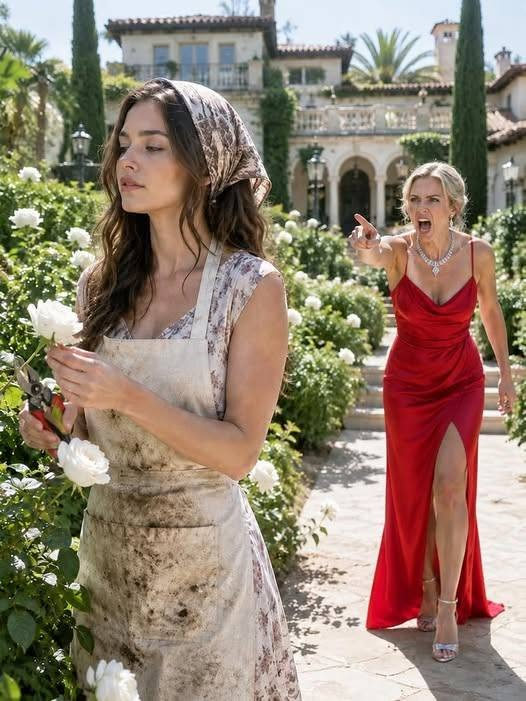
I lowered the pruning shears and carefully lifted the envelope from beneath the white rose bush.
Tabitha’s heels were still clicking somewhere beyond the garden wall.
A few moments earlier, she had stood among my father’s flowers and told me to start packing because she and my ex-husband intended to take the house after the will reading.
Then she had made the mistake that changed everything.
She mentioned my brother Kyle.
She said he had helped her understand my father’s state of mind during his final months.
Until that moment, I had assumed Tabitha’s confidence came from Calvin’s usual arrogance. My ex-husband had always believed that speaking with certainty could turn a lie into reality. He could announce that a restaurant reservation had been canceled, a bill had already been paid, or an affair was “just a misunderstanding” with such confidence that everyone around him briefly doubted their own memories.
But Tabitha had not merely been confident.
She had known something.
Something involving Kyle.
Something involving my dying father.
My fingers trembled as I opened the envelope.
Inside was a single folded page.
The ink had blurred along one edge, but the words were still readable.
My dearest Paige,
If you find this before Penelope arrives, do not call Calvin, Kyle, or anyone connected to them. Take the brass key from the potting shed and open the lower compartment of my desk.
Do not trust the will they expect to read.
Trust the roses.
Dad.
For several seconds, I could hear nothing but the wind moving through the leaves.
Do not trust the will they expect to read.
My father had died three weeks earlier after an eight-month battle with pancreatic cancer. His decline had been fast, merciless, and difficult to understand. One month he was walking through the garden with a cane, complaining that the roses were being overwatered. Two months later, he could barely sit upright without help.
During those final weeks, Kyle became strangely protective of him.
At first, I felt grateful.
My younger brother had always been restless. He changed jobs frequently, borrowed money he rarely repaid, and disappeared whenever responsibility entered the room. Yet after our father became ill, Kyle suddenly volunteered to manage medical appointments, household bills, and legal paperwork.
He told me I had already sacrificed enough.
“You’re here every day,” he said. “Let me handle the boring stuff.”
I wanted to believe illness had matured him.
Now, standing in the garden with my father’s warning in my hand, I wondered whether Kyle’s helpfulness had been something else entirely.
A car pulled into the driveway.
Ms. Penelope Ward arrived ten minutes after my call.
She had been my father’s attorney for thirty-two years and his closest friend for almost as long. She was seventy-one, with silver hair cut neatly beneath her jaw and the stern posture of someone who had spent decades watching wealthy people underestimate careful women.
She entered the garden carrying a leather briefcase.
When she saw the envelope in my hand, she stopped.
“Where did you find that?”
“Under the roses.”
“Which bush?”
“The first white one beside the stone path.”
Her expression tightened.
“Did anyone see you pick it up?”
“Tabitha had already left.”
Penelope looked toward the gate.
“Tell me everything she said.”
I repeated the conversation as accurately as I could.
Tabitha’s claim that Calvin had remained close to my father.
Her insistence that the house would belong to them.
Her comment about Kyle helping her understand my father’s state of mind.
The threat to tear out the roses.
At that final detail, Penelope’s gaze moved toward the flowers.
“She said that?”
“Almost proudly.”
Penelope released a slow breath.
“Your father was right.”
“About what?”
“That arrogance would make one of them reveal too much.”
She held out her hand.
I gave her the letter.
She read it twice.
“This is his handwriting,” she said.
“I know.”
“And this was not one of the letters he gave me.”
“How many did he give you?”
“Seven.”
My stomach tightened.
“Why did my father leave secret letters all over the property?”
“Because by the end, he no longer knew which legal documents he could trust.”
She closed the garden gate and locked it.
Then she turned to me.
“We need to go inside.”
My father’s house stood at the edge of a wooded property outside Lake Forest, Illinois. He had designed it himself before I was born—three stories of red brick, white columns, dark shutters, and wide windows that caught the afternoon light.
It was not the largest house in the neighborhood, but it had the kind of character money could not purchase later. Every doorway had been measured by my father. Every piece of stone had been selected with care.
Calvin used to call it the Hale estate, even though it had never belonged to him.
My maiden name was Bennett.
Calvin had always preferred calling the property by his own surname at dinner parties, as if marriage had transferred my family’s history into his possession.
After our divorce, I returned to the house to help my father through treatment.
He never asked why my marriage had ended.
He already knew.
The night Calvin admitted his affair with Tabitha, my father drove to our home, packed my belongings into his truck, and told my husband, “The greatest mistake of my life was believing you deserved my daughter.”
Calvin laughed then.
He said my father would calm down.
Apparently, he believed death had made forgiveness inevitable.
Penelope and I entered the potting shed at the back of the garden.
It smelled of cedar, fertilizer, and the peppermint candies my father kept in a chipped blue bowl. Gardening tools hung in perfect rows along the wall.
“The brass key,” I said.
We searched the shelves, drawers, and hooks.
Nothing.
Then I remembered my father’s habits.
He believed the best hiding places were visible but ordinary.
I picked up the chipped blue candy bowl.
A small key had been taped beneath it.
Penelope gave me a brief nod.
“Your father knew you would find it.”
The lower compartment of his desk was concealed behind a decorative wooden panel. I had played in that office as a child and never known the space existed.
The brass key opened a small lock beneath the center drawer.
Inside was a black metal box.
Penelope placed it on the desk.
“Before we open this,” she said, “you need to understand what happened during your father’s final months.”
I sat in his leather chair.
The cushion still carried a faint impression where his body had rested.
Penelope remained standing.
“Eight months ago, Everett contacted me because he believed money was disappearing from one of his accounts.”
“How much?”
“At first, seventy-five thousand dollars.”
I stared at her.
“He never told me.”
“He was ashamed.”
“My father had nothing to be ashamed of.”
“People who are deceived often feel shame that belongs to the deceiver.”
The words felt uncomfortably familiar.
After Calvin’s affair, I had spent months wondering what I had done wrong. I questioned my appearance, my career, my personality, and every ordinary argument in our marriage.
Calvin was the one who betrayed me.
Yet somehow, I had carried the embarrassment.
“What did Dad discover?” I asked.
“Several checks had been written using his signature. There were also withdrawals approved through an online account he rarely used.”
“Kyle had access.”
“Yes.”
Pain settled behind my ribs.
I remembered Kyle driving our father to appointments, bringing groceries, and posting sentimental photographs online.
MY HERO.
BEST DAD IN THE WORLD.
NEVER TAKING A SINGLE DAY FOR GRANTED.
Thousands of people had praised him for being a devoted son.
“How much did he take?”
“We still don’t know.”
Penelope placed her hand on the black box.
“Everett initially believed Kyle was acting alone. Then he learned Calvin had visited the house several times when you were at the hospital or pharmacy.”
“Tabitha said they still went to the club together every Sunday.”
“They did not.”
“But Calvin knew details about Dad’s health.”
“Kyle provided them.”
I looked toward the window.
The white roses moved gently in the wind.
“Why would Kyle help my ex-husband steal from our father?”
“Because Calvin promised him part of the estate.”
“That estate was never Calvin’s to promise.”
“Kyle had debts. Serious debts.”
I knew about some of them.
Failed businesses.
Sports betting.
A luxury car he could not afford.
But whenever I confronted him, he insisted everything was under control.
My father often rescued him.
Perhaps Kyle had begun thinking rescue was his inheritance.
Penelope inserted the brass key into the box.
It opened with a soft click.
Inside were copies of medical forms, bank records, photographs, and a small digital recorder.
On top rested a document titled:
LAST WILL AND TESTAMENT OF EVERETT JAMES BENNETT.
I looked at Penelope.
“Is this the real will?”
“One of them.”
“One of them?”
“Your father signed a new will four months ago. Then, six weeks before his death, Kyle produced another document supposedly replacing it.”
She removed a second copy.
This version left the house to Kyle.
It also appointed Calvin Hale as executor of the estate.
I read the lines twice, unable to accept them.
Calvin, who had cheated on me.
Calvin, whom my father had thrown out of this house.
Calvin, who had not attended a single chemotherapy appointment.
“He would never sign this.”
“I agree.”
“But tomorrow they plan to read it.”
“Yes.”
“Why?”
“Because Kyle filed it with the probate court two days after your father died.”
I stood so quickly that the chair rolled backward.
“And you didn’t tell me?”
“I needed to know who was involved before challenging it.”
“You let me think tomorrow was a normal will reading.”
“No will reading is legally required in the dramatic sense people imagine. But Calvin arranged a family meeting and insisted everyone attend. He wants the forged document accepted before questions begin.”
“Why would he involve Tabitha?”
“Because Calvin never does anything without an audience.”
I picked up the recorder.
“What is on this?”
“Your father’s insurance.”
Penelope pressed the play button.
Static filled the office.
Then I heard my father’s voice.
It was weaker than I remembered but unmistakably clear.
“This is Everett Bennett. Today is March fourteenth. I am recording this because my son Kyle brought me a legal document and told me Penelope had prepared it.”
My throat tightened.
On the recording, my father coughed.
“The document appointed Calvin Hale as executor and transferred my home to Kyle. I did not sign it. I pretended I was too tired to read.”
A second voice entered.
Kyle.
“You don’t have to read every page, Dad. Calvin already checked it.”
My father answered, “Calvin is not my lawyer.”
“He understands these things.”
“No, son. Calvin understands how to take things that do not belong to him.”
There was a long silence.
Then Kyle’s voice became colder.
“You’ve always trusted Paige more.”
“I trust Paige because she has never treated my love like a bank account.”
The recording ended.
I covered my mouth.
My father had known.
He had known his own son was trying to deceive him, yet he continued allowing Kyle into the house.
“Why didn’t he confront him?” I asked.
“He wanted evidence.”
The answer sounded like him.
My father had built a construction company from nothing. He believed in measurements, records, and foundations. He never tore down a wall until he understood what supported it.
Penelope lifted a stack of photographs.
They showed Kyle entering the office.
Calvin arriving through the side door.
Tabitha photographing documents with her phone.
The images had been captured by a hidden camera.
One photograph made my blood run cold.
A woman in medical scrubs stood beside my father’s medication cabinet while Kyle watched.
“Who is she?”
“Her name is Denise Mallory. She worked for the private nursing agency Kyle hired.”
I remembered Denise.
She had been efficient, quiet, and strangely protective of my father’s medication. Whenever I offered to help, she insisted everything had to follow strict medical protocols.
“Did she hurt him?”
“We do not know.”
The thought was almost impossible to hold.
My father had been dying.
But there were different ways to die.
There was illness.
And there was betrayal disguised as care.
Penelope handed me a toxicology report.
“Everett became suspicious after he felt unusually confused following certain doses. He asked his oncologist to order independent testing.”
The report identified unusually high levels of a sedative not included in his treatment plan.
My knees weakened.
“They drugged him.”
“It appears they were trying to make him seem mentally incompetent.”
“Why?”
“To create medical support for the forged will.”
I thought of Tabitha standing in the garden.
Kyle helped me understand your father’s state of mind.
She had not been speaking casually.
She had been referring to a plan.
A plan to portray a sick man as confused.
A plan to steal his home.
A plan Calvin probably believed had succeeded.
I looked down at the documents.
“Why are we waiting until tomorrow?”
“We aren’t.”
Penelope took out her phone.
“I contacted Detective Alvarez before coming here. He is already reviewing the evidence.”
“Then why attend Calvin’s meeting?”
“Because your father wanted them to believe they had won.”
I stared at her.
Penelope opened another envelope.
Inside was a note addressed to her.
She read aloud.
“Let Calvin present the false will. Let Kyle defend it. Let Tabitha speak freely. People reveal themselves most clearly when they believe the consequences belong to someone else.”
A tear escaped before I could stop it.
Even near death, my father had understood them.
“He planned all of this?”
“He planned more than I knew.”
Penelope lifted the final document from the box.
It was another will.
This one left the house and garden to me.
Most of the financial estate was divided among several charities, long-term employees, and a trust for my brother’s two children.
Kyle himself would receive one dollar.
There was also a clause I had never seen before.
Any beneficiary found to have coerced, manipulated, drugged, or defrauded Everett would forfeit all claims and become liable for the cost of investigating the estate.
My father had built a trap into his legacy.
But one question remained.
“Why did he hide the letter beneath the roses?”
Penelope looked toward the garden.
“I don’t think Everett placed it there.”
The air in the office changed.
“Who did?”
“We need to find out.”
That afternoon, Detective Sofia Alvarez arrived with a forensic technician. They photographed the envelope, the hidden compartment, and the documents.
The envelope contained two sets of fingerprints.
Mine.
And Tabitha’s.
“She touched it,” I said.
“Or placed it,” Detective Alvarez replied.
“That makes no sense. Why would she give me evidence?”
“Perhaps she did not know what was inside.”
Then I remembered Tabitha’s heels sinking into the soil.
She had not walked along the stone path like a visitor familiar with the garden.
She had stepped directly beside the rose bush.
“Maybe she was looking for something,” I said.
Penelope nodded slowly.
“Everett may have told them he hid documents near the roses.”
Tabitha’s visit had not simply been an act of humiliation.
She had come to search.
Her threat to tear out the rose bushes was not merely cruel.
She believed something valuable was hidden beneath them.
That was her mistake.
By talking too much, she had revealed exactly where we needed to look.
We searched the garden until sunset.
Under the third white rose bush, the technician discovered a waterproof container buried beneath the roots.
Inside were three flash drives and a handwritten ledger.
The flash drives held security recordings from the house.
The ledger documented every withdrawal Kyle had made, every visit Calvin arranged, and every suspicious medication episode.
My father had recorded dates, times, and names in his precise handwriting.
The final page contained only one sentence.
If Paige is reading this, tell her the roses were never about Calvin.
I read it several times.
“What does that mean?”
Penelope’s eyes filled with sadness.
“Your father planted the white roses on your wedding day because you believed they represented a fresh beginning.”
“I remember.”
“But he continued caring for them after the divorce because he said their meaning had changed.”
“To what?”
“Survival.”
The next morning, Calvin arrived at the house as though he already owned it.
He wore a navy suit, a gold watch, and the expression of a man attending his own coronation.
Tabitha walked beside him in a white designer dress. She smiled when she saw my suitcases near the staircase.
I had packed them exactly where she suggested.
What she did not know was that they were empty.
Kyle entered a few minutes later.
He avoided my eyes.
The sight of him hurt more than seeing Calvin.
My brother looked tired and frightened. For a moment, I remembered the boy who used to follow me through the garden, crying whenever bees came too close.
Then I remembered my father’s drugged confusion.
Childhood could not excuse adulthood.
We gathered in the library.
Penelope sat at my father’s desk.
I took a chair near the window.
Two people introduced as representatives from the bank stood near the door.
They were actually financial investigators.
Detective Alvarez waited in an adjoining room with two officers.
Calvin looked at his watch.
“Can we begin? Tabitha and I have contractors coming this afternoon.”
“You scheduled contractors before the estate was settled?” Penelope asked.
“The outcome is obvious.”
Tabitha crossed her legs.
“We’re trying to be efficient.”
Kyle rubbed his palms against his trousers.
Penelope opened the file containing the forged will.
“This document was filed by Kyle Bennett and appoints Calvin Hale as executor.”
Calvin smiled.
“Correct.”
“It transfers the property to Kyle.”
“With an understanding between us,” Calvin added.
I looked at my brother.
“What understanding?”
Kyle finally met my eyes.
“Calvin is buying my share.”
“You don’t have a share yet.”
“I will in a few minutes.”
Tabitha laughed softly.
“There’s no need to make this unpleasant, Paige.”
“No,” I said. “There really isn’t.”
Penelope continued reading.
The false will gave Kyle the house, assigned several accounts to Calvin’s management, and left me a small collection of jewelry belonging to my mother.
Calvin leaned back with visible satisfaction.
“So that’s settled.”
“It is not,” Penelope said.
She placed the document on the desk.
“Mr. Hale, when did Everett sign this?”
“Six weeks before his death.”
“Were you present?”
“Yes.”
Tabitha looked at him sharply.
That answer had not been rehearsed.
Penelope remained calm.
“Who else was present?”
“Kyle.”
“Anyone else?”
“The nurse.”
“Denise Mallory?”
“Yes.”
“And Everett understood the document?”
“Perfectly.”
Kyle swallowed.
Penelope turned to him.
“Do you agree?”
He hesitated.
Calvin’s eyes hardened.
“Yes,” Kyle said. “Dad knew what he was signing.”
“Was he medicated?”
“He was receiving cancer treatment.”
“That was not my question.”
Kyle’s voice weakened.
“He took whatever his doctor prescribed.”
Tabitha interrupted.
“Everett was completely lucid. I spoke to him that afternoon.”
I looked at her.
“You were here?”
She realized too late that Calvin had not mentioned her.
“Well, briefly.”
Penelope folded her hands.
“What time?”
“About three.”
Calvin stared at her.
Tabitha shifted in her seat.
“Maybe four.”
“Were you present when Everett signed?”
“I may have been in the hallway.”
Penelope opened another folder.
“Interesting.”
The confidence began leaving Tabitha’s face.
Penelope placed a photograph on the desk.
It showed Tabitha inside the office at 2:47 that afternoon, holding the unsigned will while Kyle stood beside the medication cabinet.
“This image was taken before Everett supposedly signed.”
No one spoke.
Penelope added a second photograph.
Denise was preparing a syringe.
Then a third.
Calvin was positioning my father’s hand over the signature line.
Kyle stood abruptly.
“This is being twisted!”
The library door opened.
Detective Alvarez entered.
“I suggest you sit down.”
Kyle froze.
Calvin did not.
“This is a private estate matter.”
“It became a criminal matter when someone administered an unprescribed sedative to Everett Bennett.”
Tabitha’s face went white.
“I didn’t give him anything.”
No one had accused her specifically.
Detective Alvarez looked at her.
“What did you believe he was given?”
“I don’t know.”
“But you knew he was given something.”
“No. I meant—Calvin told me it was normal medication.”
Calvin turned on her.
“Stop talking.”
The same arrogance that brought her into the garden now drove her to defend herself.
“You said it would only make him sleepy.”
Kyle whispered, “Tabitha.”
She pointed at him.
“You hired Denise!”
Calvin rose.
“This meeting is over.”
One of the investigators blocked the door.
“No one is leaving.”
Penelope removed the digital recorder from her briefcase and played my father’s statement.
His voice filled the library.
He described the false document, Kyle’s pressure, Calvin’s involvement, and his suspicion that his medication had been altered.
Kyle began crying before the recording ended.
“I needed money,” he whispered.
I looked at him.
“So you helped them drug Dad?”
“I didn’t know it would hurt him.”
“You watched a nurse inject him.”
“She said it was safe.”
“You knew it was not prescribed.”
He covered his face.
“Calvin said Dad would change his mind once he understood the plan.”
“What plan?”
Kyle looked at Calvin.
My ex-husband remained silent.
Detective Alvarez answered.
“The property is worth approximately nine million dollars. Developers have been attempting to purchase the surrounding land for years.”
I stared at Calvin.
He had never wanted the house.
He wanted the land beneath it.
Tabitha’s comments about remodeling and removing the roses had been a distraction.
Calvin planned to demolish everything.
“You were going to sell it,” I said.
He adjusted his cuffs.
“It is an inefficient use of valuable property.”
“My father’s home?”
“Sentiment does not pay taxes.”
Kyle had been promised two million dollars.
Tabitha expected a luxury apartment from the sale.
Calvin intended to keep the rest.
But my father had discovered the plan.
That was why Calvin needed a forged will, a compromised witness, and medical evidence suggesting my father lacked capacity whenever he contradicted them.
Penelope slid the real will across the desk.
“This is Everett Bennett’s valid final will, signed four months before his death and witnessed by three independent parties.”
Calvin barely looked at it.
“We’ll challenge it.”
“You are welcome to try.”
She opened the document.
“The house and garden pass to Paige Bennett.”
Tabitha gripped the arm of her chair.
“No.”
“The remaining estate funds charitable trusts, employee pensions, and educational accounts for Kyle’s children.”
Kyle looked up.
“My children?”
“Your father protected them from your debts.”
“And me?”
Penelope read the clause awarding him one dollar.
His face crumpled.
Calvin laughed coldly.
“This is not over.”
“You are correct,” Penelope said.
“It is not.”
She presented the handwritten ledger, the recordings, and the toxicology report.
Detective Alvarez then informed Calvin, Kyle, and Tabitha that they were under investigation for attempted inheritance fraud, forgery, financial exploitation of a vulnerable adult, conspiracy, and unlawful administration of controlled medication.
Calvin’s expression remained almost calm.
“You cannot prove Everett did not willingly sign.”
My father had anticipated that too.
Penelope turned toward the wall beside the fireplace.
There, above a row of old family photographs, hung a landscape painting.
She removed it.
Behind it was a small camera.
The investigators played the final recording on the library television.
My father sat at his desk, visibly weak but alert.
Calvin placed the false will in front of him.
“Sign it,” my ex-husband said.
My father looked at him.
“You betrayed my daughter.”
“This is business.”
“You built nothing. You only learned how to stand beside people who did.”
Calvin’s expression hardened.
Kyle moved behind my father’s chair.
“Dad, just sign.”
My father pushed the document away.
Then Denise entered with the syringe.
The recording stopped before the injection.
It did not need to show more.
Tabitha began sobbing.
Kyle collapsed into his chair.
Calvin stared at the blank screen.
For fifteen years, I had believed I understood the man I married.
I thought his greatest betrayal was choosing another woman.
I was wrong.
His greatest betrayal was believing every person around him existed to be used.
The officers handcuffed him first.
As they led him toward the door, he looked at me.
“Paige, tell them this is family business.”
I remembered all the times he had asked me to protect his reputation.
The suspicious messages.
The missing evenings.
The lipstick on his shirt.
Whenever I questioned him, he accused me of trying to embarrass him.
Now, even in handcuffs, he expected my silence.
“You stopped being my family when you decided my father’s death was a business opportunity.”
Tabitha struggled as an officer approached her.
“I didn’t plan any of this. Calvin manipulated me.”
“You came here yesterday,” I said. “You threatened me in my father’s garden.”
“I was angry.”
“You searched beneath the roses.”
Her eyes widened.
That was the final confirmation.
“You found the envelope,” I continued. “But you didn’t open it.”
“I thought it contained the original property survey.”
Calvin closed his eyes.
Tabitha had believed the survey identified a boundary issue that could delay the development sale. She found the envelope but heard my car returning from the pharmacy, so she shoved it beneath the nearest bush and planned to retrieve it later.
Then, after my father’s funeral, she returned to search.
Instead of staying quiet, she boasted that the roses would be removed.
Her arrogance led me directly to the evidence.
“You ruined everything,” Calvin said to her.
Tabitha stared at him.
“No. You did.”
They were taken away separately.
Kyle remained in the library.
Because he cooperated immediately and testified against Calvin, Tabitha, and Denise, he later received a reduced sentence.
But reduced did not mean erased.
He lost his freedom for several years.
He lost access to the trust created for his children.
Most painfully, he lost the right to pretend his betrayal had been an accident.
Before the officers took him, he asked me one question.
“Did Dad hate me?”
I looked at the rose garden through the library window.
“No.”
Kyle began crying.
“I think that hurt him more.”
The criminal cases lasted nearly two years.
Calvin was convicted of conspiracy, forgery, attempted financial exploitation, and multiple fraud charges connected to other estates he had helped manipulate through his development company.
My father had not been his first target.
Tabitha accepted a plea deal and testified that Calvin taught her how to search private homes for financial records while pretending to offer grieving families “estate assistance.”
Denise lost her nursing license and went to prison.
Kyle’s testimony helped uncover the broader scheme.
The judge acknowledged his cooperation but reminded him that desperation did not excuse what he had done to his father.
During sentencing, Kyle turned toward me.
“I’m sorry.”
For once, I believed him.
But belief was not forgiveness.
Not yet.
Perhaps not ever.
The house remained mine.
Developers continued sending offers.
Some were almost impossible to refuse.
I refused them anyway.
I did not keep the property because walls mattered more than people. I kept it because my father had wanted it to become something living rather than a monument to grief.
With money recovered from the fraud case, I transformed part of the house into the Everett Bennett Center for Elder Protection.
We provided legal assistance, financial reviews, and emergency advocacy for older adults facing coercion, forged documents, or exploitation by relatives.
Penelope became the center’s first volunteer director.
She claimed she was retired.
No one believed her.
The guest wing became temporary housing for elderly people whose caregivers had stolen from them.
My father’s office became a consultation room.
The hidden compartment remained beneath the desk.
Inside, I placed a copy of his letter.
Trust the roses.
I kept the white rose bushes exactly where they had always been.
Every spring, they returned.
Some branches died during harsh winters. Others grew in unexpected directions. I learned that pruning was not about forcing a plant into perfection.
It was about removing what was damaged so the rest could breathe.
Three years after the will reading, I received a letter from Kyle.
He was still in prison.
He wrote that he had joined a financial responsibility program and was working in the library. He did not ask for money or forgiveness.
At the end, he wrote:
Dad once told me thorns have a purpose. I thought he meant they hurt people who came too close. Now I think he meant they protect something that still deserves to grow.
I folded the letter and placed it in my father’s desk.
Then I went outside.
A woman named Ruth was waiting near the garden path with her adult granddaughter. Ruth’s son had convinced her to sign documents she did not understand and was attempting to sell her home.
She looked frightened.
“I don’t want my family arrested,” she told me.
“You don’t have to decide anything today.”
“I only want my house back.”
“Then we’ll begin there.”
As Penelope led them inside, I returned to the roses.
The morning was cool, and drops of water rested on the petals.
For years, I thought the flowers represented the beginning of my marriage.
Then I believed they represented its failure.
My father had understood their real meaning before I did.
They were not symbols of Calvin.
They were proof that something could survive being cut back.
Proof that a season of damage did not have to become the end.
I trimmed a dead branch from the first bush beside the path.
That was where I had found the envelope.
That was where Tabitha’s mistake had begun unraveling everything.
She came to my father’s house expecting to watch me pack.
Instead, she revealed the hidden alliance between my ex-husband, my brother, and the woman entrusted with my father’s care.
Calvin believed the will would make him rich.
Instead, it became the document that led investigators to every crime he had tried to bury.
Kyle believed our father’s love was something he could convert into money.
Instead, he learned too late that love could protect his children while refusing to reward his betrayal.
And I believed I had returned to the house only to care for a dying parent.
In truth, my father had left me one final lesson.
A legacy was not simply property passed from one generation to another.
It was truth protected long enough to reach the person willing to defend it.
I wiped the pruning shears clean and looked across the garden.
The white roses moved beneath the morning sun.
They were still standing.
So was I.
THE END
