Part 2: The Deletion Trail Under Her Name
The project lead did not raise his voice.
That made it worse.
He stood beside the flickering screen while water dripped from my sleeves onto the concrete, each drop sounding louder than the stunned crowd.
“Archive access, 8:13 this morning,” he read. “User: Brielle Harrington.”
Brielle’s face lost its color.
For one second, she looked at the screen like it had betrayed her personally.
Her father, Conrad Harrington, stepped toward the projector table. “Turn that off.”
Nobody moved.
The project lead, Emil Varga, glanced at him. “This is a public restoration archive tied to county funding. It stays on.”
Conrad’s jaw tightened.
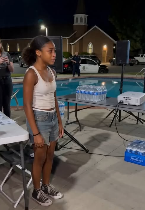
The pool water clung to my old clothes, dragging them heavy against my skin. My shoes squelched when I shifted my weight. A volunteer had thrown a towel over my shoulders, but I could still feel every camera watching me try not to shake.
Brielle pointed at me.
“She probably used my login.”
A murmur spread through the folding chairs.
Emil clicked the next entry.
The screen showed a security still from the restoration room: Brielle in a cream designer dress, diamond earrings flashing, standing beside the archive terminal that morning.
Her hand was on the mouse.
Below the image was the deleted credit line.
Restored missing frames: Nala Bailey.
Then the replacement line.
Ceremonial contributor: Brielle Harrington.
Someone gasped.
Brielle’s father whispered, “Brielle.”
She spun toward him. “They are making it look worse than it is.”
Emil’s face stayed hard. “You attempted to remove Nala from the opening reel, the printed program, and the archive record.”
“That archive is messy,” Brielle snapped. “Everybody edits it.”
I lifted my head.
My throat burned from chlorine and humiliation, but I forced the words out.
“Not everybody deletes another student before pushing her into a pool.”
The crowd went still again.
Brielle’s eyes narrowed. “You fell.”
The lie landed so cleanly, so easily, that something inside me steadied.
I had spent years around people who lied with beautiful teeth. I knew what it sounded like when a rich person expected the room to bend.
Emil clicked again.
A second video filled the giant screen.
It showed the poolside performance area from above. Me standing near the vintage projector. Brielle stepping close. Her arm shooting forward. My body stumbling backward. The splash rising white under the lights.
No angle could rescue her.
Everyone saw what she did to me.
This time the room did not gasp.
It went silent in a colder way.
Brielle stared at the footage until her mouth opened and closed with no sound.
County officials began whispering. Reporters lifted microphones. PTA volunteers who had been smiling beside bottled water crates now looked at the Harrington table like they were seeing rot under fresh paint.
Conrad Harrington reached for Emil’s arm.
Emil stepped back.
“Do not touch me.”
That was when Brielle’s expression changed.
Not fear.
Fury.
“You think she restored those frames?” she said, laughing too loudly. “Ask her where she got the lost reel.”
My stomach dropped.
Emil froze.
Brielle smiled at me through the pool lights.
“Go on, Nala,” she said. “Tell them what you stole.”
Part 3: The Reel Hidden In The Church Basement
For a heartbeat, the entire ceremony shifted away from Brielle and landed on me.
The towel around my shoulders suddenly felt like a witness blanket.
“What does she mean?” a county official asked.
Brielle folded her arms, pleased with the damage she had finally found.
“She had no authority to touch the lost reel,” she said. “It was Harrington property.”
Emil looked at me carefully. “Nala?”
I wanted to answer fast.
I wanted to say she was twisting it.
But I had learned that truth sounded weaker when it rushed.
So I breathed once, tasted chlorine, and said, “The reel was not Harrington property.”
Brielle scoffed.
I kept my eyes on Emil.
“It was found in the basement of St. Maren’s Church beside the old parking lot. The label was water-damaged. The canister had no sponsor marking. Father Anton asked the student restoration group if anyone could identify it.”
A few church volunteers nodded immediately.
An older woman in a blue cardigan stood near the folding tables. Her name was Greta Lechner, and she had handed out bottled water all afternoon.
“That is true,” Greta said. “I was there when Father Anton opened the storage cabinet.”
Conrad Harrington’s face tightened. “The Harrington Foundation funded the original silent film exhibition decades ago.”
“Funding is not ownership,” Emil said.
Brielle’s smile thinned.
I stepped closer to the projector table. My legs were still trembling, but anger had become a stronger bone inside me.
“The reel was almost ruined. Vinegar smell, warped edges, missing frames, broken splices. Nobody wanted to touch it because if it tore, everyone would blame the poor girl who tried.”
The words came out sharper than I expected.
A reporter lowered her microphone slightly, listening.
“I scanned it after school. I matched the missing frames to the still-photo archive. I rebuilt the opening sequence from fragments. I uploaded every fix with timestamps because I knew someone would try to say it was not mine.”
Brielle looked away.
Only for a second.
But I saw it.
Emil opened another archive folder. “Nala’s account uploaded thirty-six restoration passes. Brielle’s account uploaded none.”
Conrad’s voice hardened. “My daughter was placed in a ceremonial sponsor role. She was never expected to perform technical labor.”
“Then why was my name replaced with hers?” I asked.
He did not answer.
Greta stepped forward again, clutching a small key ring.
“There is another record,” she said.
Conrad’s head snapped toward her.
Greta’s voice trembled, but she continued.
“The church kept donation ledgers from the original film nights. St. Maren’s never sold the reels to Harrington. They were loaned for public screening. After the old program closed, several reels disappeared.”
The crowd stirred.
Brielle snapped, “That has nothing to do with tonight.”
Greta looked at Emil. “It has everything to do with tonight.”
She placed a brown envelope on the table.
Emil opened it.
Inside was a faded ledger page, the ink old but readable beneath the poolside lights.
His eyes moved across the columns.
Then he looked at Conrad Harrington.
“This says three reels were removed from church storage in 1998 by a Harrington Foundation employee.”
Conrad smiled tightly. “Administrative transfer.”
Greta shook her head.
“No. The note says temporary inspection.”
Emil turned the page.
The giant screen caught the scanned ledger line.
Reels not returned. Family requested silence before donor gala.
Brielle whispered, “Dad?”
Conrad’s expression did not change.
But his hand closed around the back of a chair so tightly his knuckles turned white.
Then the vintage projector behind us suddenly clicked on by itself.
The opening reel began to turn.
And the first restored frame appeared on the screen.
Part 4: The Frame That Showed The Old Crime
The image flickered in black and white.
At first, it looked harmless—just a grainy poolside performance from decades earlier, children sitting cross-legged near a silent film screen, women in summer dresses, men in pale shirts carrying wooden crates.
Then Emil whispered, “Wait.”
The frame steadied.
A young man stood near the edge of the shot, half hidden behind the projector cart. He was lifting a film canister into a leather case.
Greta inhaled sharply.
“That is Markus Harrington.”
Conrad’s father.
The old sponsor name that appeared on plaques, banners, scholarship envelopes, donor walls, and every speech about community generosity.
The projector rattled softly.
Another restored frame flashed.
Markus Harrington handing cash to a church caretaker.
Another.
The caretaker shaking his head.
Another.
Markus placing the canister into the case anyway.
The crowd watched the dead past accuse the living present.
Conrad said, “This is absurd. Silent film frames have no context.”
Emil’s voice was low. “They have enough.”
Brielle stared at the screen like she wanted to hate it but could not stop watching.
I remembered that frame.
I had almost deleted it as damage.
It had taken me five nights to restore the corner detail. I had thought it was unimportant, just background movement near the projector cart.
But my notes had said: possible handling of film canister — preserve.
I had preserved the evidence that Brielle’s family had buried.
A county official approached the screen. “Are you telling us this restored reel documents the original removal?”
Greta’s eyes shone. “Yes.”
Conrad’s calm finally cracked.
“You cannot rewrite family history because of a few dirty frames and a wet student with a grudge.”
The words hit the room badly.
A wet student.
Not Nala.
Not the person standing there shaking under a towel after his daughter shoved me into a pool.
Something changed in Emil’s face.
He removed his glasses and set them carefully on the table.
“Mr. Harrington,” he said, “this project exists because students restored what adults neglected. If Nala had not saved those frames, your family’s old theft would still be hiding inside decay.”
Brielle snapped, “Do not call it theft.”
Greta turned on her.
“What else do you call taking community property and letting people thank you for generosity afterward?”
Brielle stepped back as if the old woman had slapped her.
Conrad’s phone buzzed. Then buzzed again. Then others followed.
Reporters were already posting.
The footage of the shove.
The deletion logs.
The restored frames.
The Harrington family’s perfect ceremony was falling apart in real time.
Then a man in a dark coat entered from the church parking lot side of the venue.
He moved slowly, leaning on a cane, but every church volunteer seemed to know him. Greta covered her mouth when she saw him.
“Father Anton,” she whispered.
The old priest looked at the screen, then at me.
“You restored the missing reel?”
I nodded.
His eyes filled with something too old to be surprise.
He reached into his coat and pulled out a small metal film canister.
“The one you found was not the only reel,” he said.
Conrad went pale.
Father Anton lifted the canister.
“This one shows why Markus Harrington wanted the others gone.”
Part 5: The Priest Who Kept The Worst Reel Safe
Nobody moved when Father Anton placed the canister on the table.
It was dented, scratched, and marked with a strip of yellowing tape.
Pool Benefit Night — Final Reel.
Conrad’s voice dropped. “That belongs to my family.”
Father Anton looked at him sadly.
“That is what your father said when he came for it in 1998.”
Greta’s hand flew to her chest.
“You never told us.”
“I could not prove what was on it,” Father Anton said. “And I was afraid he would destroy it.”
His gaze shifted to me.
“Then I saw Nala’s restored frames tonight. I realized the truth had already begun without me.”
Emil handled the canister as carefully as glass. “Can it be played?”
I wiped water from my face. “Not directly.”
Everyone looked at me.
“It has to be scanned. If the film is brittle, the projector could tear it apart.”
Brielle laughed weakly. “Convenient.”
I turned toward her.
“Do you want it played so badly you are willing to destroy it?”
Her mouth closed.
The question landed because everyone knew that was exactly what people like her did when truth became fragile.
Emil signaled to the restoration technician, Lars Meijer, who had been managing the archive station. Lars took the reel and moved it to the portable scanner beside the pool equipment table.
The waiting hurt.
My clothes were still soaked. My leg had bumped the pool wall when I fell, and a deep ache had begun spreading through my hip. But I would not leave. Not while Brielle stood dry in diamonds pretending she was the injured one.
The scanner began to hum.
Frame by frame, the final reel appeared.
At first, it showed the end of an old poolside charity night. Guests applauding. Children waving. A silent film title card: For The Public Library Fund.
Then the image cut to the storage room.
Two men stood beside stacked film cases.
One was Markus Harrington.
The other was younger, anxious, holding a clipboard.
Father Anton gripped the back of a chair. “That is Elias Becker.”
Greta whispered, “The student archivist.”
On screen, Markus pointed to the cases. Elias shook his head. Markus leaned close, his face sharp even without sound.
Then came a handwritten title card, inserted between frames, likely by whoever had filmed it:
Sponsor Demands Reels Be Removed Before Audit.
The crowd made a low, horrified sound.
Another frame.
Elias blocking the doorway.
Another.
Markus shoving him aside.
Not hard enough to be dramatic.
Hard enough to tell the truth.
A final title card appeared.
If I Lose My Place, Let The Film Speak. — E.B.
Father Anton bowed his head.
“What happened to him?” I asked.
Greta answered quietly. “Elias Becker was blamed for losing the reels. He lost his scholarship. Left the city before the year ended.”
My stomach turned.
Another student.
Another erased name.
Brielle’s face had gone strangely blank.
Maybe she was seeing the shape of her family for the first time.
Conrad was not blank.
He was furious.
“This is ancient gossip,” he said. “My father is dead.”
Father Anton looked up.
“Elias Becker is not.”
The room jolted.
Conrad froze.
Father Anton nodded toward the church parking lot.
A thin elderly man stood under the lights near the bottled water crates, one hand resting on the shoulder of a younger woman.
His face was pale, but his eyes were fixed on the screen.
Father Anton said, “He came tonight because Nala’s restoration put his name back where your family removed it.”
Part 6: The Archivist They Blamed For Everything
Elias Becker walked slowly into the poolside light.
The applause did not come.
No one knew what sound belonged to a man returning to the scene of a stolen life.
He wore a brown coat too heavy for the weather and held a folded program in one hand. The younger woman beside him—his granddaughter, Lena—kept her arm close behind him without touching, ready if he needed support.
Elias stopped in front of the screen.
For a long moment, he stared at his younger self in the restored film.
Then he looked at me.
“You found my card.”
I did not understand.
He reached into his coat and took out a faded archive badge.
Elias Becker — Student Film Custodian.
The same name I had seen once, barely visible on the edge of a damaged frame.
“I tried to restore that badge,” I said softly. “The letters were almost gone.”
“But you did not erase them.”
“No.”
His eyes filled.
“That was more mercy than I received from adults.”
Conrad stepped between us. “This is becoming theatrical.”
Elias turned toward him.
His voice was thin, but it carried.
“Your father made me sign a statement saying I misplaced the reels. He said if I refused, he would tell the scholarship board I had stolen equipment.”
Conrad’s lips tightened. “I know nothing about that.”
“You inherited the foundation archive.”
Conrad said nothing.
Elias unfolded the program in his hand. It was tonight’s glossy booklet.
On the front, Brielle smiled beside a headline about the Harrington legacy preserving forgotten cinema.
Elias touched the paper with one finger.
“I came tonight because I wanted to see whether your family had finally learned how to return what it took.”
His voice broke slightly.
“Then I watched your daughter push another student into water for standing near her own work.”
Brielle flinched.
It was small.
But real.
Elias looked at her.
“Child, someone taught you that cruelty was inheritance.”
Brielle’s eyes flashed with tears. “Do not talk to me like you know me.”
“I know the shape of it,” Elias said. “I have lived under it longer than you have been alive.”
The words silenced her.
Lars finished scanning the reel. “There are documents at the end.”
Emil frowned. “Documents?”
Lars projected the final frames.
They showed paper laid under bright light, filmed deliberately by Elias decades ago. A loan agreement. A public ownership clause. A scholarship recommendation letter for Elias. Then a handwritten note across it:
Destroy after Harrington gala.
Below it was a signature.
Markus Harrington.
But beside it, in the corner, was a second signature as witness.
Conrad Harrington.
The younger version.
Not his father.
Him.
The crowd erupted.
Conrad staggered backward.
Brielle stared at him.
“You said you did not know.”
Conrad’s face hardened. “I was a teenager.”
“So was Elias,” I said.
The words escaped before I could stop them.
Conrad turned toward me with pure contempt.
“You are very proud for someone who was nothing before tonight.”
Something inside Brielle snapped.
“Stop.”
He looked at her.
She was shaking, but she stepped away from him.
“Stop talking to her like that.”
The pool lights shimmered behind us. The projector kept clicking softly, as if the old film itself was breathing.
Conrad’s voice went cold. “Do not embarrass me further.”
Brielle laughed once, broken and bitter.
“I embarrassed you? I learned from you.”
Then she turned toward Emil.
“I have the foundation drive.”
Conrad’s face changed.
“Brielle.”
She reached into her designer bag and pulled out a silver flash drive.
Her hand trembled as she held it up.
“He made me delete her name,” she said. “And he made me practice what to say after she was gone.”
Part 7: The Drive Brielle Was Never Supposed To Use
Conrad lunged.
Security reached him first.
The movement was so sudden that several guests cried out, chairs scraping across concrete as people backed away from the pool.
Brielle clutched the drive to her chest.
For the first time all night, she looked genuinely afraid of her father.
Not annoyed.
Not spoiled.
Afraid.
Emil stepped between them. “Give it to me.”
Brielle hesitated.
I did not know what I wanted.
Part of me wanted her punished so completely she would never again confuse shame with power. Another part, the part still dripping in front of strangers, did not want to owe anything to the girl who had pushed me into water and called me pathetic.
Brielle looked at me.
Her eyes were red now.
“I am not doing this for you,” she said.
“I know.”
That seemed to hurt her more than if I had thanked her.
She handed the flash drive to Emil.
Lars connected it to an offline laptop. The screen filled with folders.
Media plan.
Sponsor messaging.
Archive revisions.
Student substitution list.
My breath caught at the last one.
Lars opened it.
Names filled the screen.
Not just mine.
Dozens.
Students from small restoration clubs, church archives, county programs, public library projects. Names crossed out. Sponsor relatives inserted. Notes beside them:
Too plain for camera.
No donor value.
Family optics better.
Replace before press.
I saw my name halfway down.
Nala Bailey — technical restoration. Replace with Brielle Harrington for opening reel.
Beside it was a note:
If student resists, frame access as unauthorized.
My hands went numb.
Brielle whispered, “I did not know there were so many.”
Elias Becker closed his eyes.
Father Anton made the sign of the cross, not dramatically, but like a man grieving evidence.
Emil opened another file.
Audio.
Conrad’s voice filled the poolside air.
“People donate when they see themselves reflected. Nobody writes checks because a tired scholarship girl fixed damaged frames.”
Then Brielle’s voice, younger, uncertain.
“What if she says something?”
Conrad replied, “Then make her look unstable.”
Brielle covered her mouth.
The recording continued.
“You do not need talent, Brielle. You need possession. Stand near the finished thing, and people will remember you as the one who made it happen.”
The crowd listened to a father teaching theft as strategy.
Brielle began to cry silently.
I wanted to feel satisfaction.
Instead, I felt sick.
Because even now, even after everything, I could see the terrible machinery that had built her.
But being built badly did not excuse what she had done with her own hands.
I stepped to the microphone.
My voice was hoarse.
“Brielle Harrington pushed me into the pool.”
No one moved.
“She lied about it. She tried to erase my work. She tried to make me look like a thief.”
Brielle lowered her head.
I kept going.
“But the archive also proves she was handed a script before she handed me humiliation.”
Conrad smiled faintly, thinking I had softened.
I had not.
“So every adult who helped create that script needs to answer for it. Not privately. Not with a donation. Publicly.”
Marta Solenne, the county official leading the cultural grant board, stood.
“The county will suspend Harrington Foundation control immediately.”
Conrad’s smile vanished.
“The restored reels,” she continued, “will be transferred to a public archive. Student restoration credits will be audited. Law enforcement will receive the evidence of assault, falsified credits, and grant misrepresentation.”
Brielle whispered, “Assault?”
Marta looked at her. “You pushed a student into a pool in front of witnesses.”
There it was.
Not drama.
Not a scene.
A fact.
Brielle’s knees seemed to weaken.
Then the vintage projector flickered again behind us.
The restored opening reel had reached its final frame.
It was a title card I had rebuilt from torn pieces.
I had not known what it meant until now.
The words glowed across the giant screen:
When The Picture Ends, Count Who Is Missing.
Elias Becker began to sob.
Part 8: The Final Credit Nobody Could Steal
Nobody tried to restart the ceremony.
That version of the night was dead.
The sponsor banners came down first.
Two volunteers unfastened them from the blue backdrop and carried them away, folding the Harrington name into a shape small enough to fit under one arm. The empty space behind the screen looked strange at first, but then it looked honest.
Someone brought me dry clothes from the church donation room.
A plain gray sweatshirt. Black trousers too long at the ankles. Socks that did not match.
They were the most beautiful clothes I had ever worn because nobody expected me to look polished in them.
My wet hoodie and jeans were sealed in a plastic evidence bag. Brielle watched that happen from the edge of the pool area, wrapped in silence instead of diamonds.
Conrad Harrington was escorted away after trying twice to call someone powerful enough to reverse the truth. No one came fast enough.
Elias Becker sat near the projector with Father Anton beside him.
Greta brought him water.
He held the cup with both hands and stared at the restored reel case like it was a returned child.
I walked over slowly.
My hip still hurt, but I wanted to stand in front of him without limping too much.
“I am sorry,” I said.
Elias looked up. “For what?”
“I almost missed your name. The frame was so damaged.”
He smiled through tears.
“But you did not.”
That was all he needed.
Emil joined us with the archive laptop. “Nala, there is one more thing.”
I stiffened. “What now?”
His expression softened. “A credit file.”
He turned the screen toward me.
The original final reel credit list appeared, rebuilt from the frames I had restored. There were church volunteers, student ushers, projection assistants, and one line nearly erased by decay:
Film Custodian — Elias Becker.
Below it, Emil had added a new restoration credit.
Missing Frame Restoration — Nala Bailey.
I stared at my name.
Not in a temporary program.
Not on a sponsor slide.
In the archive.
Where erasure had started.
My eyes burned.
Brielle approached quietly.
Security watched her, but did not stop her.
She had removed her high heels. Her bare feet looked pale against the concrete. Without the shoes, without the perfect posture, she looked less like a villain from a stage and more like a girl standing in the wreckage of what she had chosen.
“I am making a statement,” she said.
I looked at her.
“Good for you.”
She flinched, but accepted it.
“To the police. To the county. To whoever asks.” Her voice shook. “I will say I pushed you. I will say I lied. I will say my father told me to take the credit, but I will also say I chose to do it.”
I said nothing.
She swallowed.
“I thought if I admitted he made me, it would make me innocent.”
“It does not.”
“I know.”
For the first time, I believed her.
Not enough to forgive her.
But enough to hear the next sentence.
“My father kept saying people like you only mattered when families like mine lifted you. I believed him because it made everything easy.” She wiped her cheek angrily. “Then I saw your notes. All those nights. All those fixes. You were already standing. We were the ones climbing on your work.”
The pool lights trembled across the ground between us.
“I cannot undo what I did,” she said.
“No.”
“So what do I do?”
It was such a strange question that I almost laughed.
Then I realized she was not asking for comfort.
She was asking for a sentence.
I gave her one.
“Tell the truth even when it stops helping you.”
Her face crumpled.
She nodded once and walked toward Marta Solenne.
The official relaunch happened two months later in Bologna, not Los Angeles, and not beside a sponsor’s pool.
It took place in a public film archive with stone floors, narrow windows, and old projectors lined up like patient witnesses. The restored silent film was renamed The Missing Frame Collection. Every student contributor was credited. Every recovered reel carried its ownership history. Every grant file was made public.
Elias Becker was invited to turn the projector.
He refused.
Then he pointed at me.
“She restored the door,” he said. “Let her open it.”
So I stood before the vintage projector, in a borrowed navy dress and my same worn sneakers, because I had decided one honest thing from that night would come with me.
My mother sat in the front row, crying before anything even happened.
Emil nodded.
Father Anton held the reel case.
Greta held the old ledger.
Marta Solenne held the public transfer order.
And Brielle Harrington sat three rows from the back, alone, no cameras near her, waiting to testify again the next morning.
I turned the projector.
The machine clicked, warm and alive.
Black and white light filled the archive wall.
The first frame appeared: children gathered beside a screen decades ago, faces bright with expectation.
Then the restored title card.
When The Picture Ends, Count Who Is Missing.
This time, when the picture ended, no one was missing.
Elias’s name appeared.
The church’s name appeared.
The student restoration group appeared.
Then mine.
For a second, I was back in the pool, underwater, hearing the muffled gasp of a room that had watched me fall.
Then the applause rose around me, not like rescue, not like pity, but like the sound of people finally seeing the hands that had held the light together.
I looked at my name on the wall until it stopped feeling impossible.
And for the first time in my life, I did not hope the work would speak louder than my bank account.
I spoke with it.
