Part 2: The Page With Kennedy’s Signature
The staff member held the last page like it might burn his fingers.
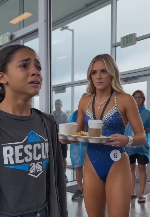
Water from the rescue demonstration tanks clicked against the tile. The smell of chlorine, coffee, and frosting sat thick in the air while the cameras kept recording my stained hoodie and Kennedy Prescott’s frozen face.
The man from the control table, Mr. Adler, looked at the committee chair.
“Read it,” the chair said.
Kennedy’s father stood from the sponsor row. “This has gone far enough.”
Nobody moved.
Mr. Adler swallowed and lifted the page.
“At 7:41 this morning,” he said, “Kennedy Prescott signed an objection claiming Noemi Wright’s final repair was unsafe, incomplete, and falsely documented.”
My stomach dropped.
I had expected credit theft.
I had not expected sabotage on paper.
Kennedy snapped, “Because it was unsafe.”
Mr. Adler turned the page around.
Her signature sat at the bottom in dark blue ink.
Below it was one handwritten line.
Remove Wright before first demonstration. Sponsor exposure risk.
The room seemed to inhale all at once.
I stood there with sauce sliding cold down my sleeve, hearing my own heartbeat louder than the microphones.
Sponsor exposure risk.
Not safety.
Not children.
Me.
Kennedy’s father, Graham Prescott, stepped into the aisle. “My daughter is not trained in technical evaluation. That document should never have been accepted.”
The committee chair, Maren Holt, looked at him sharply. “Then why did she have access to the approval folder?”
Graham’s mouth tightened.
Kennedy’s eyes darted toward him.
That tiny glance told the whole room more than either of them wanted.
Mr. Adler placed another sheet under the document camera. The projector screen above the rescue pool lit up with a maintenance log.
My name appeared over and over.
Noemi Wright — pump sensor recalibration.
Noemi Wright — rescue alert delay fixed.
Noemi Wright — final test passed at 6:18 a.m.
I pressed my shaking hands together.
For weeks, nobody had cared that I stayed late tightening connectors and checking alarm timing while other students left for rides home and clean dinners. Nobody had cared that my fingers were raw from cold water tests.
Now every entry filled the screen.
Maren Holt spoke into the microphone.
“The official record confirms Noemi Wright completed the final repair that prevented the rescue alert from failing during today’s demonstration.”
The crowd stayed silent.
Not because they doubted it.
Because the truth had arrived too late to be polite.
Kennedy whispered, “She is making herself look like a victim.”
Something inside me hardened.
I stepped toward the microphone.
My voice shook, but it did not break.
“I did not throw food on myself.”
The words landed like a slap.
Someone near the back said, “Exactly.”
Kennedy’s face reddened.
Then Mr. Adler clicked again.
The screen changed.
A security clip appeared from the glass doors near the equipment hall. Kennedy stood at the approval table that morning, flipping through folders while everyone else was setting up chairs. She removed one page, signed another, and slid my record beneath a stack of sponsor materials.
Maren’s voice went cold.
“She hid the safety record.”
Kennedy looked toward the exit again.
Security did not move.
Then the rescue system beside us beeped.
A red warning flashed across the control screen.
Mr. Adler went pale.
“No,” he whispered.
Maren turned. “What happened?”
He stared at the monitor.
“The rescue alert system just went into manual override.”
Kennedy smiled before she could stop herself.
Part 3: The Override That Put Everyone At Risk
That smile vanished almost instantly, but everyone had seen it.
Mr. Adler lunged toward the keyboard. “The override is locking us out.”
Maren Holt stepped closer to the control table. “Can you stop it?”
“I need administrator access.”
Graham Prescott adjusted his jacket. “Perhaps the demonstration should be canceled until professionals review the system.”
His voice was smooth.
Too smooth.
My skin prickled.
This was not panic.
This was a plan.
The red warning blinked against the gray daylight coming through the glass doors. The invited guests shifted uneasily. A few parents pulled younger kids closer to them. The rescue pool sat still and blue beside us, but suddenly it looked less like a ceremony prop and more like a trap.
Mr. Adler typed fast.
“Someone triggered a sponsor-level lockdown.”
Maren turned slowly toward Graham.
“Sponsor-level?”
Graham lifted his hands. “Do not look at me like that.”
Kennedy said, “Maybe Noemi broke it.”
I laughed once.
It came out sharp and strange.
Everyone turned toward me.
I wiped sauce from my wrist with the sleeve already ruined.
“That is your answer for everything,” I said. “If I fix it, you take it. If it fails, you blame me.”
Kennedy’s eyes flashed. “You do not know anything about pressure.”
I stared at her.
She stood there in perfect hair, perfect shoes, perfect family name, complaining about pressure while my clothes were stained in front of every camera.
“No,” I said. “I know what pressure does to cheap shoes when you stand on wet tile for six hours fixing something nobody else will touch.”
A murmur went through the room.
Mr. Adler looked at me. “Noemi, did you keep a local test copy?”
I froze.
The blue notebook.
The one in my backpack.
I had made it because the system logs kept freezing during night tests. I had written down every sensor delay, every corrected pressure reading, every manual reset code.
Kennedy noticed my expression.
“What is she hiding?”
I ignored her and limped toward my backpack under the folding table. The food had hit my shoulder, but some had splattered into the bag. The front pocket was sticky. My hands shook as I pulled out the notebook.
Kennedy laughed. “A diary? Seriously?”
Mr. Adler’s eyes widened when I opened it.
“Those are calibration sequences.”
I nodded. “And backup timing codes.”
Maren came to stand beside me. “Can they restore access?”
Mr. Adler scanned the page. “If she recorded the pre-lockout anchors, yes.”
Kennedy’s face changed.
Graham’s changed worse.
He stepped forward. “No student should be entering codes into a live rescue system.”
Maren blocked him.
“No sponsor should be locking one.”
The room snapped silent.
Mr. Adler entered the first sequence.
The red warning flickered.
He entered the second.
A green line appeared.
The system chirped once, then displayed:
LOCAL RESTORE AVAILABLE — SOURCE: WRIGHT MANUAL TEST LOG
My name.
Again.
Kennedy looked like she hated the letters themselves.
Mr. Adler whispered, “It is working.”
Then the screen opened a hidden access report.
Maren leaned closer.
Her face drained.
“Who initiated the lockdown?” she asked.
Mr. Adler did not answer at first.
He looked at Kennedy.
Then he looked at her father.
Finally, he said, “Graham Prescott’s sponsor account.”
The room erupted.
Graham smiled tightly. “Accounts can be misused.”
The screen refreshed.
A camera still appeared beside the login record.
Graham Prescott stood at the control terminal twenty minutes before the ceremony.
His hand was on the access panel.
Kennedy whispered, “Dad?”
And for the first time, she sounded afraid.
Part 4: The Father Behind The Perfect Daughter
Graham Prescott did not deny the image.
That was what made it worse.
He simply looked at the screen, then at the room, as if deciding which version of the truth would cost him least.
“This demonstration was not ready,” he said.
Maren’s eyes narrowed. “So you locked the rescue system during a public event?”
“I prevented an unsafe launch.”
Mr. Adler slammed his palm on the table.
“No. Noemi prevented an unsafe launch. You tried to create one.”
The words cracked across the room.
Kennedy spun toward her father. “You said she was exaggerating her part.”
Graham’s expression hardened. “She is a student.”
“So am I.”
“You are a Prescott.”
The sentence landed like something ugly dropped in clean water.
Kennedy went still.
For the first time, I saw it.
Not guilt yet.
A crack.
The polished sponsor daughter had not invented the entire cruelty by herself. She had been trained in it. Fed it at breakfast. Dressed in it. Sent into rooms believing the family name was a kind of ownership.
But she had still walked toward me.
She had still thrown the food.
She had still smiled when the alarm locked.
Maren pointed to the screen. “Why did you need Noemi removed?”
Graham looked toward the cameras, then away.
Nobody was letting him choose privacy anymore.
Mr. Adler clicked into the sponsor folder.
A file opened.
Prescott Rescue Legacy Presentation.
The first slide showed Kennedy in a white blazer beside the rescue pool, smiling as if she had built the whole system with manicured hands.
Below it was a caption:
Kennedy Prescott, Student Innovation Ambassador.
My name was nowhere.
Maren’s voice shook with anger. “This was never about safety.”
Graham said nothing.
Mr. Adler opened the edit history.
Two hours before the ceremony, my technical credit was deleted.
Kennedy’s ambassador title replaced it.
Then another note appeared:
If Wright resists, emphasize unauthorized access and appearance concerns.
Appearance concerns.
My worn clothes.
My cheap sneakers.
My tired face.
My poverty had been written into their strategy.
I looked at Kennedy.
She would not meet my eyes.
“Did you know?” I asked.
She swallowed.
No answer.
That was answer enough.
Then a voice came from near the glass doors.
“She knew enough.”
Everyone turned.
A woman in a yellow rain jacket stood holding a paper coffee cup with both hands. She had been sitting quietly in the second row all morning, the kind of adult people mistake for a volunteer until she starts speaking.
Her badge read Elena Marceau — Public Safety Grant Review.
Graham’s face darkened.
“Elena,” he said. “This is not your concern.”
She walked forward.
“It became my concern when a sponsor account deliberately interfered with a youth rescue system tied to public funding.”
Kennedy looked from her father to Elena. “Who is she?”
Elena stopped beside the control table.
“The person deciding whether the Prescott Foundation keeps its rescue grant authority.”
The sponsor row stiffened.
Graham forced a laugh. “This is a misunderstanding.”
Elena set down her coffee.
“No. It is a pattern.”
She removed a sealed folder from her bag.
Graham’s face changed completely.
Elena looked at me, and her voice softened.
“Noemi, I am sorry. This started before you.”
Then she opened the folder.
The first page showed another student’s name.
Lena Hoffmann — removed from rescue credit list, Munich pilot.
Then another.
Sofia Klein — deleted from final report, Vienna water safety trial.
Then another.
Amara Wright — technical assistant, accident review sealed.
My breath stopped.
Wright.
My last name.
Elena looked at me carefully.
“Noemi,” she said, “your mother was part of the first rescue pool trial.”
Part 5: The Name My Mother Never Explained
The room seemed to pull away from me.
My mother’s name sat on the screen like a door I had never known existed.
Amara Wright.
Technical assistant.
Accident review sealed.
My mouth went dry.
“My mother worked in laundry service,” I said. “She never worked on rescue systems.”
Elena’s eyes filled with something like regret.
“She did when she was seventeen.”
Seventeen.
My age.
My legs felt weak enough that Maren guided me into a chair. I hated sitting while Kennedy stood, but my body had gone cold under the stained hoodie.
Graham spoke sharply. “That file is sealed.”
Elena turned toward him.
“Not anymore.”
Kennedy stared at her father. “What accident?”
He did not answer.
Mr. Adler placed the folder under the document camera.
An old report appeared on the giant screen. It had been scanned from paper, edges yellowed, official stamps bleeding into the margins.
Orlando Youth Rescue Trial — Emergency Delay Incident.
My hands went numb.
Elena spoke quietly.
“Twenty-one years ago, during a rescue demonstration, the alert delay failed. A student assistant noticed the timing problem before the test began. Her warning was ignored because the sponsor team wanted the event to continue.”
My voice barely worked. “My mother?”
Elena nodded.
“She tried to stop the demonstration.”
Graham snapped, “That version was never confirmed.”
Elena looked at him. “Because your family buried her statement.”
Kennedy whispered, “Dad.”
Graham’s jaw tightened.
“She was unstable,” he said.
The word hit me like a slap.
Unstable.
The same script.
Different girl.
Different decade.
Elena turned another page.
There was my mother’s handwriting.
Thin, careful, familiar.
I knew it from grocery lists and birthday cards and sticky notes on the fridge.
The delay is wrong. The alarm does not sound soon enough. Please do not run the test.
I covered my mouth.
For years, my mother had hated pools. She never told me why. She said she just did not like the smell of chlorine. She never came to swim meets. Never watched rescue competitions. Never let me ignore a safety check.
I thought she was afraid of water.
Maybe she was afraid of being unheard again.
Elena continued.
“After the incident, Amara Wright was blamed for entering the system without permission. Her scholarship was withdrawn. Her technical notes disappeared from the official review.”
My eyes burned.
“She never told me.”
Graham said coldly, “Perhaps she was ashamed.”
I stood so fast the chair scraped behind me.
“No.”
Everyone looked at me.
I was shaking now, but not from humiliation.
From rage.
“She was not ashamed. She was silenced.”
Kennedy flinched.
Elena nodded once.
Then she removed one more document.
“This is the missing statement. We recovered it from a former county archive clerk three weeks ago.”
Maren stared at her. “You knew this before today?”
“I suspected the same pattern was repeating. I came to observe.”
I looked at her sharply.
“You came because of my mother?”
“Yes,” Elena said. “And because your name appeared in the new rescue project files.”
My heart pounded.
Before I could answer, Mr. Adler’s phone rang on the control table.
He looked at the screen.
Then at me.
“It is your mother.”
The room blurred.
I nodded.
He answered on speaker.
My mother’s voice came through, breathless and terrified.
“Noemi? Baby, are you safe?”
For the first time all morning, I almost broke.
“I’m here,” I said.
She heard my voice and exhaled shakily.
Then she said, “Tell Graham Prescott I still have the original delay tape.”
Graham’s face went white.
Part 6: The Tape That Survived The First Lie
Nobody spoke after my mother said it.
Even Kennedy stopped crying.
Graham Prescott stared at the phone as if my mother had reached through it and closed a hand around his throat.
Elena leaned toward the speaker. “Mrs. Wright, what tape?”
My mother took a breath.
“The trial recording from twenty-one years ago. The one they said was damaged.”
Graham said sharply, “That material belongs to the foundation.”
My mother laughed once.
It was not warm.
“No, Graham. It belongs to the truth you stole from a seventeen-year-old girl.”
The room shifted.
Kennedy looked at her father with horror spreading across her face.
My mother continued.
“I made a copy because one technician believed me. He slipped it into my backpack after the hearing and told me one day I might need proof more than permission.”
Elena’s voice softened. “Can you send it?”
“I already did.”
Mr. Adler’s computer chimed.
A video file appeared.
My hands were shaking so hard I pressed them against the table.
The first frame loaded.
The footage was grainy, dated, filmed from a fixed camera near a rescue pool much older than this one. The colors looked washed out. People moved around in polo shirts and clipboards.
Then I saw her.
My mother at seventeen.
Same dark eyes. Same determined chin. Same way of standing when scared but unwilling to move.
She was pointing at the control board.
The audio crackled.
Her young voice came through.
“The delay is still wrong. The alarm is late.”
A younger Graham Prescott stood beside the sponsor table, hair darker, face smoother, but with the same polished contempt.
“We are not stopping the demonstration for a student guess.”
“It is not a guess,” my mother said. “I logged the timing.”
A man off camera said, “We are live in two minutes.”
My mother stepped in front of the control panel.
“Then fix it now.”
Graham leaned close.
His voice dropped, but the tape caught it.
“Move, Amara, or I will make sure nobody ever lets you near a technical program again.”
The room erupted.
My mother’s voice on the speaker stayed quiet.
“That was the last day I was allowed in the program.”
I could not breathe for a moment.
The tape continued.
The demonstration began.
The alarm delay failed exactly as my mother warned. Staff rushed. A test dummy stayed submerged too long before the signal triggered. No one was harmed because it had been a controlled trial, but the failure was undeniable.
Then the footage cut to a review room.
Graham’s voice again.
“She accessed equipment without authorization.”
My mother’s younger voice shook. “I was trying to prevent this.”
Another adult said, “The foundation cannot have liability attached to sponsor oversight.”
Then the tape ended.
I looked at Graham.
He had nothing left but anger.
“This is ancient history.”
Elena’s voice cut through the room.
“No. This is active misconduct repeated across decades.”
Maren Holt turned to the county officials.
“The Prescott Foundation is suspended from this project immediately.”
Graham barked, “You do not have that authority.”
Elena lifted her badge.
“I do.”
Kennedy stepped backward from him.
“You ruined her,” she whispered.
Graham turned. “I protected our family.”
“No,” Kennedy said, voice breaking. “You taught me to ruin people before they could matter.”
For once, he had no answer ready.
Then Mr. Adler’s screen flashed.
The restored rescue system had completed its reboot.
A message appeared.
FINAL DEMONSTRATION READY — AUTHORIZED LEAD: NOEMI WRIGHT
The room turned toward me.
My stained clothes still smelled like sauce.
My hands were still shaking.
My mother was still listening through the phone.
Maren approached slowly.
“Noemi,” she said, “you do not have to do this.”
I looked at the rescue pool. At Kennedy. At Graham. At my mother’s name glowing in old evidence.
“Yes,” I said.
Then the system flashed again.
SPONSOR MASTER LOCK ATTEMPT DETECTED.
Graham Prescott smiled.
Part 7: The Rescue Test They Tried To Kill
The smile lasted only a second.
But it was enough.
Mr. Adler shouted, “He is trying to lock it again.”
Security moved toward Graham.
He lifted his hands calmly. “I am standing nowhere near your computer.”
Elena looked at the screen. “Remote access?”
Mr. Adler typed fast. “Yes. Backup sponsor credential.”
Maren turned to him. “Can you block it?”
“I can try.”
The rescue system beeped faster.
The green status bars flickered yellow.
Children in swim team jackets near the back began whispering. Their parents pulled them away from the demonstration pool. Reporters spoke into cameras. County officials crowded around Elena.
Everything Graham had lost in evidence, he was trying to reclaim through chaos.
If the system failed now, the news would not be that Noemi Wright saved it.
The news would be that the rescue program collapsed during launch.
Kennedy stared at her father.
“Stop it.”
He did not look at her.
“Do not involve yourself further.”
Her face twisted.
“I already involved myself when I threw food on her because you told me she was a threat.”
Graham’s eyes flashed. “You did that because you are weak enough to envy someone beneath you.”
Kennedy went white.
Even after everything, the cruelty of it stunned the room.
My mother’s voice came through the speaker.
“Noemi.”
I stepped closer to the control table.
“I’m here.”
“You kept paper backups, didn’t you?”
A strange laugh caught in my throat.
“Of course I did. You taught me never to trust a system that powerful people can edit.”
The speaker went quiet for a beat.
Then my mother said, “Good girl.”
I opened my blue notebook to the final section.
Mr. Adler saw it and whispered, “Manual failsafe sequence.”
I nodded.
“I tested it last night.”
Maren’s eyes widened. “You tested a failsafe nobody asked you to test?”
“The first rule of rescue is assuming the obvious plan will fail.”
For the first time all day, Elena smiled.
Mr. Adler took the notebook and began entering the sequence.
Graham’s remote lock pushed again.
The screen flashed red.
Kennedy suddenly moved.
Security tensed, but she did not go toward me.
She went toward the sponsor table, grabbed her father’s open laptop, and turned it around.
A remote access portal glowed on the screen.
Graham shouted, “Kennedy!”
She flinched hard.
Then she hit disconnect.
The system steadied.
Mr. Adler entered the final code.
The screen turned green.
MASTER LOCK REJECTED — LOCAL SAFETY AUTHORITY RESTORED
The crowd erupted, but I barely heard it.
Kennedy stood over the laptop, breathing like she had just jumped from a burning room.
Graham looked at her with pure fury.
“You just ended this family.”
Kennedy wiped her face.
“No,” she said. “I just stopped repeating it.”
Maren lifted the rescue whistle.
“The demonstration can proceed only if Noemi chooses.”
Everyone looked at me again.
This time, I did not shrink.
I walked to the edge of the rescue pool. The same gray daylight shone through the glass doors. The same paper coffee cups sat abandoned on folding tables. The same cameras watched.
But something had changed.
I was no longer trapped under them.
I was using them.
“The system saved the alert delay because someone wrote down what powerful people tried to erase,” I said.
My voice carried.
“My mother did it first. Nobody listened. Today you will.”
Mr. Adler started the test.
A weighted rescue dummy slipped beneath the water.
The room held its breath.
One second.
Two.
The sensor flashed.
The alarm sounded instantly.
The rescue arm deployed cleanly.
The dummy surfaced.
The system screen displayed:
RESCUE RESPONSE PASSED — CREDIT: AMARA WRIGHT LEGACY / NOEMI WRIGHT FINAL FIX
My knees nearly gave.
My mother sobbed through the phone.
Nobody clapped at first.
They were too stunned.
Then one child started.
Then another.
Then the whole room rose.
But before the applause could swallow everything, Kennedy stepped to the microphone.
Her face was streaked with tears.
She looked at me, then at the cameras.
“I need to confess what I did.”
Part 8: The Name They Could Not Delete Twice
Kennedy’s hands shook around the microphone.
For once, no one rushed to steady her.
Not her father. Not the sponsor row. Not the adults who had spent years teaching her that consequences were for other people.
She stood alone.
“I threw food on Noemi Wright,” she said. “I did it because I wanted her humiliated before she could lead the demonstration.”
The room stayed silent.
She swallowed.
“I knew my name was being placed over hers. I knew she had done the final fix. I told myself it did not matter because my family paid for the event.”
Her voice cracked.
“It mattered.”
Graham Prescott was already being escorted toward the side hall by security and county officials, but he stopped when he heard her.
“Kennedy,” he warned.
She looked at him.
That old fear crossed her face.
Then it left.
“And my father attempted to lock the system twice to discredit her and hide what he did to her mother twenty-one years ago.”
Graham lunged forward, but security held him back.
Reporters surged.
Elena Marceau stepped between them with the calm of someone who had waited years for a room like this.
“All sponsor records will be seized for review,” she said. “All student credits connected to Prescott Foundation rescue trials will be audited.”
Maren Holt added, “The Competition Pool Rescue project will continue under public safety supervision, not sponsor control.”
My mother was still on speaker.
Her voice came through quietly.
“Noemi, baby?”
I picked up the phone.
“I’m here.”
“I am coming.”
“You do not have to.”
“Yes,” she said. “I do.”
Forty minutes later, my mother walked through the glass doors in her work shoes, hair pulled back badly, face pale with urgency.
The room parted for her.
Not because of money.
Because her name was now on the screen.
She stopped when she saw the display.
AMARA WRIGHT LEGACY / NOEMI WRIGHT FINAL FIX
Her hand flew to her mouth.
I ran to her.
She held me so tightly I could barely breathe, and for the first time that day, I let myself cry.
“I thought if I kept you away from what happened to me, you would be safe,” she whispered.
I shook my head against her shoulder.
“You taught me how to keep records.”
She laughed through tears.
“That was not the childhood I wanted for you.”
“But it saved us.”
Behind us, Kennedy stood near Maren, giving her formal statement. She did not look heroic. She looked wrecked. That seemed right. Truth was not a costume she could put on to look better. It was work she would have to do when the cameras stopped caring.
Graham Prescott’s name came down from the sponsor banner before sunset.
The project did not end.
That was the part nobody expected.
The county kept it alive, but changed everything. The rescue pool system was renamed the Wright Alert Initiative. Every safety test had to include independent student documentation. Every sponsor edit became publicly visible. Every technical contributor’s name stayed attached to the work.
Kennedy was removed from the ambassador role and ordered into formal accountability hearings. Months later, she testified against her father. Not perfectly. Not prettily. Sometimes she cried. Sometimes she sounded angry that truth cost so much.
But she told it.
My mother testified too.
She wore a navy dress borrowed from our neighbor and brought the old tape in a plastic case. When the review board played her seventeen-year-old voice warning them about the delay, the room stood.
She did not smile.
She just closed her eyes.
Afterward, she squeezed my hand and whispered, “They heard it this time.”
A year later, the first public rescue training opened in a renovated pool hall in Valencia. Not Orlando. Not under Prescott banners. No sponsor daughters in front of student workers. No polished lie pretending to be generosity.
I stood beside my mother at the control panel while a group of nervous teenagers in rain jackets checked sensor readings.
One girl with frayed sleeves raised her hand.
“What if somebody says our notes do not count?”
My mother looked at me.
I looked at the logbook on the table, thick and public and impossible to edit without leaving a mark.
“Then you make a copy,” I said.
The girl nodded seriously and wrote her name on the first line.
Kennedy came that day too, not as a speaker, not as a guest of honor, but as one of the people required to listen. She sat in the back row with a plain notebook, writing down every name as the students introduced themselves.
When the final test began, my mother let me press the start button.
The dummy dropped.
The sensor flashed.
The alarm sounded instantly.
A clean, bright tone filled the hall.
No delay.
No silence.
No stolen credit.
On the screen, the system displayed two names again.
Amara Wright — Original Warning
Noemi Wright — Final Restoration
My mother took my hand.
The applause rose around us, but this time it did not feel like rescue.
It felt like proof.
They had deleted her once.
They had tried to delete me too.
But the record held, the alarm sounded, and every person in that room finally understood the truth: we were never dramatic—we were the ones who heard danger first.
