Part 2: The Signature Victoria Could Not Explain
“Don’t let her leave,” the man with the report said.
The words landed harder than the splash had.
Victoria Fairchild stopped so suddenly that her pearl bracelet slid down her wrist and clicked against her knuckles. For one bright, cruel second, she looked exactly like the girl who had shoved me into the pool—chin high, eyes glittering, mouth ready to cut someone smaller.
Then she saw the paper.
Her face changed.
Not all at once. First her smile thinned. Then her cheeks lost color. Then her gaze dropped to the bottom of the page, where her own signature sat beneath the approval stamp like a trap she had willingly stepped into.
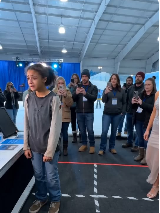
I stood dripping beside the pool, the cold water dragging my sleeves against my arms. My shoes made wet sounds on the tiles. People were still filming. PTA volunteers clutched paper programs to their chests. The blue stage curtains swayed behind the spotlight as if the room itself had taken a breath and forgotten how to release it.
Victoria’s father, Edmund Fairchild, rose from the sponsor row.
“Anton,” he said sharply to the staff member, “this is not the place.”
Anton Becker did not lower the paper. His hands shook, but his voice didn’t. “It became the place when your daughter assaulted the student who saved the demonstration.”
A woman in a navy coat gasped. A local journalist stepped closer.
Victoria turned on Anton with a whisper that somehow carried. “You don’t know what you’re holding.”
“I know exactly what I’m holding,” Anton said. “Final approval documents from the Innsbruck municipal review file. The repair log. The emergency override notes. And the transfer request.”
My stomach tightened at that last phrase.
Transfer request.
I knew about the final fix. I knew about the frozen pressure valve, the broken relay, the three hours I had spent alone behind the control table with numb fingers and borrowed tools while everyone else decorated the hall.
But I did not know about a transfer request.
Edmund moved forward, smiling now, the kind of smile rich people used when they were deciding whether someone was worth ruining. “This is a misunderstanding. Victoria signs many ceremonial forms.”
Anton flipped to the second page.
The paper snapped in the quiet.
“Then she should remember signing this one,” he said. “It requested that Zofia Cooper’s name be removed from the technical credit list and replaced with Victoria Fairchild’s.”
The room broke open.
Voices rose, chairs scraped, cameras swung toward Victoria. Someone said my name like they had just learned it was dangerous.
Victoria stared at the page, then at me.
For the first time, she looked afraid of me.
Not sorry. Not ashamed.
Afraid.
I wanted to say something fierce. I wanted to stand tall and make every camera catch me refusing to shrink. But my teeth were chattering so hard I could barely breathe.
Then a coat settled around my shoulders.
I looked up and saw Marta Weiss, the oldest PTA volunteer, her silver hair pinned with two crooked clips. She had been the one who brought biscuits to every student meeting and pretended not to notice when I took extra.
“Stand here, love,” she whispered. “Let them see who they tried to drown.”
Victoria snapped, “She fell.”
The lie was so ugly, so quick, that something inside me went still.
Anton looked toward the camera crews. “The security feed will show otherwise.”
Victoria’s eyes flashed toward the control table.
Too fast.
Anton noticed. So did I.
A thin man in a black suit leaned near Edmund and murmured something. Edmund’s jaw tightened. He lifted his hand, and two security guards moved—not toward Victoria, but toward the control table.
Anton shouted, “No one touches the system!”
But one guard was already reaching beneath the console.
That was when I realized the signature was not the last secret.
Someone was trying to erase the video.
Part 3: The Video Hidden Under The Snow Machine
I ran before anyone expected me to move.
The wet coat slipped from one shoulder. My soaked shoes skidded across the tile. Someone shouted my name, but the only thing I could hear was the soft electronic chirp from the control table—the sound the system made when an external drive was being pulled without permission.
The guard’s hand closed around the cable.
I slammed my palm over the emergency lock switch.
The console beeped twice, bright and furious.
ACCESS HOLD.
The guard froze. “Move away.”
“No,” I said.
My voice came out small, but it came out.
He looked past me toward Edmund Fairchild. That told me everything. He wasn’t confused. He wasn’t protecting equipment. He was waiting for orders.
Victoria laughed shakily behind me. “This is ridiculous. She’s soaked and hysterical.”
Marta’s voice cut across the room. “She is soaked because your daughter pushed her.”
More people murmured now. Not polite murmurs. Angry ones.
Anton reached me at the table, breathing hard. “Zofia, did you lock it?”
“Yes.”
His eyes flicked to the display. “Good girl.”
Nobody had called me that in a way that didn’t sound pitying for years. Somehow, it nearly broke me.
The spotlight buzzed overhead. Water dripped from my hair onto the taped floor marks. The fake indoor snow machine, silent beside the pool, still smelled faintly of cold metal and soap.
Anton crouched behind the console and opened the lower panel. “There’s a backup module.”
Edmund barked, “Stop this immediately. That equipment belongs to Fairchild Foundation.”
“No,” Anton said without looking at him. “The foundation donated stage access. The city owns the safety system.”
He pulled out a small gray drive taped beneath the panel.
Victoria went motionless.
I saw it then—the tiny twitch near her eye, the way her fingers curled into her palm. She knew that drive existed.
Or she had forgotten.
Anton held it up. “Independent backup. Installed after the Salzburg rehearsal malfunction.”
A journalist asked, “Does that include today’s recording?”
Anton looked at me.
I nodded, barely.
“I routed the rehearsal and ceremony feeds through it,” I said. “The main storage was unstable after the pressure relay failed.”
Edmund stared at me as though I had spoken a language he hated. “Who authorized you to make changes to the system?”
“The safety manual,” I said. “Page forty-two.”
A few people turned toward me. Not because I was wet. Not because I was poor. Because I had answered before he could scare me.
Anton plugged the drive into a laptop on the demo table. The screen flickered onto the projection curtain.
For three seconds, there was only static.
Then the video appeared.
There I was, standing near the pool, thin shoulders tight, trying to smile as the announcer called my name. There was Victoria behind me, moving forward, mouth twisted.
The room watched her shove me.
Not a stumble.
Not a mistake.
A clean, deliberate push.
The sound of my body hitting the water filled the hall.
Victoria whispered, “Turn it off.”
No one did.
The video kept playing.
It showed Anton running in with the report. It showed Edmund lifting his hand. It showed the guards moving toward the console.
Then the feed jumped backward to an earlier timestamp.
Midnight.
The hall was dark except for the control table glow.
Victoria stood beside the snow machine in a cream-colored coat, holding a folder.
And beside her was my committee mentor, Lukas Varga.
My chest went cold in a way the pool water hadn’t managed.
Lukas took the folder from Victoria and said clearly, “Once her name is gone, she’ll have nothing to prove.”
Victoria smiled.
“Then make sure Zofia looks like the reason it failed.”
Part 4: The Mentor Who Sold My Name
Lukas Varga had taught me how to solder a damaged circuit with a steady hand.
He had brought me tea during late rehearsals. He had told the committee I was “quiet but useful.” I had thought that was almost kindness.
Now he stood near the back wall with his face drained gray, watching himself betray me on a curtain bigger than any confession.
I turned toward him slowly.
He didn’t meet my eyes.
That hurt more than Victoria’s hands.
“Lukas,” I said.
His mouth opened, closed, then opened again. “Zofia, listen to me.”
The entire room seemed to lean in.
I wanted him to deny it. I wanted him to say the video was fake, that there was some twisted explanation, that I hadn’t been foolish enough to trust someone who had been selling pieces of me behind my back.
Instead, he wiped his forehead and said, “I had debts.”
The words were so plain they almost sounded reasonable.
Victoria hissed, “Shut up.”
But Lukas was unraveling now. His eyes darted from the cameras to Anton to Edmund. “Fairchild Foundation promised a contract renewal. They said no one would lose anything. Zofia would still get a volunteer certificate.”
A laugh came out of me.
It didn’t sound like me.
“A certificate?” I asked.
My voice shook, but I stepped closer. Water pooled beneath my shoes. “You watched me fix the relay. You watched me miss school lunch to recalibrate the snow output because the children’s area would have flooded. You watched me stay until midnight.”
Lukas flinched.
“And you thought I could be paid back with a certificate?”
Marta took my hand. Hers was warm and dry and furious.
Edmund’s lawyer-looking man moved forward. “These accusations involve minors and municipal property. We should pause all public discussion until proper counsel is present.”
The journalist from Tirol Heute lifted her microphone. “Mr. Fairchild, is your foundation accused of falsifying public youth award records?”
“No,” Edmund snapped. Then he softened instantly for the camera. “Absolutely not. We are victims of staff misconduct.”
Victoria turned on him. “Father.”
That single word carried panic.
He did not look at her.
The shift was quiet but brutal. Victoria understood it before anyone else did. Her father was stepping away from her, leaving her alone in the wreckage she had made for him.
But Anton wasn’t finished.
“There’s another file,” he said.
Lukas made a strangled sound.
Anton clicked through the drive. A spreadsheet appeared on the curtain. Names, dates, payments, initials.
At the top, in bold file text, was the heading: Youth Visibility Adjustment.
I stared at it, not understanding at first.
Then I saw other names.
Anika Bauer. Removed from Vienna robotics showcase.
Elena Novak. Reassigned credit at Prague winter science fair.
Sofia Lindholm. Marked “unsuitable for sponsor image” in Malmö.
My throat tightened.
I hadn’t been the first.
I had just been the one who locked the console fast enough.
The hall changed after that. It was no longer about a shove, or a pool, or one stolen credit line. Mothers pulled their children closer. Teachers whispered to each other. Volunteers looked sick.
Victoria’s voice cracked. “That spreadsheet isn’t mine.”
Anton zoomed in.
The final column showed approval initials.
V.F.
Again and again.
Then, beside my name, a note in a comment box:
“Remove before ceremony. She looks wrong for the campaign.”
I forgot the cameras.
I forgot the cold.
I looked at Victoria and said, “What exactly was wrong with me?”
She had no answer.
But her silence did.
Part 5: The Other Girls Begin To Arrive
By evening, the story had already crossed Austria.
Not because of the shove, though that clip traveled fastest. Not because I looked pitiful climbing out of a pool in worn clothes while Victoria Fairchild stood dry and glittering.
It spread because of the spreadsheet.
By nine o’clock, I was wrapped in three borrowed blankets in a municipal office overlooking the dark streets of Innsbruck, watching my name appear on news banners while my hands curled around a paper cup of hot chocolate I couldn’t taste.
Marta sat beside me like a guard dog in wool.
Anton spoke with investigators near the door. Every few minutes, he glanced over as if making sure I hadn’t vanished.
I wanted to vanish.
My phone buzzed until the screen warmed under my palm.
Unknown numbers. Messages. Clips. Apologies from people who had watched and done nothing. Questions from reporters who had learned my name only after it became useful.
Then one message stopped me.
It was from Anika Bauer.
I know exactly how it feels. I’m coming.
I stared at it until the letters blurred.
Another message arrived.
Elena Novak: Don’t let them make you stand alone.
Then another.
Sofia Lindholm: My train leaves Malmö at dawn.
I looked up. “Marta?”
She leaned closer. “What is it?”
I showed her the phone.
Her face changed, not with surprise, but recognition. As if she had always known the world was full of girls carrying locked rooms inside them.
“They’re coming here?” I asked.
“It seems they are.”
“Why?”
Marta brushed damp hair from my cheek with a tenderness that made my eyes burn. “Because you opened the door.”
Across the room, Edmund Fairchild’s voice rose behind the glass wall of a conference office. “My daughter is seventeen. You cannot expect her to understand administrative language.”
Anton replied, “She understood enough to sign it.”
Victoria sat inside that office, arms folded, staring at the table. Her perfect hair had loosened. Without the crowd around her, she looked younger. Not innocent. Just young enough that the ugliness in her seemed learned rather than born.
For one dangerous second, I almost felt sorry for her.
Then I remembered the comment beside my name.
She looks wrong.
The office door opened. Edmund stepped out with two attorneys and a face made of polished stone.
He walked directly toward me.
Marta stood.
So did Anton.
Edmund stopped just out of reach. “Miss Cooper,” he said, “today was regrettable.”
I waited.
“We are prepared to offer a private apology, full replacement of your damaged clothing, and a scholarship contribution. In exchange, you will agree not to participate in further media discussion while authorities review the misunderstanding.”
Marta inhaled sharply.
Anton said, “That is not appropriate.”
Edmund ignored him. His eyes stayed on me. “Think carefully. Public attention fades. Opportunities do not.”
The old me would have looked at my shoes. The old me would have heard scholarship and thought of rent, textbooks, food, all the things pride could not buy.
But my phone buzzed again.
Anika: I was thirteen when they took mine.
I lifted my eyes.
“No,” I said.
Edmund’s expression did not move.
So I said it again, louder.
“No. You don’t get to buy my silence with money stolen from girls you erased.”
For the first time all day, Edmund Fairchild looked truly startled.
Then Victoria appeared in the office doorway behind him and whispered, “You should have taken it.”
I looked at her.
“No,” I said. “You should have never offered it.”
Part 6: The Hearing In Vienna Turns Against Them
The emergency hearing in Vienna took place in a building so clean and bright it felt designed to make poor people afraid of touching anything.
I wore a borrowed navy dress from Marta’s niece. The sleeves were too long. My shoes were still old. I had tried polishing them with a hotel napkin that morning, and the left one showed a dull streak near the toe.
Victoria arrived in a charcoal coat with her father on one side and a legal team on the other. She did not look at me.
But the other girls did.
Anika Bauer sat behind me with her mother’s scarf twisted in both hands. Elena Novak had come from Prague overnight, her eyes sharp with exhaustion. Sofia Lindholm was tall and quiet, with a folder thick enough to frighten anyone who had lied on paper.
There were more of them than I expected.
Nine girls in the first row.
Nine names from the spreadsheet.
Nine stolen moments sitting upright beneath fluorescent lights.
A municipal investigator named Dr. Clara Meier opened the file. “This hearing concerns possible falsification of youth innovation records, sponsor interference, and retaliation against a minor participant.”
Victoria stared at the table.
Edmund leaned toward his microphone. “We reject the framing.”
Dr. Meier looked at him over her glasses. “You may reject conclusions, Mr. Fairchild. You may not reject evidence.”
Anton gave his statement first. He explained the relay failure, my repair, the backup drive, the attempted removal of credit. He spoke carefully, like a man placing stones across deep water.
Then Lukas Varga was called.
He looked smaller in Vienna.
His suit hung badly. His hands trembled. When he saw me, his face folded with something like shame.
“Did Fairchild Foundation pressure you to alter participant records?” Dr. Meier asked.
Lukas swallowed. “Yes.”
Victoria closed her eyes.
“Did Victoria Fairchild directly instruct you to remove Zofia Cooper’s credit?”
He whispered, “Yes.”
Her eyes snapped open.
Edmund’s attorney objected, but Dr. Meier lifted one hand and silenced him.
Lukas continued, voice breaking now. “She said the campaign needed a better face. She said her father wanted the donor families to see continuity. I thought… I told myself Zofia would still be allowed to participate.”
Dr. Meier asked, “And the planned malfunction?”
My fingers dug into my palms.
Lukas looked at me then. “The system was supposed to fail before she began. Not dangerously. Just enough to embarrass her.”
The room shifted in horror.
I felt Anika’s hand touch my shoulder from behind.
Victoria suddenly spoke. “I didn’t tell him to make it dangerous.”
The silence that followed was absolute.
Her attorney whispered urgently, but it was too late.
Dr. Meier leaned forward. “So you admit knowledge of a planned disruption?”
Victoria’s face crumpled with fury, not tears. “You don’t understand. My father built everything around this event. My name was already in the donor program. She was not supposed to be chosen.”
I stood before I knew I was moving.
Dr. Meier said, “Miss Cooper?”
I should have waited. I should have been formal. But my whole body was shaking with every swallowed insult of the day before.
“She was not supposed to be chosen?” I repeated.
Victoria finally looked at me.
I said, “I was chosen because I fixed what you broke.”
Then Sofia Lindholm stood behind me and placed her folder on the table.
“And I can prove,” Sofia said, “that Fairchild Foundation did this before Zofia was ever born.”
Edmund’s face went white.
Part 7: The Oldest File Names The Real Thief
Sofia’s folder smelled faintly of rain and train stations.
She opened it with careful hands and removed a photograph from sixteen years earlier. It showed a young woman standing beside a winter-energy model in Munich, smiling shyly while a man in an expensive suit accepted a prize beside her.
The man was Edmund Fairchild.
The young woman was not named in the caption.
Sofia tapped the picture. “My aunt, Ingrid Lindholm. She designed the thermal snow-melt system that became the first Fairchild winter safety patent.”
Edmund laughed once, too loudly. “Absurd.”
Sofia removed another page. Patent drafts. Letters. A handwritten design note. A rejection notice. A transfer agreement signed after Ingrid had been denied funding.
“My aunt died thinking she had failed,” Sofia said. Her voice did not break, and that made it more devastating. “But she didn’t fail. Her work was taken, renamed, and used to build your foundation’s first fortune.”
The hearing room turned colder than the indoor snow hall.
Dr. Meier examined the documents. “Where did you get these?”
“From a storage box in Lund,” Sofia said. “My grandmother kept everything. She never trusted him.”
Edmund’s attorney demanded verification. Dr. Meier ordered the documents scanned immediately.
Victoria stared at her father.
For the first time, she looked less like a villain and more like a girl watching the floor disappear beneath her family name.
“Father?” she whispered.
Edmund did not answer her.
That was his mistake.
Because Victoria knew that silence. I saw it cross her face: the awful recognition of being useful only while polished. Her father had abandoned her in the hall. Now he would abandon her here too.
Dr. Meier asked, “Mr. Fairchild, did your foundation originate from disputed intellectual property?”
He stood. “This hearing is over.”
“No,” Dr. Meier said. “It is expanding.”
Two officials moved to the door.
Edmund’s polished mask cracked. “You cannot hold me here.”
“We can require your cooperation,” Dr. Meier replied. “And we can freeze municipal partnerships pending criminal review.”
The words hit like falling glass.
Freeze partnerships.
Edmund’s empire was not collapsing from outrage. It was collapsing from paperwork.
Then Victoria stood.
Her attorney grabbed her sleeve. She pulled free.
“I have access to the private archive,” she said.
Edmund turned slowly. “Victoria.”
She flinched at the warning in his voice, but she kept going.
“There’s a locked donor archive in Zürich. It has old transfer files, campaign adjustments, image rankings, all of it.”
Edmund’s face hardened into something terrifyingly calm. “Sit down.”
Victoria looked at him, and suddenly I understood something I had not wanted to understand.
He had made her cruel.
But she had chosen where to point it.
Her lips trembled. “You told me girls like Zofia were threats. You told me if they rose, we fell.”
She turned toward me.
No apology came. Not yet. Maybe she did not know how to make one without making it about herself.
But she said, “The archive password is Snowglass.”
Edmund lunged for the microphone.
Security stopped him.
The room erupted, but I heard only one thing: Anton beside me, whispering, “Zofia, do you know what this means?”
I did.
It meant my name had opened a door into sixteen years of theft.
And it meant the person who shoved me into the water had just handed me the key.
Part 8: The Girl In The Archive Room
Three months later, the archive room in Zürich was colder than the pool had ever been.
Not physically. The heating worked perfectly. The windows overlooked a clean, expensive street where people carried umbrellas and paper bags and never looked up at buildings where lives were being rewritten.
But the room itself felt cold because of what waited inside it.
Boxes. Drives. Signed transfers. Campaign notes. Photographs of smiling children whose names had been replaced by donor daughters. Files marked unsuitable, unmarketable, unpolished.
And one file marked Cooper.
I stood with Marta on one side and Dr. Meier on the other while Anton opened it.
I expected my repair log.
I expected Victoria’s note.
I did not expect a birth certificate.
For a moment, nobody spoke.
My name was there.
Zofia Elise Cooper.
But beneath it was another document, older, creased, scanned from a hospital in Kraków.
A guardianship record.
Marta’s hand tightened around mine.
I looked at her. “What is this?”
Her eyes filled.
Dr. Meier read quietly, “Your mother was named Helena Kowalska. Mechanical engineer. Former applicant to Fairchild Foundation youth design program.”
The room narrowed.
Anton turned another page.
There was a photograph of a young woman with tired eyes and a fierce smile, holding a small metal prototype shaped like a snow regulator.
She had my mouth.
My fingers went numb.
Marta whispered, “Zofia…”
I couldn’t look away from the page.
Dr. Meier continued, softer now. “Helena filed a complaint against Edmund Fairchild seventeen years ago. She alleged theft of her safety valve design. The complaint disappeared after she died.”
Died.
The word did not strike like lightning. It sank like a stone.
I had grown up with fragments. A mother who was gone. Foster papers. Half-answers. Adults who said grief was complicated when what they meant was inconvenient.
Anton clicked open the attached schematic.
It was the same design I had repaired at the Community Day event.
Not similar.
The same.
The final fix I had made—the one that saved the project—was not luck. It was not just talent. It was instinct sharpened by blood and memory, a daughter’s hands completing what her mother had been punished for creating.
I covered my mouth.
Marta began to cry silently.
Then the door opened.
Victoria stood there with no pearls, no cameras, no father beside her. Her coat was plain. Her hair was tied back. She looked at the file on the table and understood before anyone explained.
“Your mother?” she asked.
I nodded once.
Victoria’s face collapsed.
Not prettily. Not dramatically. She looked sick with herself.
“I didn’t know,” she whispered.
I believed her.
That did not heal anything.
She stepped forward and placed a small envelope beside the file. “My father kept personal ledgers at the Lausanne house. I copied them before the investigators sealed it.”
Dr. Meier opened the envelope.
Inside were account numbers, names, payment records—and a handwritten note from Edmund Fairchild authorizing the suppression of Helena Kowalska’s complaint.
The final wall fell.
A year later, the Fairchild Foundation no longer existed.
Its remaining assets became the Helena Kowalska Trust, funding student engineers across Europe with one rule carved into every agreement: no sponsor could remove a child’s name from their own work.
Anika built a flood sensor in Vienna. Elena led a bridge safety project in Prague. Sofia recovered her aunt’s patent legacy in Munich.
And I returned to Innsbruck—not to the poolside hall, but to a new workshop with my mother’s photograph on the wall.
Victoria came once, months after her father’s sentencing. She stood outside in the snow holding a folder of records she had helped recover. She did not ask forgiveness. She simply handed me the folder and said, “I’m learning how to give back what was never mine.”
That was the first honest thing I had ever heard her say.
I took the folder.
Then I opened the workshop door behind me, where twelve girls were waiting beside tools, wires, notebooks, and machines with their own names printed clearly across the top.
I looked at my mother’s photograph, then at the girls, then at the repaired snow valve humming steadily on the table.
For the first time in my life, the record did not need correcting.
