Part 2: The Name Audrey Could Not Explain
“…the boarding records further revealed,” the captain said, his voice carrying across the dock, “that Audrey Beaumont attempted to board using a guest authorization assigned to another student.”
The marina went so quiet I heard sauce dripping from my sleeve onto the wooden planks.
Audrey’s face changed.
Not in the loud way she had humiliated me. Not with laughter or disgust or that polished little sneer she wore like jewelry. It changed slowly, like a yacht turning in dangerous water. Her eyes flicked to the screen, then to the captain, then to the cluster of reporters who had suddenly forgotten how to blink.
“That is a mistake,” Audrey said.
Captain Adrian Leclerc did not look away from her. “The system records do not suggest a mistake.”
“My family owns half this harbor.”
“No,” he said coldly. “Your family leases three slips and sponsors youth maritime programs. That does not make the passenger manifest yours to edit.”
A murmur moved through the crowd.
I stood frozen near the lunch table, shrimp shells stuck to my patched uniform, sauce drying across my chest. A teacher tried to dab my sleeve with napkins, but her hands were shaking so badly she only smeared it worse.
Audrey looked at me then.
For the first time all day, she was not looking down at me.
She was looking at me like I had somehow become evidence.
The dock coordinator, a nervous man named Emil Novak, stepped toward the microphone with a second folder tucked under his arm. “Captain, there is also a discrepancy in the submitted guest request.”
Audrey snapped, “Emil, don’t.”
That one sentence did more damage than any accusation.
Everyone heard the fear in it.
Captain Leclerc turned. “Read it.”
Emil swallowed. “The special voyage was reserved for students selected by the coastal scholarship committee. Marisol Vega was approved yesterday at 4:18 p.m.”
That was me.
My full name struck the air like something official and unerasable.
Emil continued, “At 7:03 p.m., a replacement request was submitted from the Beaumont Yacht Group sponsor portal.”
Audrey’s father, Marcel Beaumont, stood near the VIP tent. Until then, he had been smiling tightly, like a man waiting for a small mess to be swept away.
Now he stopped smiling.
Emil’s voice thinned. “The request asked that Marisol Vega be removed due to ‘presentation concerns’ and replaced with Audrey Beaumont.”
I forgot the sauce.
I forgot the cameras.
Presentation concerns.
Those two words landed in the same place every insult had landed all my life. My patched sleeves. My father’s bait stand. The smell of shrimp that clung to our hands even after washing. The way people at school pretended not to know me until they needed help with homework.
Audrey’s lips parted. “I didn’t write that.”
Captain Leclerc’s expression sharpened. “Then you will want to know whose signature is on it.”
Emil opened the second folder.
He held up a page.
At the bottom, beneath the removal request, was a looping signature in blue ink.
Audrey Beaumont.
A reporter whispered, “Zoom in on that.”
The screen changed. The signature grew larger.
Audrey backed up one step.
Her heel struck the edge of the seafood tray she had thrown at me. It clattered loudly against the deck, and she flinched as if the sound had accused her.
Marcel Beaumont moved forward. “This is being mishandled.”
Captain Leclerc looked at him. “No, Mr. Beaumont. It appears it has been mishandled for some time.”
A crew member leaned toward the captain and whispered something. His face darkened.
Then the captain lifted the microphone again.
“There is more.”
Audrey whispered, “Please don’t.”
But the screen had already changed.
A security image appeared.
It showed Audrey near the boarding office the night before, holding a key card.
Beside her stood my school’s trip coordinator, Thomas Bellamy.
The same man who had told me that students like me needed to be grateful when doors opened.
On the recording, Audrey slid an envelope across the desk.
Thomas looked around nervously.
Then Audrey said clearly, “If the bait girl boards tomorrow, my father will know you failed.”
Part 3: The Envelope In The Boarding Office
Thomas Bellamy tried to disappear into the sponsor crowd.
He was not quick enough.
Two marina security officers moved toward him, and suddenly the man who had spent all semester telling students to respect procedures looked like he had never believed procedures could touch him.
“Mr. Bellamy,” Captain Leclerc said, “come forward.”
Thomas shook his head. “This is a misunderstanding.”
The word had become a lifeboat for guilty people.
Audrey seized it immediately. “Exactly. Everyone is overreacting because she made a scene.”
She pointed at me.
Me.
Still covered in seafood and sauce. Still standing there with my wet eyes burning from humiliation I had refused to let fall.
A girl from my school named Elise Harper finally spoke. “Audrey, you threw food on her.”
Audrey’s head snapped toward her. “Stay out of this.”
“No,” Elise said, voice shaking but steadying as she continued. “We all saw it.”
Phones lifted higher. Reporters stepped closer. One sponsor quietly moved away from the Beaumont banner as though distance could save him.
Captain Leclerc turned to Emil. “Show the envelope.”
Emil looked terrified, but he obeyed. He opened the folder and removed a cream-colored envelope with a gold Beaumont crest embossed on the flap.
Thomas Bellamy went pale.
“This was recovered from the boarding office waste bin after the system flagged the unauthorized change,” Emil said. “It contained a handwritten note and two marina access cards.”
Marcel Beaumont’s face hardened. “You searched private sponsor materials?”
“It was in a public authorization office,” Emil said.
The captain unfolded the note.
He read it aloud.
“Thomas, make the adjustment tonight. Audrey must be seen boarding with the scholarship group. Remove the pier girl quietly. M.B.”
The initials struck the dock like a dropped anchor.
M.B.
Marcel Beaumont did not move.
Audrey stared at her father.
For one dangerous second, she looked less like the girl who had humiliated me and more like someone realizing the ladder beneath her had been built from lies.
Then Marcel smiled.
It was a calm, expensive smile. “Many people have those initials.”
Captain Leclerc lifted his gaze. “Few of them use Beaumont Yacht Group stationery.”
The crowd broke into whispers.
A teacher guided me toward a chair, but I stayed standing. I did not know why. Maybe because sitting felt too close to collapsing, and I refused to let Audrey see my knees give out.
Thomas Bellamy suddenly spoke. “I was told it was only a sponsor preference.”
Everyone turned toward him.
Audrey’s eyes widened. “Don’t.”
Thomas looked at her, then at Marcel, then at the cameras. His mouth trembled.
“I was told Marisol’s presence would make donors uncomfortable,” he said. “That the committee had made an unfortunate optics choice.”
I felt my father’s name in my throat though he was not there.
My father, who woke before sunrise to sort bait buckets. My father, who had pressed my patched sleeve flat that morning and said, “A clean heart stands taller than a clean cuff, niña.”
A reporter asked, “Who told you that?”
Thomas closed his eyes.
“Mr. Beaumont.”
Marcel’s smile disappeared.
Audrey whispered, “Dad?”
He did not answer her.
Captain Leclerc signaled to another crew member. “Bring up the full passenger revision log.”
The screen shifted again.
Rows of names appeared.
Not just mine.
Dozens.
Students from other coastal programs. Scholarship recipients. Dockworkers’ children. Fishing families. Public school nominees.
A column read: Removed Before Sponsor Boarding.
Another column read: Replacement Guest.
The replacement names were familiar.
Children of donors.
Children of executives.
Children of people who smiled in photos while someone else’s opportunity vanished without a sound.
I stepped toward the screen before anyone could stop me.
My name glowed in the final row.
Marisol Vega — removed due to presentation concerns.
Replacement: Audrey Beaumont.
Audrey looked at the list, then at me.
And I realized the passenger list had not exposed one stolen seat.
It had exposed an entire system of stolen futures.
Part 4: The Students Who Were Never Allowed Aboard
The yacht behind us rocked gently against its ropes as if it had no idea it had become a courtroom.
Luxury should have made noise. Music, laughter, clinking glasses, engines humming with promise.
Instead, all I heard was the slap of water against the dock and the buzzing of news cameras recording every second Audrey Beaumont wished could be dragged under the tide.
Captain Leclerc ordered the boarding gates closed.
Nobody would sail until the manifest was secured.
That announcement sent panic through the sponsor tent. Adults in linen jackets pulled out phones. Teachers formed anxious clusters. Students who had been posing happily moments earlier now stared at the screen as if their own names might change if they looked away.
Mine stayed there.
Approved.
Invited.
Authorized.
The word looked almost impossible beside my name.
A woman pushed through the crowd near the back. She wore a faded blue raincoat and had gray curls pinned under a sun visor. I recognized her from the pier. She bought bait from my father every Friday and always counted exact change into his palm.
“Marisol,” she called.
My chest cracked open.
“Dad?” I asked before thinking.
Then I saw him behind her.
My father, Rafael Vega, stood at the edge of the dock in his old work shirt, boots damp from the pier, hands still stained faintly from bait dye. He must have heard from someone. Or seen the live stream. Or felt, in the strange way fathers sometimes do, that his daughter needed him.
He took one look at me covered in sauce and seafood.
His face did not twist with shame.
It broke with tenderness.
“Mi hija,” he said softly.
I walked to him, and the crowd parted.
He removed his clean overshirt and wrapped it around my shoulders. It smelled like salt, soap, and the wooden bait counter where I had done homework between customers.
Then he looked at Audrey.
Not angrily.
That made it worse.
He looked at her like she was smaller than the cruelty she had chosen.
“You threw food at my daughter,” he said.
Audrey did not answer.
Marcel Beaumont stepped forward. “This is an emotional moment, but we must not allow it to become theatrical.”
My father turned to him.
“You wrote that she made donors uncomfortable?”
Marcel’s eyes flicked to the cameras. “I wrote nothing of the kind.”
Captain Leclerc said, “The investigation will determine that.”
My father nodded slowly. “Good. Then let it determine everything.”
Emil called from the screen, “Captain, we have incoming calls from three families listed in older revision logs.”
“Put the names up,” the captain said.
Marcel snapped, “You are exposing private minors.”
“No,” Captain Leclerc said. “We are exposing removed public scholarship records.”
The screen changed.
Lucia Moretti, Naples youth navigation program.
Henrik Larsen, Copenhagen harbor science exchange.
Sofia Mendes, Lisbon marine safety project.
Eva Novak, Split coastal cleanup fellowship.
One by one, names appeared. Beside them were notes.
Too rough for donor event.
Family background unsuitable.
Replace before press photos.
My father’s hand tightened on my shoulder.
Audrey stared at the names. Her mouth parted slightly, but no words came out.
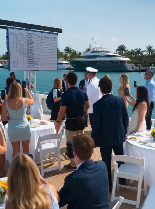
Then a new video loaded.
Emil looked confused. “This was attached to an archived complaint.”
The screen showed a boy standing at another marina years earlier, holding a life jacket and trying not to cry as staff told him there had been an error. Behind him, donor children boarded laughing.
The file label read: Henrik Larsen removal dispute.
A voice behind me said, “That was my brother.”
Everyone turned.
A tall woman with blond hair and a camera badge stepped out of the press line. Her eyes were shining with fury.
“I’m Freja Larsen,” she said. “I have been investigating Beaumont Yacht Group for six months.”
Marcel Beaumont’s face turned gray.
Freja lifted her camera.
“And now,” she said, “you have finally given me the proof.”
Part 5: The Reporter With The Missing Brother
Freja Larsen did not look like a reporter chasing a headline.
She looked like a sister who had been carrying a wound so long it had sharpened into purpose.
She stood near the edge of the dock, wind pulling strands of blond hair across her face, her press badge swinging against her jacket. The other reporters lowered their microphones for half a second, as if they sensed she had walked into the story from a place deeper than theirs.
“My brother Henrik won a place on a youth maritime exchange eight years ago,” Freja said. “He designed a low-cost emergency beacon for small fishing boats.”
My father inhaled quietly beside me.
Small fishing boats were not an idea to us. They were bills, weather, risk, prayer.
Freja pointed toward the screen. “The day before departure, his invitation disappeared. A donor’s son took his seat. My family was told Henrik’s paperwork had failed.”
Captain Leclerc looked at Emil. “Find the original complaint.”
Emil typed quickly.
Audrey whispered, “This isn’t my fault.”
I looked at her.
Maybe she meant the old cases. Maybe she meant her father. Maybe she meant the entire ugly machine she had been born sitting on top of.
But then I looked down at my ruined uniform.
“You chose today,” I said.
Her face tightened.
Freja heard me. She turned toward Audrey. “Yes. She did.”
Marcel Beaumont moved toward the captain. “I am ending this event.”
Captain Leclerc stepped in front of him. “You do not command this vessel.”
“I own the company that maintains it.”
“And I command the manifest,” the captain said. “Today, that matters more.”
The crowd murmured in approval.
That seemed to frighten Marcel more than anger did.
Because anger could be dismissed.
Approval meant people were choosing a side.
Emil found the archived complaint. It appeared on the screen: letters from Henrik’s family, emails from the program office, a signed donor adjustment form.
At the bottom was a signature.
Marcel Beaumont.
The dock erupted.
Freja’s hand shook around her microphone, but her voice stayed clear. “Mr. Beaumont, did your company remove scholarship students from youth voyages and replace them with donor children?”
“No.”
“Did you remove my brother?”
“No.”
“Did you remove Marisol Vega?”
He looked at me then.
For the first time, Marcel Beaumont truly saw me. Not as a stain on his daughter’s perfect day. Not as a poor girl from the pier. As a witness.
As a problem.
“No,” he said again.
Captain Leclerc turned to Emil. “Open the audio attachment.”
Marcel’s head snapped toward him. “There is no audio.”
Emil clicked.
For a moment, static crackled through the marina speakers.
Then Marcel Beaumont’s voice filled the dock.
“The Larsen boy is clever, but donors do not pay to photograph fish-market children beside their heirs. Replace him before boarding.”
Freja closed her eyes.
The crowd went silent around her pain.
The recording continued.
“And if anyone complains, call it a paperwork failure.”
Captain Leclerc stopped the audio.
Nobody needed more.
Freja opened her eyes and looked at her camera operator. “Keep filming.”
Audrey had gone pale. “Dad, tell them it isn’t real.”
Marcel did not comfort her. He did not touch her shoulder. He did not even look at her.
Instead, he leaned toward his attorney and whispered, “Get the car.”
Audrey heard him.
So did I.
Her expression changed in a way I would remember long after the smell of seafood left my clothes. She realized her father was not going to defend her. He was going to leave with the documents he could save and abandon the daughter he had taught to believe she was untouchable.
She looked at me, and for the first time there was no sneer.
Only fear.
Then Emil said, “Captain, there is a final locked folder.”
Captain Leclerc read the label.
His eyes lifted to mine.
The folder was named Vega Pier.
Part 6: The Locked Folder Named After My Family
My father’s arm tightened around my shoulders.
“Why would they have a folder named after our pier?” I whispered.
He did not answer.
That scared me more than anything.
Because my father had an answer for everything. Bad weather. Empty bait buckets. Broken lights. Customers who tried to underpay. He always had some steady sentence ready, some small joke or quiet wisdom to keep the day from feeling too heavy.
Now he stared at the screen like a man watching a ghost step out of the water.
Captain Leclerc looked at us. “Marisol, Mr. Vega, I will not open this publicly without your consent.”
The crowd shifted.
For the first time all day, someone had asked before exposing my life.
My father swallowed. “What is the date on the folder?”
Emil checked. “Created sixteen years ago. Updated repeatedly. Most recently last night.”
Sixteen years.
I was seventeen.
My father closed his eyes.
“Papá?” I whispered.
He looked down at me, and his face carried something I had never seen there before. Not shame. Not fear. Grief.
“There was a voyage before you were old enough to remember,” he said. “Your mother was chosen for a coastal restoration partnership. She never got to board.”
The dock seemed to tilt.
“My mother?”
I had grown up with stories of her voice, her laugh, the way she could mend a net faster than anyone on the pier. I knew she had died when I was little. I knew my father kept her photograph wrapped in cloth in the top drawer of our kitchen cabinet. I knew he never spoke about the month before she died.
But nobody had told me she had once stood where I stood.
My father looked at Captain Leclerc.
“Open it,” he said.
The captain hesitated. “Are you sure?”
My father’s voice broke, but did not bend. “They have hidden enough.”
Emil opened the folder.
The first file was a passenger record from sixteen years earlier.
Approved Participant: Elena Vega.
My mother.
Project: Living Reef Mooring System for Small Fishing Communities.
Replacement Guest: Camille Beaumont.
Marcel’s late sister.
A low sound moved through the dock.
I gripped my father’s shirt.
The next file was a complaint letter written in my mother’s name. The words appeared on the screen, formal and careful.
I was invited because my design protects working boats from anchor damage while restoring reef beds. My removal was not accidental.
My vision blurred.
My father whispered, “She wrote that at our kitchen table.”
More files opened. Diagrams. Photos. A design plan with my mother’s neat handwriting. Then a Beaumont Yacht Group brochure from the following year.
The same reef mooring system appeared in glossy color beneath the Beaumont logo.
My father made a sound I had never heard from him before.
Not a sob.
Something deeper.
Audrey covered her mouth.
Freja Larsen stepped closer to the screen, whispering, “They didn’t just steal seats.”
Captain Leclerc finished the sentence.
“They stole designs.”
Marcel Beaumont turned toward the exit.
Security moved first.
He stopped.
The final file opened.
It was an email from Marcel Beaumont to Thomas Bellamy, dated the night before.
Subject: Vega Issue.
Tell Audrey the girl is not to board. The mother caused trouble years ago. I will not have another Vega embarrassing this family on camera.
My father’s hand slipped from my shoulder.
I stared at those words until they burned into me.
The mother caused trouble.
Trouble.
That was what they called a woman asking not to be robbed.
Audrey looked at her father, tears finally spilling down her face. “You knew who Marisol was.”
Marcel’s silence answered.
And then Audrey did something nobody expected.
She stepped toward the microphone.
Part 7: The Daughter Who Turned On The Empire
Audrey Beaumont had used microphones all her life.
For charity photos. Sponsor welcomes. Polished speeches about opportunity written by adults who had stolen it from others. She knew how to stand tall, how to angle her face toward cameras, how to smile as if the world had been arranged correctly.
But when she reached for Captain Leclerc’s microphone, her hand trembled.
Her father’s voice cracked across the dock. “Audrey, step away.”
She froze.
For a second, I thought she would obey.
Then she looked at me.
Not at my ruined uniform. Not at the sauce on my sleeves. At my face.
“I knew about today,” she said.
The dock went silent.
Her attorney said, “Audrey, stop speaking.”
She did not.
“I knew my father wanted Marisol removed. I knew Thomas was supposed to change the list. I knew I wasn’t authorized.” Her breath hitched. “I told myself it didn’t matter because this was supposed to be my event anyway.”
The words were ugly.
But they were true.
She turned toward me. “And when you were still on the manifest, I got angry. Not because you did anything wrong. Because your being there proved I wasn’t special. I was just protected.”
My throat tightened despite myself.
She looked down at the seafood tray lying near the table.
“I threw that at you because I wanted everyone to see you the way my father taught me to see you.”
My father’s jaw tightened.
Audrey’s face crumpled. “Less.”
The word sat between us.
Small. Poisonous. Honest.
Then Audrey reached into her handbag and pulled out a silver flash drive.
Marcel lunged forward. Security caught his arms.
“Audrey!” he shouted.
She flinched, but held the drive higher.
“This is the private sponsor archive,” she said. “Passenger removals. Design transfers. Settlement threats. My father keeps copies because he thinks records are power.”
Freja Larsen’s camera light glowed red.
Captain Leclerc took the drive.
Marcel was breathing hard, his face dark with fury. “You stupid girl.”
Audrey turned toward him.
Something inside her seemed to break free.
“No,” she said. “I was stupid when I believed cruelty was inheritance.”
For the first time, applause started without permission.
Not loud at first. A few students. Then teachers. Then pier workers standing near the edge of the marina. Then sponsors who suddenly wanted to be seen applauding the truth.
I did not clap.
I could not.
My chest was too full of my mother.
Captain Leclerc inserted the drive into the secure dock computer. Files began loading across the screen in long rows.
Names. Years. Projects.
Henrik Larsen’s beacon.
Elena Vega’s reef mooring system.
Lucia Moretti’s tide sensor.
Sofia Mendes’s emergency ladder design.
The Beaumont empire had been built not only on yachts, but on stolen work from children and families they believed would never be heard.
Then one file appeared at the bottom.
Marked: Active Threats — Vega.
Captain Leclerc opened it.
Inside was a legal draft prepared that morning.
If Marisol Vega speaks publicly, initiate defamation response and report Rafael Vega’s pier stall for permit violations.
My father went still.
They had planned to take our livelihood too.
Audrey saw it and whispered, “I didn’t know about that.”
I believed her.
But my voice came out cold.
“You knew enough.”
She bowed her head.
Captain Leclerc removed the flash drive and handed it to Freja, then to the city attorney who had arrived at the dock with two officers.
Marcel Beaumont was escorted away while cameras flashed around him.
As he passed me, he leaned close enough to whisper, “This will not bring your mother back.”
My father stepped between us.
“No,” he said. “But it will bring her name back.”
Part 8: The Voyage That Finally Carried Her Name
Six months later, the marina looked different.
Not because the water had changed. The harbor still smelled of salt, diesel, and sun-warmed rope. Gulls still screamed over the slips. Boats still knocked gently against their moorings like impatient hearts.
But the Beaumont banners were gone.
Every single one.
In their place hung blue-and-white signs for the Elena Vega Youth Maritime Trust, created after court orders froze Beaumont assets connected to stolen scholarship programs and design theft. The trust had one rule written into its founding papers: no student could be removed from a voyage, project, or credit list without an independent review and public record.
My mother’s name was on the first line.
I stood at the same dock where Audrey had covered me in seafood and called me unworthy.
This time, my uniform was clean.
Still patched at the sleeve.
I had kept the patch.
My father said it reminded people that dignity did not require new fabric.
He stood beside me now in his best shirt, the one he saved for church, permit renewals, and days he wanted my mother to see from wherever she was. His hands were rough, folded carefully in front of him. When he looked at the new plaque near the boarding gate, his eyes shone.
ELENA VEGA
Designer of the Living Reef Mooring System
Mother, fisherwoman, inventor, and rightful founder of this program.
I touched her engraved name with two fingers.
For years, I had known my mother only through small things. A photograph. A lullaby my father hummed when he forgot I was listening. The old red scarf folded in a drawer.
Now I knew her through proof.
Through diagrams.
Through letters.
Through a design that had protected boats all along while her name was hidden beneath someone else’s logo.
Freja Larsen stood near the press line, reporting live as Henrik, now grown, prepared to board as a guest engineer. Lucia Moretti had flown in from Naples. Sofia Mendes came from Lisbon. Families from old removal logs lined the dock, some crying quietly, some holding folders, some simply staring at the water as if it had finally returned what it swallowed.
Captain Leclerc approached me.
“Marisol Vega,” he said, holding out the official manifest. “You are authorized to lead the first voyage.”
The crowd applauded.
This time, I let myself hear it.
Then a hush moved near the back.
Audrey Beaumont had arrived.
She wore no designer sunglasses, no gold jewelry, no polished smile. Her hair was tied back, and she carried a cardboard box in both arms. A few people turned away from her. Others stared openly.
She walked to my father first.
That surprised me.
She set the box down and said, “These are original files from my family’s private storage. I found more references to Elena’s work.”
My father looked at the box but did not touch it.
Audrey swallowed. “I am sorry for what I did to your daughter.”
The dock was silent.
My father’s face remained steady. “Apology is a beginning. Not a payment.”
Audrey nodded. “I know.”
Then she turned to me.
“I cannot undo the tray,” she said. “Or the list. Or what I helped protect by wanting it to be true.” Her voice trembled. “But I am testifying in the remaining cases. All of them.”
I studied her.
There was no performance in her face now. No expectation that tears would buy forgiveness.
Only work waiting to be done.
I took the box.
Not as absolution.
As evidence.
Captain Leclerc opened the boarding gate.
Students stepped forward one by one. Their names appeared on the screen, each approved record locked in place.
Henrik Larsen.
Lucia Moretti.
Sofia Mendes.
Marisol Vega.
And at the bottom, added by unanimous vote of the trust board, one honorary passenger:
Elena Vega.
My father saw it and covered his mouth.
The captain handed him a small framed copy of the manifest. “She sails with us today.”
My father’s shoulders shook once.
I took his hand, and together we boarded.
As the yacht eased from the dock, the marina grew smaller behind us. The water opened wide and bright ahead. I stood at the bow with my father beside me, my mother’s name on the manifest, and the wind pulling salt through my hair.
For the first time, I was not someone they had tried to remove.
I was the daughter of the woman who had been here first.
