Part 2: The Speech Charlotte Could Not Finish
Charlotte Beaumont’s donor speech lay open on the podium like it had been caught lying.
The room stayed frozen around it.
Cake frosting clung to the front of my altered dress, sinking into the seam my mother had repaired by hand the night before. I could still feel the force of Charlotte’s hand, the sudden press of sugar and cream against my chest, the hot humiliation rushing up my throat while cameras turned toward me.
But nobody was looking at my dress anymore.
They were looking at the display table.
The security volunteer, Mr. Elias Moore, stood beside the unlocked case with the volunteer journal open in both hands. His face had gone pale beneath the warm chandelier light.
He read the line again, slower this time.
“Selene Carter donated her own work money to rescue the scholarship fund after the Beaumont pledge was delayed.”
A whisper moved through the old-money library gala like wind through dry pages.
Charlotte’s lips parted.
Her mother, Vivienne Beaumont, rose from the front row with a pearl clutch pressed against her waist. “That journal is private committee material.”
Mr. Moore looked at her. “It was placed in the restoration archive by the gala committee.”
“Then it was misplaced,” Vivienne said.
I stared at the page.
My own name was there in neat black ink.
Selene Carter — personal donation received.
I remembered counting the money in my bedroom. Twenty-dollar bills from shelving shifts. Tips from weekend coat-check work. Cash I had saved for winter shoes. My mother had watched me put it into an envelope and asked me three times if I was sure.
I had said yes because the scholarship fund was going to collapse, and without it, five students would lose access to the library’s summer restoration program.
Nobody was supposed to know.
Charlotte laughed suddenly. “That proves nothing. Poor girls donate little amounts all the time so people will clap.”
The words were so ugly that even her friends looked down.
Then Mr. Moore turned another page.
His expression changed.
“There is a second entry,” he said.
Charlotte’s eyes flicked toward the journal.
Too fast.
Mr. Moore read, “Original Beaumont pledge marked unpaid after three collection notices.”
Vivienne’s face tightened.
A man in a dark suit near the donor table leaned toward her, whispering urgently, but she lifted one hand and silenced him.
The gala chair, Mrs. Helena Whitaker, stepped forward. Her voice trembled, but only slightly. “Mr. Moore, please continue.”
Charlotte snapped, “This is humiliating.”
I looked at her ruined little smile.
“Yes,” I said quietly. “It is.”
She turned toward me like she had forgotten I could speak.
Mrs. Whitaker approached the podium, took Charlotte’s open donor speech, and read the highlighted line at the top.
“Tonight, we honor Charlotte Beaumont, whose family generosity preserved the student scholarship fund.”
Her voice broke on generosity.
Then she looked at the journal.
“And yet the archive says the fund was preserved by Selene Carter.”
The cameras moved closer.
Vivienne Beaumont said, “This gala is over.”
“No,” Mrs. Whitaker said, lifting the journal with both hands. “The gala has finally begun.”
Part 3: The Ledger Beneath The Manuscript Case
Charlotte stepped backward from the stage as if the old floorboards had turned unstable beneath her heels.
“Mother,” she whispered.
Vivienne did not answer her. She was staring at the rare manuscript case, not at Charlotte, not at me, but at the lower drawer beneath the glass.
Mr. Moore noticed.
So did I.
The drawer was small and brass-handled, built into the restoration table where the oldest books were examined under low light. I had cleaned that table after volunteer shifts. I knew the drawer stuck unless you pulled it gently upward first.
Mrs. Whitaker followed Vivienne’s gaze.
“What is in that drawer?” she asked.
Vivienne smiled thinly. “Old repair slips. Nothing suitable for a public event.”
Mr. Moore reached for the handle.
Vivienne’s voice sharpened. “Do not touch that.”
The entire room heard the fear behind the command.
Mr. Moore paused.
Then Mrs. Whitaker said, “Open it.”
The drawer resisted once, then gave way with a wooden groan.
Inside lay a black restoration book tied shut with faded blue ribbon.
The moment I saw it, my chest tightened.
I had seen that book before.
Not inside the drawer. In the basement archive, months earlier, when a cracked water pipe had threatened the storage shelves and I had helped carry boxes to higher ground. The book had fallen open near my feet, its pages filled with lists of donors, repairs, and names of students who had worked without anyone applauding.
I had told Charlotte about it once.
That was my mistake.
Mr. Moore untied the ribbon.
Charlotte went still.
Mrs. Whitaker leaned over the book, and her hand rose to her throat.
“What is it?” someone asked.
She turned the book toward the room.
The first page showed a restoration expense ledger.
The Beaumont name appeared again and again.
Not under donations.
Under outstanding balances.
Vivienne’s cheeks lost color.
Mr. Moore read from the page. “Beaumont Family Fund: pledged restoration support, unpaid. Replacement amount covered by student emergency donations.”
A reporter near the fireplace asked, “How many times?”
Mr. Moore turned pages.
Once.
Twice.
Six times.
Eight.
The room grew colder with every page.
Charlotte’s perfect donor speech suddenly looked like costume jewelry under bright light.
I pressed my hands against my ruined dress, trying to stop them shaking. My mother had worried that people would notice the altered hem. Now the whole room was seeing something Charlotte had worked much harder to hide.
Then Mr. Moore stopped.
A folded note had been pressed between two pages.
He opened it carefully.
“This is addressed to Charlotte Beaumont,” he said.
Charlotte’s voice cracked. “That is private.”
Mrs. Whitaker said, “So was Selene’s humiliation until you made it public.”
Mr. Moore read.
Charlotte, remove Carter from the unlocking ceremony if possible. The scholarship story must remain with our family. If questioned, imply she exaggerated her role.
Vivienne Beaumont.
A sound moved through the crowd, half gasp, half disgust.
Charlotte looked at her mother.
“You wrote that?”
Vivienne’s eyes stayed fixed on the book. “I protected our name.”
I stepped forward, frosting stiffening across my dress.
“No,” I said. “You used mine to protect yours.”
Part 4: The Girls Written In The Margins
Mrs. Whitaker closed Charlotte’s speech folder with a snap.
The sound made Charlotte flinch.
Outside the library windows, Philadelphia rain streaked the glass, turning the city lights soft and blurred. Inside, everything had become too sharp. Every pearl necklace, every polished shoe, every gold donor plaque on the wall seemed to shine with accusation.
Mr. Moore turned another page of the restoration book.
Then another.
His brow furrowed.
“These margins,” he said. “There are names written here.”
Mrs. Whitaker moved closer. “Student volunteers?”
“No,” he said slowly. “Students removed from recognition programs.”
A strange quiet settled over the room.
The kind that arrives when people understand the scandal is larger than the first wound.
Mr. Moore read the first name.
“Elena Rossi. Removed from rare-map cataloging ceremony.”
A woman near the back covered her mouth.
“Elise Moreau. Replaced in donor newsletter after binding repair.”
“Greta Lindholm. Omitted from manuscript rescue acknowledgments.”
“Selene Carter.”
My name looked different there.
Not like a person.
Like evidence.
Charlotte whispered, “I didn’t write all of that.”
Nobody answered.
Vivienne stepped forward. “This is an old institution. Records are messy. Mistakes happen.”
An elderly librarian named Miss Agnes Rowe slowly stood from her chair beside the fireplace. She had worked at the library longer than anyone, her white hair pinned beneath a black velvet headband.
“Mistakes,” she said, “do not always benefit the same family.”
Vivienne turned on her. “Agnes, you will regret involving yourself.”
Miss Rowe smiled sadly. “My dear, I have regretted my silence for fifteen years.”
The room shifted toward her.
Miss Rowe walked to the restoration table with careful steps. Her cane tapped against the wooden floor. When she reached the book, she rested one trembling hand beside the open page.
“I kept copies,” she said.
Vivienne’s face hardened.
Charlotte stared at Miss Rowe like she had never understood old women could be dangerous.
Miss Rowe looked at me. “Selene, I am sorry.”
My throat tightened. “For what?”
“For knowing this family had done it before.”
She reached into her handbag and removed a small envelope. Inside were photocopied ledger pages, donor letters, and old committee notes.
“This began before Charlotte,” she said. “Before Selene. Before most of these girls were born.”
A reporter whispered, “Are you saying the Beaumont family claimed credit for student restoration work?”
Miss Rowe’s voice shook.
“I am saying they built a reputation on it.”
Charlotte suddenly snapped, “I only did what everyone expected.”
The confession was small.
But it landed like a dropped chandelier.
I looked at her.
She was crying now, but the tears did not soften the cake on my dress or the insult in my ears.
I asked, “And what did they expect you to do?”
Charlotte looked at the floor.
Miss Rowe answered for her.
“Erase girls who made the Beaumonts look unnecessary.”
Part 5: The Basement Archive Opens At Midnight
By midnight, the gala guests were gone, but the library was more awake than it had been all evening.
Police officers stood near the entrance. Reporters waited outside under umbrellas. Committee members gathered in tight circles, whispering around cups of untouched coffee. My mother had arrived twenty minutes after seeing the livestream, still wearing her work shoes and the gray cardigan she used when cleaning hotel offices.
The moment she saw my dress, her face changed.
Not because it was ruined.
Because she had spent forty minutes steaming dignity into it, and Charlotte had tried to turn that dignity into a joke.
She wrapped her coat around me without a word.
Then she looked across the room at Charlotte.
Charlotte looked away first.
Mrs. Whitaker approached us, holding the restoration book against her chest. “Selene, your mother may come with us. We need to check the basement archive.”
My mother’s arm tightened around me. “Why?”
Miss Rowe answered quietly, “Because the book suggests there are sealed boxes.”
The basement archive smelled of dust, glue, old paper, and rainwater trapped in stone. Fluorescent lights hummed overhead as Mr. Moore unlocked a storage gate.
Charlotte came with us.
So did Vivienne, though two officers walked close behind her.
“Is this necessary?” Vivienne asked.
Miss Rowe did not look at her. “It became necessary when your daughter shoved cake into a child’s dress.”
Charlotte whispered, “I didn’t shove it. I—”
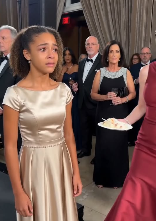
My mother turned.
Charlotte stopped.
There was something in my mother’s face that did not need volume. She had worked too hard, swallowed too much, repaired too many hems under bad kitchen light to let Charlotte edit that moment too.
Mr. Moore pulled a box from the shelf.
Beaumont Restoration Partnership — Restricted.
He cut the seal.
Inside were folders arranged by year.
The first contained gala speeches.
The second contained pledge records.
The third contained letters from students who had asked why their names had vanished from programs.
My mother picked up one letter.
Her lips parted.
“Selene,” she said.
I took it.
The letter was fifteen years old, written in careful handwriting.
My name is Maribel Carter. I completed the emergency binding repair on the Whitaker manuscript, but the public record names Vivienne Beaumont.
My mother sat down hard on a wooden crate.
“Mom?”
Her hand shook against her mouth.
“That’s your aunt,” she whispered.
I had heard Aunt Maribel’s name only in fragments. She had died before I could remember her clearly. My mother said she had loved books, had once dreamed of becoming a conservator, had stopped speaking about the library before she passed.
Now I knew why.
Vivienne said sharply, “That was a misunderstanding.”
My mother stood.
“No,” she said, voice low and shaking. “That was my sister.”
Charlotte stared at her mother. “You took credit from her family too?”
Vivienne’s silence answered.
Then Miss Rowe opened the final folder.
On the tab was written:
Carter Risk.
Part 6: The Letter My Aunt Never Sent
The Carter Risk folder was thin.
Somehow, that made it worse.
A life could be crushed with only a few pages if the right people had enough money.
Miss Rowe opened it on the basement table.
The first document was a memo from the Beaumont family office.
Maribel Carter may challenge donor attribution. Discourage future access to restoration rooms.
My mother made a sound like she had been struck.
I reached for her hand.
The second page was a draft letter addressed to my aunt, never sent.
Miss Rowe read it aloud, her voice trembling.
Dear Miss Carter, while your volunteer enthusiasm is appreciated, the library must prioritize contributors whose public standing supports institutional fundraising.
My mother closed her eyes.
I imagined Aunt Maribel reading those words. Enthusiasm. Appreciated. Public standing.
Words polished smooth enough to hide the blade.
Charlotte hugged herself near the shelves, her face pale. “Mother, how could you?”
Vivienne’s voice was cold. “Because institutions survive through reputation.”
Miss Rowe slammed her palm on the table.
The sound shocked all of us.
“Institutions survive through trust,” she said. “Reputation is what people like you purchase when trust is gone.”
Mr. Moore turned another page.
“This one is handwritten.”
He lifted a folded letter from the back of the folder.
My mother reached for it before he could read.
The handwriting made her knees bend.
“That’s Maribel’s.”
She unfolded the letter carefully.
Her voice broke on the first line.
If anyone ever finds this, please know I did the work.
The basement seemed to vanish around me.
My mother kept reading.
I repaired the Whitaker manuscript after the binding split during transport. I stayed overnight because no one else knew how to stabilize the spine. Vivienne Beaumont arrived in the morning with photographers. By afternoon, my name was gone.
Charlotte covered her mouth.
The letter continued.
I am not angry that she is rich. I am angry that she can stand beside my work and make me feel invisible in front of it.
My vision blurred.
My mother whispered, “She never told me it was this bad.”
Vivienne looked uncomfortable for the first time, not guilty exactly, but cornered.
“She was unstable,” she said.
My mother’s head lifted.
The room went deadly quiet.
I stepped between them before my mother could move closer.
“No,” I said. “She was stolen from.”
Vivienne’s eyes cut to me. “You are a child.”
I held up the volunteer journal.
“And you are in the record.”
Mr. Moore opened the last page.
A receipt was taped inside.
My aunt had paid for emergency materials herself.
The same pattern.
The same theft.
The same Carter women giving money and labor to a library that let Beaumonts hold the microphone.
Then Miss Rowe found one final envelope beneath the folder lining.
Inside was a key.
A brass key with a tag.
Whitaker Manuscript Case — Original Lock.
Miss Rowe stared at it.
“This key disappeared fifteen years ago,” she whispered. “The night Maribel was removed.”
Charlotte looked at the key, then at the locked manuscript case upstairs.
“What does it open now?” she asked.
Miss Rowe’s face went white.
“The hidden compartment.”
Part 7: The Hidden Compartment Beneath The Book
We returned upstairs in silence.
The gala hall looked wrecked now. Not physically. The flowers were still arranged, the chandeliers still glowing, the donor tables still covered in cream linen.
But the room had lost its costume.
Without guests laughing and cameras flattering the wealthy, the library looked older, sadder, almost ashamed.
The rare manuscript case stood beneath the stage lights.
Miss Rowe held the brass key like it weighed more than metal.
“The Whitaker manuscript was built with a lower preservation drawer,” she explained. “For loose fragments, repair notes, original bindings. After the lock disappeared, we stopped using it.”
Vivienne’s face had gone rigid.
Charlotte noticed.
“Mother,” she whispered, “what is in there?”
Vivienne did not answer.
Miss Rowe inserted the key.
For one breath, nothing happened.
Then the lock clicked.
Mr. Moore opened the hidden compartment.
Inside lay a packet wrapped in linen.
Miss Rowe lifted it out and placed it on the table with a tenderness that made my throat ache.
The packet contained three things.
A strip of repaired manuscript binding.
A photograph of Aunt Maribel standing beside the open case, smiling shyly.
And a signed restoration certificate.
Maribel Carter.
Lead emergency conservator.
My mother began to cry.
Not loudly. She pressed her fist to her mouth and bent forward as if the truth had reached inside her and pulled out fifteen years of grief at once.
I held her.
Miss Rowe turned the certificate over.
There was writing on the back.
Maribel’s handwriting again.
Agnes, hide this if you must. One day, someone will need proof that we were here.
Miss Rowe sobbed once.
“I was afraid,” she whispered. “Vivienne threatened my position. I hid it, but I never brought it out.”
Vivienne snapped, “Because you knew it would damage the library.”
“No,” Miss Rowe said. “I knew it would damage you.”
Charlotte sank into a chair.
The girl who had shoved cake into my dress now looked at the photograph of my aunt as if she were seeing the ghost at the center of her inheritance.
Then she stood.
Vivienne said, “Charlotte, don’t.”
Charlotte ignored her.
She walked to the podium, where her donor speech still sat closed.
Her hand trembled as she lifted the microphone.
“I lied tonight,” she said.
The few remaining staff, officers, and committee members turned.
“I knew Selene had donated money. I knew my family pledge was late. I didn’t know about her aunt, but I knew enough to be cruel.”
Vivienne hissed, “Stop humiliating yourself.”
Charlotte looked at her mother.
“No,” she said. “I humiliated someone else because you taught me that was easier.”
She turned toward me.
“I am sorry, Selene.”
I did not answer.
Not because I wanted to be cruel.
Because some apologies need to stand alone before anyone decides what to do with them.
Charlotte placed her donor speech into the trash.
Then she opened her phone and sent something.
Vivienne’s eyes widened. “What did you just do?”
Charlotte’s voice shook.
“I released the Beaumont archive password to Mrs. Whitaker.”
Vivienne lunged toward her.
An officer stepped between them.
Charlotte looked at me, pale but steady.
“The private files are under the family office account,” she said. “The password is Maribel.”
Part 8: The Library That Finally Spoke Her Name
Six months later, my mother steamed another dress in our tiny apartment.
This one was not borrowed.
It was simple, dark blue, and mine.
She still fussed with the sleeves for forty minutes.
“Mom,” I said softly, “it’s fine.”
She smoothed the fabric again anyway. “I know.”
But her eyes were wet.
The library gala looked different that spring.
No Beaumont banners hung near the stage. No donor portraits stood beside the manuscript case. The gold plaque outside the restoration room had been removed, melted down, and replaced with one made from reclaimed brass.
THE MARIBEL CARTER RESTORATION FELLOWSHIP
For students whose hands preserve what history forgets.
My aunt’s photograph stood beneath it.
So did the certificate from the hidden compartment.
After Charlotte released the archive password, investigators found years of altered attribution records. Students from Philadelphia, Boston, London, Dublin, and Edinburgh had been erased from restoration programs while donor families collected speeches and praise.
Vivienne Beaumont resigned from the library board before she could be removed.
Then she was removed anyway from three other boards.
Mrs. Whitaker created an independent archive review committee. Miss Rowe became its first chair. My mother, who once thought libraries belonged to people who whispered better than we did, was invited to help read the recovered letters.
She said yes.
Charlotte came to the reopening ceremony too.
She stood near the back in a plain black dress, no cameras around her, no friends waiting to laugh. Her face was thinner, quieter. She had spent months testifying to the review board, surrendering files, naming people who had helped her family turn generosity into theater.
When she approached me, my mother stiffened beside me.
Charlotte stopped at a respectful distance.
“I found another box,” she said.
She held it out with both hands.
Inside were volunteer badges, old letters, and photographs of students standing beside restored books they had never been credited for.
“I thought you should have it before the committee sees it,” she said. “Not to hide it. Just to know first.”
I took the box.
Our fingers did not touch.
“Thank you,” I said.
It was not forgiveness.
But it was not nothing.
The ceremony began with no donor speech.
Mrs. Whitaker stepped to the microphone and looked directly at the students seated in the front row.
“For many years,” she said, “this institution confused wealth with worth. Tonight, we correct the record.”
One by one, names appeared on the screen.
Elena Rossi.
Elise Moreau.
Greta Lindholm.
Maribel Carter.
Selene Carter.
My mother squeezed my hand so tightly it hurt.
Then Mrs. Whitaker turned toward me.
“Selene Carter,” she said, “will unlock the manuscript case.”
The room stood.
I walked forward.
No cake. No laughter. No whisper that I had tricked anyone.
Just my mother in the front row, crying openly now, and Miss Rowe beside her, holding Aunt Maribel’s photograph against her heart.
I slid the key into the case.
The lock opened with a soft click.
Inside lay the restored Whitaker manuscript, its repaired binding glowing under gentle light. Beside it was the volunteer journal, opened to the page where my donation had first exposed the lie.
But there was one new line beneath it, written in Mrs. Whitaker’s careful hand.
Selene Carter restored the record her aunt protected.
My throat tightened.
I looked at my mother.
She nodded once.
So I lifted the manuscript case lid, not for Charlotte, not for the cameras, not for the old families watching from their polished chairs.
I lifted it for Maribel.
For my mother.
For every girl whose name had waited in the margins.
And as the library filled with applause, I finally understood that history does not stay buried when the hands that saved it learn how to open the case.
