Part 2: The Name Sloane Tried To Delete
The project lead did not raise his voice.
That made the room even quieter.
Mr. Elias Hart stood beneath the giant screen with one hand on the laptop and the other gripping the microphone like it was the only thing keeping him from shaking. Behind him, the hive archive glowed across the wall in clean white rows.
My name was everywhere.
Amani Dawson — 11:48 p.m. upload.
Amani Dawson — emergency mite-count correction.
Amani Dawson — hive ventilation note.
Amani Dawson — colony stress warning.
I stood near the stage area with my cheek burning, one hand pressed against my face where Sloane had hit me. I could still hear the sound of it. Not just the slap. The gasp after. The silence after that. The way everyone had waited to see whether I would crumble before deciding what kind of story they were watching.
Sloane Sterling had stepped back, but not far enough to seem afraid.
Not yet.
Her father, Grant Sterling, stood near the sponsor row, his chair lying crooked behind him after he shot to his feet. He wore a navy suit, a silver watch, and the kind of expression powerful men used when they were trying to decide who to destroy first.
“Turn that off,” he said.
Mr. Hart looked at him. “No.”
The word cracked through the room.
Church ladies in the front row stopped fanning themselves with the program cards. A local news camera pushed closer. A teacher near the sweet tea table whispered, “Oh my Lord.”
Sloane laughed, but the sound came out thin. “This is ridiculous. She helped with notes. That does not make her the face of the hive.”
Mr. Hart clicked once.
A deletion log opened.
My stomach clenched before I even understood what I was seeing.
User: Sloane Sterling.
Action: Removed contributor name from public recognition slide.
Deleted: Amani Dawson.
Replacement: Sloane Sterling.
Timestamp: 8:06 a.m.
The room seemed to tilt.
Sloane’s mouth fell open.
“That is not what happened,” she said.
Mr. Hart scrolled down.
A security still appeared beside the log. Sloane stood at the registration laptop that morning, one hand on the keyboard, her sponsor badge hanging from a ribbon around her neck. Behind her, the open recognition slide showed my name in the student lead position.
In the next still, my name was gone.
Hers was there.
I stared until my eyes watered.
All those weeks I thought nobody noticed me. All those nights I cleaned frames, recorded hive temperatures, checked for moisture and strange bee movement while everyone else went home. I had told myself the work was enough.
But Sloane had noticed.
She had noticed enough to steal it.
Grant Sterling stepped forward. “My daughter has administrative access because our family funded this program.”
Mr. Hart’s voice hardened. “Funding a program does not grant permission to falsify student records.”
Sloane snapped, “She was never supposed to be announced.”
The words leapt out of her like a trapped insect.
Everyone heard.
Even Sloane seemed startled by herself.
I lowered my hand from my cheek.
“Why not?” I asked.
My voice was rough, but it carried.
Sloane looked at my worn clothes, my scuffed shoes, the loose thread at my cuff, and for one second she forgot to hide what she really thought.
Then she said, “Because people like you make everything look desperate.”
The silence after that was worse than the slap.
Then Mrs. Pearl Whitaker, one of the church ladies in the front row, stood slowly.
“Baby,” she said, looking straight at me, “desperate people do not save colonies. Careful people do.”
Part 3: The Backup File Under The Hive Table
Mr. Hart turned back to the archive.
“I need everyone to remain where they are,” he said. “No one touches the laptops. No one touches the hive table.”
Grant Sterling smiled coldly. “You have no authority to detain guests.”
A county agriculture inspector near the observation hive lifted her badge. Her name was Dr. Maren Lowell, and she had been quiet until then.
“I do,” she said.
That changed Grant’s smile.
Sloane looked toward the side doors.
Two security volunteers moved closer.
I should have felt relieved, but my knees were still weak. The slap had not hurt as much as the words after it. Press needed polished, not pathetic. A girl like me could never represent her family’s brand.
The truth was on the screen, but my body had not caught up yet.
Mrs. Whitaker stepped out of the front row and placed a cool paper napkin in my hand. “For your cheek, child.”
“Thank you,” I whispered.
She did not move away. She stood beside me like she had been assigned by heaven to make sure I stayed upright.
Mr. Hart clicked through more files. “The public recognition slide was altered, but the inspection log remained intact because it was submitted to the state bee health archive at midnight.”
Sloane’s face tightened. “So?”
“So,” Dr. Lowell said, “state inspection records are protected documents.”
Grant’s jaw worked once.
Mr. Hart opened the hive inspection log.
There it was.
My entry from three nights earlier.
Observation: queen movement irregular near lower frame. Worker clustering indicates heat stress. Possible ventilation blockage. Recommend immediate inspection before public opening.
Then the follow-up:
Amani Dawson identified blocked lower vent and early wax moth signs. Intervention completed. Colony stable.
My name sat beside the words like it had finally learned how to breathe.
A reporter asked, “Was the colony in danger?”
Dr. Lowell stepped toward the microphone. “Yes. If the issue had not been caught early, this hive could have been lost before the public launch.”
The church ladies murmured.
One sponsor whispered, “Lost?”
Dr. Lowell nodded. “The observation hive is not decoration. It is a living colony.”
That sentence hit harder than I expected.
Because that was what I had been trying to say for weeks.
The bees were not props. The hive was not a photo opportunity. The whole project was alive, fragile, warm, moving with thousands of tiny decisions nobody could fake.
Mr. Hart opened another folder.
Then he froze.
“What is it?” Dr. Lowell asked.
“There’s a backup from under the hive table,” he said.
Sloane went pale.
Grant said, “That equipment belongs to Sterling Pollinator Trust.”
“No,” Mr. Hart said. “The trust donated the table display. The recording unit belongs to the school.”
He clicked.
A video loaded.
The timestamp read 7:52 a.m.
The room on-screen was nearly empty. The sweet tea had not been poured yet. The banners still leaned against the wall. Sloane stood beside the hive table with another girl, her friend Camille.
Camille whispered, “What if Amani says something?”
Sloane rolled her eyes.
“She won’t. Girls like that are used to swallowing things.”
I felt Mrs. Whitaker’s hand tighten around my shoulder.
On-screen, Sloane opened the laptop.
Camille asked, “And if Mr. Hart notices?”
Sloane smiled.
“Then Daddy handles him.”
The video continued.
Sloane deleted my name.
Then she opened another folder labeled Media Notes.
Inside was a line highlighted in yellow.
Avoid centering Amani Dawson. Background does not match Sterling brand image.
My chest went cold.
Grant Sterling’s voice rose from the sponsor row. “This is selective and defamatory.”
Dr. Lowell looked at him.
“No,” she said. “It is archived.”
Part 4: The Other Names In The Hive Book
Sloane stopped pretending after that.
Her face hardened. The panic slipped behind pride, and pride was clearly where she felt safer.
“This is being twisted,” she said. “My family made this event possible.”
Mr. Hart turned slowly. “The bees made this event possible. The students made it possible. Your family put its logo on the banner.”
A few people clapped before catching themselves.
Grant Sterling pointed toward the screen. “You will regret speaking to my daughter that way.”
Dr. Lowell stepped between them. “Mr. Sterling, do not threaten staff during a county-recorded inquiry.”
That word—recorded—made several adults glance toward the cameras.
I stared at the Media Notes file. My name was not the only one inside.
Mr. Hart saw it too.
He opened the full document.
A spreadsheet filled the screen.
Student visibility assessment.
At first, I did not understand the rows.
Then I saw names.
Rosa Bennett — removed from orchard pollinator tour.
Elena Brooks — credit minimized in meadow restoration event.
Marta Collins — omitted from hive-build press release.
Nadia Flores — replaced in donor photo ceremony.
A note beside Rosa’s name read: Family farm foreclosure may distract from uplifting message.
Elena’s note read: Accent not ideal for broadcast.
Marta’s note read: Does not photograph as sponsor-facing lead.
Then mine.
Amani Dawson — worn presentation, low-income optics, use only in group mention.
My face burned worse than my cheek.
Not because they had insulted me.
Because they had organized the insult into a spreadsheet.
Mrs. Whitaker whispered, “Lord have mercy.”
A young woman near the news vans pushed through the side aisle. She wore a green jacket and carried a press notebook.
“My sister is on that list,” she said.
Everyone turned.
The woman pointed at the screen. “Rosa Bennett. She worked on the orchard pollinator tour two years ago. She was told her records were incomplete.”
Dr. Lowell asked, “Your name?”
“Clara Bennett,” she said. “And I have emails.”
Grant Sterling’s expression flickered.
Just once.
But enough.
Mr. Hart looked at the spreadsheet again. “There are archived attachments.”
Sloane whispered, “Don’t open those.”
I looked at her.
Her voice had not sounded cruel that time.
It had sounded scared.
Mr. Hart opened the first attachment.
An email appeared.
From: Grant Sterling.
To: Program Staff.
Subject: Youth Brand Alignment.
The message read:
The pollinator initiative cannot be represented by students whose circumstances pull attention away from Sterling Trust leadership. Keep hardship stories controlled. Replace leads where necessary.
The room erupted.
Clara Bennett lifted her notebook. “I knew it.”
Grant’s attorney, who seemed to materialize from the sponsor row, muttered something in his ear.
But the damage was already moving faster than strategy.
Mr. Hart opened a second attachment.
It was a donor speech draft.
Opening Hive Lead: Sloane Sterling.
Prepared date: four weeks earlier.
Four weeks.
Before my inspection log.
Before the colony problem.
Before my name was ever announced.
Sloane stared at the draft.
“I thought it was decided,” she whispered.
Dr. Lowell looked at her. “What was decided?”
Sloane’s eyes filled with angry tears.
“That I would open the hive,” she said. “That was the whole point.”
I stepped toward her, heart pounding.
“No,” I said. “The whole point was keeping the bees alive.”
Part 5: My Mother Arrives With The Old Receipt
The livestream reached my mother before anyone called her.
I knew because the side doors flew open fifteen minutes later, and she stepped in wearing her diner apron under a raincoat, her hair still pinned in the messy twist she wore for lunch shifts.
Her name was Lila Dawson, and she had never entered a room apologizing for existing.
But when she saw my cheek, she stopped.
Not because she was ashamed.
Because every mother has a line inside her, and Sloane had stepped on it with both feet.
“Amani,” she said.
I crossed the room before I knew I had moved.
She pulled me into her arms, and the smell of coffee, rain, and fryer oil almost undid me completely.
“I’m okay,” I whispered.
“No,” she said softly. “You are standing. That is not the same thing.”
I cried then.
Only once. One sharp breath into her shoulder. Then I wiped my face and turned back toward the screen.
My mother looked at Sloane.
Sloane looked away.
Grant Sterling stepped forward. “This is becoming emotional theater.”
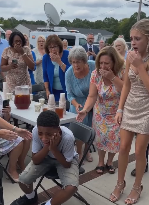
My mother’s eyes moved to him.
“You must be her father,” she said.
He stiffened. “Grant Sterling.”
“I did not ask your name.”
A ripple went through the room.
She released my hand and walked toward the hive table. “My daughter spent nights talking about those bees like they were babies. She worried over that queen. She checked temperatures before breakfast. She missed sleep. She missed dinner. And your child hit her because a screen told the truth.”
Grant’s face tightened. “Madam, you do not understand the scale of what my family has contributed.”
My mother reached into her raincoat pocket.
“I understand contribution.”
She pulled out an old folded receipt sealed in plastic.
The paper was yellowed at the edges.
My stomach tightened. “Mama?”
She did not look at me.
She looked at Dr. Lowell. “Does your archive go back sixteen years?”
Dr. Lowell frowned. “For state pollinator projects, yes.”
My mother placed the receipt on the table. “Then search Dawson Apiary.”
Grant Sterling went still.
I saw it.
So did Dr. Lowell.
She walked to the laptop and typed.
Sloane whispered, “Dad?”
Grant said nothing.
The search results loaded slowly.
Dawson Apiary appeared in the archive.
The first file opened.
Community Hive Rescue Grant — applicant: Samuel Dawson.
My grandfather.
I had only known him through stories. A gentle man with big hands, a smoker’s laugh, and a backyard full of hives he treated like a church choir. He died before I was born, but my mother kept his old bee veil folded in a box under her bed.
Dr. Lowell read the file, and her face changed.
“This grant was marked abandoned.”
My mother held up the receipt. “It was not abandoned. My father paid the emergency inspection fee himself when the sponsor delayed funds.”
Mr. Hart opened the next attachment.
A scanned design appeared.
Low-cost observation hive ventilation system.
Inventor: Samuel Dawson.
Then a Sterling Trust brochure from the following year appeared beside it.
The same design.
Under a Sterling name.
My mother’s voice trembled with fifteen years of swallowed anger.
“My father died thinking nobody believed him.”
Grant Sterling looked toward the exits.
Security moved first.
The final archive note opened.
Dawson family may challenge attribution. Avoid public connection.
I stopped breathing.
They had stolen from my grandfather.
Then they tried to erase me.
Sloane stared at the screen, tears spilling now.
“You knew who she was,” she whispered to her father.
Grant’s silence answered.
Part 6: The Hive That Carried My Grandfather’s Design
Dr. Lowell requested the room be sealed for formal documentation.
Nobody left.
Maybe curiosity held them. Maybe guilt. Maybe the sudden fear that if they walked out now, their own silence would follow them home.
I stood beside my mother while Mr. Hart projected my grandfather’s design across the screen.
The drawing was careful and beautiful in a way only working people’s inventions are beautiful. Not fancy. Not ornamental. Every line had a purpose. Every vent, latch, and frame angle solved a problem someone had actually touched with tired hands.
My mother pointed to the lower vent.
“He designed that after a winter hive overheated during a school demonstration,” she said. “He wanted children to see bees safely without stressing the colony.”
Dr. Lowell compared the drawing to the observation hive beside the stage.
Her expression darkened.
“The current hive uses this configuration.”
Mr. Hart whispered, “Sterling Trust called it their signature educational design.”
My mother laughed once.
It was not amused.
“It was my father’s porch design.”
Sloane sank into a chair.
All the color had left her face.
“I didn’t know,” she said.
I looked at her.
Maybe she did not know about my grandfather. Maybe she did not know about the original design. Maybe she had been raised inside a house where stolen things were already polished before she could question who they belonged to.
But she knew about me.
She knew enough to delete my name.
She knew enough to slap me.
She knew enough to call me pathetic.
“You knew today,” I said.
Her eyes filled again.
Grant Sterling’s attorney finally spoke loudly. “My client will not respond to unverified historical claims in a public room.”
Clara Bennett stepped forward, holding her phone. “Then respond to current ones.”
She lifted the screen.
“My sister Rosa just sent me the email that removed her from the orchard tour. Sterling Trust said the donor wanted a better harvest story.”
Another woman near the church ladies stood. “My niece Nadia was on that list too.”
Then a man in a baseball cap rose from the back. “Marta Collins is my daughter.”
The names on the spreadsheet were becoming people.
That was when Grant began to look truly afraid.
Not because evidence existed.
Because evidence had faces now.
Mrs. Whitaker took my free hand. “Child, you understand what happened?”
I stared at the hive.
At the bees moving behind glass, alive because I had noticed the signs early.
At the vent my grandfather had designed.
At the screen where the Sterling name sat over stolen work like a lid.
“Yes,” I said.
My voice was quiet, but it did not shake.
“They were not protecting a brand. They were protecting a theft.”
Mr. Hart opened one more file from the Dawson archive.
A letter appeared, handwritten.
My mother covered her mouth.
“That’s Daddy’s writing.”
Dr. Lowell read the first line softly.
If this design is ever used, let the children know who built it and why.
My mother began to cry.
Not loudly. She just folded inward for a second, and I held her the way she had held me.
Sloane stood.
Grant snapped, “Sit down.”
She froze.
The old obedience crossed her face before pride could cover it.
Then she looked at me, at my mother, at the hive, at the stolen drawing.
And she did not sit.
Part 7: The Daughter Who Opened The Sterling Vault
Sloane walked toward the microphone like someone approaching deep water.
Her friends whispered her name, but she ignored them. Her father’s attorney tried to block her path. She stepped around him.
Grant Sterling’s voice went low. “Sloane, you will ruin this family.”
She stopped.
For one second, I thought that would be enough.
Then she turned back to him.
“No,” she said. “You already did.”
The words stunned the room.
Sloane faced the audience. Her hands were shaking so hard the microphone picked up the faint tap of her rings against metal.
“I deleted Amani’s name,” she said.
The confession landed quietly.
No gasp this time.
Everyone already knew.
But hearing her say it stripped away the last hiding place.
“I knew she was chosen. I knew she found the hive problem. I knew my speech had been prepared before the final inspection.” She swallowed. “I told myself that meant the role was mine and she was embarrassing me by standing in it.”
My mother’s hand tightened around mine.
Sloane looked directly at me.
“I hit you because I wanted the room to see you as small.”
My cheek burned again, as if the truth had memory.
“I am sorry,” she said.
I did not answer.
She looked down, accepting that silence.
Then she lifted her head.
“But my father knew who Amani was before today. I heard him say the Dawson name was inconvenient. I didn’t understand why until now.”
Grant shouted, “Enough.”
Sloane reached into her designer bag and pulled out a small gold keycard.
“This opens the Sterling Trust private archive.”
Her father lunged forward.
Security caught him before he reached her.
Sloane flinched at the movement, but she held the card out to Dr. Lowell.
“The password is Honeyglass,” she said.
Grant’s face twisted. “You ungrateful little fool.”
Sloane’s eyes filled, but her voice steadied.
“You taught me gratitude meant helping you steal applause.”
Dr. Lowell took the keycard.
The archive was remote, protected behind sponsor credentials. It took Mr. Hart and the county IT officer several minutes to connect. Nobody spoke while they worked. The only sound was the low hum of the observation hive and the rain hitting the windows.
Then the private files opened.
Rows of folders filled the screen.
Dawson Apiary.
Bennett Orchard.
Flores Meadow.
Collins Hive Build.
Brooks Pollinator Map.
Each folder contained the same pattern: student or community work, Sterling branding, removal notes, donor language, legal warnings.
Dr. Lowell opened Dawson Apiary.
Inside was a signed internal memo from Grant Sterling.
Samuel Dawson’s ventilation design remains useful. Do not credit original source; attribution complicates trust ownership.
My mother closed her eyes.
Then another file opened.
A legal draft from that morning.
Subject: Dawson Risk.
If Amani Dawson challenges student lead designation, prepare response questioning her reliability and family history. Contact school regarding disciplinary optics if necessary.
My stomach dropped.
“They were going to come after me,” I whispered.
My mother’s voice was steel. “They were going to try.”
Grant Sterling looked toward the cameras, and finally, fully, fear crossed his face.
The hive behind us buzzed softly.
Alive. Witnessing. Unimpressed by money.
Dr. Lowell turned to the officers.
“Secure Mr. Sterling’s devices.”
And as they moved toward him, Sloane stepped away from her father and stood alone.
Part 8: The Colony That Remembered Our Name
One year later, the Sterling banner was gone.
Not folded. Not stored for another event.
Gone.
In its place, above the entrance to the new bee education center, hung a wooden sign carved by a local craftsman from reclaimed maple.
SAMUEL DAWSON COMMUNITY APIARY
Built for the children, the bees, and the names history tried to cover.
My mother cried when she saw it.
She tried to hide it by adjusting my collar, but I knew her tricks. I had learned them from years of watching her turn fear into instructions and grief into busy hands.
“Stand tall,” she whispered.
“I am.”
“Taller.”
So I did.
The Community Day Honeybee reopening looked nothing like the day Sloane slapped me. There were still cameras, still church ladies in the front row, still sweet tea on a long table. But the air felt different. Cleaner. Not because everyone there was innocent, but because the truth had finally been invited and given a chair.
The observation hive stood at the center of the room, rebuilt with my grandfather’s original ventilation design credited on a brass plate.
Samuel Dawson — inventor, beekeeper, teacher.
Below it, another plate read:
Hive saved by Amani Dawson through early inspection and emergency intervention.
I touched the letters when nobody was looking.
My name did not disappear.
It stayed cool and solid beneath my fingers.
Mr. Hart now directed the student program without sponsor control. Dr. Lowell had helped create a public archive for every contribution record. Clara Bennett’s sister Rosa led the orchard pollinator project. Nadia Flores returned to design meadow signage. Marta Collins taught younger students how to build frame boxes without crushing the corners.
And Sloane Sterling came too.
She arrived quietly, wearing a plain blue dress and carrying two banker’s boxes. Her father was awaiting trial for fraud tied to charitable records and stolen community designs. The Sterling Trust had been dissolved, its remaining assets redirected into independent pollinator programs.
People stared when Sloane entered.
She did not pretend not to notice.
She walked first to my mother.
“I found more Dawson files,” she said. “Letters from your father. Early sketches. Photos from his apiary.”
My mother looked at the boxes for a long moment.
Then she took them.
“Thank you,” she said.
It was not warm.
But it was honest.
Sloane turned to me.
“I’m testifying again next month,” she said. “For the Bennett and Flores cases.”
“Good,” I said.
Her eyes lowered to my cheek for a second, though there was no mark there anymore.
“I think about that moment every day.”
“I think about it too,” I said.
She nodded, tears gathering. “I know I do not deserve forgiveness.”
“No,” I said softly. “You deserve the work that comes after not getting it.”
She accepted that like it hurt.
Good.
Some truths should.
The ceremony began when Mrs. Whitaker rose from the front row and rang a little brass bell she had brought from her church kitchen. Everyone laughed, and the tension broke just enough for breathing.
Mr. Hart stepped to the microphone.
“Today,” he said, “Amani Dawson will open the first observation hive under its rightful name.”
The applause rose.
This time, it did not feel unreal.
It felt earned.
My mother stood in the front row holding my grandfather’s old bee veil against her heart. The veil had been cleaned and repaired, but one tiny tear remained near the edge. She said we should leave it that way.
Proof of use.
Proof of life.
I walked to the hive.
Behind the glass, the colony moved in golden waves. Worker bees crossed the frame. The queen slipped through the center, steady and alive. The lower vent hummed with careful air.
My grandfather’s air.
My saved colony.
Our name.
I unlocked the viewing panel and lifted it slowly while the cameras clicked.
No one laughed.
No one shoved.
No one called me pathetic.
I looked out at the room, at my mother, at the students, at the church ladies, at the brass plate, at Sloane standing near the back with her hands clasped and her head bowed.
Then I read the first line from my grandfather’s recovered letter.
“If this design is ever used, let the children know who built it and why.”
My voice trembled, but it did not break.
“He built it because living things deserve care before they are useful to anyone.”
The room went silent in the best way.
The bees moved gently behind me, carrying their small impossible work from cell to cell.
And for the first time in my life, I understood that a colony survives not because no one tries to harm it, but because enough hands finally choose to protect what was always worth saving.
