Part 2: The Video She Begged Them Not To Show
The first frame of the security video appeared on the white wall behind the podium, and Victoria Pemberton stopped breathing like the room had turned to glass around her.
Gia Marsh stood with one hand pressed against her chest, still feeling the sting of humiliation burn hotter than the chandelier lights. The orchids, the pearls, the silver trays of champagne, the rows of polished guests at the Vienna jewelry reception—all of it blurred into one bright, cruel shape.
Then the video moved.
It showed the exhibit hall three nights earlier.
No guests. No music. No cameras. Just the crown resting beneath a linen cloth, the display lamps dimmed, and Gia herself walking in with a sketch folder tucked under one arm.
Someone in the crowd whispered, “That’s her.”
Victoria’s mother, Celeste Pemberton, rose halfway from her chair. “This is inappropriate.”
The director, Helena Weiss, did not look at her. “So was theft.”
The video showed Gia kneeling beside the crown base, carefully placing tracing paper over the unfinished setting. Her fingers moved quickly, not with greed, but with focus. She adjusted the pearl pattern, marked the height of the central gem, then photographed the arrangement for the archive.
Gia remembered that night perfectly. Her feet had ached. Her stomach had been empty. But when the final design finally made sense, she had smiled like the room had opened a door just for her.
Then the video skipped forward.
A new timestamp appeared.
2:17 a.m.
Victoria entered.
She wore a silk robe under a fur-collared coat, her hair pulled back, her expression sharp and irritated. She crossed directly to the archive table, opened Gia’s folder, and removed the top design sheet.
The room gasped.
Victoria on the screen took a photo of the sketch.
Then she slid the original into her handbag.
Gia’s throat tightened.
Victoria beside the stage whispered, “Turn it off.”
But the video kept playing.
A man entered behind her.
Not a guard.
Not a curator.
Victoria’s father, Edmund Pemberton.
He watched his daughter hold up Gia’s design.
On the silent footage, he smiled.
Then he took a pen from his jacket and signed a document on the archive table.
Helena lifted the stack of papers from the podium.
“That signature,” she said, “approved the false claim that the centerpiece concept belonged to the Pemberton family archive.”
Victoria’s face went white.
Gia looked from daughter to father.
The theft had not been a spoiled girl’s mistake. It had been a family decision.
Part 3: The Pearl Ledger Opened Like A Wound
Edmund Pemberton did not shout.
Men like him rarely needed to.
He stood slowly, buttoned his jacket, and gave the room a calm smile so practiced it looked carved into his face.
“My daughter is young,” he said. “There has clearly been a misunderstanding about volunteer materials.”
Gia almost laughed.
Volunteer materials.
That was what her work became when rich people wanted it.
Helena’s fingers tightened around the papers. “The design file was registered under Gia Marsh’s name, with date stamps, witness notes, and the original transfer receipt.”
Celeste Pemberton stepped toward the podium. Diamonds flashed at her throat. “Do you realize what you are accusing this family of?”
Helena turned one page.
“I am accusing your family of exactly what your own ledger records.”
The word ledger changed the room.
Older guests leaned forward. Jewelers exchanged looks. A man from the museum board lowered his champagne glass without drinking.
Victoria looked at her mother.
Celeste whispered, “Helena, do not.”
But Helena already had.
She placed a leather-bound book on the podium. Its cover was cracked, the gold lettering nearly faded away.
“The pearl ledger has been sealed for fifty-two years,” Helena said. “It was opened today because the centerpiece crown was advertised as a restored Pemberton legacy object.”
Edmund’s smile thinned.
Gia stared at the old book. She had dusted the shelf beneath it for weeks and never known what it held.
Helena opened it carefully.
“The original crown design belonged to Amalia Rousseau,” she said.
A murmur passed through the hall.
Gia did not recognize the name, but Celeste did. Her hand flew to the pearls at her neck.
Helena continued. “Amalia Rousseau was a young apprentice in Marseille. Her design was purchased for a private exhibition in 1971. The payment was never completed. Her name was removed from the record before the crown entered the Pemberton collection.”
Victoria swallowed. “What does that have to do with Gia?”
Helena looked at her with cold sadness.
“Everything.”
She turned the ledger toward the room.
Tucked inside was a photograph of a young woman standing beside a half-finished crown, her dark hair pinned loosely, her eyes bright with the same guarded hope Gia had worn all evening.
Beneath the photograph was a handwritten note.
Amalia Rousseau Marsh.
Gia’s knees weakened.
Marsh.
The room tilted.
Helena’s voice softened. “Gia, Amalia was your grandmother.”
Part 4: The Grandmother They Buried In The Archive
Gia could hear the rain against the tall windows.
Not loudly. Just enough to make the silence feel colder.
“My grandmother was a cleaner,” Gia said.
Her voice sounded far away, like it belonged to another girl.
Helena stepped down from the podium. “She became one after the Pemberton contract vanished. She tried to fight the claim, but the family lawyers buried her petition. She moved to Manchester, then later to Galway. The archive lost her under her married name.”
Gia looked at the photograph again.
The young woman’s hands were resting on the worktable, fingers stained from metal polish. Gia knew those hands. Not from memory, but from old stories. Her mother used to say Grandma Amalia could fix a broken clasp with a needle and patience. She never said Amalia had once designed a crown.
Victoria’s voice cracked through the silence. “That is not my fault.”
Gia turned to her.
“No,” she said. “But what you did tonight is.”
Victoria flinched.
For a second, Gia saw past the diamonds and posture. She saw a girl who had been trained to defend a throne she did not build.
Then Edmund’s voice cut in.
“This is sentimental theater,” he said. “An old disputed ledger does not change ownership.”
Helena’s expression hardened. “The ledger is only one piece.”
The director clicked another file.
The screen changed.
This time it showed scanned letters.
Amalia’s letters.
Each one had been stamped received by the Pemberton office. Each one asked for payment, credit, or the return of her drawings. One letter had a line underlined so deeply the paper seemed wounded.
If you keep the crown, at least do not steal my name from it.
Gia pressed both hands over her mouth.
A woman in the front row began to cry.
Edmund looked bored, but his eyes had sharpened.
Helena lifted the final page.
“This is the transfer draft Celeste Pemberton planned to announce tonight. It would have donated the crown to the European Heritage Trust under the Pemberton name forever.”
Celeste whispered, “Enough.”
Helena ignored her.
“And once donated, Gia’s claim would have become nearly impossible to prove.”
Gia looked at the crown beneath its glass case.
She had thought she was placing the final gem into a beautiful exhibit.
She had nearly sealed her grandmother’s erasure with her own hands.
Part 5: The Heiress Finally Lost Her Audience
Victoria moved first.
She crossed the stage and reached for the glass case. “This is insane. You are all acting like she owns it because of some old letters.”
Marta Lind, the security chief, caught her wrist before she touched the lock.
Victoria jerked back. “Do not put your hands on me.”
Marta did not blink. “Then do not touch evidence.”
The word evidence made Victoria’s face twist.
“Evidence?” she spat. “She is a volunteer. She copied old patterns and now everyone wants to pretend she’s some hidden genius.”
Gia felt the old shame rise again, familiar and sour.
The room had heard proof. The room had watched video. Still, Victoria knew exactly where to aim: at Gia’s clothes, her position, the way she did not belong among pearls and orchids.
But this time, someone answered before Gia could.
An elderly jeweler in a black suit stood from the second row. “I examined the new centerpiece design last week.”
Everyone turned.
His name was Lukas Mertens. Gia knew him only because the other volunteers whispered whenever he entered the hall. He had restored tiaras for royal museums and once refused a billionaire commission because the stones were “rude.”
Lukas leaned on his cane. “The work was not copied. It solved a structural flaw in the original crown.”
Victoria stared at him.
He continued, “The central pearl setting had always been unstable. Miss Marsh corrected the tension points without disturbing the historic pattern. That is not imitation. That is mastery.”
Gia’s eyes stung.
Victoria looked around for support.
She found less than she expected.
Phones were still raised, but not for her. Reporters were taking notes. The museum board members who had once laughed at her jokes now looked at her like she was a liability.
Celeste stood and said quietly, “Victoria, sit down.”
“No.” Victoria’s voice shook. “You told me that crown was mine.”
Gia looked at Celeste.
The older woman’s lips parted, then closed.
Edmund’s eyes flashed a warning.
But Victoria saw it.
The hesitation.
The tiny betrayal.
Her voice dropped. “You knew.”
Celeste gripped the back of the chair.
Victoria turned slowly toward her father. “Both of you knew.”
Edmund smiled thinly. “We knew what was necessary.”
Victoria whispered, “Necessary for what?”
Helena answered from the podium.
“For the sale.”
Part 6: The Buyer Waiting Behind The Curtain
A new kind of silence fell.
Not shocked.
Hungry.
“The sale?” the museum board chair asked.
Helena opened a sealed envelope. “The crown was not being donated tonight. That was the public story. The donation would have transferred it briefly through the Heritage Trust, then into a private collection through a prearranged acquisition.”
Edmund’s calm finally cracked.
“You have no authority to disclose private agreements.”
Helena looked at him. “You used a public cultural reception to launder stolen credit into legal ownership.”
A reporter repeated the line into her microphone.
Celeste sat down hard.
Gia stared at the crown. The pearls glowed softly under the display lights, innocent and trapped. Everyone had treated it like treasure. Now it looked like a witness.
Helena unfolded the agreement.
“The buyer is listed as Valerian House.”
Lukas Mertens inhaled sharply.
Gia turned to him.
He spoke before she could ask. “Valerian House is not a museum. It is a private vault network. Art goes in. It never comes out.”
Gia’s stomach dropped.
Her grandmother’s work would have disappeared forever.
Her own design would have vanished with it.
Victoria looked from the contract to the crown. “You were selling it?”
Edmund’s voice hardened. “We were protecting the family.”
“No,” Victoria said. “You were cashing it in.”
He stepped toward her. “Do not embarrass me further.”
Something in her face changed at that.
Gia knew that look.
It was the moment humiliation turned into anger because there was nowhere left for it to hide.
Victoria walked to the podium.
Her father said her name like a command.
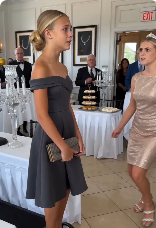
She did not stop.
“My access card opened the archive room,” she said, her voice shaking. “But I was not alone.”
Edmund froze.
Victoria looked at Helena. “Check the hallway camera at 2:31. My father went into the west office after I left. He took something from the old safe.”
Celeste gasped. “Victoria.”
The director clicked to the hallway camera.
The footage appeared.
Edmund Pemberton entered the west office carrying a black document tube.
When he came out, the tube was gone.
Helena whispered, “The missing original drawings.”
Gia’s blood went cold.
Edmund turned toward the exit.
Marta’s security team stepped in front of him.
Then Lukas Mertens lifted his cane and pointed at the stage curtain.
“The west office safe connects to the service wall,” he said. “If he hid the drawings, they are still here.”
Part 7: The Drawings Hidden Behind The Pearls
They found the panel behind the velvet curtain.
At first, it looked like part of the stage wall, painted cream and trimmed in gold. But Lukas tapped the lower molding with his cane, and the sound changed from solid to hollow.
Marta knelt, pressed two fingers beneath the trim, and pulled.
The panel opened with a soft click.
Inside was a narrow cavity.
And inside the cavity was the black document tube.
Gia could not move.
Helena lifted it out like something sacred.
Edmund said, “Those belong to me.”
Lukas turned on him with sudden fire. “No. Men like you confuse possession with creation.”
Helena untied the tube.
The first drawing slid free.
It was old, yellowed at the edges, but the lines were breathtaking. A crown of pearls and silver leaves, delicate as frost, stronger than it looked. At the bottom, in faded ink, was a signature.
Amalia Rousseau.
Gia touched the edge of the table to steady herself.
Helena removed the second drawing.
This one made the whole room fall silent.
It was not the old crown.
It was Gia’s new centerpiece concept.
Not a copy from the archive.
A companion piece.
Amalia had sketched an unfinished second crown decades earlier, almost identical in spirit to Gia’s design, but incomplete at the central setting.
Gia had finished what her grandmother had once imagined.
She pressed a hand to her mouth.
Helena read the note pinned to the sketch.
For the daughter I may have one day. Let her finish what they would not let me claim.
Gia broke then.
Not loudly. Not beautifully. She folded over herself, and Elena, one of the volunteers, caught her before she sank to the floor.
Victoria stood a few feet away, crying silently now.
Nobody comforted Edmund.
Marta spoke into her radio. “Seal the exits.”
Two officers entered through the side hall.
Celeste whispered, “Edmund, what have you done?”
He looked at his wife with contempt. “What your family should have done years ago. I kept the name valuable.”
Victoria turned to the cameras.
“My father stole the drawings,” she said. “I stole Gia’s design. My family planned to sell both.”
Edmund shouted, but the officers took his arms.
Gia lifted her head.
The crown still waited beneath glass.
But now the room knew whose hands had dreamed it first.
Part 8: The Crown That Chose Its Real Name
The ceremony did not happen that night.
The orchids were removed. The champagne was cleared away. The pearls were locked under evidence seal, and the Pemberton family left through separate doors: Edmund with officers, Celeste with lawyers, Victoria alone.
Gia went home with Amalia’s copied letters in a museum folder pressed against her chest.
Her mother read them at the kitchen table in Milan two nights later.
She read the first letter silently.
Then the second.
By the third, her hands were shaking.
“She never told me,” her mother whispered.
Gia sat beside her. “Maybe it hurt too much.”
Her mother touched Amalia’s signature. “She used to say pearls remember pressure. I thought she meant life.”
Gia looked down at the letters.
“Maybe she meant both.”
Three months passed before the crown returned to public view.
Not at a private gala. Not under Pemberton banners. Not behind a stage where rich people could turn theft into ceremony.
It opened in a restored hall in Prague, under the care of the European Heritage Court, with Amalia Rousseau’s name engraved first.
Gia had not wanted to attend.
Helena insisted.
“You are not attending for them,” she said. “You are attending for her.”
So Gia stood beside the exhibit case in a simple black dress her mother had altered by hand. No borrowed pearls. No pretending. Just Gia, with her grandmother’s signature printed on the wall behind her.
Victoria came just before the doors opened.
Security watched her carefully.
She looked smaller without the armor of her family. Her hair was tied back. Her face was pale. In her hands was a small velvet box.
“I brought something,” she said.
Gia did not answer.
Victoria opened the box.
Inside was a pearl necklace.
“My grandmother wore it at every Pemberton reception,” Victoria said. “It was made from pearls taken out of Amalia’s original setting before they hid her name.”
Gia stared at it.
Victoria held the box out. “I signed the legal transfer this morning. It belongs to the Rousseau-Marsh archive now.”
Gia did not take it immediately.
“Why?” she asked.
Victoria’s mouth trembled. “Because I was raised to inherit applause. I do not want to inherit theft too.”
For a long moment, the two girls stood with the box between them.
Then Gia took it.
Not as forgiveness.
As evidence returned.
At noon, Helena unveiled the exhibit title.
THE ROUSSEAU-MARSH CROWN: COMPLETED BY GIA MARSH FROM THE LOST DESIGNS OF AMALIA ROUSSEAU.
The crowd applauded, but Gia barely heard them.
She was looking at the central pearl, set exactly where her hands had placed it, held by the structure she had designed, shining beneath her grandmother’s name.
Beside the case, a second plaque had been added.
It held one sentence from Amalia’s letter.
If you keep the crown, at least do not steal my name from it.
Gia reached for her mother’s hand.
This time, when the cameras turned toward her, Gia did not feel trapped under their gaze.
She felt seen.
And behind the glass, beneath pearls that had survived greed, silence, and generations of stolen credit, the crown finally carried the only legacy that mattered: the truth.
