Part 2: The Article Charlotte Tried To Erase
The microphone caught my breath before it caught my words.
A shaky, humiliating sound filled the room, and for one second I wanted to disappear inside it. Spaghetti slid from my sleeve onto the polished floor. Sauce dotted the front of my faded shirt. My hands trembled at my sides while everyone waited for me to speak.
The engineer leaned toward the booth mic again. “Arielle, tell them what was deleted.”
Charlotte Beaumont’s face turned hard. “Do not answer that.”
Her father, Conrad Beaumont, lowered his phone slowly.
That scared me more than when he had been calling someone.
The crowd shifted. Students in badge lanyards pressed closer to the demo aisle. The sponsor banners behind us still showed the Beaumont Media Foundation logo, but the main screen now belonged to the project history file.
Line after line.
My initials.
My uploads.
My late-night saves.
My name in a place Charlotte had tried to empty.
I swallowed.
“The deleted file was not just a draft,” I said.
My voice cracked, but the microphone carried it anyway.
“It was the anniversary article.”
A murmur moved through the room.
The Anniversary Student Newspaper had spent months building one special issue: a digital archive, interviews with former student editors, old photos, a timeline of the paper’s best investigations. I had helped organize it because nobody else wanted to sort broken files from twenty years of student journalism.
Charlotte rolled her eyes. “Everyone knows there was an article.”
“No,” I said, forcing myself to look at her. “There was a different article.”
The room sharpened around me.
Mr. Vale, the newspaper adviser, stepped closer. “Arielle, which article?”
My lips felt numb.
“The one about the missing scholarship donations.”
Conrad Beaumont’s expression froze.
Charlotte’s friends stopped recording.
That was when I knew.
They had not known everything.
The screen flickered again as the control booth volunteer opened a recovered folder.
ARCHIVE_REPAIR_AH_FINAL.
My initials.
Inside were interview clips, scanned bank letters, old meeting notes, and a draft headline I had written at 2:13 in the morning with my eyes burning from exhaustion.
Where Did The Beaumont Scholarship Money Go?
A gasp broke from the back of the room.
Charlotte stepped forward. “That is fake.”
Mr. Vale whispered, “Arielle.”
I turned toward him, terrified I had gone too far. But his face was not angry.
It was devastated.
“You found the missing scholarship trail?”
“I think so,” I said. “I was going to bring it to you after the ceremony. I wanted to make sure the files were real first.”
Conrad Beaumont laughed softly. “A child sorting archives thinks she has uncovered a financial scandal. This is absurd.”
Mrs. Moreau, the event director, walked to the podium. “Then you will not mind if we review the documents publicly.”
Conrad’s eyes snapped toward her.
“That would be defamatory.”
“No,” she said. “It would be journalism.”
The word landed like a match.
Journalism.
That was what the whole day was supposed to celebrate. Not sponsor logos. Not polished speeches. Not Charlotte’s designer outfit or her father’s perfect smile.
Truth.
The volunteer clicked the first file.
A scanned thank-you letter appeared. It was addressed to the student newspaper board from a local education trust, confirming a donation meant for low-income student reporters.
Then another document appeared.
A transfer notice.
Then a budget summary.
Then a line where the money had been moved into something called Sponsor Visibility Expenses.
Mr. Vale covered his mouth.
Charlotte stared at the screen, but her anger had shifted into fear.
Conrad stepped toward the podium. “Turn that off.”
Mrs. Moreau did not move.
The engineer’s voice came from the booth. “There is one more recovered file.”
I closed my eyes.
I knew which one he meant.
The room waited.
The speakers crackled.
Then Charlotte’s voice filled the hall.
“Delete Arielle’s article before Vale sees it. Daddy says the scholarship story cannot run.”
Part 3: The Recording Under The Sponsor Logo
Charlotte lunged for the nearest cable.
Two pilots from the guest media panel—there to discuss press ethics in public institutions—stepped in front of her before she reached it. One of them, an older woman named Elise Laurent, held up one hand.
“Do not touch the equipment.”
Charlotte stopped, breathing hard. Sauce from the spaghetti she had thrown still marked the floor between us like evidence nobody could ignore.
The recording continued.
Another voice entered.
Conrad Beaumont.
Calm.
Bored.
Dangerous.
“If the poor girl wants to play journalist, let her learn what editors cut.”
The crowd erupted.
Students shouted. Teachers stood. Phones rose again, but now they pointed at Conrad, not at me.
He looked around the room with disgust. “This is an illegal recording.”
The engineer called back, “It was captured by the newspaper’s own booth recorder during archive repair. The booth has a posted recording notice.”
Charlotte’s face twisted. “You little thief.”
I flinched.
I hated that I flinched.
But then Mr. Vale moved beside me.
“She is not the thief here.”
Charlotte looked as if he had slapped her.
For years, teachers had smiled carefully around her. Students had let her take center stage. Adults called her ambitious when she interrupted, confident when she humiliated people, passionate when she took credit.
Now Mr. Vale looked at her like she was exactly what she had done.
Mrs. Moreau turned to Conrad. “Mr. Beaumont, did you instruct your daughter to delete a student investigation?”
“I instructed my daughter to prevent a false story from damaging a charitable foundation.”
“By removing the reporter’s name from the project record?”
Conrad’s jaw tightened.
“By letting her be publicly humiliated?” Mrs. Moreau continued.
He glanced at my stained clothes. “That was unfortunate.”
The word broke something open in me.
Unfortunate.
Not cruel.
Not wrong.
Just inconvenient.
I stepped toward the mic before fear could stop me.
“My mother applied for that scholarship fund,” I said.
The room went quiet again.
My voice trembled, but this time I did not lower it.
“She was told there was no money left. I thought that was normal. We are used to being told there is nothing left.”
Mr. Vale turned to me slowly.
I kept going.
“Then I found old donor letters. The money was there. It had been there for years. But students like me were still paying for printing, bus passes, notebooks, recording apps, everything.”
Charlotte whispered, “You are making this about yourself.”
I looked at her.
“You threw food at me in front of everyone because you were afraid I would.”
Her mouth shut.
Conrad stepped closer to the stage. “This event is over.”
Mrs. Moreau faced security. “No. Mr. Beaumont’s sponsorship is over.”
The sentence stunned the room.
Conrad went very still.
“You do not have authority to do that.”
“I have enough authority to remove your name from the live program pending investigation.”
She nodded to the booth.
The sponsor logo vanished from the screen.
In its place appeared the student newspaper masthead: The Red Brick Press.
No gold border.
No Beaumont crest.
Just our name.
The applause started from the student section first. Then the volunteers. Then the alumni editors. It rose slowly, like people were remembering they had voices too.
Charlotte stood frozen.
For the first time, she looked less like a queen and more like a girl whose throne had been taken away.
Then Conrad’s phone rang.
He glanced at the screen.
His face changed.
He turned away, but the microphone near the podium was still live.
Everyone heard him say, “Tell the bank to freeze the student account before they access the rest.”
Part 4: The Account He Tried To Freeze
The applause died instantly.
Mrs. Moreau’s eyes narrowed. “What student account?”
Conrad slowly lowered the phone.
For a man who built his life on perfect public words, he had finally chosen one sentence too quickly.
Mr. Vale grabbed the event laptop and opened the finance archive. His fingers shook so badly he mistyped the password twice.
I stood beside him, sticky and cold, watching Charlotte’s father stare at the doors like he was calculating how fast he could leave.
Security moved closer.
“Mr. Beaumont,” Mrs. Moreau said, “you will remain here.”
He smiled without warmth. “I will do no such thing.”
Charlotte grabbed his sleeve. “Dad, what account?”
He did not answer her.
That scared her.
It should have scared me too, but my fear had become something else. A hard little flame.
Mr. Vale opened the archive.
A folder appeared.
STUDENT EQUIPMENT FUND.
He clicked it.
The screen filled with records—donations, deposits, transfers, handwritten notes scanned into PDF files. The paper had been raising money for years, not just for scholarships, but for equipment, printing, travel, and emergency aid for student reporters.
Most students had never heard of it.
I had never heard of it.
A line near the top showed the current balance.
The room gasped.
It was enough to buy every student reporter a laptop, pay transportation for years, and still fund scholarships.
Mr. Vale looked sick. “They told us this fund closed before I became adviser.”
Mrs. Moreau whispered, “It never closed.”
Then the screen refreshed.
The balance changed.
A pending transfer appeared.
Amount: all funds.
Destination: Beaumont Media Foundation Administrative Reserve.
Mrs. Moreau shouted, “Disconnect the network.”
The engineer unplugged the main cable.
The transfer kept spinning.
“It is cloud-authorized,” the booth volunteer yelled.
Mr. Vale stood so fast his chair nearly fell. “Can we stop it?”
“Not from here.”
Conrad began walking toward the exit.
Security blocked him.
“You do not understand,” he said coldly. “That fund has always been administered through my foundation.”
Mrs. Moreau stepped in front of him. “Administered is not the same as stolen.”
Charlotte whispered, “Stolen?”
He turned on her. “Do not be naive.”
The way he said it made her recoil.
The transfer bar crawled across the screen.
Sixty-two percent.
Seventy.
My heart pounded.
All that money. All those years. All those students who had quit because they could not afford bus fare or camera batteries or one more unpaid afternoon.
And now it was disappearing in front of us.
The engineer shouted, “We need a trustee override.”
Mrs. Moreau looked at Conrad.
He smiled.
“You will not get one.”
Mr. Vale whispered, “There were two student trustees listed in the original bylaws.”
“What students?” I asked.
“Founding editors,” he said, scanning the old documents. “But that was twenty years ago.”
The transfer hit eighty-four percent.
Mrs. Moreau read the trustee names aloud.
“Julian Hayes and Vivienne Marchand.”
Everything inside me stopped.
Hayes.
My last name.
I stared at the screen.
“Julian Hayes was my father.”
The words came out before I understood them.
Mr. Vale turned to me. “Your father was a founding editor?”
I could barely nod.
My father had died when I was eight. My mother never talked much about his school years, only that he loved newspapers and carried a pen everywhere. I still had one of his notebooks in a shoebox under my bed.
Mrs. Moreau looked at the account page.
“If Julian Hayes was a trustee, his beneficiary authority may have transferred.”
The engineer shouted, “Transfer at ninety-one percent.”
Mr. Vale looked at me. “Arielle, do you know any old passwords your father used?”
My mind went blank.
Students shouted suggestions. My hands shook. The screen kept moving.
Ninety-five percent.
Then I remembered the inside cover of his notebook.
Three words he had written beneath every draft.
Tell it straight.
I grabbed the keyboard.
Username: JHAYES_TRUSTEE.
Password: TellItStraight.
The screen flashed red.
Incorrect.
My stomach dropped.
Then I tried again without spaces.
TellItStraight.
Incorrect.
Ninety-eight percent.
Tears blurred my eyes.
“Try lowercase,” Mr. Vale said.
tellitstraight.
The screen froze.
The transfer stopped.
A new box appeared.
SECONDARY TRUSTEE OVERRIDE ACTIVATED.
The whole hall went silent.
Then, beneath my father’s name, another message appeared:
Welcome, Arielle Hayes.
Part 5: My Father’s Name Opened The Door
I stared at the screen until the letters doubled.
Welcome, Arielle Hayes.
My father had been dead for nine years, but for one impossible second it felt like he had reached through the machine and put his hand over mine.
The pending transfer vanished.
The balance returned.
The student equipment fund was safe.
A cheer exploded through the hall, but I barely heard it. I was looking at my own name under his, connected by a rule nobody had bothered to erase because nobody thought a girl like me would ever find the door.
Conrad Beaumont’s face had gone pale.
Not angry now.
Afraid.
Charlotte stared at the screen, then at me. “How did you do that?”
“I didn’t,” I whispered. “He did.”
Mr. Vale’s eyes were wet. “Julian Hayes protected the fund.”
Mrs. Moreau opened the trustee archive. “He protected more than that.”
A folder unlocked automatically.
FOUNDERS’ CONTINGENCY FILE.
Conrad snapped, “Do not open that.”
Nobody listened.
Mrs. Moreau clicked.
A video file appeared, dated almost twenty years earlier.
The thumbnail showed a teenage boy with serious eyes, messy brown hair, and a crooked smile I knew from the only photo my mother kept on the mantel.
My father.
The room faded around me.
Mr. Vale looked at me gently. “Arielle?”
“Play it,” I said.
The video began.
My father sat in the old newspaper office, surrounded by stacks of papers and cheap coffee cups. He looked younger than I had ever imagined him. Behind him stood a girl with dark curls and a sharp, bright expression.
Vivienne Marchand.
The other trustee.
“If this file has opened,” my father said, “then someone tried to move the student fund without student approval.”
A murmur ran through the hall.
My father leaned closer to the camera.
“The fund was created because students kept being told journalism was open to everyone, while poor students were quietly priced out. We built this money from alumni donations, bake sales, community grants, and one very angry letter-writing campaign.”
A few people laughed through tears.
He did not smile.
“We added a failsafe because we already had concerns about the Beaumont Foundation.”
Conrad looked like stone.
Charlotte slowly turned toward him.
“Dad?”
On the screen, Vivienne stepped forward. “If a Beaumont representative attempts to absorb this fund, publish the attached ledger immediately. The scholarship money must belong to students, not sponsors.”
The video ended.
A ledger file appeared beside it.
Mrs. Moreau opened it.
Names filled the screen.
Donors.
Students.
Transfers.
Warnings.
Then one line highlighted in red.
CONRAD BEAUMONT — REQUESTED PRIVATE ADMINISTRATION ACCESS — DENIED.
Date: nineteen years ago.
Conrad had been trying to reach that money since before I was born.
Mr. Vale said, “You knew about the fund all along.”
Conrad’s mouth tightened. “I knew a group of children created a poorly managed account that should have been placed under professional control.”
“My father was not a child to you when you wanted his money,” I said.
The room went quiet.
Conrad looked at me with pure contempt.
“Your father was sentimental. Sentimental people lose.”
I flinched at the cruelty, but then Charlotte spoke.
“Did you know her father?”
Conrad glanced at her. “This is not relevant.”
“Did you?”
His silence answered.
Mrs. Moreau found another file in the contingency folder.
CORRESPONDENCE — BEAUMONT/HAYES.
She opened it.
Emails appeared. Letters. Scanned handwritten notes.
My father refusing Beaumont control.
My father warning the board.
My father asking why scholarship records were disappearing.
Then the final letter.
Dated three weeks before his death.
Conrad Beaumont had written:
If you continue making accusations, Julian, you will leave your daughter with nothing but your stubborn little newspaper.
My throat closed.
Charlotte covered her mouth.
Conrad stepped backward. “That was taken out of context.”
I could not breathe.
My father had died in a car crash after a late shift at work. That was all I knew. A rainy road. Bad visibility. A tragedy people stopped mentioning because grief made them uncomfortable.
But now the room had changed around that story.
Mrs. Moreau’s voice was careful. “Arielle, did your mother ever see these files?”
I shook my head.
My hand was already reaching for my phone.
Because if my father had hidden one truth inside the newspaper archive, I needed to know what else my mother had been carrying alone.
Part 6: The Notebook My Mother Never Burned
My mother arrived wearing her grocery store uniform.
She had not changed. She had not brushed her hair differently. She came through the museum doors with her name tag still pinned to her chest and her face already frightened because I had called her crying and said only, “It’s about Dad.”
When she saw me covered in sauce, she stopped.
“Arielle.”
I ran to her.
I hated crying in front of everyone, but the second her arms closed around me, the whole day broke open. The humiliation. The files. My father’s face on the screen. The money nearly stolen in front of me.
My mother held me so tightly I could feel her shaking.
“Who did this?”
I looked toward Charlotte.
Charlotte stood near the stage, pale and silent.
“I did,” she said.
My mother’s eyes hardened in a way I had never seen before.
Charlotte lowered her head. “I am sorry.”
My mother did not answer her.
She looked at Conrad.
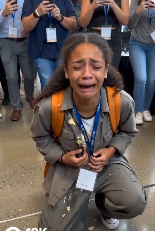
He had been kept near the administrative table by security, still pretending he was too important to be trapped.
“You,” my mother said.
One word.
It carried nine years.
Conrad gave her a polished nod. “Mrs. Hayes.”
My mother’s face went white with rage. “Do not use my name like you did not try to bury it.”
The room fell silent.
I pulled back. “Mom?”
She reached into the tote bag she carried everywhere and removed an old notebook wrapped in a plastic grocery sack.
My father’s notebook.
The one I thought was under my bed.
“You kept it?” I whispered.
“I kept the real one,” she said. “The one under your bed is empty pages from his old desk. I wanted you to have something without giving you the danger.”
Danger.
That word made the whole room colder.
She placed the notebook on the table.
Conrad stared at it.
For the first time, I saw panic break through his face.
My mother noticed too.
“Still scared of paper, Conrad?”
His lips parted, but nothing came out.
Mrs. Moreau gently opened the notebook.
Inside were clippings, handwritten notes, names, dates, and sketches of account movements. My father’s handwriting covered every page. Near the middle was a folded accident report.
My mother touched it but did not open it.
“Julian was investigating the scholarship fund,” she said. “He believed Beaumont Media had been diverting student money for years.”
Mr. Vale’s voice was soft. “Why did he stop?”
My mother looked at Conrad.
“He didn’t.”
No one moved.
She opened the accident report.
“The night he died, Julian was driving to meet a former Beaumont accountant in Leeds. He told me if he was late, I should call Vivienne Marchand. I never got the chance.”
“Why?” I whispered.
My mother’s eyes filled.
“Because by morning, Vivienne had vanished from every number we had.”
Mrs. Moreau straightened. “Vivienne Marchand, the second trustee?”
My mother nodded.
“I thought she abandoned us. Years later, I received one postcard with no return address.”
She pulled out a faded card.
On the back were five words:
I am sorry. He threatened everyone.
Charlotte was crying now.
Not loudly.
Not to be seen.
She stared at her father like she had finally found the monster under the expensive suit.
Conrad laughed, but it came out wrong. “This is grief mythology.”
My mother turned the notebook toward Mrs. Moreau. “Read the last page.”
Mrs. Moreau did.
Her expression changed.
“What?” I asked.
She looked at me. “Your father wrote a final instruction.”
She read aloud.
“If anything happens to me, do not let Arielle grow up thinking silence is safety. But do not give her this fight until she has her own voice.”
My knees weakened.
My mother grabbed my hand.
“I wanted to protect you,” she whispered.
“I know,” I said, crying harder. “But he left it for me.”
The engineer suddenly called from the booth. “Mrs. Moreau, there’s a contact file attached to Julian’s contingency folder.”
Mrs. Moreau looked up. “Open it.”
A name appeared.
Vivienne Marchand.
Below it, a current email address.
The room froze.
Mr. Vale whispered, “She is alive.”
Then a new message notification appeared on the project inbox.
Subject: I Have Been Waiting For Arielle Hayes.
Part 7: The Editor Who Disappeared Returned
Mrs. Moreau opened the message with trembling hands.
The room leaned toward the screen.
The email was brief.
I saw the livestream. I am Vivienne Marchand. I was the second trustee of the student fund. I have the original Beaumont ledger and Julian’s final interview tape. I left because Conrad Beaumont threatened my family. I am ready to come back.
Attached was a video call link.
No one spoke.
Then Mrs. Moreau clicked it.
For a few seconds, the screen showed only a dark loading circle. I could hear my own breathing. My mother’s hand crushed mine.
Then a woman appeared.
She had silver in her dark curls now, and lines around her eyes, but she was unmistakably the girl from my father’s video.
Vivienne Marchand looked at me through the screen.
For a moment, she could not speak.
“You have his eyes,” she whispered.
My mother made a small sound.
Vivienne closed her eyes. “Lena, I am sorry.”
My mother’s name sounded different in her mouth, like it belonged to a life before exhaustion.
“Why did you leave?” my mother asked.
Vivienne looked down.
“Because Conrad sent men to my father’s shop after Julian died. They did not touch him. They did not need to. They told me accidents were contagious.”
Charlotte gasped.
Conrad shouted, “Lies.”
Security stepped closer to him.
Vivienne looked directly at him through the screen. “Hello, Conrad.”
He went silent.
She lifted a folder into view. “I kept copies of everything.”
Mrs. Moreau asked, “Do you have evidence related to the student fund?”
“Yes,” Vivienne said. “And the scholarships. And the donor letters. And the night Julian died.”
My mother swayed.
I wrapped my arm around her.
Vivienne’s voice softened. “Lena, I cannot prove he caused the crash. I will not claim what I cannot prove.”
Conrad smiled faintly.
Then Vivienne continued.
“But I can prove Julian was meeting a witness that night. I can prove Conrad knew the route. And I can prove the witness was paid to disappear before police interviewed him.”
The smile died.
Mrs. Moreau turned to the school board representative. “Are you recording this?”
“Yes.”
Vivienne sent the files live.
They landed in the project inbox one after another.
Original ledger.
Witness payment.
Scholarship diversion.
Threat letters.
Audio tape.
Mrs. Moreau played the tape.
My father’s voice filled the hall.
Older than in the first video. Tired. Urgent.
“Vivienne, if I do not make it to the meeting, publish everything. Beaumont has been taking money from the students most afraid to complain. He thinks poor families are too busy surviving to fight records. He is wrong.”
My mother covered her face and sobbed.
I could not move.
My father had known exactly what kind of man he was facing.
And he had still driven into the rain.
On the tape, another voice spoke.
Vivienne’s younger voice. “Julian, what about Arielle?”
My father laughed softly.
The sound broke me.
“My girl will be a better journalist than both of us,” he said. “But I hope she gets to choose that freely.”
I pressed my hand against my mouth.
The tape clicked off.
Nobody clapped.
Some moments were too heavy for applause.
Charlotte walked toward her father.
He looked at her with warning in his eyes.
She stopped a few feet away.
“Did you threaten them?”
“Charlotte—”
“Did you steal the scholarship money?”
His face hardened. “I built the foundation you enjoy.”
She shook her head. “That is not an answer.”
“It is the only answer children like you understand.”
She flinched.
Then, slowly, she reached into her designer bag and pulled out a small silver drive.
Conrad’s expression changed.
“What is that?”
Charlotte looked at me, then at Vivienne on the screen.
“My father’s private donor archive,” she said. “I copied it last month because I thought he was hiding money from my trust.”
A stunned laugh escaped someone in the back.
Charlotte’s face crumpled.
“I was selfish,” she said. “I was cruel. I did not copy it for justice.”
She held out the drive to Mrs. Moreau.
“But justice can have it anyway.”
Conrad lunged.
Security caught him before he reached her.
For the first time all day, Charlotte did not step back.
She watched her father struggle and said, “You taught me to protect the Beaumont name. So I am protecting it from you.”
Part 8: The Front Page With My Father’s Truth
The first edition without Beaumont money went live at midnight.
No glossy sponsor banner.
No donor statement.
No photo of Charlotte smiling beside work she had not done.
Just a black-and-white masthead and a headline Mr. Vale let me write myself.
The Fund They Tried To Steal Was Built For Students Like Us.
My name appeared under it.
Arielle Hayes.
Not helper.
Not pity story.
Reporter.
I stared at the byline for so long my mother finally leaned over my shoulder and whispered, “Your father would have complained about the comma in paragraph four.”
I laughed and cried at the same time.
The investigation did not fix everything overnight. Conrad Beaumont was not dragged away in some dramatic scene with flashing lights. People like him had lawyers, statements, delays, and friends who called themselves neutral.
But the files were real.
The ledger was real.
Vivienne’s testimony was real.
Charlotte’s silver drive opened three more accounts and a list of private transfers hidden behind public generosity.
By morning, the city education board froze the Beaumont Foundation’s access to every student program. By the end of the week, former scholarship applicants began receiving letters saying their cases would be reviewed. By the end of the month, the student equipment fund was legally returned to the newspaper, protected by a new trustee board with students from every income level.
My mother received a letter too.
Not money.
Not apology enough.
But confirmation that Julian Hayes had been telling the truth when everyone powerful had called him reckless.
She read it at the kitchen table, touching his name with two fingers.
“He did not lose,” she said quietly.
“No,” I answered. “They just delayed the printing.”
She smiled through tears.
Charlotte disappeared from school for a while.
When she came back, nobody knew what to do with her. Her friends had turned her into gossip. Her father’s allies had turned her into a traitor. The students she had humiliated did not owe her comfort.
Especially me.
One afternoon, she found me in the newspaper room.
Not the stage.
Not the ceremony.
The real room.
Dusty shelves, old keyboards, half-broken chairs, coffee stains, and deadline panic.
She stood in the doorway holding a stack of folders.
“I found more,” she said.
I looked at the folders, then at her.
“Put them on the table.”
She did.
Her hands were bare. No rings. No perfect manicure. She looked tired in a way expensive girls usually paid to hide.
“I am not asking you to forgive me,” she said.
“Good.”
She nodded, accepting the hit.
“I signed a statement about the deletion. About throwing food at you. About the credit changes.”
I kept sorting notes. “You should have.”
“I know.”
Silence stretched.
Then she said, “I also asked to be removed from the anniversary board.”
That made me look up.
Charlotte swallowed. “The seat should go to someone who did the work.”
“It should,” I said.
She nodded again.
Then, after a moment, she added, “I would like to help archive documents. No photos. No speeches. No credit unless the adviser approves it.”
I studied her.
Part of me wanted to say no just because I could.
Part of me wanted her to feel what it was like to stand outside a door.
But then I thought about journalism. Not revenge. Not performance. Records. Work. Truth.
“You can start with box seven,” I said. “It smells like mildew, and the scanner jams every six pages.”
She almost smiled, then thought better of it.
“Okay.”
That was not forgiveness.
It was labor.
It was a beginning with no applause.
Months later, the Anniversary Student Newspaper held its delayed public relaunch. The red-brick sidewalks outside were wet from rain, and the room was crowded again with lanyards, students, teachers, alumni, and families.
No Beaumont banners.
Instead, the wall behind the stage displayed old front pages from student reporters across generations. In the center was a photo of my father and Vivienne in the original newspaper room, both of them young and stubborn and alive in the way truth keeps people alive.
Vivienne came in person.
When she hugged my mother, neither of them spoke for a long time.
Charlotte sat in the third row, not on stage. When the student credits rolled, her name appeared small under archive assistance, exactly once, exactly where it belonged.
Mine appeared under lead investigation.
Then Mr. Vale handed me the first printed copy of the relaunch edition.
The ink smelled fresh.
My hands shook as I turned it over.
On the front page was my article.
Below it was a sidebar titled The Julian Hayes Student Fund Restored.
And at the bottom, in a box I had not known Mr. Vale added, was one line from my father’s tape:
Poor families are too busy surviving to fight records. He is wrong.
I pressed the paper to my chest.
When I stepped to the microphone, I saw my mother in the front row. She had repaired my old jacket cuffs with red thread this time, bright enough that no one could pretend not to see the stitching.
I looked at the crowd, then at the newspaper in my hands.
“I was chosen first,” I said. “But that is not the important part.”
The room went still.
“The important part is that my father kept records, my mother kept courage, Vivienne kept proof, and students kept working even when sponsors tried to turn us invisible.”
My voice did not shake now.
“So this paper will not belong to the richest name in the room. It will belong to whoever tells the truth when silence would be easier.”
The applause rose slowly, then fiercely.
My mother cried. Vivienne smiled. Mr. Vale wiped his glasses three times even though they were already clean.
And I stood there in my old shoes, holding the front page my father never got to publish, finally understanding that being chosen was not the miracle.
Being impossible to erase was.
