Part 2: The Photograph That Fell Face Down
The photo landed on the polished floor between Brielle’s silver heels and my scuffed black shoes.
Nobody moved.
Not the donors in velvet chairs. Not the violinists near the grand staircase. Not the mayor’s wife, whose champagne glass hovered halfway to her mouth. Even Brielle froze with the folder clutched against her chest, her painted nails digging into the cardboard hard enough to bend it.
I looked down.
The photograph was face down, but there was writing on the back in blue ink.
My handwriting.
My throat tightened.
Brielle noticed it at the same time I did. Her eyes dropped, then snapped back to mine, and for the first time that evening, she did not look disgusted.
She looked terrified.
“Give that to me,” she said.
Her voice was quiet, but it carried through the hall like a knife sliding from a drawer.
I bent before she could.
Brielle lunged.
The staff member gasped. “Miss Aldridge, don’t—”
But Brielle’s hand closed around my wrist, squeezing hard enough that the photo trembled between my fingers.
“You already had your little charity moment,” she hissed. “Do not embarrass yourself further.”
I looked at her hand on me. Then I looked at the room.
All those people who had smiled at me from a distance now stared like I had become something dangerous. Not because Brielle had humiliated me. Not because my cheek still burned from what she had done.
Because the first page had said the scholarship fund survived because of me.
Because money talked in rooms like this.
And mine had been silent until now.
I pulled my wrist free.
“No.”
The word left my mouth before fear could swallow it.
Brielle’s face changed.
I turned the photo over.
A sharp sound moved through the room.
It was not a dramatic picture. No scandal. No jewelry. No party. Just a grainy image of a small office in a rain-darkened part of Prague, with a young woman sitting at a desk beside a cracked radiator, sorting envelopes under a weak lamp.
Me.
Except I was not alone.
Beside me stood Brielle Aldridge.
No designer gown. No diamond clips. No cruel smile.
She was wearing a plain black coat, her hair tied messily back, her eyes red from crying.
And on the desk between us was a handwritten note.
I remembered that night so clearly my knees nearly gave out.
Brielle whispered, “Stop.”
But the staff member had already picked up the next sheet.
Her hands shook as she read aloud.
“Record of private appointment. Miss Brielle Aldridge requested emergency assistance from volunteer coordinator Raya Vogel regarding unpaid scholarship pledges, donor concealment, and missing reserve funds.”
A murmur tore across the gala.
Brielle’s father stood from the front table.
His chair scraped the marble like a warning.
“Brielle,” he said, very softly.
She spun toward him, still gripping the folder. “Papa, it is not what it looks like.”
But I could barely hear her.
Because in that moment, I realized the folder did not only prove I had donated my wages.
It proved Brielle had come to me first.
Part 3: The Night Brielle Knocked In The Rain
Two years earlier, Brielle Aldridge had arrived at the volunteer office soaked through and shaking.
I had been closing alone. The old building in Prague smelled of wet wool, dust, and burnt coffee. I remember locking the donation box twice because three envelopes had gone missing that week, and I was too young to understand how rich people made money vanish without touching it.
Then someone knocked.
Not confidently.
Desperately.
When I opened the door, Brielle stood on the steps with rain dripping from her lashes.
At first, I thought she was lost. Girls like Brielle did not come to that street after dark. Their drivers took them past places like ours with tinted windows and locked doors.
“I need to speak to whoever keeps the records,” she said.
“That’s me,” I answered.
She looked past me, saw the chipped walls, the secondhand chairs, the old kettle steaming on the windowsill.
Then she laughed once, but it came out broken.
“Of course it is.”
I should have sent her away. She had ignored me at school events. She had looked through me at committee lunches. Her friends had once called my donated coat “museum fabric” because the sleeves were shiny from wear.
But that night, she was not an heiress.
She was a girl holding a waterproof envelope with both hands like it contained a beating heart.
Inside were copies of pledge letters.
Her family’s foundation had promised to cover twenty-six scholarships across Prague, Vienna, and Kraków.
Only the money had never arrived.
Students had already received acceptance letters. Families had already celebrated. One boy from Brno had turned down a factory apprenticeship because he thought university fees were covered.
Brielle’s lips trembled as I read.
“My father says the fund is delayed,” she whispered. “But I heard him on the phone. There is no delay. There is no money.”
“Why bring this to me?”
“Because you check everything.”
That answer stunned me.
She wiped her cheek roughly. “Everyone thinks you are quiet because you are weak. You are quiet because you notice things.”
I remember standing there with rain tapping the glass and feeling, for one dangerous second, seen.
Together, we spent three nights rebuilding the numbers.
Brielle brought copied letters. I brought journals, receipts, bank notices, lists of donors who had paid and sponsors who had not. When the truth became impossible to ignore, she cried into her sleeve, embarrassed that I could see her.
Her father had been using the scholarship fund to cover losses in a private art investment scheme.
Brielle made me promise not to expose him yet.
“He will fix it,” she said. “He has to.”
I did not believe her.
But I believed the students deserved time.
So I started giving my wages quietly. Catering shifts. Cleaning work. Translation notes for visiting donors. Every spare euro I had went into the emergency reserve.
And Brielle kept coming back.
Until one night, she stopped.
A week later, the Aldridge Foundation announced a glamorous new gala in Vienna.
And Brielle stood beside her father in a white dress, smiling for photographers, while I watched from the back with ink-stained fingers and an empty purse.
Now, in the gala hall, her father stared at the same proof.
His face had gone gray.
“Who else has seen this?” he asked.
The room went still.
Brielle turned toward me, pleading with her eyes.
But before I could answer, an old man at the donors’ table slowly raised his hand.
“I have,” he said.
And Brielle made a sound like the floor had opened beneath her.
Part 4: The Donor Who Already Knew Everything
The old man’s name was Henrik Voss, though most people in the hall only knew him as the man who never smiled.
He had built half the hospitals in southern Germany, funded libraries in Austria, and terrified every banker from Zurich to Munich by asking simple questions until their lies fell apart. He rose slowly, leaning on a black cane with a silver handle, his pale eyes fixed on Brielle’s father.
“I received copies three months ago,” Henrik said.
Brielle’s father, Konrad Aldridge, recovered faster than anyone else would have.
His shoulders straightened. His expression softened into public sorrow.
“Henrik,” he said, “surely you understand how easily emotional young volunteers can misinterpret internal documents.”
I almost laughed.
Emotional.
Young.
Volunteer.
He made the words sound like stains.
Henrik did not blink. “I understand numbers.”
Konrad’s jaw tightened.
Brielle stepped forward. “Mr. Voss, please—”
“No,” Henrik said, and the single word silenced her. “You asked for mercy once. I gave it.”
Her eyes filled.
That made the room shift again. Some donors looked at her with suspicion now, others with curiosity. They had watched her slap me. They had heard her insult me. But now there was another Brielle in the room too, the one from the photograph, the one who had once arrived drenched and frightened with copies hidden under her coat.
Konrad saw sympathy beginning to flicker.
So he killed it.
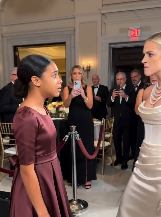
“My daughter is unstable,” he announced.
Brielle went white.
The words landed harder than any slap.
He turned to the crowd with practiced regret. “For some time, Brielle has struggled with resentment toward our family responsibilities. She attaches herself to causes, exaggerates problems, and seeks attention from people who flatter her rebellion.”
“Papa,” Brielle whispered.
He did not look at her.
“She has been manipulated,” Konrad continued, his eyes moving briefly to me, “by someone who clearly wanted influence over this foundation.”
My stomach turned cold.
There it was.
The new story.
Not that he stole. Not that Brielle hid. Not that I paid from my own pocket until my rent was late and my hands shook from skipping meals.
No.
I had manipulated an heiress.
I heard someone murmur, “Is that possible?”
Then another voice: “She did have access to the records.”
Brielle looked at me.
For a heartbeat, I thought she would defend me.
Her mouth opened.
Nothing came out.
Konrad walked toward me, smiling gently for the room. “Miss Vogel, I admire ambition. But ambition without dignity becomes something ugly.”
My fingers curled around the photograph.
The ceremony stage glowed behind him. Crystal glasses glittered. Cameras waited like hungry eyes.
I wanted to disappear again.
Then Henrik Voss tapped his cane once.
“Enough.”
He turned to me.
“Miss Vogel,” he said, “when Miss Aldridge stopped coming to the office, did you continue keeping records?”
I swallowed. “Yes.”
“Where are they?”
Brielle’s hand flew to her mouth.
Konrad’s smile flickered.
I looked toward the stage, where the podium waited beneath the chandeliers.
“My journal is not in that folder,” I said.
I lifted my chin.
“It is inside the ceremonial book I was supposed to open tonight.”
Part 5: The Book Under The Velvet Ribbon
The ceremonial book sat on a glass stand beneath a velvet ribbon, displayed like a holy object no one was meant to touch until applause made it safe.
I walked toward it with every eye following me.
My cheek still burned. My wrist ached. My heart pounded so loudly that the string quartet’s abandoned music seemed to pulse with it.
Konrad moved first.
Two security guards stepped into my path.
“Miss Vogel,” he said smoothly, “foundation property cannot be handled during an active investigation.”
Henrik gave a dry laugh. “There is no active investigation.”
“There is now,” Konrad snapped.
The mask cracked for only a second, but everyone saw it.
Brielle saw it most of all.
She looked from her father to the guards, then to me, and something inside her finally broke clean instead of breaking crooked.
“Move,” she said.
One guard frowned. “Miss Aldridge?”
Brielle’s voice shook, but she did not step back.
“I said move.”
Konrad turned on her. “Brielle, do not embarrass this family more than you already have.”
She flinched.
Then she did something I never expected.
She reached up, unclipped the diamond necklace at her throat, and dropped it into a champagne bucket.
The sound was small.
The meaning was not.
“I think the family can survive embarrassment,” she said. “It has survived theft.”
The hall erupted.
Konrad’s face hardened into something I had only seen once before: in the office copies, reflected in a dark window beside Brielle’s crying face.
The face of a man who had run out of charm.
Brielle took my hand.
Not gently. Not elegantly.
Like someone grabbing the edge of a cliff.
Together, we walked past the guards.
My fingers trembled as I untied the velvet ribbon. The ceremonial book opened with a heavy sigh, its pages thick and cream-colored, printed with donor names in gold.
But beneath the decorative pages was a hidden pocket.
I had sewn it there myself during a night shift in Vienna, using thread borrowed from a hotel laundry basket.
Inside was my real volunteer journal.
Not the polished version the foundation printed.
The ugly one.
Receipts taped beside names. Dates. Missing transfers. Students nearly removed from lists. Emergency payments marked in blue. My wages marked in black. Brielle’s copied documents marked with tiny red stars.
And at the very back, one sealed envelope.
Brielle stared at it.
“What is that?”
I had almost forgotten how heavy a secret could feel.
“That,” I said, “is why I was chosen to open the ceremony.”
Henrik stepped closer.
“Read it,” he said.
Konrad shouted, “No!”
Too late.
I broke the seal.
Inside was a notarized letter from the gala committee chair, dated six weeks earlier.
My voice shook as I read.
“Upon verification of independent rescue contributions, whistleblower records, and donor fund misdirection, the committee has voted to suspend Konrad Aldridge from all financial control pending formal review.”
Gasps broke across the room.
But the next line stole even Brielle’s breath.
“Interim authority shall pass to the original emergency donor whose funds preserved the scholarship program.”
I looked up.
Henrik’s eyes were steady.
Brielle whispered, “Raya…”
I forced myself to read the final sentence.
“That donor is Raya Vogel.”
Part 6: The Heiress Who Chose The Wrong Side
For one impossible moment, nobody spoke.
Then cameras started flashing.
Konrad lunged for the letter.
Brielle stepped between us.
His hand stopped inches from her shoulder.
The room watched him decide who he was willing to hurt in public.
That was the first time I understood power could be a trap. Konrad Aldridge had spent his life building rooms where everyone feared him. Now that same room held him still.
He lowered his hand.
“My daughter is confused,” he said again, but the words had gone stale.
Brielle laughed.
It was not a happy sound.
“You keep saying that,” she said. “Because if I am confused, then you are not guilty.”
His eyes narrowed. “You have no idea what you are destroying.”
“Yes,” she said. “I do.”
Then she turned toward the donors.
“I lied,” she said.
The hall went silent again, deeper this time.
Brielle’s shoulders trembled, but she kept going.
“I let people believe the foundation rescued those scholarships. It did not. Raya did. I knew money was missing. I knew my father was hiding it. And when Raya kept the students safe, I let her stay invisible because I was afraid of losing my name, my house, my life.”
Her voice cracked.
Then she looked at me.
“I also let her become the kind of person I could attack without feeling guilty.”
I did not know what to do with that.
An apology would have been easier if it were smaller. Cleaner. A little polished jewel placed in my palm. But this was raw and public and ugly. It did not erase anything. It made everything visible.
Konrad clapped once, slowly.
A cruel smile returned to his mouth.
“Very touching,” he said. “But legally useless.”
He looked at the committee chair near the stage, a nervous woman named Marta Klein who had been twisting her program in both hands.
“Marta,” he said, “perhaps you should explain to Miss Vogel that sentimental letters do not transfer institutional authority.”
Marta’s face drained.
Henrik turned to her. “Chairwoman?”
Marta did not answer.
Konrad smiled wider.
And then I understood.
The committee had voted, but someone had stopped the filing.
Marta’s silence confirmed it.
Brielle whispered, “What did you do?”
Konrad adjusted his cufflinks. “What I always do. I protected the foundation from chaos.”
My hope dropped like a stone.
He leaned toward me.
“Did you really think a girl with a notebook could take anything from me?”
The lights above the stage suddenly flickered.
Once.
Twice.
Then the giant screen behind the podium turned blue.
A technician shouted from the back, “I didn’t start that!”
The screen flashed.
A file opened.
And across the ballroom, in letters tall enough for every donor to read, appeared a title:
ALDRIDGE FOUNDATION — OFFSHORE TRANSFER RECORDINGS.
Konrad stopped breathing.
Part 7: The Voice Hidden Inside The Gala Screen
The first recording began with static.
Then Konrad’s voice filled the ballroom.
Not the soft voice he used at donor tables. Not the elegant voice from interviews.
This voice was tired, irritated, and vicious.
“She has the journal?” he asked.
Another man answered, “The volunteer girl? Yes. But she doesn’t know what it means.”
Konrad laughed.
“She knows enough to be inconvenient.”
My skin went cold.
On the screen, bank records appeared beside call transcripts. Transfers routed through shell arts councils in Monaco. Scholarship donations moved to private accounts in Luxembourg. Emergency reserves drained and replaced with forged pledges.
Beside me, Brielle swayed.
I caught her before she fell.
The recording continued.
“Your daughter keeps asking questions,” the other man said.
Konrad sighed. “Brielle will behave once she understands poverty is contagious.”
A sharp sound escaped Brielle.
It was not crying.
It was something worse.
Something breaking its last thread.
On the screen, a new document appeared: an email drafted but never sent.
Subject: Raya Vogel.
The room blurred.
I read fragments as they appeared.
Background vulnerable. Limited family support. Financial pressure. Useful target if public blame required.
My hands went numb.
I was not just a volunteer he tried to dismiss.
I had been chosen as the fall girl.
Konrad backed away from the screen. “Turn it off.”
No one moved.
“Turn it off!” he roared.
The technician lifted both hands. “It’s not coming from my system.”
Henrik looked toward the balcony.
So did I.
A woman stood there in a dark green suit, one hand resting on the railing. She was in her sixties, silver-haired, composed, and utterly unfamiliar.
Beside her stood three officials with badges clipped to their jackets.
The woman descended slowly.
Every step sounded final.
Konrad stared at her as if seeing a ghost.
“Elena,” he whispered.
Brielle turned sharply. “Who is she?”
The woman reached the bottom stair.
“My name is Elena Markovic,” she said. “I was the first treasurer of the Aldridge Foundation.”
Konrad’s mouth opened, but no words came.
Elena looked at Brielle, and her expression softened with something painful.
“I am also the woman your father paid to disappear from Zurich nineteen years ago.”
A murmur swept the hall.
Brielle’s fingers tightened around mine.
Elena faced Konrad again.
“You built your fortune on stolen charity money,” she said. “But you made one mistake.”
He swallowed.
“You kept insulting the girls who kept better records than you.”
Then she looked at me.
“I received your journal copies, Raya. Every page.”
My breath caught.
I had sent them anonymously months ago to an old treasurer listed in the archives, never knowing if the address still worked.
Elena raised a small drive.
“I gave them to financial authorities in Vienna, Zurich, and Luxembourg this morning.”
Konrad turned and ran.
He made it three steps before the officials stopped him.
Brielle watched her father being led away beneath the chandeliers.
Then Elena spoke one last time.
“There is still one secret left,” she said.
And she was looking directly at Brielle.
Part 8: The Name Written Beneath The First Donation
Brielle let go of my hand.
“What secret?” she asked.
Her voice was barely there.
The gala had become unrecognizable. Donors stood in stunned clusters. Cameras captured everything. The stage flowers lay crushed near the podium where someone had knocked them over. Konrad Aldridge was gone through the side doors, shouting about lawyers until the doors closed and swallowed him.
But Elena Markovic did not look victorious.
She looked sad.
She opened a leather folder and removed a single page, yellowed at the edges.
“When the foundation began,” she said, “there was an anonymous founding donation. Konrad claimed it came from an Aldridge family trust.”
Brielle frowned. “It didn’t?”
“No.”
Elena handed the page to Henrik, who read it, then closed his eyes.
I stared at the paper from where I stood, unable to understand why my pulse had started racing.
Elena turned it toward the room.
At the bottom was a signature.
Not Aldridge.
Vogel.
My breath vanished.
“That is my mother’s name,” I whispered.
Elena nodded. “Annalena Vogel created the first scholarship reserve after leaving Zurich. She did not want recognition. She wanted students protected from men like Konrad.”
My knees weakened.
My mother had died when I was twelve. I remembered her mending cuffs by the window, counting coins twice, telling me that kindness only mattered when it cost something. I had thought she left me nothing but a tin box of buttons and a habit of saving receipts.
“She was a donor?” I asked.
“She was the donor,” Elena said. “Konrad buried her name after her death and folded the reserve into his foundation.”
Brielle covered her mouth.
The room seemed to tilt.
All this time, I had been begging to stand in a place my mother had built.
Elena stepped closer. “The committee did not choose you because you were useful, Raya. They chose you because your records proved what the archive already suggested.”
Henrik finished gently, “The scholarship fund belongs under the Vogel name.”
Brielle began to cry then, quietly, without performance.
“I slapped you in your mother’s house,” she whispered.
The words struck harder than I expected.
Not because they were cruel.
Because they were true.
For a moment, I saw every version of myself at once: the girl in the worn dress, the volunteer counting coins, the child watching her mother fold bills into envelopes for people she would never meet.
Then I walked to the stage.
Nobody stopped me.
I stood behind the podium, opened the ceremonial book, and removed the gold donor page printed with the Aldridge name.
A gasp moved through the hall.
I set it aside.
Then I took my volunteer journal, worn and taped and ugly and honest, and placed it open beneath the lights.
“My mother did not build this fund so rich people could decorate themselves with poor children’s futures,” I said.
My voice trembled, but it held.
“So tonight, the scholarships continue. Every student stays funded. Every stolen euro gets pursued. And no donation will ever again be accepted without public records.”
I looked at Brielle.
She lowered her head, ready for punishment.
But I was tired of inheritance meaning revenge.
“Brielle Aldridge will not lead it,” I said.
Her shoulders flinched.
“She will work for it. Publicly. Without title. Without salary. Until every student her family endangered has graduated.”
Brielle looked up, tears bright on her face.
Then she nodded.
“Yes,” she said. “Whatever it takes.”
Months later, the building in Vienna reopened with no chandelier gala, no velvet rope, no donor wall carved in marble.
Just a brass plate beside the door.
THE ANNALENA VOGEL SCHOLARSHIP HOUSE
Inside, students laughed over coffee, volunteers argued over budgets, and Brielle sat at a plain desk stamping receipts under Marta Klein’s strict supervision.
She never became my friend in the easy way people expect after a public confession.
But one winter evening, she left a repaired photograph on my desk.
The old picture from Prague.
This time, she had framed it beside a new one: me unlocking the scholarship house doors while my mother’s name shone behind me.
On the back, Brielle had written one line.
Some doors only open after the wrong people try to shut them.
I stood there until the hallway emptied, holding the frame against my chest, finally understanding that my mother had not left me poverty, or silence, or shame.
She had left me a key.
