Part 2: The Video Blair Could Not Silence
The first frame showed Blair standing beside the velvet rope with her phone hidden against her palm.
No one moved.
The ballroom in Bellagio, above the dark mirror of Lake Como, seemed to hold its breath. The chandeliers trembled in the reflection of the windows. Cold soup dripped from my sleeve onto the polished floor, one pale drop at a time.
On the screen, Blair leaned toward the display table before the gala began. Her hand slid under the linen cloth. She pulled out a folder marked with my name.
“Elena Wells,” the director read aloud from the file in a strained voice. “Original concept sketches. Centerpiece layout. Volunteer restoration proposal.”
Blair laughed too loudly. “That proves nothing.”
Then the video changed.
The timestamp showed three nights earlier.
Blair was in the archive room.
She was not alone.
A tall man in a charcoal suit stood beside her, his back to the camera. He lifted my folder from the archive drawer and replaced it with another one. Blair’s face appeared clearly when she turned toward the door.
The room erupted.
Her mother, Vivienne Pemberton, went rigid beside the sponsor table. Her father looked down as if the marble floor had suddenly become fascinating.
Blair’s perfume still hung between us, sweet and sharp, but her confidence drained so quickly it almost frightened me.
“That is edited,” she snapped. “Someone set me up.”
The archivist, Frau Keller, did not blink. “The footage came from the old security system. It cannot be accessed remotely.”
Blair’s eyes darted to the man in the video.
The director paused the screen and enlarged the frame. The man turned just enough for the room to see his profile.
A woman near the front whispered, “That’s not a staff member.”
My stomach tightened.
Because I knew him.
Not by name. Not personally.
But I had seen him that morning in the service corridor, arguing with the resort manager in German. He had carried a silver cufflink shaped like a falcon.
Vivienne Pemberton stepped forward so fast her diamond bracelet flashed like a blade.
“Turn that off,” she ordered.
The director did not move.
Vivienne’s voice dropped. “I said, turn it off.”
That was when Frau Keller placed a second file on the podium.
“This is not only about a stolen centerpiece,” she said.
Blair’s face changed.
Not anger now.
Fear.
Frau Keller opened the file, and the pages inside were yellowed at the edges, older than my sketches, older than the gala, older than Blair’s perfect life.
“The centerpiece design Elena created was based on the original stained-glass compass from Villa Rosner,” she said. “A compass believed to have been lost after the fire in 1998.”
My fingers went cold.
Villa Rosner.
The abandoned lakeside estate my late mother used to sketch in old notebooks.
Vivienne’s lips parted. “You have no right.”
Frau Keller looked directly at her. “No. You had no right to bury a dead woman’s work.”
The room went still again, but this silence felt different. Heavier. Older.
The director turned toward me. “Elena, your mother’s name was Marta Wells, wasn’t it?”
I nodded, barely able to breathe.
Frau Keller slid the second file toward me.
On the first page was a faded photograph of my mother, younger than I remembered, standing in front of Villa Rosner with a glass compass in her hands.
Below it was a signature.
Not Wells.
Marta Rosner.
And beneath that, in blue ink, three words that made Vivienne Pemberton step backward.
Sole surviving heir.
Part 3: The Name My Mother Buried
I touched the page, but it felt like touching a locked door.
Marta Rosner.
My mother had never used that name with me. She had been Marta Wells, seamstress, night cleaner, woman with cracked hands and a laugh that always sounded tired at the edges. She had died with unpaid bills in a rented flat in Leeds, leaving me a tin box of thread, two old notebooks, and one warning.
Never trust people who offer kindness in silk.
Now her photograph stared back from the podium in the grandest room I had ever entered.
Blair whispered, “No.”
It was the smallest sound she had made all night.
Vivienne grabbed her wrist, but Blair pulled away. “Mother, what is this?”
“Nothing that concerns you.”
“It has our name in it.”
“No,” Frau Keller said softly. “It has the Rosner name in it. Your family only managed the estate after the fire.”
The sponsor guests began murmuring. Phones rose higher. Reporters stepped closer.
Vivienne’s face hardened into something cold enough to freeze the lake outside. “This girl is a volunteer. She is confused. Her mother was an employee who left behind sentimental rubbish.”
I looked at my dress, stained and clinging. My hands were shaking so badly I had to press them flat against the podium.
Then a voice came from the back of the room.
“That is a lie.”
Everyone turned.
An elderly man stood near the entrance, leaning on a black cane. His coat was wet from the mist outside. His white hair was combed neatly back, and his eyes were fixed on Vivienne with the exhausted fury of someone who had waited years to speak.
Frau Keller’s breath caught. “Herr Albrecht.”
Vivienne went pale.
The old man walked forward slowly. Each tap of his cane struck the marble like a judge’s hammer.
“I was the night watchman at Villa Rosner,” he said. “I saw Marta leave the night of the fire. She was carrying a baby blanket and a locked case.”
I could not move.
My throat closed.
“A baby?” Blair said.
Herr Albrecht looked at me.
“Yes,” he said. “Elena was born Rosner.”
The world tilted.
I gripped the podium so hard my nails hurt.
Vivienne laughed, but it broke halfway through. “A senile watchman and an archivist with a grudge. That is your proof?”
Herr Albrecht reached into his coat and pulled out a small brass key.
Frau Keller’s eyes filled with tears.
“I kept this because Marta begged me to,” he said. “She told me if her daughter ever returned to the lake, I was to open the blue room.”
“The blue room burned,” Vivienne hissed.
“No,” he said. “You told everyone it burned.”
The director stared at Vivienne. “What is in the blue room?”
Herr Albrecht looked at me, and his voice softened.
“Your mother’s last testimony.”
Blair shook her head as if she could shake the truth loose. “This is insane.”
Then the lights flickered.
Once.
Twice.
The screen went black.
A sharp crack echoed from the speakers.
Every door in the ballroom unlocked at once with a heavy metallic click.
And from the resort’s old intercom, a distorted voice whispered:
“Leave the Rosner file alone, Elena. Or your mother’s death will not be the last.”
Part 4: The Locked Room Beneath The Villa
The ballroom exploded into panic.
Chairs scraped. Glass shattered somewhere near the dessert table. The orchestra members abandoned their instruments, and the violin gave one wounded note as it slipped against a chair.
The director shouted for security, but his voice drowned under the rush of frightened guests.
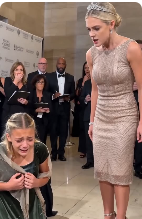
Blair stood frozen beside me.
For the first time since she threw the soup, she looked less like my enemy and more like a girl who had discovered the floor beneath her life was made of paper.
Vivienne recovered first.
“Everyone remain calm,” she called, but no one listened.
Herr Albrecht grabbed my elbow with surprising strength. “We go now.”
“To the blue room?”
“No. To the villa before they seal it.”
I looked at Blair. Her eyes were wide, her mascara beginning to blur. “You knew about this?”
“I knew about the file,” she said, voice shaking. “I thought it was just the design. I thought you were taking my family’s gala away.”
“You stole my work.”
Her mouth opened. No excuse came out.
Behind her, Vivienne was speaking urgently to the man with the falcon cufflink. He had appeared near the side exit, half-hidden behind two security guards.
Blair saw him too.
Her face drained. “That’s Uncle Kaspar.”
Herr Albrecht stiffened. “Kaspar Pemberton is no uncle.”
Before I could ask what he meant, Frau Keller pushed a coat into my arms. “The old footpath is faster. Go through the garden.”
The four of us slipped behind the stage curtain while the crowd surged toward the main doors. My wet dress clung to my legs. Cold air hit my face as we ran into the terrace garden, past white roses and stone lions beaded with mist.
Lake Como stretched below, black and silent.
The abandoned Villa Rosner sat across the water like a sleeping animal.
We took Herr Albrecht’s old boat from a private dock hidden behind cypress trees. Blair nearly fell stepping in. I caught her wrist before she hit the boards.
She stared at my hand.
I let go first.
The boat engine coughed, then started.
As the resort lights shrank behind us, Blair sat opposite me, shivering in her silk gown.
“I did not know about your mother,” she said.
“That does not make what you did smaller.”
“No,” she whispered. “It makes it uglier.”
The villa’s dock was rotten, the iron gate chained but not locked. Herr Albrecht led us through the overgrown garden. Ivy covered the walls. The windows looked blind.
Inside, dust floated through our flashlight beams. My mother’s notebooks had drawn these corridors again and again, but standing there made my chest ache.
Herr Albrecht stopped before a blue-painted door hidden behind a tapestry.
The brass key slid in.
The door opened with a sigh.
Inside was a room untouched by fire.
A desk. A covered mirror. Shelves of rolled plans. And on the desk, a small tape recorder with my mother’s handwriting on it.
For Elena.
My hands trembled as I pressed play.
My mother’s voice filled the room.
“Elena, if you are hearing this, then the Pembertons have failed to keep you away forever.”
Blair covered her mouth.
The tape crackled.
“The night of the fire, I found the contract proving Vivienne and Kaspar sold Villa Rosner’s restoration rights illegally. But that was not the worst thing.”
A floorboard creaked behind us.
We turned.
Kaspar stood in the doorway with a pistol held low at his side.
His smile was almost gentle.
“That is where Marta should have stopped talking.”
Part 5: The Man With The Falcon Cufflink
Nobody screamed.
Fear became too large for sound.
Kaspar stepped into the blue room and closed the door behind him with his heel. The pistol stayed pointed at the floor, but that made it worse somehow, as if he wanted us to know he was not nervous.
Blair whispered, “What are you doing?”
He glanced at her with disappointment. “Cleaning up a family mess.”
“You told me Elena forged the sketches.”
“And you were useful when you believed me.”
The words hit her harder than any slap could have. She folded in on herself, one hand pressed to her stomach.
I kept my eyes on the tape recorder.
My mother’s voice had stopped, but the reels still turned softly.
Kaspar noticed.
“Move away from the desk.”
Herr Albrecht stepped between us. “You have stolen enough from that child.”
Kaspar smiled. “From that child? Her mother stole from us. Marta wanted to give the villa to the city. A public archive. A museum. Can you imagine such waste?”
Frau Keller’s voice shook with fury. “It was hers.”
“It was dying.” Kaspar’s face sharpened. “We saved it.”
“You burned it.”
The room went colder.
Blair stared at him. “You said the fire was an accident.”
Kaspar’s eyes flicked toward her. “Blair, darling, accidents are what rich families call necessary events.”
She stepped back as if he had become a stranger.
I reached behind me, fingers searching the desk. Paper. Dust. A metal letter opener.
Kaspar lifted the pistol slightly. “Do not be brave, Elena. Brave girls become photographs in files.”
My hand froze.
Then Blair moved.
She stepped directly in front of me.
It was so unexpected that even Kaspar blinked.
“Let her go,” she said.
A bitter laugh escaped him. “You threw soup at her in front of three hundred people.”
Blair’s face twisted, but she did not move. “Yes. And I will carry that shame. But you do not get to use me again.”
For one second, I saw the girl beneath the diamonds. Not innocent. Not forgiven. But awake.
Kaspar’s patience snapped. “Vivienne should have sent you back to school in Geneva.”
He reached for Blair.
Herr Albrecht swung his cane at Kaspar’s wrist.
The pistol fired into the ceiling.
Plaster burst over us like white rain.
Frau Keller lunged for the tape recorder. I grabbed Blair and pulled her down behind the desk. Kaspar cursed, fighting Herr Albrecht near the shelves.
The old man fell.
I saw Kaspar raise the pistol again.
Then Blair seized the covered mirror and shoved it with all her strength.
It crashed into Kaspar’s shoulder.
He hit the floor.
The pistol skidded under a cabinet.
Frau Keller snatched the tape recorder, but the old device cracked against the desk, spilling magnetic ribbon.
“My mother’s testimony,” I gasped.
Herr Albrecht, bleeding from a cut near his brow, pointed at the wall behind the mirror.
“No,” he rasped. “That was only the key.”
Behind the broken mirror was a steel safe.
And carved into its center was the same compass design from my centerpiece.
Part 6: The Safe That Opened With Blood
The safe had no number dial.
Only a circular glass plate set into the steel, surrounded by bronze rays. The compass design was not decoration. It was a lock.
Frau Keller held the broken tape recorder with both hands as if it were a wounded bird. Blair knelt beside Herr Albrecht, pressing her silk scarf against his brow.
Kaspar groaned on the floor.
I rushed to the safe.
“What opens it?”
Herr Albrecht winced. “Marta said only Elena could.”
“That makes no sense.”
“She said the Rosner line carried the last mark.”
Blair looked up. “A fingerprint?”
“No,” Frau Keller said slowly. “The old Rosner family used blood seals on private inheritance boxes. A terrible tradition, but real.”
I stared at the glass plate.
“No.”
The word came out small.
All my life, my mother had hidden me from this place. From this name. From these people. Now everyone was looking at my hand like my body was evidence.
Blair stood. “She does not have to do it.”
Kaspar laughed from the floor, coughing dust. “Then she leaves with nothing.”
I looked at him.
That was when anger finally steadied me.
Not loud anger. Not dramatic. Something quieter and stronger.
I picked up the letter opener from the desk and nicked the tip of my finger just enough for one bead of blood to rise.
Blair turned away, jaw tight.
I pressed my finger to the glass.
For three seconds, nothing happened.
Then the compass glowed amber.
The safe unlocked.
Inside were three objects: a sealed envelope, a bundle of contracts, and a small velvet pouch.
Frau Keller opened the contracts first. Her face went blank.
“What?” I asked.
She handed them to the director, who had just burst into the room with two police officers behind him.
“These prove Vivienne and Kaspar sold protected heritage assets through shell companies,” she said. “For nearly twenty years.”
Kaspar closed his eyes.
The director opened the envelope.
Inside was a handwritten letter from my mother.
He read only the first line aloud before his voice failed.
“To my daughter Elena: I am sorry I could not give you a castle, so I tried to give you the truth.”
I took the letter.
My mother’s handwriting blurred as tears filled my eyes.
She had written about fleeing, about changing our name, about working in silence because she believed returning would put me in danger. She had written that the centerpiece idea—the glass compass—was not simply art.
It was a map.
A map to every stolen Rosner piece hidden across Europe.
Then I opened the velvet pouch.
Inside was a blue enamel ring.
The Rosner seal.
Blair inhaled sharply.
The director looked at me as if I had transformed in front of him.
Kaspar smiled faintly from the floor.
“You think this saves you?” he whispered. “The police can take me. Vivienne will destroy her before morning.”
A phone rang.
Blair looked down.
Her mother’s name glowed on the screen.
For once, Blair did not answer like an obedient daughter.
She pressed speaker.
Vivienne’s voice sliced into the room.
“Kaspar failed. Listen to me carefully, Blair. If Elena signs anything tonight, your father goes to prison with us.”
Blair’s face collapsed.
Then Vivienne added the sentence that changed everything.
“After all, he was the one who ordered Marta followed the night she vanished.”
Part 7: The Daughter Who Betrayed Her Own House
Blair dropped the phone.
It hit the floor still glowing.
Her mother’s voice kept calling her name from the speaker, smaller now, almost ridiculous.
“Blair? Blair, pick up.”
No one moved.
The police officer reached for the phone, but Blair stepped on it, ending the call with a crack of glass.
Her eyes were wet, but her voice was clear.
“My father knew?”
Kaspar said nothing.
That was answer enough.
Blair looked at me, and whatever pride remained in her face broke apart.
“I cannot undo what I did to you,” she said. “But I can stop them from using my silence.”
The director warned her softly, “Blair, think carefully.”
She laughed once, empty and sharp. “That is what my family always says before asking someone decent to disappear.”
She turned to the police.
“I have access to the Pemberton private server. The archive transfers, donor payments, insurance documents. My mother made me sign into it for gala planning because she thought I was too spoiled to understand what I was seeing.”
Kaspar snarled, “You stupid girl.”
Blair flinched.
Then she straightened.
“No,” she said. “I was cruel. I was jealous. I was useful to you. But I am not stupid anymore.”
By dawn, the villa was swarming with officers, heritage investigators, and stunned city officials from Como. The mist lifted off the lake in silver sheets. Reporters gathered outside the gates, shouting questions through the iron bars.
Blair sat beside me on the front steps, wrapped in a police blanket over her ruined gown.
My dress had dried stiff with soup and lake air.
Neither of us looked like the girls from the gala anymore.
She handed me a tablet.
On the screen were folders labeled Milan, Prague, Vienna, Bruges, Lisbon.
Every stolen piece my mother’s map had named.
“I copied it months ago,” Blair said. “I thought it might protect me from my mother one day.”
“Why give it to me?”
“Because your mother died trying to protect it.”
I stared at her.
She swallowed. “And because I need to become someone who would have stopped myself.”
That sentence stayed between us.
At noon, Vivienne arrived with lawyers.
She stepped from a black car wearing cream wool and pearls, as if she were attending a luncheon rather than walking into ruin. Cameras flashed. She did not look at Blair.
She looked at me.
“Miss Wells,” she said pleasantly. “You have had a dramatic evening. I am prepared to offer you a settlement.”
I almost laughed.
Behind her, the director held the Rosner contracts. Frau Keller stood beside Herr Albrecht, who refused a hospital until he saw Vivienne arrested.
Vivienne continued, “Sign over restoration authority. Keep the ring if it comforts you. I will make you wealthy enough to forget this ugliness.”
Blair stepped forward. “Mother, stop.”
Vivienne’s face twitched.
“Go sit in the car.”
“No.”
The word stunned her.
Blair lifted the tablet. “I gave them everything.”
For the first time, Vivienne looked truly afraid.
Then she turned not to Blair, but to me.
“You have no idea what your mother really did,” she said.
I froze.
Vivienne smiled through the camera flashes.
“She did not run from us, Elena. She made a bargain with us.”
Part 8: The Bargain Hidden Inside My Mother’s Letter
The cameras caught my face before I could hide it.
Vivienne knew exactly where to aim a blade.
“She gave us access to the collection,” she said. “In exchange, we let her disappear with you. Your sainted mother was not as pure as you want her to be.”
Blair whispered, “Mother, don’t.”
But the damage had already entered me.
I unfolded my mother’s letter again with shaking hands. I read past the lines I had not been brave enough to finish.
At first, all I saw were apologies.
Then I saw the truth.
My mother had made a bargain.
But not the one Vivienne described.
She had given the Pembertons one false inventory, leading them toward copies and empty crates, while Herr Albrecht moved the real pieces into protected hiding places across Europe. She had let them believe she was frightened and beaten because fear made them careless.
At the bottom of the final page, my mother had written:
“Let them think I surrendered. It was the only way to make thieves guard a map they could never read.”
I looked up.
Vivienne’s smile faded.
“You never had the real collection,” I said.
Frau Keller read the letter over my shoulder, and her face changed with dawning wonder.
The director opened the velvet pouch again. Beneath the ring lining was a folded strip of blue silk covered in tiny embroidered coordinates.
My mother had hidden the true map in the object everyone assumed was symbolic.
The Rosner ring was not the inheritance.
It was the key to returning everything.
Within a week, arrests spread from Como to Milan and Zurich. Kaspar confessed when Blair’s server copy revealed his accounts. Vivienne’s lawyers abandoned their polished threats when museums began identifying stolen Rosner works in private vaults linked to the Pembertons.
Blair testified publicly.
She did not cry for sympathy. She did not ask me to forgive her in front of cameras. She stood in a plain black dress and said, “I humiliated Elena Wells because I believed power made me valuable. I was wrong. I helped steal her moment. My family stole far more.”
That mattered more than an apology whispered in private.
Months later, Villa Rosner reopened not as a resort annex, not as a private trophy, but as a public restoration school for young artists, archivists, and apprentices who could never have afforded rooms like the gala ballroom.
The first exhibition was my mother’s.
Her notebooks filled the blue room. Her glass compass hung above the entrance, restored from fragments hidden in Vienna. Under it, a small plaque read:
Marta Rosner Wells
She Saved What They Tried To Own
On opening day, Blair arrived carrying no diamonds, no cameras, no entourage. She brought a box of old archive labels and asked Frau Keller where to begin.
Frau Keller handed her gloves.
“Shelving room,” she said.
Blair looked at me once.
I nodded.
Not forgiveness exactly.
A door left unlocked.
At sunset, Herr Albrecht led me to the balcony overlooking Lake Como. The water shone gold below us. The villa no longer looked haunted.
He placed the Rosner ring in my palm.
“You should wear it,” he said.
I closed my fingers around it, then shook my head.
“No,” I said. “It belongs downstairs.”
That night, we placed the ring in a glass case beside my stained gala dress, the signed design file, and the ruined first ribbon I never got to cut.
The final label was mine.
It did not say heiress.
It did not say victim.
It said:
Elena Wells, founder of the Rosner Open Archive, who learned that inheritance is not what blood gives you, but what truth asks you to protect.
