Part 2: The Speech Celeste Never Got To Finish
Celeste’s hand was still raised when the room turned against her.
Not all at once. Rich rooms never move that honestly. First came the tiny shifts—the donor who lowered his champagne flute, the photographer who stopped pretending not to record, the woman in emerald silk who stepped backward like Celeste had become contagious.
My cheek burned.
I could feel the shape of her fingers on my skin, hot and humiliating, while the security volunteer held up the restoration log beneath the display lights.
“There must be some mistake,” Celeste said.
Her voice was perfect. Smooth. Trained. Almost bored.
But her eyes flicked toward the podium, where her donor speech waited in its cream folder with her name embossed in gold.
The security volunteer, a broad-shouldered man named Otto Klein, looked uncomfortable but firm. “No mistake. The log shows Tessa Cole corrected the damaged hinge assembly at 11:48 last night.”
A murmur ran through the ballroom.
My hands were shaking so hard I pressed them into the skirt of my dress, the one my mom had steamed over our kitchen table like it was made of silk instead of clearance-rack satin.
Celeste laughed once. “She cleaned a hinge. That does not mean she saved anything.”
The coordinator, Marta Voss, stepped forward so quickly her badge swung against her black jacket.
“It was not cleaning,” Marta said. “The entire ceremonial display case would have collapsed when opened. The donor medallion would have shattered.”
Celeste’s mouth tightened.
The medallion sat inside the glass case, silver and blue enamel, supposedly from an old Belgian foundation that had financed orphan schools across Europe after the war. It was the centerpiece of the gala. The thing everyone had come to applaud, auction, and photograph.
Marta turned to me.
“Tessa, did you sign this?”
I could barely speak. “Yes.”
Celeste moved toward the table. “Anyone could have written her name.”
Otto blocked her path.
That made the room gasp louder than the slap had.
Celeste Beaumont was not used to being blocked by anyone.
Her father, Alaric Beaumont, rose from the front table. He was tall, silver-haired, and so calm it frightened me more than Celeste’s anger.
“Let her look,” he said.
Otto hesitated.
Marta shook her head. “Mr. Beaumont, the display is now evidence.”
His smile thinned. “Evidence of what?”
Before Marta could answer, an elderly woman near the front stood up.
She wore a dark navy dress, no diamonds, no dramatic makeup, just a single pearl pin shaped like a bird.
“I can answer that,” she said.
Celeste went completely still.
The older woman looked straight at me, and her eyes filled with something so sharp and sad that I forgot the pain in my cheek.
“The hinge was not the final mistake,” she said. “It was the first clue.”
Part 3: The Woman With The Pearl Bird
Nobody seemed to know whether to sit, stand, or pretend they had not heard her.
The old woman came forward slowly, using a polished wooden cane. People parted for her, not because she looked powerful, but because she looked like someone who had already survived the worst thing in the room.
Alaric Beaumont’s face changed when she reached the stage.
“Isolde,” he said.
Her smile was cold. “You remember my name. How disappointing. I had hoped guilt had taken at least one useful thing from you.”
Celeste looked between them. “Father?”
Alaric did not answer.
Isolde stopped beside the glass case and touched the edge of the restoration log with two fingers.
“This book belonged to my brother, Matthias Vale,” she said. “He kept every repair, every adjustment, every hidden marking on the medallion.”
Marta frowned. “Hidden marking?”
Isolde nodded to Otto. “Turn the medallion under the left lamp.”
Otto looked at Marta. Marta looked at Alaric. Alaric’s expression had frozen into something almost polite, which somehow made him look guilty.
“Do it,” Marta said.
Otto unlocked the inner support and tilted the medallion.
At first, nothing happened.
Then the blue enamel caught the light.
A tiny mark appeared beneath the silver rim—a bird with one broken wing.
Isolde inhaled sharply.
My stomach twisted, though I did not know why.
Celeste whispered, “That means nothing.”
“It means everything,” Isolde said. “It is the Vale mark. It proves this medallion was not donated by the Beaumont family.”
Alaric’s voice dropped. “Careful.”
Isolde turned to him. “I was careful for thirty years.”
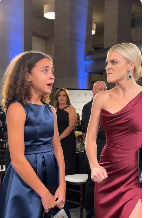
The room went so quiet I could hear the camera shutters clicking.
She looked at me again. “Tessa, who taught you to repair old metal?”
“My mother,” I said, throat tight. “And my grandmother before she died.”
“What was your grandmother’s name?”
“Evelina Cole.”
Isolde’s cane slipped slightly on the marble.
She caught herself, but her eyes filled at once.
“No,” Celeste said quickly. “No, whatever this is, no.”
Isolde reached into a small black purse and removed a folded photograph. Her hand trembled as she held it out.
I did not want to take it. Some part of me already knew it would break the floor beneath me.
But Marta nodded gently.
I unfolded the photo.
Three young women stood in front of a workshop in Antwerp. One wore the same pearl bird pin Isolde wore now. One had dark curls and paint on her sleeve.
And the third had my mother’s eyes.
On the back, in faded ink, someone had written:
Evelina Vale, before they forced her to become Cole.
Part 4: The Name My Mother Hid
I stopped hearing the room for a moment.
Everything became distant: the chandeliers, the whispers, Celeste’s furious breathing, the camera flashes that kept bursting like silent lightning.
Vale.
My grandmother’s name had not been Cole.
My whole life, I had thought our family was just small. Quiet. Unimportant in the way families become when bills pile up and nobody has a portrait over a fireplace.
I looked at Isolde. “Why would she change her name?”
Isolde’s mouth trembled.
“Because the Beaumonts made sure no one with the Vale name could work again.”
Alaric stepped forward. “That is a lie.”
Isolde turned on him so fiercely even Celeste flinched.
“Your father blacklisted my brother. Your lawyers took our workshop. Your family sold our repairs as Beaumont restorations for decades.”
Alaric’s nostrils flared. “The Vales were bankrupt.”
“The Vales were robbed.”
Celeste laughed, but it sounded strained. “This is pathetic. She gets slapped and suddenly she is part of some tragic lost family?”
I looked at her then.
My cheek still hurt. My eyes were swollen. My dress felt too cheap, too bright, too visible.
But for the first time all night, I did not want to disappear.
“You slapped me because you thought everyone would look away,” I said. “They are looking now.”
Celeste’s face sharpened with hatred.
Alaric raised one hand. “Enough. This event is for charity, not old resentments.”
Marta stepped between him and the podium. “This event is also under foundation audit.”
The word audit landed hard.
Alaric’s eyes snapped to hers. “What did you say?”
Marta swallowed, but she did not step back. “The restoration committee received an anonymous packet this morning. We were waiting until after the ceremony to review it.”
Isolde whispered, “Anonymous?”
Marta nodded. “It included insurance discrepancies, missing provenance files, and instructions to check the medallion under angled light.”
Alaric looked at his daughter.
Celeste looked genuinely confused. “I did not send anything.”
From the back of the room, a woman’s voice rose.
“No,” she said. “I did.”
Every head turned.
My mother stood near the entrance in her old black coat, breathing hard like she had run through half the city to get there.
Her eyes found mine.
Then she looked at Alaric Beaumont and said, “I kept quiet when I was a child. I will not do it while they hurt my daughter.”
Part 5: The Mother Who Carried The Proof
My mom had never looked small to me before.
Tired, yes. Worried. Bent over bills at midnight with her fingers pressed to her temples.
But not small.
Standing under those chandeliers, surrounded by silk gowns and polished shoes, she looked like a woman who had walked straight into a storm with nothing but a folder and the truth.
“Marina,” Isolde whispered.
My mother’s face crumpled for half a second. “Aunt Isolde.”
The word aunt shook the room harder than any accusation.
Celeste gripped the podium. “This is insane.”
My mother walked toward me but stopped when she saw my cheek. Her eyes changed. Not loudly. Not dramatically. Something worse. A quiet devastation that made me want to be five years old again.
“She hit you?”
I nodded once.
My mother turned to Celeste.
For the first time, Celeste looked afraid of someone who owned nothing expensive.
“You thought shame would make her quiet,” my mother said. “That was your mistake.”
Alaric spoke through clenched teeth. “Marina, think carefully before you embarrass yourself.”
“I have been careful my entire life,” she said. “Careful with names. Careful with documents. Careful not to attract men like you.”
She placed the folder on the display table.
Marta opened it.
Inside were copies of old workshop permits, insurance reports, handwritten repair diagrams, and letters with broken seals. At the top was a childhood photograph of my mother standing beside my grandmother in a narrow metalworking studio.
Marta lifted one page. “This says the Beaumont foundation acquired the Vale workshop after a fire.”
“The fire was set,” my mother said.
The ballroom erupted.
Alaric barked, “That is slander.”
“No,” said a man from the donor tables.
He stood slowly, holding a phone in one hand. He was younger than Alaric, with dark blond hair and a scar along his jaw.
Celeste stared at him. “Uncle Rafael?”
Alaric’s face drained of color.
Rafael Beaumont walked toward the stage, not looking at his brother.
“I was fourteen,” he said. “I heard Father order the night watchman to leave the workshop door unlocked.”
Isolde covered her mouth.
My mother closed her eyes.
Rafael looked at me. “I am sorry. I should have spoken years ago.”
Alaric whispered, “Rafael, do not do this.”
Rafael lifted his phone.
“I already did,” he said. “The full confession is with the police.”
Then the ballroom doors opened behind him.
Two officers stepped inside.
Part 6: The Confession Beneath The Chandeliers
Celeste stumbled backward as if the officers had come for her personally.
Maybe, in a way, they had.
Not with handcuffs. Not yet. But with the end of the world she understood.
Alaric stood perfectly still, his face arranged into calm authority. “There has been a misunderstanding.”
The older officer, Inspector Leona Gruber, did not blink. “That is usually what people call fraud before the documents are read.”
A few donors made startled sounds. Someone near the champagne table whispered, “Fraud?”
Inspector Gruber approached Marta. “We received Mr. Rafael Beaumont’s sworn statement and supporting materials this evening.”
Alaric’s voice hardened. “My brother is unstable.”
Rafael laughed once. It was not happy. “You sound exactly like Father.”
Celeste looked from her uncle to her father. “What is happening?”
No one answered her.
That was the cruelest part.
All night, she had owned the room. Now the truth had entered, and suddenly her family spoke around her like she was a child left outside a locked door.
My mother took my hand.
Her fingers were cold.
“I wanted to tell you when you were older,” she whispered.
“I am older,” I whispered back, though my voice broke.
Her grip tightened. “Not enough for this.”
Inspector Gruber studied the medallion, the log, the hidden Vale mark, then the documents on the table. “The gala will continue only as a witness gathering. No items connected to the Vale collection may be sold.”
Alaric snapped, “You do not have that authority.”
“I do.”
The inspector turned slightly.
A second officer handed her a sealed paper.
“The Zurich court issued an emergency preservation order one hour ago.”
Isolde sagged against her cane.
Marta looked like she might cry from relief.
Celeste suddenly shouted, “Stop acting like we murdered someone!”
The room froze.
Rafael’s face went white.
My mother looked down.
Isolde closed her eyes.
And Alaric, for one terrible second, looked not angry but afraid.
I felt my pulse in my throat.
“What does that mean?” I asked.
No one moved.
“What does that mean?” I repeated.
Inspector Gruber looked at Rafael.
Rafael’s jaw trembled. “The workshop fire killed the night watchman.”
Celeste pressed a hand over her mouth.
My mother pulled me closer.
Rafael forced the next words out like broken glass.
“His name was Oskar Cole. Tessa’s grandfather.”
Part 7: The Daughter Who Broke First
I had heard my grandfather’s name only in soft pieces.
Oskar was kind.
Oskar loved apricots.
Oskar could fix anything with patient hands.
Oskar died before I was born.
No one ever said murdered.
The ballroom blurred.
My mother caught me before my knees folded. The satin of my dress rustled too loudly as I leaned into her, suddenly unable to hold the weight of a dead man I had never met.
Alaric’s voice came from somewhere far away. “This is speculation.”
Inspector Gruber answered, “No. It is testimony supported by archived fire reports.”
Celeste began crying.
Not graceful tears. Not the pretty kind rich girls allow themselves in mirrors. Her face twisted, and she looked at her father like he had become a stranger wearing his own skin.
“You knew?” she whispered.
Alaric said nothing.
“Father,” she said, louder. “Did you know?”
His silence ruined him.
Celeste backed away until she hit the podium. Her donor speech slid to the floor, pages scattering across the marble.
The top page landed near my shoe.
I looked down.
The first line read: My family has always believed in protecting forgotten histories.
A sound escaped me—half laugh, half sob.
Celeste saw it too.
Something in her broke.
She bent, picked up the page, and tore it in half.
Alaric snapped, “Celeste.”
She tore another page. Then another.
“You made me stand up here and lie,” she said.
“I made you represent your family.”
“No.” Her voice shook, but it grew stronger. “You made me cruel because you told me cruelty was dignity.”
Alaric stepped toward her.
Rafael moved between them.
For a second, I thought Alaric might strike his own brother right there beneath the chandeliers.
Instead, Celeste turned toward me.
My whole body tensed.
She looked at my cheek. Then at my dress. Then at my mother’s hand gripping mine like a lifeline.
“I slapped you,” she said, voice cracking. “Because I was scared you had earned something I was only handed.”
I did not answer.
She swallowed hard.
Then she picked up the microphone from the podium.
Her father said her name once, low and threatening.
Celeste turned it on anyway.
The speakers hummed.
Everyone heard her next words.
“My name is Celeste Beaumont, and I will give a full statement to the police tonight.”
Alaric’s face went blank with rage.
Then the inspector stepped forward and said, “Mr. Beaumont, come with us.”
Part 8: The Log That Gave Us Back Our Name
By morning, the gala was gone.
Not physically. The chandeliers still hung above us. The flowers still crowded the tables. The red carpet still stretched from the entrance to the stage like nothing had happened.
But the performance had collapsed.
The donors left in whispers. The cameras stayed until their batteries died. Officers carried out sealed boxes while Marta sat at a table with shaking hands, labeling documents one by one.
Celeste sat alone near the podium, wrapped in a silver shawl someone had given her. She looked younger without her certainty.
I sat beside my mother on the stage steps.
Neither of us spoke for a long time.
Finally, she touched my hair. “I thought hiding the name would protect you.”
I looked at the restoration log resting in its clear evidence sleeve.
Tessa Cole.
My signature.
My proof.
My grandmother’s hidden history.
My grandfather’s death.
All of it pressed into one night.
“I do not want to stop being Cole,” I said.
My mother’s eyes filled.
“You do not have to.”
Isolde came toward us slowly, carrying the pearl bird pin in her palm.
“This belonged to Evelina,” she said. “She gave it to me the night she left Antwerp.”
I stared at it.
The tiny bird had one broken wing, but its head was lifted.
Isolde placed it in my hand.
“Vale was the name they tried to steal,” she said. “Cole was the name your family survived under. Perhaps you are both.”
Across the room, Celeste stood.
Inspector Gruber had already taken her statement. Rafael had given his. Alaric Beaumont was gone through a side door, not grandly, not tragically, just escorted out under gray morning light while no one applauded.
Celeste approached us carefully.
“I know I cannot fix what I did,” she said.
“No,” I replied. “You cannot.”
She nodded, accepting it.
Then she held out a folded paper. “But this is the Beaumont family’s controlling donation agreement for the gala fund. My signature can freeze it until the court transfers oversight.”
My mother stared at her. “Why would you do that?”
Celeste looked at the destroyed donor speech on the floor.
“Because I finally read the first line and hated myself.”
Six months later, the Vale-Cole Restoration Fund opened its first workshop in Lisbon, inside a building with blue tiles, wide windows, and workbenches donated by people who had once paid to hear Celeste speak.
My mother taught metal repair.
Isolde taught provenance.
Rafael funded scholarships in Oskar Cole’s name.
And Celeste came every Thursday, not as a donor, not as a Beaumont, but as the girl assigned to polish hinges until her hands learned patience.
On the wall near the entrance, we framed the restoration log beneath glass.
Visitors always leaned close to read the signature at the bottom.
And every time they did, I remembered the slap, the silence after it, and the moment truth opened its eyes.
They tried to erase our name, but the log remembered where we belonged.
