I was setting up a white Target crib in our Ohio split-level nursery when our Labrador planted himself in front of it like the room was cursed.
David was overseas, my back hurt, and I was already crying because the instructions made zero sense.
Scout kept blocking me every time I tried to roll the crib under the ceiling fan.
I snapped at him to move, and I still hate how mean I sounded.
He didn’t move.
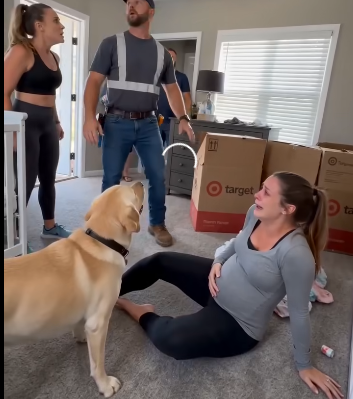
He lowered his head, dug his paws into the carpet, and gave me this low warning whine I’d never heard before.
My neighbor Brittany heard me yelling and came over with a Starbucks cup and an attitude.
She said Scout was just jealous of the baby.
Then Scout shoved the crib sideways with his shoulder.
The second it rolled away, the ceiling fan ripped loose and crashed exactly where the mattress had been.
Brittany dropped her coffee all over the rug.
I was so stunned I couldn’t breathe.
For three full seconds, the room made no sound except the fan blades rocking against the floor.
The white crib shook from the impact. The little cloud mobile I had spent twenty minutes tying to the rail swung wildly, bumping against the wooden slats like a tiny warning bell. Dust floated down from the ceiling in pale strips, drifting over the yellow baby blanket my mother had mailed from Columbus.
Scout stood between me and the wreckage with his body stiff, his tail low, his chest heaving.
I stared at the place where the crib had been.
Where the mattress had been.
Where, in six weeks, my baby might have been sleeping.
My knees buckled.
Brittany reached for me, but Scout turned his head and gave one sharp bark.
She froze.
“Okay,” she snapped, raising both hands. “Relax. I’m helping.”
But she didn’t sound like she wanted to help.
She sounded annoyed that the dog had made her look wrong.
I sank onto the carpet, one hand on my belly and the other pressed against my mouth. The baby moved once, soft but real, and that tiny shift inside me broke whatever shock had been holding me upright.
I started crying.
Not loudly. Not dramatically.
Just the kind of crying that happens when your body realizes it missed disaster by inches.
Brittany looked at the fan, then at the ceiling, then at Scout.
“Well,” she said, too quickly, “that’s obviously a maintenance issue.”
I lifted my eyes to her.
“A maintenance issue?”
She swallowed.
“I mean, these old split-levels are full of surprises. You know how houses are.”
I didn’t answer.
Because I did know how houses were.
I knew the hallway outlet sparked if you plugged in the vacuum too fast. I knew the basement door stuck when it rained. I knew the upstairs bathroom ceiling had a faint stain David kept saying he’d fix when he got home.
But I did not know that a ceiling fan could tear itself loose from a nursery ceiling and crash into a crib.
Scout moved closer to me and pushed his head under my shaking hand.
I grabbed his collar.
“I’m sorry,” I whispered into his fur. “I’m so sorry.”
He leaned against me like he understood every word.
Brittany crouched near the fallen fan but didn’t touch it.
Her coffee had soaked into the rug in a spreading brown stain. It smelled sweet and burnt, mixing with the dust and hot metal smell from the broken fixture.
“You should call someone,” she said.
I stared at her.
“Call who?”
“Maintenance. Insurance. Maybe the electrician.”
“This is our house, Brittany.”
She blinked.
“I know.”
“So there’s no maintenance.”
“Oh. Right.”
That was when I noticed her hands.
They were shaking.
Not a little.
A lot.
Brittany was the kind of woman who made nervousness look like bad manners. She always stood too straight, smiled too hard, judged too quickly. She had opinions on porch flags, grass height, Amazon boxes left outside too long, and whether pregnant women should be lifting things.
But now her fingers were trembling around the empty Starbucks cup like she wanted to crush it.
“Did you know something?” I asked.
Her eyes snapped to mine.
“What?”
“The fan. The ceiling. Did you know something?”
She laughed once, sharp and fake.
“Why would I know anything about your ceiling fan?”
Scout growled.
Low.
Not loud enough to be dramatic.
Just enough to make every hair on my arms lift.
Brittany stood.
“I don’t have to be insulted in my own neighbor’s house.”
“You came into my house.”
“Because you were yelling!”
“Because I was alone and scared and building a crib while my husband is deployed.”
Her mouth tightened.
“Overseas,” she corrected.
“What?”
“You said deployed last week. But David’s a contractor, right? Not active duty. Overseas sounds different than deployed.”
For a moment, I just stared at her.
The fan had fallen.
My baby could have been hurt.
My dog had just saved me from rolling a crib under it.
And Brittany was correcting my vocabulary.
Something cold slid through me.
I pushed myself up slowly, using the crib rail for balance.
“Get out.”
Her face changed.
“Maya—”
“Get out of my house.”
Scout stepped forward.
Brittany glanced at him, then at the doorway.
“You’re emotional right now.”
“I am pregnant, terrified, and standing next to a ceiling fan that almost landed where my baby’s crib was supposed to go. Get out before I call someone who can make you leave.”
Her cheeks flushed.
“Fine.”
She turned, then paused at the nursery door.
“You should really crate that dog before the baby comes,” she said. “A dog that shoves furniture around isn’t safe.”
Scout barked once.
This time I didn’t tell him to stop.
Brittany left.
The front door shut hard enough to rattle the hallway picture frames.
For a while, I couldn’t move.
I called David first.
The call rang and rang.
International calls were always a gamble. Sometimes he answered from a noisy hotel lobby. Sometimes from a truck. Sometimes he couldn’t answer at all.
This time, voicemail.
I tried again.
Nothing.
I texted:
Call me as soon as you can. Emergency. I’m okay. Baby’s moving. Scout saved us.
Then I called my mother.
She answered on the first ring.
“Maya?”
The second I heard her voice, I fell apart.
It took ten minutes to explain everything because I kept stopping to breathe, to cry, to repeat that the baby was moving, that I was okay, that Scout was okay, that no, the fan had not hit me.
My mother didn’t waste time panicking.
“I’m getting in the car.”
“Mom, you’re two hours away.”
“Then I’ll be there in two hours.”
“I need to call someone about the ceiling.”
“You need to sit down, drink water, and not touch anything. Take photos. Lots of photos. Do not move the fan. Do not clean the rug. Do not let Brittany back in.”
At Brittany’s name, Scout lifted his head.
My mother heard my silence.
“What did she do?”
I looked toward the hallway.
“I don’t know yet.”
That was the first time I said it.
Yet.
After I hung up, I took pictures.
The broken ceiling mount.
The fan on the carpet.
The crib shoved sideways.
The coffee stain.
The dust.
The little scrape where the fan blade had hit the floor.
Scout followed me around the room, pressing his nose to my hand every few seconds. When I got too close to the broken fixture, he stepped in front of me again.
That was when he did something stranger.
He walked to the nursery closet and sniffed the door.
Then he whined.
Not the same warning whine from before.
This one was sharper, frustrated.
“Scout,” I whispered.
He pawed the closet door.
I opened it.
Nothing fell. Nothing moved.
The closet looked normal: stacked diapers, a box of tiny socks, a folded baby bath, two unopened packs of crib sheets, and a plastic tub full of things David’s sister had given us.
Scout ignored all of it.
He shoved his nose toward the back corner.
At first I didn’t see anything.
Then I noticed a square patch in the ceiling above the closet shelf.
An attic access panel.
I had forgotten it was there.
Scout stared up at it, trembling.
I backed away.
“No,” I said softly. “Absolutely not.”
I called the fire department’s non-emergency number.
Then, because I was scared I’d sound ridiculous, I said the plainest version of the truth:
“I’m eight months pregnant, a ceiling fan just fell in my nursery, and my dog is alerting at the attic access. I don’t know if there’s an electrical issue or structural damage.”
They didn’t laugh.
They sent someone.
Fifteen minutes later, two firefighters and a city building inspector stood in my nursery while Scout sat beside me in the hallway like a golden statue.
One firefighter looked at the fallen fan and said, very quietly:
“Good dog.”
Scout’s tail thumped once.
The inspector, a man named Mr. Weller with gray eyebrows and a clipboard, examined the ceiling with a flashlight. He didn’t touch the wires at first. He just looked.
Then he sighed.
That sigh scared me more than anything.
“What?” I asked.
He glanced at me, then softened his voice.
“Ma’am, this fan was not installed correctly.”
My stomach tightened.
“What does that mean?”
“It was mounted into drywall with inadequate support. And there’s moisture damage around the box.”
I looked at the ceiling.
“Moisture?”
He pointed with the flashlight.
Now that he said it, I could see it.
A faint ring.
Barely visible under the white paint.
Like someone had painted over an old bruise.
Mr. Weller turned to one of the firefighters.
“Can you check the attic access?”
The firefighter brought a ladder from the truck. Scout whined when he opened the closet, but he didn’t bark. He just watched.
The firefighter pushed up the panel and aimed a light inside.
The second the attic air came down, I smelled it.
Wet wood.
Dust.
Something old and sour.
The firefighter went still.
Then he said:
“Yeah. We’ve got a problem.”
Mr. Weller looked up.
“How bad?”
The firefighter’s voice came from above the closet.
“There’s staining across the joist. Old leak, maybe active at some point. And somebody sistered a board badly. Looks DIY.”
I gripped the hallway wall.
“What does that mean in normal words?”
Mr. Weller turned to me.
“It means someone knew there was damage up there and tried to patch it without properly repairing it.”
My ears rang.
Someone knew.
Scout had known something was wrong.
Brittany had acted like she knew something was wrong.
And suddenly I remembered a conversation from three months earlier.
Brittany standing at the mailbox, tapping her acrylic nails against a stack of envelopes.
“You’re putting the nursery upstairs?” she had asked.
“Yeah.”
“In the front room?”
“Yeah. Why?”
“No reason. Just wouldn’t be my first choice.”
I had laughed awkwardly.
“What’s wrong with the front room?”
She smiled too quickly.
“Oh, nothing. Just gets warm.”
But it hadn’t been about warmth.
Mr. Weller came back from his truck with a form.
“I’m going to recommend you don’t use this room until it’s fully inspected and repaired.”
My hand went to my belly.
“Is the rest of the house safe?”
“I can’t say without inspection. But the immediate issue is this ceiling area. You’ll need a licensed contractor and electrician.”
I nodded because my mouth couldn’t form words.
One of the firefighters crouched in front of Scout.
“You saved them, buddy.”
Scout leaned into his hand.
And I cried again.
By the time my mother arrived, the nursery was taped off.
She walked in carrying a tote bag, a folder, and the expression she wore when she was trying very hard not to scare me.
Then she saw the fan.
Her face crumpled.
“Oh, Maya.”
I stepped into her arms.
For a minute, I was not a wife with a husband overseas, not an expectant mother, not a homeowner dealing with repairs and forms and insurance.
I was just someone’s daughter.
My mother held me and stared over my shoulder at Scout.
“Thank you,” she whispered to him.
Scout wagged his tail.
David called at 1:17 a.m.
I remember the exact time because I was sitting at the kitchen table, unable to sleep, with the inspector’s temporary notice beside my water glass.
His face appeared on the screen, pixelated and exhausted.
“Maya? What happened?”
I told him.
All of it.
The crib.
Scout.
The fan.
Brittany.
The attic.
The inspector.
The moisture.
The bad patch.
David went silent.
Not the normal kind of worried silence.
A different silence.
A silence with memory inside it.
“David,” I said.
He rubbed both hands over his face.
“I need to tell you something.”
My mother looked up from the sink.
I went cold.
“What?”
“When we bought the house, the seller disclosed a repaired leak near the upstairs bathroom. They said it was fixed years ago.”
“You knew there had been a leak?”
“Yes, but not in the nursery. I thought it was the bathroom hallway.”
“You never told me.”
“I didn’t think it mattered. The inspection report said repair appeared complete.”
My voice went flat.
“Did it?”
He looked away from the camera.
“David.”
“There was an addendum.”
The room seemed to tilt.
“What addendum?”
He swallowed.
“The inspector recommended further evaluation of the attic framing before installing overhead fixtures.”
I stared at him.
“What?”
“I was going to handle it when I got back.”
“When you got back?”
“I didn’t know you were going to put the crib under the fan.”
“I didn’t know there was a reason not to!”
He flinched.
My mother put a hand on the back of my chair, steadying me without speaking.
David’s voice cracked.
“I’m sorry.”
I laughed once, but there was no humor in it.
“Scout knew more about keeping us safe than you did.”
That hurt him.
I saw it.
But I didn’t take it back.
Because it was true.
He looked down.
“You’re right.”
I hated that too.
I hated how small “you’re right” sounded after a ceiling fan had crashed where our child was supposed to sleep.
“Where is the addendum?” I asked.
“In the closing folder. The blue one. Office cabinet.”
My mother was already moving.
She found it in three minutes.
The blue folder had tabs. Inspection. Insurance. Closing. Warranty.
And there, behind the inspection report, was a thin packet I had never seen.
My mother laid it on the table.
The top page read:
RECOMMENDATION: ADDITIONAL STRUCTURAL REVIEW BEFORE INSTALLATION OF CEILING-MOUNTED FIXTURES IN FRONT UPPER BEDROOM.
Front upper bedroom.
The nursery.
My hands went numb.
“David,” I said quietly.
He closed his eyes.
“I didn’t hide it to hurt you.”
“But you hid it.”
“I minimized it.”
“You hid it.”
He didn’t argue.
That, somehow, made it worse.
I looked at the paper again.
Then I noticed a sticky note on the side.
Not David’s handwriting.
A woman’s handwriting.
Looped, neat, familiar from every neighborhood flyer ever taped to our door.
Ask Brittany. Her uncle did the patch.
I stopped breathing.
My mother saw my face.
“What is it?”
I turned the paper toward her.
She read the sticky note.
Then we both looked at the screen.
David’s face changed.
“I forgot that was there.”
My voice dropped.
“Brittany’s uncle patched the ceiling?”
David swallowed.
“Before we bought it. She said he used to do work for the previous owner.”
“And you never thought to mention that?”
“I thought it was fixed.”
“You thought a ceiling that needed structural review was fixed because Brittany said her uncle patched it?”
David said nothing.
My mother sat down slowly.
The whole house felt suddenly unfamiliar. The walls. The floor. The nursery upstairs. The neighbor next door. The woman who had walked into my house with a coffee and told me my dog was jealous.
Brittany had known.
Maybe not everything.
But enough.
The next morning, she came over before I could go to her.
She knocked at 8:04 a.m.
Scout stood before I did.
My mother answered the door but kept the chain on.
Brittany stood on the porch in leggings, a quilted vest, and sunglasses pushed into her hair.
“I saw the fire truck last night,” she said.
My mother stared at her.
“Yes.”
“Is Maya okay?”
“I am right here,” I said.
I stepped into the entryway.
Scout came with me.
Brittany’s eyes flicked to him.
“I wanted to apologize if I came off harsh yesterday.”
My mother’s eyebrows lifted.
If.
Brittany kept going.
“I was just startled. The fan falling was scary for everyone.”
“For everyone?” I repeated.
She smiled weakly.
“You know what I mean.”
“No. I don’t.”
Her smile disappeared.
I held up the sticky note.
“Your uncle patched the ceiling?”
Brittany’s face drained.
Just a little.
But enough.
“My uncle did a lot of work around here years ago.”
“That’s not what I asked.”
She looked past me into the house.
“Can we talk privately?”
“No.”
My mother opened the door wider but kept herself between Brittany and the entry.
Brittany lowered her voice.
“Maya, this is not something you want to turn into a neighborhood thing.”
Scout growled.
My mother said:
“Careful.”
Brittany’s mouth tightened.
“That dog needs training.”
“That dog saved my daughter,” my mother said.
Brittany ignored her.
“My uncle helped the previous owner with a small cosmetic repair. That’s all.”
“Then why did you tell David to ask you about it?”
Her eyes sharpened.
“I didn’t.”
“The sticky note says otherwise.”
“That could mean anything.”
“It means you knew about the ceiling.”
She glanced toward her own house.
For the first time, I saw real fear.
Not fear for me.
Fear for herself.
“Look,” she said, “the previous owner was impossible. Always complaining about leaks and stains and creaks. My uncle helped because he was being neighborly. He wasn’t hired for some official job.”
“So he covered it.”
“He patched cosmetic damage.”
“A ceiling fan fell into my nursery.”
Her jaw flexed.
“That fan was old.”
“The inspector said the support was wrong and the wood was moisture-damaged.”
She inhaled.
Then she said the sentence that ended any doubt.
“Well, nobody told you to put a baby under it.”
My mother moved so fast I thought she was going to step outside.
I caught her wrist.
Scout barked once, sharp and furious.
Brittany realized what she’d said.
Her sunglasses slipped lower on her hair.
“I didn’t mean—”
“Yes,” I said. “You did.”
Her face hardened.
“You’re emotional.”
There it was again.
The word people use when they want a woman’s reasonable anger to sound like a symptom.
I stepped closer to the doorway.
“I am emotional. I am also correct.”
Brittany looked at my mother, then at Scout, then back at me.
“You can’t prove anything.”
That sentence was quieter.
And more honest than every apology before it.
I held up my phone.
“I can prove you knew enough to warn me and chose not to.”
Her face changed.
“What did you record?”
“Enough.”
I hadn’t been recording.
But she didn’t know that.
And her reaction told me more than any recording could have.
She stepped backward.
“This is ridiculous.”
“No. What’s ridiculous is that my dog had to protect my baby from a danger three adults minimized.”
Brittany’s nostrils flared.
“Don’t drag me into your marriage problems.”
My mother’s voice went cold.
“You should leave now.”
Brittany looked like she wanted one last cruel line.
But Scout stepped forward.
Not past the doorway.
Not aggressively.
Just forward.
Brittany left.
That afternoon, David emailed me everything.
The original inspection report.
The addendum.
The seller disclosure.
A text from Brittany from the week after closing.
If you guys ever redo that front bedroom, don’t mess with the ceiling without talking to someone. Old houses, lol.
Old houses, lol.
I stared at that text for a long time.
Then I forwarded everything to the inspector, our insurance company, and a real estate attorney my mother found through a friend.
I also called David back.
He answered immediately.
“I sent it,” he said.
“I saw.”
“I’m sorry.”
I closed my eyes.
“I know you are.”
“I should have told you.”
“Yes.”
“I should have had it checked before I left.”
“Yes.”
“I should have taken your nesting seriously instead of assuming you’d wait.”
That one hurt differently.
Because it was true in a way neither of us had said before.
David had treated the nursery like a project that could wait until he came home.
But the baby wasn’t waiting.
My body wasn’t waiting.
I was here, growing our child, lifting boxes I shouldn’t lift, assembling furniture because I needed to feel prepared while he was thousands of miles away.
“You left me alone with decisions you still thought belonged to you,” I said.
He stared at me through the screen.
Then he nodded.
“I did.”
That was the beginning of a different conversation.
Not solved.
Not pretty.
But real.
The contractor came two days later.
A licensed one.
Not someone’s uncle.
He opened the attic access and took pictures. He checked the joists, the electrical box, the old water damage. He found more than I wanted him to find.
A slow roof leak had been repaired badly years ago.
The fan had been installed into a box that was never rated for that kind of weight.
Someone had painted over stains.
Someone had added a board in a way that looked sturdy from below but did almost nothing.
The contractor climbed down from the ladder and looked at Scout, who had refused to leave the hallway.
“I don’t know what he smelled or heard,” he said, “but he knew.”
I looked at my dog.
Scout blinked back at me, calm as a saint.
My mother cried.
I almost did too.
We moved the nursery downstairs.
Not permanently, maybe, but for now.
The dining room became a nursery in two days. My mother and I cleared out the table, rolled in the crib, washed the sheets, hung the cloud mobile from a safe stand instead of the ceiling.
The white crib looked strange beside the china cabinet.
But safe.
Safe mattered more than pretty.
Scout approved.
He sniffed every corner, walked around the crib twice, then lay down beside it with his head on his paws.
My mother looked at him and said:
“Well, I guess the nursery passed inspection.”
For the first time since the fan fell, I laughed.
A week later, Brittany tried one last time.
She didn’t come to the door.
She sent a letter.
A real paper letter, folded into our mailbox without an envelope.
It said she was sorry I had “interpreted her concern as hostility.”
It said pregnancy could make women “highly sensitive.”
It said her uncle had “no official responsibility.”
It said she hoped I would not “spread damaging rumors in a family neighborhood.”
At the bottom, she wrote:
For everyone’s sake, let this go.
I showed it to my mother.
She read it twice.
Then she said:
“People only say ‘let this go’ when they’re still holding something.”
I sent a copy to the attorney.
Then I stopped answering Brittany.
That silence drove her crazy.
She stopped waving.
Then she started watching from her porch whenever contractors came.
Then, one morning, Mr. Weller returned for a follow-up inspection and Brittany crossed the lawn in slippers, pretending to take out trash.
“I hope all this isn’t because of some misunderstanding,” she called.
Mr. Weller looked at her.
“Ma’am, a ceiling fan fell from a structurally compromised area into a nursery.”
Brittany opened her mouth.
He added:
“That’s not a misunderstanding.”
She went back inside.
Scout watched from the window.
His tail didn’t move.
David came home three weeks before my due date.
He walked into the house with a duffel bag, tired eyes, and the expression of a man who had rehearsed a hundred apologies and knew none of them were enough.
Scout greeted him first.
Not with wild excitement.
With a careful sniff.
David knelt and put both hands on Scout’s shoulders.
“Thank you,” he whispered.
Scout licked his chin.
David cried.
I stood in the hallway with my arms crossed over my belly, and for a moment I let him cry.
Not as punishment.
As truth.
Then he came to me.
He didn’t touch me right away.
“Can I hug you?” he asked.
That question almost broke me.
Because before the fan, before the addendum, before the ceiling, David would have simply reached for me, assuming love made permission unnecessary.
I nodded.
He hugged me gently.
“I failed you,” he said into my hair.
I closed my eyes.
“Yes.”
“I’m going to fix what I can.”
“You can’t fix what almost happened.”
“No,” he said. “But I can stop pretending almost doesn’t count.”
That was the closest thing to the right answer.
We didn’t rebuild trust in one conversation.
We rebuilt it in small things.
He moved the crib without complaining.
He called the contractor himself.
He read every report out loud with me.
He apologized to my mother.
He wrote a statement for the attorney admitting he had failed to disclose the addendum to me.
He installed nothing, moved nothing, decided nothing without asking.
And every night, before bed, he checked the downstairs nursery while Scout watched him like a supervisor.
Two weeks later, our son was born.
Not in the dramatic way I had feared.
Not with sirens or collapsing ceilings or emergency warnings.
He arrived on a rainy Tuesday morning in a hospital room that smelled like antiseptic and coffee, with my mother holding one hand and David holding the other.
When the nurse placed him on my chest, tiny and warm and furious at the world, I thought of the empty space under the ceiling fan.
The place he could have been.
The place Scout refused to let him be.
David touched our son’s back with one trembling finger.
“What should we name him?” he whispered.
We had a list.
Miles.
Henry.
Caleb.
But the answer came before I could think.
“Samuel,” I said.
David looked at me.
“My grandfather?”
I shook my head.
“No. It means God heard.”
David’s eyes filled.
My mother cried.
And when we brought Samuel home three days later, Scout met him at the door.
He didn’t jump.
He didn’t bark.
He sat.
David lowered the car seat carefully to the floor. Scout leaned forward and sniffed the blanket with the seriousness of a guard inspecting a royal arrival.
Samuel made a tiny squeak.
Scout’s tail swept once across the floor.
Then he lay down beside the car seat.
Exactly where he had lain beside the crib.
A month later, the nursery upstairs was fully repaired.
New joists.
New electrical box.
New ceiling.
No fan.
I stood in the doorway holding Samuel while David painted the trim.
Scout sat beside me.
The room looked beautiful again.
White crib.
Soft rug.
Cloud mobile.
Fresh walls.
But I didn’t roll the crib under the center of the ceiling.
I placed it near the inner wall, away from windows, away from anything overhead.
David didn’t question it.
He just said:
“Good spot.”
Scout walked over, sniffed the crib, circled once, and lay down.
Approval.
Brittany moved that spring.
No goodbye.
No wave.
A moving truck came on a Saturday morning, and she stood in her driveway with sunglasses on, pretending not to see me on the porch with Samuel in my arms and Scout at my feet.
For a second, I thought she might say something.
Apologize.
Defend herself.
Blame me one last time.
But she only got into her car and drove away.
The house next door sold to a retired teacher named Mrs. Alvarez, who brought homemade muffins the first week and asked before petting Scout.
Scout liked her immediately.
That told me everything.
Sometimes people ask me if I’m afraid now.
Afraid of old houses.
Afraid of ceiling fans.
Afraid of what I almost didn’t know.
The truth is, yes, a little.
But I’m more afraid of the way people dismiss warnings just because they come from someone inconvenient.
A pregnant woman.
A nervous neighbor.
A dog with his paws dug into the carpet.
Scout couldn’t explain moisture damage, bad wiring, hidden addendums, or a neighbor’s guilty silence.
He couldn’t read inspection reports.
He couldn’t call David overseas.
He couldn’t point to a line in a closing document and say: this matters.
So he did the only thing he could.
He stood in the way.
He let me yell at him.
He let me think he was being stubborn.
He let Brittany call him jealous.
And when words failed, he put his whole body between my baby and danger.
People say dogs don’t understand.
Maybe they don’t understand the way we do.
Maybe they understand better.
Because Scout never cared about being polite.
He never cared about looking dramatic.
He never cared whether Brittany rolled her eyes or whether I sounded frustrated or whether the crib looked prettier under the fan.
He cared about the one thing everyone else had managed to forget.
Safe is more important than convenient.
Now, every night, before I put Samuel down, Scout walks into the nursery first.
He sniffs the rug.
He checks the crib.
He looks up once at the smooth, fanless ceiling.
Then he lies beside the rocking chair and waits.
I used to think that was just habit.
Now I know it is a promise.
And every time I lower my son into his crib, I whisper the same thing to Scout:
“You saw what we didn’t.”
He closes his eyes.
Samuel sleeps.
The room stays quiet.
And the white crib stands exactly where my Labrador decided it was safe.
