The first thing I remember was not the cold pasta sauce dripping from my eyelashes or the laughter Audrey Sinclair tried to start before anyone understood what she had done.
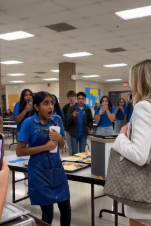
It was the sound of forty-seven phones rising at once.
That soft, mechanical chorus—cases scraping against tables, cameras clicking open, chairs shifting as students leaned forward—told me my humiliation had already escaped the room. Before the food slid down my cheek and stained the collar of my white blouse, I knew the moment would be online before I reached the nearest bathroom.
Audrey stood three feet away from me, still clutching the empty tasting bowl.
For one terrible second, even she looked shocked.
Then the expression disappeared.
Her lips curved into the controlled smile she wore whenever an adult entered the room, the smile that made teachers call her “poised” and donors call her “a natural leader.”
“Oh my God, Elena,” she said loudly. “It slipped.”
Nobody believed her.
The bowl had not slipped. Audrey had grabbed it with both hands, stepped around the corner of the tasting table, and thrown its contents directly into my face.
But belief and truth were not always the same thing at Briarwood Preparatory High School.
Belief belonged to whoever spoke first.
And Audrey Sinclair had been speaking first her entire life.
The multipurpose room had been decorated for the prom menu tasting with silver streamers, battery-operated candles, and paper signs reading MIDNIGHT IN PARIS. Six local caterers had arranged sample dishes along the walls while members of the prom committee carried clipboards and evaluation cards between tables.
It should have been ordinary.
It should have been fun.
Instead, everyone was staring at me while tomato cream sauce dripped from my chin onto the evaluation ledger I had refused to surrender.
Audrey pointed at the folder in my hands.
“She’s been trying to sabotage the tasting all afternoon,” she announced. “She’s angry because her menu idea wasn’t selected.”
“That isn’t true,” I said.
My voice came out quieter than I wanted.
Audrey heard the weakness and stepped closer.
“She keeps accusing people of cheating because she can’t handle losing.”
“I didn’t accuse anyone of cheating.”
“You said the votes were fake.”
“I said the numbers didn’t match.”
A few students stopped recording and looked toward the sealed acrylic ballot box sitting on the judges’ table.
Inside it were folded evaluation cards from students who had supposedly sampled all six proposed prom meals.
The box had been sealed with two blue security strips.
At least, that was what everyone had been told.
I wiped sauce from my eyes with my sleeve and held the ledger against my chest. My hands were trembling so badly that the pages rattled.
“I counted the tasting wristbands,” I said. “One hundred and eighty-four were handed out. But the ledger says two hundred and thirty-one students voted.”
Audrey laughed.
It was too quick and too sharp.
“You counted wristbands?”
“Yes.”
“Who does that?”
“Someone assigned to inventory.”
That someone was me.
I was not president of the prom committee. I was not a student ambassador, cheer captain, legacy admission, or daughter of anyone whose name appeared on a building.
I was Elena Morales, a seventeen-year-old scholarship student whose mother worked double shifts at a hospital laundry facility and whose father repaired commercial refrigerators whenever his back allowed him to stand.
I had joined the prom committee because the activities coordinator promised ten volunteer hours and a free ticket.
The free ticket mattered.
At Briarwood, prom tickets cost more than my mother’s weekly grocery budget.
The inventory job had seemed harmless: count wristbands, record sample portions, collect caterer receipts, and make sure the final evaluation cards matched the attendance sheet.
I had always liked numbers because numbers did not care what shoes you wore.
They did not become friendlier when someone’s father donated a scoreboard.
They simply matched or they did not.
And that afternoon, they did not.
Audrey folded her arms.
“Maybe some students received replacement wristbands.”
“They didn’t.”
“How could you possibly know?”
“Because replacements were supposed to be recorded on the second page.”
I opened the ledger.
The replacement column was empty.
The room quieted.
At the front, Mrs. Whitaker, the faculty adviser, looked as if she wished the floor would swallow all of us. She was a kind woman in ordinary situations, but Audrey’s mother chaired the school foundation, and kindness had never been tested by a family capable of funding an entire science wing.
“Elena,” Mrs. Whitaker said, “perhaps we should discuss this privately.”
“No.”
The word escaped before fear could stop it.
Audrey’s eyebrows lifted.
I swallowed.
“I’m sorry, but no. The ballots are already sealed. If there’s an innocent explanation, opening the box now will prove it.”
Audrey turned toward Mrs. Whitaker.
“You cannot let her destroy the integrity of the vote because she’s having an emotional episode.”
An emotional episode.
The words struck harder than the food.
Audrey understood exactly how to make a girl like me disappear. She did not need to prove I was wrong. She only needed to make everyone uncomfortable enough to stop listening.
I looked around the room.
My friend Maya Patel stood near the beverage station, her phone lowered, her face pale with anger. She started toward me, but I shook my head.
Not yet.
I had learned something during my three years at Briarwood: if someone powerful wanted you to look irrational, the safest thing you could do was become painfully calm.
I placed the stained ledger on the judges’ table.
“Please open the box,” I said.
Audrey’s smile vanished.
That was the moment I knew.
Until then, I had believed the mismatch might have been sloppy bookkeeping. Perhaps a volunteer had distributed extra cards. Perhaps students had voted without eating. Perhaps someone had copied the wrong number.
But Audrey was not annoyed anymore.
She was afraid.
Mrs. Whitaker reached toward the ballot box.
Audrey moved between them.
“The principal needs to approve that.”
“Then call him,” I said.
Audrey’s eyes flashed.
“You really want to embarrass yourself in front of Dr. Bennett?”
“I want the numbers checked.”
“And when they match?”
“Then I’ll apologize.”
She leaned close enough that only I could hear her.
“You should have learned by now that people like you do not survive here by making people like me look bad.”
My stomach tightened.
People like you.
She had never said the words so plainly before.
Audrey usually hid her cruelty inside jokes, smiles, and phrases adults could reinterpret. She complimented thrift-store dresses by calling them “brave.” She invited scholarship students to events after all the good seats had been assigned. She praised our “inspiring circumstances” as if hardship were a costume we wore for her entertainment.
But fear had stripped away her polish.
I looked directly at her.
“What did you do?”
Her face changed again.
Then Dr. Nathaniel Bennett entered the multipurpose room.
The principal was a tall, silver-haired man who rarely raised his voice because the entire school had been trained to quiet itself whenever he appeared. Behind him walked Vice Principal Lawson, the school security director, and two members of the parent foundation.
One of them was Audrey’s mother.
Vivian Sinclair looked like an older, perfected version of her daughter. Her navy suit had no wrinkles. Her blond hair was pinned neatly behind her ears. A diamond brooch glittered at her collar.
She took in the room, the cameras, the sauce on my face, and the ballot box.
Then she looked at Audrey.
The message between them passed without words.
Audrey straightened.
Mrs. Whitaker hurried forward.
“Dr. Bennett, there has been a misunderstanding.”
“There was no misunderstanding,” Maya called from the back.
Every head turned.
Maya walked toward us, holding her phone.
“I recorded what happened.”
Audrey scoffed. “Of course you did. Elena probably told you to.”
“I started recording when you tried to take the ledger from her.”
“I never touched the ledger.”
“You did. Twice.”
Vivian Sinclair stepped forward.
“This has clearly become an unhealthy spectacle. For the protection of all students involved, phones should be put away.”
Nobody moved.
Dr. Bennett studied me.
“Miss Morales, are you injured?”
“No, sir.”
“That was not my question.”
My throat tightened.
I touched the side of my face. The sauce had been warm, not hot. My skin stung from embarrassment more than pain.
“I don’t think so.”
He turned to Vice Principal Lawson.
“Please ask the nurse to come here.”
Vivian’s posture stiffened.
“Nathaniel, surely we don’t need to escalate—”
“A student had food thrown into her face,” Dr. Bennett said. “The situation has already escalated.”
For the first time, Audrey looked toward her mother for rescue.
Vivian did not look back.
Dr. Bennett’s attention shifted to the ballot box.
“What is being disputed?”
I explained the wristband count, the evaluation total, and the empty replacement column. My voice shook at first, but the numbers steadied me.
“One hundred and eighty-four students received tasting wristbands,” I finished. “The official record shows two hundred and thirty-one ballots.”
Dr. Bennett looked at Mrs. Whitaker.
“Is that correct?”
“The ledger does appear to show those totals.”
“Who collected the ballots?”
“Audrey and two student volunteers.”
“Who sealed the box?”
Mrs. Whitaker hesitated.
“Audrey did.”
A murmur spread through the room.
Audrey lifted her chin.
“I sealed it because Mrs. Whitaker was helping a caterer. That was one of my responsibilities as prom chair.”
“And the security strips?” Dr. Bennett asked.
Mrs. Whitaker looked at the box.
“They were provided by the main office this morning.”
Vice Principal Lawson stepped closer.
He examined the blue strips without touching them.
Then he frowned.
“What?” Dr. Bennett asked.
Lawson pointed to the small printed numbers on the seals.
“These aren’t the strips issued by my office.”
The room became completely silent.
Audrey’s mother spoke first.
“That is a serious allegation.”
“It is an observation,” Lawson replied. “Our seals have six-digit serial numbers beginning with four. These begin with nine.”
Audrey’s face drained of color.
I heard someone whisper, “Oh my God.”
Dr. Bennett looked at the box, then at Audrey.
“Where did you get these seals?”
“From Mrs. Whitaker.”
Mrs. Whitaker gasped.
“No, you didn’t.”
“Yes, I did.”
“You collected the envelope from my desk.”
“The envelope had those strips inside.”
Lawson took out his phone.
“My office records every security seal issued for student elections and committee votes.”
Vivian Sinclair’s voice sharpened.
“This is a prom menu, not a federal investigation.”
“No,” Dr. Bennett said. “It is a question of whether school records were falsified and whether a student was assaulted to prevent that falsification from being discovered.”
The nurse arrived and gently guided me toward a chair. As she cleaned the sauce from my face, the security director photographed the seals and the exterior of the box.
Audrey stood beside her mother, rigid and silent.
For years, I had imagined what it would feel like to see her frightened.
I expected satisfaction.
Instead, I felt cold.
Because Audrey’s fear no longer looked like the fear of someone caught changing a prom vote.
It looked larger.
Deeper.
As if the ballot box contained something much worse than extra evaluation cards.
Dr. Bennett asked the students to remain in the room while Lawson retrieved the official opening tools and the serial-number log.
“No one leaves,” he said.
Audrey immediately looked toward the side exit.
That was when Dr. Bennett asked the question that made her face go completely blank.
“Why does the hallway camera show you carrying this ballot box into the storage room forty minutes before the tasting began?”
The room erupted.
Audrey stared at him.
Her mouth opened, but nothing came out.
Vivian Sinclair turned slowly toward her daughter.
“What camera?” she demanded.
Dr. Bennett looked at Lawson.
The security director placed a tablet on the judges’ table and opened a video file.
The footage showed the multipurpose-room hallway at 2:16 that afternoon.
Audrey appeared carrying the empty acrylic ballot box.
She stopped outside the storage room, looked both ways, and entered.
Nine minutes later, she emerged without the box.
At 2:31, a catering employee wheeled a covered supply cart into the same storage room.
At 2:38, Audrey returned, opened the door, and came out carrying the ballot box again.
This time, something pale was visible inside it.
Folded cards.
Ballots.
The tasting had not started until three o’clock.
“That isn’t possible,” Audrey whispered.
Maya leaned over the tablet.
“It’s definitely you.”
“The time stamp is wrong.”
Lawson shook his head.
“The system synchronizes automatically.”
Vivian’s face hardened.
“Audrey, explain.”
“I was organizing supplies.”
“With a ballot box containing votes before voting began?”
“I didn’t put them there.”
“Then who did?”
Audrey’s eyes moved toward Mrs. Whitaker.
The teacher stepped backward.
“No.”
Audrey’s voice became desperate.
“You asked me to retrieve it.”
“I asked you to collect the empty box from the office.”
“You told me the cards were already prepared.”
Mrs. Whitaker stared at her.
“I never said that.”
Audrey turned toward Dr. Bennett.
“She’s lying because she’s afraid of losing her job.”
Mrs. Whitaker’s eyes filled with tears.
For a moment, I thought the teacher might crumble.
Instead, she removed her staff badge and placed it on the table.
“I will resign before I let you blame me for something I did not do.”
That changed the energy in the room.
Mrs. Whitaker was not defending her position anymore.
She was defending her name.
Dr. Bennett nodded to Lawson.
“Open the box.”
The official seals were brought from the security office. Lawson photographed every step before cutting the false strips. Then he lifted the acrylic lid.
The first ballots looked normal.
Each listed six menu options, scored from one to five.
Option One was herb-roasted chicken.
Option Two was mushroom ravioli.
Option Three was grilled salmon.
Option Four was a vegetarian rice bowl.
Option Five was barbecue brisket.
Option Six was truffle macaroni and cheese—the dish submitted by Sinclair Hospitality Group, a company owned by Audrey’s uncle.
That detail had already made some committee members uncomfortable, but Vivian Sinclair had insisted the family connection did not matter because the tasting would be anonymous.
Except it had not been anonymous to Audrey.
She had helped coordinate the caterer stations.
Lawson unfolded the first card.
Every category for Option Six had been marked with a five.
The second card was identical.
So was the third.
And the fourth.
As the stack grew, the pattern became obvious.
Forty-seven ballots had been completed in the same black ink, with the same scores, the same angled check marks, and the same misspelling of “excellent.”
Excellant.
Audrey stared at them.
“I didn’t write those.”
Dr. Bennett examined one card.
“No one has said you did.”
“I can prove it. That isn’t my handwriting.”
Vivian stepped toward the table.
“Then this may be an attempt to frame my daughter.”
Audrey’s head snapped toward her mother.
Something passed across her face.
Surprise.
Then terror.
It lasted less than a second, but I saw it.
So did Maya.
She grabbed my hand.
Dr. Bennett looked at Audrey again.
“Who had access to the storage room?”
“Anyone,” Audrey said quickly.
Lawson answered before she could continue.
“Access requires a faculty badge or a temporary event code. The electronic log shows three entries during that time: Audrey’s student leadership code, Mrs. Whitaker’s badge, and a facilities master code.”
Mrs. Whitaker looked stunned.
“My badge was with me.”
“Are you certain?”
“Yes.”
She reached toward the lanyard around her neck.
Then stopped.
Her badge was missing.
The room seemed to tilt.
“I had it this morning,” she whispered.
Audrey began to cry.
Not the perfect tears she used in front of teachers. These were messy and frightened.
“I didn’t do this alone.”
Vivian’s voice cut through the room.
“Audrey, say nothing else.”
Every student heard it.
Every phone captured it.
Not “Tell the truth.”
Not “Explain what happened.”
Say nothing else.
Audrey looked at her mother as if she had been slapped.
“You said it would only fix the count.”
Vivian’s face did not move.
“I don’t know what you’re talking about.”
“You said no one would check.”
“Audrey.”
“You said the school owed us after everything Dad paid for.”
Vivian stepped closer.
“Stop speaking.”
But Audrey could not stop.
Years of obedience, fear, and carefully managed perfection were cracking open in front of us.
“You said Uncle Richard needed the contract. You said if his company got the prom dinner, the foundation gala and graduation catering would follow. You said it wasn’t really cheating because everyone liked the macaroni anyway.”
Vivian turned to Dr. Bennett.
“My daughter is distressed and confused.”
“I’m not confused!” Audrey shouted.
The sound echoed off the walls.
Her shoulders were shaking.
“You gave me the ballots. You gave me the seals. You told me to switch the box after the tasting.”
A stunned silence followed.
Then Dr. Bennett asked, “Where did your mother get the seals?”
Audrey wiped her face.
“I don’t know.”
“Yes, you do,” Vivian said softly.
The threat in her voice was unmistakable.
Audrey heard it.
She looked at her mother, then at the cameras surrounding them. Finally, her gaze landed on me.
I expected hatred.
What I saw was shame.
“She got them from Mr. Lawson’s house,” Audrey whispered.
The security director went still.
“That is impossible.”
“My father installed your home security system last year,” Audrey said. “Mom knew where you kept old school supplies in your garage.”
Lawson’s expression darkened.
“These seals were never stored at my home.”
“They weren’t current ones,” Audrey replied. “They were samples from a previous vendor. Mom said no one would notice the number format.”
Vivian seized her daughter’s wrist.
“That is enough.”
Dr. Bennett stepped between them.
“Remove your hand from the student.”
For the first time, Vivian Sinclair lost control.
“You have no idea what this school will lose if you turn a childish mistake into a public scandal.”
Dr. Bennett’s expression became almost sad.
“A student was publicly humiliated because she noticed falsified records.”
“She was not injured.”
I stood.
The nurse tried to stop me, but I moved toward the table.
“My mother says that people who do not want consequences always measure harm by whether there is blood.”
Vivian looked at me as though I were an insect that had spoken.
“You should be very careful, Elena.”
“No,” Audrey said.
Everyone turned.
Audrey pulled away from her mother.
“She should not.”
Vivian’s face changed.
It was not anger anymore.
It was disbelief.
Her daughter had contradicted her.
Audrey walked toward me slowly.
“I threw the food,” she said. “My mother didn’t tell me to do that.”
I said nothing.
“I panicked because you would have exposed everything. I thought if everyone saw you as unstable, they wouldn’t listen.”
My eyes burned.
“That was your plan?”
“It has always worked before.”
The honesty hurt more than an excuse would have.
Audrey glanced around at the students watching her.
“I knew exactly what people would believe about Elena,” she continued. “I knew they would believe she was jealous. Difficult. Ungrateful. I knew because I helped make them believe those things.”
Maya tightened her grip on my hand.
Audrey’s voice broke.
“I’m sorry.”
I had imagined receiving that apology a hundred times.
In every version, it felt triumphant.
In reality, it felt like standing in the ruins of a building and being told the person holding the match regretted the fire.
“I don’t forgive you,” I said.
Audrey nodded.
“I know.”
“But tell the whole truth.”
She looked at the ballot cards.
“I will.”
The police were not called immediately, but the district’s legal counsel was. Students were dismissed in small groups after their videos were copied and witness statements collected.
The official tasting was canceled.
The prom committee was suspended pending an investigation.
Vivian Sinclair left through the main corridor with two attorneys and no daughter beside her.
Audrey remained in the multipurpose room until nearly nine that evening, giving a recorded statement.
I stayed too.
Not because anyone asked me to, but because the stained ledger was still evidence, and after everything that had happened, I could not bear to let it out of my sight.
My mother arrived wearing her pale-blue hospital uniform and shoes damp from the rain. The moment she saw me, she crossed the room and wrapped both arms around me.
I had held myself together for hours.
I broke against her shoulder.
“I’m sorry,” I whispered.
“For what?”
“For making trouble.”
She pulled back and held my face between her hands.
“You found trouble. You did not make it.”
Across the room, Audrey sat alone.
Her mother had not returned.
Her father had not answered the school’s calls.
For the first time, Audrey Sinclair looked like a seventeen-year-old girl rather than a carefully constructed future.
My mother followed my gaze.
“That is the girl who threw food at you?”
“Yes.”
“She looks frightened.”
“She should be.”
My mother studied me.
“So were you.”
I looked down.
She kissed my forehead.
“Being frightened does not make you weak, Elena. Doing the right thing while frightened is what courage is.”
The investigation lasted three weeks.
It uncovered far more than anyone expected.
The falsified prom ballots were only the newest part of a pattern.
Vivian Sinclair had pressured committees to award school contracts to businesses connected to her family. Donation records had been altered. Foundation reimbursements had been approved without receipts. Student leadership votes had been manipulated to place compliant students in visible positions.
Mrs. Whitaker’s missing badge had been taken from her desk by a temporary facilities worker who had received cash from Vivian’s assistant. The worker had entered the storage room and placed the premarked ballots inside the box.
Audrey had known about the prom scheme, but she had not known about the larger financial fraud.
That was what everyone believed.
Until the principal called me into his office on the final Monday of the investigation.
My mother sat beside me.
Mrs. Whitaker was there too, along with Maya, Vice Principal Lawson, and a district attorney named Claire Rollins.
On the table lay the stained inventory ledger.
Beside it was a small black flash drive.
Dr. Bennett folded his hands.
“Elena, there is one final detail we need to discuss.”
My stomach tightened.
“What detail?”
“The camera footage that exposed Audrey.”
“What about it?”
“The hallway camera outside the storage room had been disconnected for maintenance two days before the tasting.”
I stared at him.
“But we watched the video.”
“Yes.”
“Then how—”
“The footage did not come from the school camera.”
Maya leaned forward.
“Where did it come from?”
Dr. Bennett looked at me.
“That is the question.”
No one spoke.
He pushed the flash drive toward me.
“The video was uploaded anonymously to the principal’s secure complaint portal at 3:42 p.m., approximately twelve minutes before the confrontation.”
I tried to understand.
“Someone recorded Audrey with another camera?”
“Yes.”
“Who?”
Dr. Bennett’s expression softened.
“We hoped you could tell us.”
“Me?”
“The uploaded file was titled E_MORALES_INVENTORY_BACKUP.”
My mother inhaled sharply.
I shook my head.
“I didn’t upload anything.”
“We know,” the district attorney said. “The login data confirms the upload came from an external automated account created several months ago.”
“Then why use my name?”
“Because whoever sent it wanted us to connect the video to you.”
Maya looked at the flash drive.
“What kind of camera recorded it?”
Lawson answered.
“A miniature motion-activated camera hidden inside the fire-alarm casing across from the storage room.”
Mrs. Whitaker’s eyes widened.
“Who would put that there?”
The office door opened.
Audrey Sinclair walked in.
She looked different.
Her hair was tied in a plain ponytail. She wore jeans, an oversized gray sweatshirt, and no makeup. Without the polished uniform of her old life, she seemed smaller.
She stopped when she saw me.
“I did,” she said.
My chair scraped backward.
“You planted the camera?”
Audrey nodded.
“Why?”
Her eyes filled, but she did not look away.
“Because I knew my mother was using me.”
No one moved.
Audrey sat opposite me.
“Six months ago, I found emails between my mother and two foundation vendors. They were talking about changing bids before committee meetings. I confronted her, and she told me I misunderstood.”
“So you installed cameras?”
“Not at first. I started copying documents. Then files disappeared from my laptop.”
She looked at the black flash drive.
“My mother searched my room. After that, I created an automated backup system. Whenever one of the hidden cameras detected movement, the files were uploaded to separate accounts.”
Maya stared at her.
“You knew the camera had recorded you carrying the ballot box.”
“Yes.”
“Then why were you shocked when Dr. Bennett showed it?”
“Because I thought my mother had found and disabled that camera too.”
The pieces rearranged themselves in my mind.
The fear on Audrey’s face.
The way she had looked at Vivian when her mother suggested she was being framed.
Her desperate claim that the footage was impossible.
“You knew the vote was rigged,” I said.
“Yes.”
“But you also created the evidence that exposed it.”
“Yes.”
“Why use my name?”
Audrey’s voice dropped.
“Because I knew you would check the numbers.”
Anger surged through me.
“You planned this?”
“I hoped you would notice. I made sure you received the inventory assignment. I left the wristband count untouched because I knew you would compare it with the ballots.”
“You used me.”
“Yes.”
The word struck with brutal simplicity.
Audrey’s eyes glistened.
“I was too afraid to expose my mother myself. I thought if you found the mismatch, the school would open the box. The camera footage would upload automatically, and the investigation would begin.”
“Then why did you throw food at me?”
She closed her eyes.
“Because when you confronted me in front of everyone, I panicked. I knew the footage might exist. I knew my mother would realize I had set everything up. I thought if I discredited you, maybe the box would stay closed long enough for me to delete the upload.”
I stood so quickly that my chair toppled.
“So all of it was real? The insults? The humiliation?”
“Yes.”
“You made me the target because you thought people would believe the worst about me.”
“Yes.”
My mother reached for my hand, but I pulled away.
I could not sit.
I could not breathe.
“You weren’t only exposing your mother,” I said. “You were hiding behind me.”
Audrey began crying.
“I know.”
“You decided I was safer to sacrifice.”
“I know.”
The district attorney spoke gently.
“Audrey’s anonymous evidence led us to the financial records, but her actions toward you remain separate. Cooperation does not erase harm.”
“I don’t care about the investigation,” I said. “I care that she chose me because nobody powerful would protect me.”
Audrey wiped her face.
“That is exactly why I chose you.”
The room froze.
She looked horrified by her own words.
Then she forced herself to continue.
“I don’t mean because you were weak. I chose you because you were the only person I knew who would not ignore the numbers. But I also knew the school would question you before it questioned me. I used both things.”
Her voice cracked.
“I told myself the truth coming out would make it worth it. I told myself you would eventually be seen as brave. But really, I wanted someone else to pay the price for my courage.”
Silence filled the office.
It was not the answer I wanted.
It was, however, the truth.
And truth was rarely shaped for comfort.
Audrey reached into her bag and removed an envelope.
“This is not enough,” she said. “Nothing will be. But I wrote down every time I spread a rumor about you, every teacher I influenced, every committee decision I interfered with, and every student I encouraged to exclude. I signed it and gave a copy to the district.”
I did not take the envelope.
“What do you expect me to do with that?”
“Whatever you want.”
“Do you expect forgiveness?”
“No.”
“Friendship?”
“No.”
“Then why are you here?”
Audrey looked at me with an expression I had never seen on her face before.
Not superiority.
Not panic.
Accountability.
“Because the last time I was afraid, I turned you into a shield. I will not do that again.”
The happy ending did not arrive all at once.
Real endings rarely do.
Vivian Sinclair was removed from the foundation and later charged with fraud, unlawful access to secured records, and conspiracy to manipulate school contracts. Her brother’s company was barred from district business.
Audrey accepted a semester-long suspension and withdrew from every student leadership position. She also gave testimony that helped recover foundation money intended for scholarships and arts programs.
Mrs. Whitaker kept her job.
Dr. Bennett created an independent student-audit committee with rotating membership so no single family could control votes or contracts.
Maya was elected its first chair.
I refused the position of co-chair.
Then I accepted it two days later.
Prom was delayed, reorganized, and moved to a less expensive community venue. Without the Sinclair contract, the committee hired a small family-owned caterer whose owner had never expected to compete with the wealthy companies.
The winning meal was not truffle macaroni.
It was herb-roasted chicken, garlic potatoes, roasted vegetables, and warm bread.
The tickets were reduced to twenty dollars after recovered foundation funds were redirected to student activities.
Students who could not afford that received tickets anonymously.
On prom night, I stood beneath strings of gold lights wearing a dark-green dress my mother and I had found at a resale shop. She had altered the sleeves by hand after work.
Maya walked toward me in silver heels, holding two cups of punch.
“You realize everyone is staring at you,” she said.
My stomach tightened automatically.
Then I looked around.
People were smiling.
Not laughing.
Not recording.
Smiling.
“Why?” I asked.
“Because you’re the girl who saved prom.”
“I counted wristbands.”
“You also refused to let rich people convince you numbers were a personality flaw.”
I laughed.
Across the room, near the entrance, Audrey stood alone.
She had been allowed to attend under supervision after several students—including me—told the district that permanent exile would teach her less than accountability.
She saw me looking at her but did not approach.
Months earlier, she would have assumed every room belonged to her.
Now she waited.
I walked over.
Her eyes widened.
“You came,” I said.
“I almost didn’t.”
“Why did you?”
“Mrs. Whitaker said hiding from what I did would only make the apology about my comfort.”
“That sounds like her.”
Audrey looked at my dress.
“You look beautiful.”
I raised an eyebrow.
She flinched.
“I meant that normally. Not in the old way.”
“I know.”
Music swelled across the room.
For a moment, neither of us spoke.
Then Audrey handed me a small folded card.
It was one of the original evaluation ballots.
Option Six had been marked with perfect scores.
Across the back, she had written a single sentence:
YOU WERE THE FIRST PERSON WHO MADE THE TRUTH MORE POWERFUL THAN MY LAST NAME.
I read it twice.
Then I folded it again.
“I still don’t forgive you,” I said.
“I know.”
“But I don’t hate you anymore.”
Her eyes filled with tears.
“That is more than I deserve.”
“Maybe. But it’s what I’m ready to give.”
She nodded.
I turned to leave, then stopped.
“One more thing.”
“Yes?”
“The camera.”
Her shoulders stiffened.
“What about it?”
“You named the automated file after me before the tasting.”
“Yes.”
“You were certain I would find the mismatch.”
“I was.”
“Why?”
Audrey looked across the dance floor toward the audit committee table, where Maya had displayed the new transparent voting procedures.
“Freshman year,” she said, “you corrected a chemistry teacher who had added your test score incorrectly.”
I remembered.
The mistake had been only two points. The correction did not change my grade.
“You argued for ten minutes over two points,” Audrey continued. “Everyone laughed at you.”
“You laughed too.”
“I did. But you stayed until the teacher checked the answer key.”
“So?”
“So I realized you were not fighting for a better grade. You were fighting because the record was wrong.”
The music softened.
Audrey met my eyes.
“I spent years believing power meant making people accept whatever version of reality benefited you. You were the first person I ever saw risk humiliation for something as simple as an accurate number.”
She smiled sadly.
“I hated you for that long before the prom tasting.”
“Why?”
“Because every time you told the truth, I could feel how much of my life was built on lies.”
The announcement for the first dance began.
Maya waved impatiently from the center of the room.
I placed the folded ballot inside my purse.
Then I looked back at Audrey.
“You could have told me.”
“I know.”
“You could have trusted me.”
“I didn’t know how.”
“Learn.”
Audrey nodded.
“I’m trying.”
I joined Maya under the gold lights.
The music grew louder, students flooded the dance floor, and for once, no one was counting who had the most expensive dress, the most influential parents, or the largest group of friends.
Near the stage stood the new ballot box.
It was clear acrylic, sealed with registered strips, and positioned beneath two visible cameras.
Inside were cards for prom king and queen, though the committee had added a third category after weeks of debate.
Community Courage Award.
I did not know my name had been nominated until Dr. Bennett opened the box near the end of the night.
I won by one hundred and eighty-four votes.
Exactly the number of students who had received legitimate wristbands at the tasting.
When Dr. Bennett announced the total, Maya screamed.
My mother cried from the chaperone table.
Mrs. Whitaker applauded with both hands over her heart.
And Audrey, standing quietly at the back of the room, was the first person to rise.
Soon everyone was standing.
The sound filled the hall—not the cold mechanical chorus of phones lifting to capture my humiliation, but the warm, thunderous roar of people who finally understood what had happened.
I walked onto the stage and accepted a small glass plaque.
Under the lights, it looked almost like the ballot box.
Clear.
Unhidden.
Impossible to manipulate without leaving fingerprints.
I looked at the crowd and thought about the afternoon when I had stood covered in sauce, clutching a stained ledger while someone powerful told me I did not belong.
She had been wrong.
Belonging was not something people like Audrey could grant.
It was not purchased through donations, inherited through surnames, or awarded by committees.
Sometimes belonging began with one frightened person refusing to release the record in her hands.
Sometimes justice began with forty-seven missing votes.
And sometimes the secret inside a sealed box was not merely proof of who had lied.
It was proof of who you had been all along.
I raised the plaque.
My mother smiled through her tears.
Maya shouted my name.
Audrey lowered her head, then looked up again—not asking to be rescued, not hiding behind anyone, but standing where the consequences could see her.
For the first time in my life, I did not feel like a scholarship student borrowing space inside someone else’s school.
I felt visible.
I felt heard.
I felt free.
And when the cameras rose again, I did not look away.
THE END
