The memorial ceremony at a Jacksonville VFW hall was supposed to honor my late husband, but a stranger in a leather jacket kept staring at his photo.
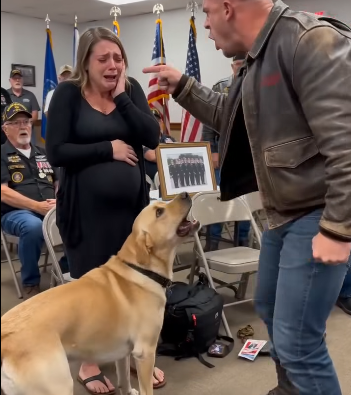
I was pregnant, holding the framed picture against my chest while my Labrador Duke sat by my feet.
The man told me I had no right to his benefits and called my baby a mistake in front of veterans who had known my husband.
I said the paperwork was already filed with the VA.
He slapped me, and the frame hit my collarbone before I caught it.
Duke roared up so fast the folding chairs scraped backward across the floor.
He slammed into the man’s backpack, knocking it off one shoulder and sending it across the VFW floor.
The zipper burst open beside my husband’s photo.
Out spilled old mail, a burner phone, and a folded condolence card I had never received.
The room went quiet in a way that felt heavier than shouting.
A veteran picked up the card and read my name on the envelope.
The man lunged for the burner phone, but Duke blocked him with his chest and a deep warning growl.
Then the phone lit up with a text that said:
Did she sign away the survivor benefits yet?
Nobody moved.
Not the bartender behind the folding table.
Not the women arranging cookies near the back wall.
Not the old Marines in ball caps who had been laughing fifteen minutes earlier over coffee and service stories.
Even the American flag near the stage seemed unnaturally still.
The man in the leather jacket froze with one hand stretched toward the phone.
Duke stood between him and the evidence, legs planted wide, head low, eyes locked on him.
I had seen Duke bark at delivery drivers.
I had seen him growl at raccoons near the trash cans.
But I had never seen him become a wall.
That was what he was now.
A golden wall between me and whatever truth had just fallen out of that backpack.
The veteran holding the condolence card was Mr. Whitaker, a retired Navy corpsman with a silver mustache and hands that shook only when he was angry. He looked from the envelope to me.
“Ma’am,” he said softly, “this is addressed to you.”
My fingers tightened around my husband’s picture.
My husband, Daniel Reeves, smiled from behind the glass in his dress uniform. The photo had been taken before our courthouse wedding, before Duke learned to sleep with his head on Daniel’s boots, before the pregnancy test turned positive on a rainy Tuesday morning.
Before the phone call that said Daniel was gone.
Before the flag.
Before the forms.
Before people I barely knew started speaking about my future like it was something they could divide on a table.
I swallowed.
“I never got that card.”
The man in the leather jacket snapped:
“She’s lying.”
Duke growled.
Mr. Whitaker turned his head slowly.
“Son, I would choose my next sentence carefully.”
The man’s jaw worked.
“I’m not your son.”
“No,” Mr. Whitaker said. “You’re not. Because my sons know better than to hit a pregnant widow in a VFW hall.”
A murmur moved through the room.
Pregnant widow.
The words wrapped around me like both armor and a wound.
The man stepped back.
His name, I had learned only minutes earlier, was Travis Cole. He had introduced himself as “someone who knew Daniel before you made him soft.” He had said it with a smirk, loud enough for three tables to hear.
At first, I thought he was just another bitter man from Daniel’s past.
Military circles had ghosts. Old friends. Old grudges. People who came to memorials carrying memories like loaded weapons.
But then he started asking about the benefits.
Not gently.
Not with concern.
With ownership.
He asked whether I had “already gotten to the VA.”
He asked who had helped me file.
He asked if Daniel had “really put a baby on the paperwork.”
Then he said my unborn child was a mistake that should not “eat from a dead man’s service.”
That was when I told him the paperwork was filed.
And that was when his hand moved.
Now the whole room knew he had not come to mourn.
He had come to make sure I signed something away.
The burner phone buzzed again.
Duke barked once.
Everyone flinched.
Mr. Whitaker bent carefully, picked up the phone with a napkin from the refreshment table, and read the screen without touching more than the edge.
His face changed.
“What does it say?” I asked.
He looked at me like he wished I did not need to hear it.
Then he read aloud:
“Don’t let her leave with the folder. If she refuses, tell her Daniel owed us.”
My stomach tightened.
“The folder?” I whispered.
I looked toward the table near the stage.
The memorial table.
Daniel’s photo had been there before I picked it up. Beside it were folded flags, a guest book, a vase of white carnations, and a blue folder someone had placed there before the ceremony began.
I had assumed it was part of the VFW program.
But now Mr. Whitaker followed my gaze.
So did everyone else.
The blue folder was gone.
A woman in the front row stood up so quickly her chair scraped the floor.
“That folder was here,” she said.
She was Captain Elise Monroe, retired Army, one of Daniel’s old mentors. She had hugged me when I arrived and told me Daniel used to talk about Duke like the dog was his commanding officer.
“I saw it,” she said. “It was on the table before Travis came in.”
Travis barked a laugh.
“Now I’m stealing folders too?”
Captain Monroe walked toward him.
Duke stayed between them, not moving.
“No,” she said. “Now you’re going to empty your pockets.”
Travis raised his hands.
“You have no authority over me.”
Mr. Whitaker held up the burner phone.
“Maybe not. But the Jacksonville police will enjoy this text.”
At the word police, Travis’s eyes flicked toward the side exit.
Just once.
But Duke saw it.
So did I.
So did every veteran in that room who had survived by noticing the direction of a man’s eyes before his feet moved.
Travis bolted.
He made it three steps.
Duke did not bite him.
He did something smarter.
He lunged sideways, hit the loose backpack with his front paws, and shoved it directly into Travis’s path.
Travis tripped over his own bag and slammed into a row of folding chairs. The chairs collapsed in a metallic crash, and three men moved at once.
Mr. Whitaker grabbed his arm.
Captain Monroe blocked the exit.
A younger veteran named Luis pulled the backpack away with his foot.
Duke planted himself in front of me again.
The whole thing lasted less than five seconds.
But by the time it ended, Travis was on the floor, furious and humiliated, with half the hall standing over him.
“Get this dog away from me!” he shouted.
Duke growled so low I felt it in my knees.
I put one hand on his collar.
“Duke.”
He did not look away from Travis, but he stopped growling.
That was my dog.
Fierce enough to stop a man.
Gentle enough to listen through rage.
Captain Monroe pulled out her phone.
“I’m calling it in.”
Travis spat:
“For what? A misunderstanding?”
Mr. Whitaker looked at the scattered mail on the floor.
“No. Assault, theft, intimidation, and whatever this phone leads to.”
The room shifted again.
Because the word theft made everyone look down.
Old mail.
Several envelopes.
A VA letter.
A bank notice.
A hospital bill with my name on it.
And the condolence card.
My condolence card.
Mr. Whitaker handed it to me carefully.
The envelope had been opened and resealed badly. My name was written in Daniel’s mother’s handwriting.
Mara Reeves.
Not Mara Cole.
Not “the girl Daniel married.”
Not “the pregnant one.”
My name.
My hands trembled as I opened it.
Inside was a simple card with white lilies on the front.
The printed message said something about sympathy and strength.
But tucked inside was a handwritten note.
Daniel’s mother, Ruth, had written it.
I recognized the careful loops from Christmas cards Daniel used to keep in a shoebox.
Mara,
I know I have not always been kind to you. I was wrong. Daniel chose you, and I should have trusted him. If the baby is his, then that baby is family. If you need help with the benefits paperwork, Daniel left copies with Mr. Whitaker at the VFW. Do not sign anything from Travis or Leonard. Daniel told me he was afraid they would try. I am sorry this is coming in a card instead of from my mouth. I am ashamed.
Ruth
My vision blurred.
I read the last line again.
Do not sign anything from Travis or Leonard.
Leonard.
Daniel’s older brother.
The one who had called me the night after the funeral and said he could “handle the complicated paperwork” if I gave him temporary authority.
The one who told me the VA would “make me prove the baby was Daniel’s unless the family backed me.”
The one who said Daniel had “private debts” I should not want public.
I had not signed.
Not because I was brave.
Because Duke had growled every time Leonard came near my front door.
I used to scold Duke for that.
Now I wanted to drop to the floor and apologize to him forever.
I looked up.
“Where is Leonard?”
The question cut through the room.
Travis stopped struggling.
For half a second, fear crossed his face.
Captain Monroe heard it.
“Who is Leonard?”
“My brother-in-law,” I said. “Daniel’s brother.”
Mr. Whitaker’s expression darkened.
“Leonard Reeves?”
I nodded.
Captain Monroe looked at him.
“You know him?”
“I know Daniel didn’t trust him.”
The room went colder.
A siren sounded faintly outside.
Travis twisted.
“You people don’t know anything. Daniel owed money. Leonard was just trying to keep the family name clean.”
“The family name?” I repeated.
My voice came out raw.
“I am carrying Daniel’s child.”
Travis glared at my belly.
“That’s what you say.”
Duke barked.
I stepped forward, still holding Daniel’s framed photo.
“No. That is what Daniel filed. That is what the doctor filed. That is what the marriage certificate says. That is what the VA paperwork says. And that is what every person in this room heard you try to steal.”
The siren got louder.
Travis looked toward the door again.
This time he did not run.
There was nowhere left to run inside a hall full of people who had just decided not to look away.
The police arrived within minutes.
Two officers came through the front entrance. Captain Monroe met them halfway and explained calmly, clearly, with the voice of someone who had given reports under pressure before.
I stood near the memorial table with Duke pressed against my leg, Daniel’s photo against my chest, and Ruth’s card in my hand.
One officer took my statement.
The other collected the burner phone, the backpack, the opened mail, and the condolence card as evidence.
When the officer reached for the card, I hesitated.
“It was meant for me,” I said.
He softened.
“We’ll photograph it and preserve it. You’ll get it back when we can release it.”
I nodded, but my fingers did not want to let go.
Because that card was more than evidence.
It was the first time anyone from Daniel’s family had admitted I belonged in the story.
The first time someone had warned me from inside the house that was trying to shut me out.
The officer asked if I needed medical attention.
I almost said no.
The word sat on my tongue out of habit.
No, I’m fine.
No, don’t make a fuss.
No, I can handle it.
Then Duke leaned his head against my belly.
And I remembered the sound of Daniel’s voice from the last voicemail he ever left me.
“Promise me you’ll stop being tough when you need to be safe.”
So I said:
“Yes. I’m pregnant. I want to be checked.”
Captain Monroe put a hand on my shoulder.
“I’ll drive you.”
The officer said they could call an ambulance.
I shook my head.
“I can walk.”
Duke stood immediately.
Captain Monroe smiled faintly.
“Looks like your escort is ready.”
As they led Travis out, he turned back at me.
“You think this makes you untouchable?”
The officer tightened his grip.
Duke stepped forward.
I lifted my chin.
“No,” I said. “It makes me done being alone.”
That shut him up.
At the hospital, they checked the baby first.
The monitor picked up the heartbeat quickly.
Strong.
Fast.
Alive.
I closed my eyes and cried into my hands while Duke lay under the chair, refusing to leave.
Captain Monroe stayed outside the curtain until I told her she could come in. She stood near the wall with her arms crossed, not mothering me, not pitying me, just present.
That felt like a kind of respect I had forgotten existed.
“Daniel talked about you,” she said after a while.
I wiped my face.
“He did?”
“All the time.”
I laughed weakly.
“He told me he didn’t talk about feelings at work.”
“He didn’t call them feelings. He called them logistics.”
For the first time that day, I smiled.
Captain Monroe’s face softened.
“He said you made him want a life with less running.”
The smile faded.
“He didn’t get it.”
“No,” she said quietly. “But he tried to build it.”
I looked down at my belly.
“He was scared about the baby.”
“He was scared he wouldn’t get enough time.”
That hit me hard.
Because Daniel had never said it that way.
He had joked about diaper duty and midnight feedings. He had asked whether newborns really needed that many tiny socks. He had built half the changing table before realizing the drawer was upside down.
But in the final weeks before his last assignment, he had become restless.
Protective.
Secretive.
He made copies of documents. He asked me where I kept my medical records. He told me not to sign anything from his family unless Mr. Whitaker looked at it first.
I thought grief had made me remember things darker than they were.
Now I knew.
Daniel had seen the storm before I did.
And he had tried to leave me anchors.
Duke.
Mr. Whitaker.
The paperwork.
The card.
Maybe even the blue folder.
“The folder,” I said suddenly.
Captain Monroe straightened.
“What?”
“The text mentioned a folder. It was on the memorial table. Then it was gone.”
She pulled out her phone.
“I’ll call Whitaker.”
Ten minutes later, she returned with a look I could not read.
“What?”
“They found it.”
“Where?”
“In the men’s restroom trash bin. Torn in half.”
I sat up too fast.
The monitor strap shifted.
The nurse frowned, but I barely noticed.
“What was inside?”
Captain Monroe looked toward the door.
“Copies of Daniel’s beneficiary forms. A letter to you. And a notarized statement.”
My throat closed.
“A statement saying what?”
She came closer.
“Saying Daniel knew you were pregnant, acknowledged the child as his, and wanted all survivor benefits and dependent claims handled through you as his legal spouse.”
I covered my mouth.
Captain Monroe’s voice tightened.
“He signed it two weeks before his last deployment.”
Daniel had known.
Not just suspected.
Not just hoped paperwork would be enough.
He had built a wall for me before anyone slapped me in front of his photo.
And someone had torn it in half and thrown it in a bathroom trash can.
“Leonard,” I whispered.
Captain Monroe did not answer.
She did not need to.
My phone rang then.
Unknown number.
Duke lifted his head.
The nurse looked at the screen.
“Do you want to answer?”
Every part of me said no.
But something in Duke’s posture changed. He did not growl. He stood, walked to my side, and stared at the phone.
I answered on speaker.
“Hello?”
A man breathed once.
Then:
“Mara.”
Leonard.
My hand turned cold.
Captain Monroe reached toward the call button, but I shook my head.
I wanted witnesses.
The nurse stayed.
Captain Monroe stayed.
Duke stood between the bed and the door.
Leonard’s voice came smooth, wounded, offended.
“I heard what happened at the hall. Travis acted emotionally. He shouldn’t have touched you.”
“Emotionally?” I repeated.
“I’m not defending him.”
“You sent him.”
Silence.
Then a sigh.
“Mara, you are grieving. You’re pregnant. People are telling you stories you don’t understand.”
The sentence was so familiar it almost made me laugh.
Every man who wanted control started by calling me confused.
“I understand the text,” I said.
“What text?”
“The one on the burner phone.”
Another silence.
Shorter this time.
Sharper.
“You went through his phone?”
“The police did.”
That word landed.
Police.
Leonard’s voice changed.
“Mara, listen to me. Whatever you think you found, it can be solved quietly. Daniel would not want his family dragged through mud.”
“Daniel left me a notarized statement.”
His breathing stopped.
Only for a second.
But everyone in the room heard it.
Captain Monroe’s eyes hardened.
Leonard said:
“You don’t know what Daniel owed.”
“I know what he gave.”
“He gave you too much power for someone he barely knew.”
I felt the baby move.
Something inside me steadied.
“He married me.”
“He was lonely.”
“He chose me.”
“He was manipulated.”
Duke growled.
Leonard heard it.
“Is that dog there?”
“Yes.”
His voice turned ugly.
“Daniel should have gotten rid of that animal years ago.”
I looked at Duke.
My loyal, watchful, beautiful dog, who had just stopped a man from stealing a phone full of evidence.
“No,” I said. “Daniel was right to trust him.”
Leonard exhaled sharply.
“You think a dog makes you safe?”
“No,” I said. “The truth does.”
Then I ended the call.
Captain Monroe immediately wrote down the number.
The nurse looked shaken.
“Do you want me to call hospital security?”
“Yes,” Captain Monroe and I said at the same time.
Duke wagged his tail once, as if approving the chain of command.
By evening, the story had grown beyond the VFW hall.
Leonard had not just wanted benefits.
He had been trying to force me into signing a “family assistance agreement” that would have given him authority to manage Daniel’s estate, survivor communications, and any funds connected to the baby until “paternity and eligibility were clarified.”
The words sounded official.
That was the trick.
Official enough to scare a grieving widow.
Vague enough to hide theft.
He had told Travis to pressure me at the memorial because he thought I would be too embarrassed to argue in front of Daniel’s friends.
He thought pregnancy would make me weak.
He thought grief would make me obedient.
He thought Duke was just a dog.
He was wrong about all three.
The police interviewed me at the hospital. Mr. Whitaker arrived with copies of everything he had salvaged from the blue folder. Daniel’s letter was wrinkled from the trash but readable.
I did not read it until I was alone.
Not completely alone.
Duke was there.
He climbed carefully onto the edge of the hospital bed only after I patted the blanket. He rested his head beside my thigh while I unfolded the paper.
Daniel’s handwriting was steady.
Mara,
If you are reading this, I was right to worry, and I hate that. First, breathe. Put your hand on Duke. He knows when you are scared, and he will help you remember you are not alone.
I did exactly what he wrote.
My hand found Duke’s fur.
Daniel continued:
Leonard believes service makes a man’s family entitled to what he leaves behind. He is wrong. You are my family. Our baby is my family. Duke too, though he would be impossible on a tax form.
I laughed through tears.
Duke lifted his eyes.
If anyone tells you I doubted the baby, they are lying. I kept the ultrasound picture in my wallet until it started wearing at the corners. I loved that little heartbeat before I knew whether it would be a son or daughter.
I pressed the letter to my mouth.
Do not sign anything under pressure. Do not let them make you feel greedy for accepting what I wanted you to have. Survivor benefits are not charity. They are a promise. I earned them loving a country that rarely knows the names of the people waiting at home. You waited. You loved me. You carried our child. You are not taking anything. You are receiving what I already chose for you.
By the time I reached the end, I could barely see.
And if Duke ever gets between you and someone from my family, trust Duke first. He always had better judgment than I did.
Love,
Daniel
I folded the letter and held it against my chest, beside his photo.
That was when I truly cried.
Not the startled sobs from the VFW hall.
Not the panicked tears from the hospital monitor.
These were deeper.
Older.
The kind of tears that come when love reaches you late but still reaches you.
The next morning, Leonard came to the hospital.
He did not make it past the lobby.
Hospital security stopped him. Captain Monroe had given them his name. The police were called. He claimed he was there to support his sister-in-law.
But Duke, who had been walking with me slowly down the hallway under the nurse’s supervision, saw him through the glass doors.
He stopped.
Every muscle in his body locked.
Leonard saw Duke.
Then he saw me.
For one second, the mask slipped.
There was no grieving brother there.
No concerned uncle.
Only rage.
Duke barked so sharply that two nurses turned.
Leonard took one step backward.
Security noticed.
One guard asked:
“Ma’am, is that the person you reported?”
I looked at Leonard through the glass.
He mouthed something.
I could not hear it.
I did not need to.
“Yes,” I said. “That’s him.”
Leonard was escorted out.
I did not feel powerful.
I felt protected.
There is a difference.
Power would have meant none of this could touch me.
Protection meant it tried, and people finally stood in the way.
Mr. Whitaker.
Captain Monroe.
The nurse.
The officer.
Duke.
Always Duke.
Weeks passed.
Travis was charged.
Leonard tried to deny everything until the burner phone records connected him to the texts. Then he claimed he had only wanted to “preserve family assets.” That phrase appeared in his lawyer’s statement, and I hated it so much I printed it out and wrote beside it:
My baby is not a family asset.
The VA paperwork continued.
Slowly.
Painfully.
With phone calls, signatures, copies, appointments, and moments where grief became bureaucracy and I wanted to scream.
But this time I was not alone.
Mr. Whitaker came with me to one appointment.
Captain Monroe helped me organize documents.
Daniel’s mother, Ruth, called me crying after she learned her card had been stolen.
I almost did not answer.
But Daniel’s letter had taught me that some people are late without being lost.
So I answered.
Ruth cried so hard she could barely speak.
“I should have come to you in person,” she said.
“Yes,” I replied.
“I was ashamed.”
“Yes.”
“I let Leonard make me afraid of my own grief.”
I said nothing.
She breathed shakily.
“I know I have no right to ask, but is the baby healthy?”
I looked down at my belly.
Duke’s head rested against it, as usual.
“Yes.”
Ruth sobbed.
“Daniel would have been so happy.”
That one broke me.
Because yes.
He would have been.
He would have painted the nursery badly and insisted it looked professional. He would have bought too many tiny socks. He would have trained Duke to bring diapers and then laughed when Duke brought the TV remote instead.
He would have been scared.
He would have been clumsy.
He would have been there.
But love does not vanish just because a person does.
Sometimes it stays in paperwork.
In letters.
In dogs who remember commands from men who are gone.
In old veterans who stand up when a room goes quiet.
My daughter was born six weeks after the VFW ceremony.
I named her Daniella Ruth Reeves.
Daniella for her father.
Ruth because forgiveness is not always immediate, but truth deserves a door if it knocks with both hands open.
When I brought her home, Duke met her at the door.
He did not jump.
He did not bark.
He sat down like a soldier waiting for inspection.
I lowered the car seat.
Duke leaned forward and sniffed her blanket.
Daniella made a tiny sound.
Duke looked up at me.
His eyes were soft.
As if he were saying:
This is what he wanted me to guard.
I knelt beside him, sore and exhausted and overflowing with a love so huge it almost frightened me.
“Yes,” I whispered. “This is her.”
Duke lay down in front of the car seat.
He stayed there all afternoon.
Months later, the VFW hall held another ceremony.
Not a memorial this time.
A fundraiser for families of fallen service members.
I almost did not go.
The memory of that room still lived in my body.
The folding chairs.
The slap.
The backpack hitting the floor.
The burner phone lighting up.
Daniel’s picture beside stolen mail.
But Mr. Whitaker called and said:
“Daniel’s table should not belong to what happened there. It should belong to him.”
So I went.
Daniella wore a white dress with tiny blue flowers. Duke wore his service vest, though I swear he carried himself like he did not need fabric to announce his importance.
The hall looked different.
Brighter.
The memorial table had been replaced by a family table. Daniel’s photo stood in the center, but this time beside it was a picture of Daniella wrapped in a yellow blanket, Duke lying next to her like a golden shield.
Ruth came too.
She stood near the entrance, uncertain, smaller than I remembered.
When she saw Daniella, her hand went to her mouth.
I walked toward her slowly.
Duke came with me.
Ruth looked down at him.
“I know,” she whispered. “I owe you an apology too.”
Duke sniffed her hand.
Then, after a long moment, he allowed her to touch his head.
Ruth cried.
I let her hold Daniella for the first time while Captain Monroe stood nearby and Mr. Whitaker pretended not to watch with wet eyes.
During the ceremony, Mr. Whitaker spoke.
He did not tell the whole story.
He did not need to.
He only said:
“Sometimes the people who protect a service member’s family are not the loudest in the room. Sometimes they are the ones who notice what falls, what is hidden, what is being taken. And sometimes they have four paws and better instincts than the rest of us.”
Everyone looked at Duke.
Duke yawned.
The room laughed.
I cried.
Afterward, I stood by Daniel’s photo holding Daniella. Duke sat at my feet, exactly where he had been the day everything broke open.
I looked at the picture of my husband.
For a moment, grief rose so sharply I could barely breathe.
Then Daniella wrapped her tiny fingers around the edge of my blouse.
And Duke leaned against my leg.
And I remembered Daniel’s letter.
Put your hand on Duke. He knows when you are scared.
So I did.
I placed my free hand on Duke’s head.
The fear eased.
Not gone.
But softer.
A woman I did not know came up to me after the ceremony. She wore a navy dress and held a folded tissue.
“Your husband served with my son,” she said. “He once told him, ‘If anything happens to me, make sure my wife knows she was never a footnote.’”
I closed my eyes.
A footnote.
That was what Leonard had tried to make me.
A small line after Daniel’s service.
A complication.
A pregnant widow with paperwork.
But Daniel had written me into the center.
And Duke had guarded the page.
That night, after I put Daniella to sleep, I opened the memory box where I kept Daniel’s letter, Ruth’s condolence card, the ultrasound photo, and Duke’s old collar tag.
The burner phone was still evidence.
The backpack was still held by the police.
But I did not need those things to remember.
I had the sound of the VFW hall going silent.
I had Mr. Whitaker reading my name.
I had Duke standing over the phone while a text exposed the truth.
I had Daniel’s words.
And I had my daughter.
People later asked if Duke attacked Travis.
I always tell them no.
Duke did not attack.
Duke revealed.
He knocked loose what a man tried to carry away.
He blocked what a man tried to grab.
He stood between violence and a pregnant woman holding her husband’s photo.
That was not aggression.
That was loyalty with a body.
And if Daniel had been there, I know exactly what he would have done.
He would have knelt, put both hands on Duke’s face, and whispered:
“Good boy. You took care of them.”
So I say it for him every night.
When the house is quiet, when Daniella is asleep, when the benefits letters are filed away and the world finally stops asking me to prove what Daniel already knew, I sit beside Duke on the living room floor.
His muzzle has a little more white now.
His eyes still follow every sound.
I touch his head and whisper:
“You took care of us.”
Duke sighs.
Daniella sleeps.
Daniel’s photo watches from the shelf.
And the backpack that fell beside it no longer feels like the moment my life broke.
It feels like the moment the truth finally hit the floor where everyone could see it.
