Part 1
The tray slipped from my hands right before everything exploded.
I was six months pregnant, wearing a faded blue drive-in uniform that barely buttoned over my stomach, and trying to survive the lunch rush without crying.
Cars filled every stall.
Engines hummed.
Kids shouted from back seats.
The kitchen bell kept ringing like an alarm.
Order up.
Order up.
Order up.
I had been running food for almost four hours without a real break. My ankles were swollen, my back ached, and the baby had been kicking all morning like she knew something was wrong.
Then stall fourteen got the wrong burger.
It was supposed to be no onions, extra pickles.
I gave them onions and no pickles.
A simple mistake.
A fixable mistake.
I apologized immediately.
“I’m so sorry,” I told the woman in the minivan. “I’ll get this corrected right away.”
She wasn’t even angry.
“Take your time, honey,” she said, glancing at my belly. “You look like you’re carrying the whole restaurant by yourself.”
I gave her a tired smile.
“I kind of am.”
I turned toward the kitchen.
That was when Earl came storming outside.
Earl Bennett.
Owner of Bennett’s Drive-In.
Local businessman.
Church donor.
Man who kept a framed newspaper article about himself by the register.
And the reason half the staff had quit in the past three months.
“What did you do now, Nora?” he shouted.
The entire parking lot seemed to pause.
I stopped near the service window, replacement ticket in my hand.
“It was just one wrong burger,” I said quietly. “I’m fixing it.”
“You’re fixing it?” Earl snapped. “Do you know how much food costs?”
I looked toward the cars.
People were watching.
Windows rolled down.
A teenager in stall nine lifted his phone.
I lowered my voice.
“Earl, please. I said I’ll correct it.”
He stepped closer.
“You are supposed to read the ticket. That is the job. A child could do it.”
My cheeks burned.
I was exhausted.
Hungry.
Pregnant.
And suddenly very aware that everyone in the parking lot could hear him.
“I’m covering two sections by myself,” I said. “Mia called out, and you didn’t schedule anyone else.”
His face darkened.
“Excuses cost me money.”
I took a breath and turned away before I said something that would get me fired.
The cook slid the corrected order into the window.
I picked up the tray.
Burger.
Fries.
Two drinks.
Smile.
Keep walking.
Just make it through the day.
But Earl followed me.
Across the pavement.
Past stall six.
Past the old neon sign.
Past customers who had gone silent inside their cars.
“Nora!” he barked.
I stopped.
“Please don’t do this,” I said, my voice shaking. “Not in front of customers.”
That made him furious.
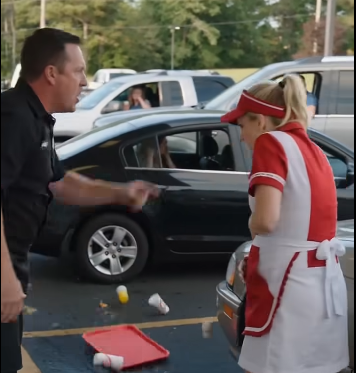
His hand shot out.
He grabbed the tray from me.
The drinks tipped.
Ice and soda splashed across the pavement.
Then his palm cracked across my face.
The sound carried through the lot.
For half a second, there was no noise at all.
No engines.
No kitchen bell.
No voices.
Just the burning sting on my cheek and the sudden terror that ran through my body.
I stumbled backward and grabbed my stomach.
The baby kicked once.
Hard.
A woman screamed.
Someone honked.
Then another horn blared.
Then another.
The entire parking lot erupted.
Earl froze with the tray still in his hand.
His face shifted from rage to panic.
“What?” he snapped, looking around. “What are you all staring at?”
That was when a man stepped out of a black pickup truck near stall twelve.
He wore jeans, work boots, and a gray T-shirt. His phone was raised in one hand, camera pointed straight at Earl.
His voice cut across the chaos.
“You should probably know your entire parking lot just watched that live.”
Earl’s mouth opened.
“What?”
The man glanced at his phone.
“Three thousand people and climbing.”
A ripple moved through the customers.
More phones appeared.
The woman from the minivan stepped out.
“She’s pregnant!” she shouted. “You hit a pregnant employee!”
Earl backed up.
“I didn’t hit her. She stumbled.”
The pickup truck man laughed coldly.
“I have the video.”
My cheek throbbed.
My stomach tightened.
I tried to breathe, but the air felt too thin.
The man from the pickup walked toward me carefully.
“Ma’am, are you okay?”
I wanted to say yes.
That was what I always said.
Yes, I’m fine.
Yes, I can work late.
Yes, I can cover another shift.
Yes, I can wait until payday.
Yes, I can handle it.
But my hand was on my stomach, my face was burning, and my boss had just hit me in front of a parking lot full of strangers.
“No,” I whispered. “I don’t think I am.”
The man turned toward a woman in the next car.
“Call 911.”
“Already did,” she said.
Earl’s panic sharpened.
“No one is calling the police. This is private property.”
The pickup man stepped between us.
“You made it public when you slapped her in front of everyone.”
Earl pointed at him.
“You don’t know who I am.”
The man lowered his phone slightly.
“No,” he said. “But I know who I am.”
Earl scoffed.
“Congratulations.”
The man reached into his back pocket and pulled out a badge.
The parking lot went still again.
“I’m Deputy Caleb Ross,” he said. “And you just assaulted a pregnant woman on a livestream.”
Earl’s face drained of color.
My knees weakened.
Deputy Ross turned to me.
“Ma’am, what’s your name?”
“Nora,” I said. “Nora Wells.”
His expression changed slightly.
“Wells?”
I nodded.
Before he could say anything else, another car door opened.
An elderly woman stepped out of a white sedan in stall three.
She had silver hair, pearl earrings, and a cane in one hand.
I recognized her immediately.
Everyone in town did.
Margaret Bennett.
Earl’s mother.
The woman whose late husband had founded the drive-in.
The woman Earl claimed had given him full ownership years ago.
She stared at him with horror.
Then she looked at me.
Then my cheek.
Her hand tightened around her cane.
“Earl,” she said, her voice shaking. “What have you done?”
Earl swallowed.
“Mom, get back in the car.”
“No.”
His eyes flashed.
“I said get back in the car.”
Margaret lifted her chin.
For the first time since I had worked there, Earl looked afraid of someone.
She slowly reached into her purse and pulled out a folded envelope.
“I came here today to give you one last chance,” she said. “But I suppose the whole town may as well hear it now.”
Earl stepped toward her.
“Don’t.”
Deputy Ross blocked him.
Margaret opened the envelope.
“My son does not own Bennett’s Drive-In,” she said loudly.
Every customer stared.
Every phone stayed raised.
Margaret looked directly at me.
“Nora Wells does.”
Part 2
For a moment, I thought I had misheard her.
The horns stopped.
The whispers stopped.
Even Earl stopped breathing.
I stared at Margaret Bennett, my hand still pressed to my stomach.
“What did you say?” I whispered.
Margaret’s eyes softened.
“Nora, your grandmother was Lillian Wells, wasn’t she?”
My throat tightened.
“Yes.”
My grandmother had died when I was fourteen.
She used to bring me to Bennett’s Drive-In every Friday night. We would split a strawberry milkshake and sit under the neon sign while she told me stories about the town when it was still small enough for everyone to know everyone’s dog by name.
Margaret took a careful step forward.
“My husband and your grandmother started this place together.”
Earl exploded.
“That is not true!”
Margaret turned on him.
“It is true. And you know it.”
My head spun.
“No,” I said. “My grandma was a waitress.”
Margaret smiled sadly.
“That is what people were allowed to call her. But she gave my husband half the money to open this place. She designed the first menu. She made the chili recipe. She worked every day for ten years without her name on the sign because back then, a Black woman and a white man owning a business together in this town would have caused trouble neither of them could afford.”
The parking lot went silent in a different way now.
Heavy.
Ashamed.
Earl’s face twisted.
“This is family business.”
Margaret snapped, “No. This is theft.”
My heart hammered.
Deputy Ross looked at me carefully.
“Nora, do you need to sit down?”
I nodded because the world was tilting.
The woman from the minivan rushed over and helped me into a chair near the outdoor tables.
Someone brought water.
Someone else brought napkins for the soda soaking into my shoes.
I barely noticed.
Margaret stood in front of Earl with the envelope in her shaking hand.
“My husband left instructions,” she said. “After Lillian died, her share was supposed to pass to her only living descendant.”
Me.
My breath caught.
Earl laughed, but it sounded desperate.
“You’re confused. Dad left the restaurant to me.”
Margaret’s eyes filled with tears.
“Your father left you management authority. Not ownership. You hid the documents. You pressured me to sign papers I did not understand. You told me I was too old to handle business matters.”
Earl’s eyes darted to the phones.
“Mom. Stop.”
“No,” she said. “I should have stopped you years ago.”
Deputy Ross took a step closer.
“Mrs. Bennett, are those legal documents?”
“Yes,” Margaret said. “Copies. The originals are with my attorney.”
Earl’s face changed.
That was when I saw it.
The same look he had when he slapped me.
Not guilt.
Not shame.
Anger that he had been exposed.
He turned toward me.
“You,” he hissed.
Deputy Ross moved between us.
“Careful.”
Earl ignored him.
“You think you can take my restaurant?”
I stared at him, stunned.
“I didn’t even know.”
“You knew enough to play helpless,” he snapped.
The baby kicked again.
I flinched and gripped the chair.
Deputy Ross noticed immediately.
“Nora?”
“My stomach hurts,” I admitted.
That shifted everything.
The woman from the minivan shouted, “Where’s the ambulance?”
Sirens sounded in the distance.
Earl looked around, trapped by witnesses, phones, and his mother’s documents.
Then he tried one final performance.
His face softened.
“Nora,” he said, voice suddenly gentle. “This has gotten out of hand. I was stressed. You know how busy lunch rush gets.”
I stared at him.
For months, I had feared this man.
He cut my hours when I asked for breaks.
He mocked my pregnancy.
He made me carry heavy trays while younger employees stood inside.
He told me I should be grateful he hired “someone in my condition.”
And now, with cameras on him, he wanted to sound kind.
“You hit me,” I said.
His jaw clenched.
“I barely touched you.”
The pickup truck man, Deputy Ross, lifted his phone again.
“The video says otherwise.”
An ambulance pulled into the lot.
Two paramedics climbed out.
As they reached me, Earl’s expression hardened again.
“This is ridiculous. She’s still on the clock.”
The entire parking lot erupted.
“Are you kidding me?”
“Fire him!”
“She owns the place!”
“Someone get him away from her!”
Deputy Ross turned sharply.
“Earl Bennett, step back.”
Earl raised his hands.
“I’m not doing anything.”
“You’re interfering with medical care.”
The paramedic crouched beside me.
“Nora, how far along are you?”
“Six months.”
“Any bleeding?”
“No.”
“Pain?”
“Yes. Tightness.”
“We’re going to take you in and check on the baby.”
I nodded, tears slipping down my face.
Not because of the pain.
Because I was scared.
Because I was tired.
Because for years, I had believed life happened to me and all I could do was survive it.
Now strangers were looking at me like I mattered.
Margaret reached for my hand.
“I’m so sorry,” she whispered.
I looked at her.
“Did my grandmother know?”
Her face broke.
“Yes. But she trusted my husband. And he did right by her in the will. I failed her by letting Earl bury the truth.”
Before I could answer, the paramedics helped me onto the stretcher.
Deputy Ross walked beside us.
“I’ll follow to the hospital and take your statement when you’re ready.”
Earl barked a bitter laugh.
“Oh, now you’re her hero?”
Deputy Ross stopped.
He looked back at Earl.
“No. I’m a witness.”
Then Margaret lifted her cane and pointed at her son.
“And I am done being silent.”
As the ambulance doors closed, I saw Earl standing alone in the middle of the parking lot, surrounded by customers, cameras, and the ruins of the kingdom he thought he owned.
For the first time since I had started working at Bennett’s Drive-In, he looked small.
Part 3
At the hospital, the nurses moved quickly.
A monitor was strapped around my stomach.
Another cuff squeezed my arm.
A doctor asked me questions while a nurse examined the red mark blooming across my cheek.
The baby’s heartbeat filled the room.
Fast.
Steady.
Alive.
I closed my eyes and cried.
The nurse squeezed my hand.
“That’s a strong heartbeat.”
I whispered, “Thank God.”
Deputy Ross waited outside until the doctor cleared him to come in.
He entered without his hat, holding a small notebook in one hand and a paper cup of water in the other.
“I can come back later,” he said.
“No,” I said. “I want to get it over with.”
He nodded and pulled a chair beside the bed.
He was careful with his questions.
What happened before the slap?
Had Earl ever threatened me?
Had he denied breaks?
Had he made me do unsafe tasks during pregnancy?
At first, I answered like an employee afraid of getting in trouble.
Then I remembered I might own the place.
The thought was so absurd I almost laughed.
“I don’t know how to explain it,” I said. “He never called it punishment. But if I asked for anything, he made sure I suffered for it later.”
Deputy Ross wrote that down.
“What kind of things?”
“If I asked to sit, he gave me extra outside stalls. If I asked not to lift crates, he said pregnancy wasn’t a disability. If I had a doctor appointment, he cut my hours the next week.”
His jaw tightened.
“Any witnesses?”
“Everyone who works there.”
“Would they speak up?”
I thought of Rosa in the kitchen, who sent money to her mother every month.
I thought of Eli, the seventeen-year-old dishwasher who needed the job to help his little brothers.
I thought of April, who had quit after Earl screamed at her until she threw up in the bathroom.
“I don’t know,” I said.
Deputy Ross looked at me.
“People are braver when they know they aren’t alone.”
After he left, my phone would not stop buzzing.
The video had spread.
Local pages.
Town groups.
A regional news station.
The caption was everywhere:
PREGNANT WAITRESS SLAPPED BY DRIVE-IN OWNER DURING LUNCH RUSH.
I hated seeing myself like that.
Stumbling.
Humiliated.
One hand wrapped around my stomach.
But beneath the video, people were talking.
Former employees.
I worked there in 2021. He did this to everyone.
He made my sister work with a fever.
He kept tips.
He fired me for asking about overtime.
My hands shook as I scrolled.
Earl had not only hurt me.
He had built a business on making people too afraid to speak.
A soft knock came at the door.
Margaret Bennett stood there with a lawyer.
The lawyer was a tall woman with silver glasses and a leather briefcase.
“Nora,” Margaret said gently. “This is Elaine Porter. She represents me. And possibly you, if you’ll allow it.”
I sat up slightly.
“I don’t understand what’s happening.”
Elaine gave me a kind but direct look.
“That is understandable. You were assaulted, hospitalized, and informed of a major ownership issue in the same hour.”
I almost smiled.
“When you say it like that, it sounds dramatic.”
“It is dramatic,” Elaine said. “But it is also documentable.”
She opened her briefcase and pulled out copies.
The paperwork looked old.
Some pages were yellowed.
Some were newly printed.
There was a partnership agreement from 1979.
Arthur Bennett and Lillian Wells.
Fifty-fifty.
My grandmother’s signature sat at the bottom.
Lillian Mae Wells.
I touched her name.
A memory rose in me.
Grandma Lillian wiping ketchup from my fingers.
Grandma Lillian humming while she cooked.
Grandma Lillian telling me, “Never let anybody make you feel lucky to be mistreated.”
I swallowed hard.
“She never told me.”
Margaret sat beside my bed.
“She wanted to. I think she was waiting until you were older. Then she got sick so quickly.”
Elaine continued.
“The original agreement gave Arthur management authority because, at the time, his name was safer on the public paperwork. But Lillian retained half ownership. Arthur’s final will acknowledged that and instructed that her share pass to her legal heir.”
“Me,” I whispered.
Elaine nodded.
“Earl appears to have concealed this information and transferred operational control to himself through questionable documents signed by Margaret under pressure.”
Margaret looked ashamed.
“He told me if I questioned him, the restaurant would close and everyone would lose their jobs.”
Elaine touched her arm.
“Coercion works by making the victim feel responsible for the abuser’s choices.”
Victim.
I looked at Margaret.
Then at myself.
The word fit in more than one direction.
“What happens now?” I asked.
Elaine adjusted her glasses.
“First, you rest. Second, we file an emergency petition to freeze business accounts and prevent Earl from destroying records. Third, we cooperate with law enforcement regarding the assault and possible fraud.”
I placed a hand over my stomach.
“And the restaurant?”
Elaine’s eyes softened.
“That depends partly on what you want.”
I laughed weakly.
“I’m a waitress. I don’t know how to own a restaurant.”
Margaret leaned forward.
“Your grandmother did.”
Those words settled deep in my chest.
After they left, I slept for almost three hours.
When I woke, Rosa was sitting beside my bed.
Her kitchen apron was still dusted with flour.
“You scared us,” she said.
I blinked.
“How did you get here?”
“Eli drove. Badly.”
A laugh slipped out of me.
Then Rosa’s eyes filled.
“I should have said something sooner.”
“About Earl?”
She nodded.
“He told us if anyone complained, he’d call immigration on my cousin. My cousin is legal, but Earl knew the threat was enough.”
Anger burned through my exhaustion.
“That man is evil.”
“He is scared now,” Rosa said. “That is different.”
“What’s happening there?”
She sat straighter.
“After ambulance left, Earl tried to go into office. Deputy stopped him. Then Mrs. Bennett locked front door and said kitchen closed until further notice. Customers cheered.”
I stared at her.
“Customers cheered?”
“Very loud. One man started chanting, ‘Pay the staff.’”
Despite everything, I laughed.
Rosa smiled.
Then she reached into her bag and pulled out a folded piece of paper.
“We made list.”
“What list?”
“Everything Earl did. Everyone signed.”
My throat tightened.
She placed it in my lap.
There were names.
So many names.
Rosa.
Eli.
April.
Terrence.
Mia.
Jules.
People I knew.
People who had left.
People I thought had simply moved on.
Under each name were notes.
Unpaid overtime.
Stolen tips.
Denied breaks.
Threats.
Unsafe conditions.
I covered my mouth.
Rosa said softly, “You were not alone, Nora.”
The baby kicked.
I pressed the paper against my heart.
For the first time all day, I did not feel like the woman who had been slapped in a parking lot.
I felt like the first crack in a wall that had needed to fall for years.
Part 4
Earl was arrested that evening.
Not dramatically.
Not with a chase.
Just Deputy Ross walking into Bennett’s Drive-In with another officer while Earl sat in the office shredding documents.
The livestream had made him infamous.
The shredded papers made him interesting to investigators.
By morning, reporters were outside the hospital.
Elaine handled them with the calm precision of a woman who had ruined many arrogant men before breakfast.
“Nora will not be making a statement today,” she told them. “She is focused on her health and the health of her unborn child.”
Then she turned around and said to me, “Do not read comments.”
“I already did.”
“Stop.”
I tried.
I failed.
Some people were kind.
Some were cruel.
But one comment made me freeze.
My mother worked with Lillian Wells. Everybody knew Bennett’s should have been called Wells & Bennett. Earl’s dad wasn’t the problem. Earl was.
I clicked the profile.
The woman who posted it was named Denise Carter.
She was in her seventies.
I showed Elaine.
Within an hour, Elaine had called her.
Within two days, three elderly former employees came forward.
They remembered my grandmother.
They remembered the partnership.
They remembered the day Lillian’s name was supposed to go on the sign, and how threats from local men made Arthur and Lillian decide to keep it quiet for safety.
One man, Mr. Howard, brought an old photograph.
He visited me at Tessa’s apartment after I was discharged.
In the photo, my grandmother stood in front of the drive-in in 1980.
She was young, beautiful, proud.
Arthur Bennett stood beside her.
Between them was a temporary paper sign taped inside the front window.
WELLS & BENNETT DRIVE-IN.
I stared at the photo until tears fell onto my shirt.
“She was real,” I whispered.
Mr. Howard frowned gently.
“Of course she was.”
“No,” I said. “I mean this part of her. The part that built something.”
He nodded.
“People tried to make women like Lillian smaller than they were. Didn’t work, though. Not really.”
I looked at the photo again.
My grandmother had owned half of a restaurant.
And I had been working there for minimum wage while Earl called me replaceable.
Something hard and bright formed inside me.
Not rage exactly.
Resolve.
The emergency court hearing happened a week later.
I attended by video from Elaine’s office because my doctor ordered limited activity.
Earl appeared on screen from another room with his attorney beside him.
His cheek was clean.
His suit was pressed.
His expression was wounded.
I hated how familiar that look had become.
His attorney argued that the assault was “an unfortunate moment of stress” and that Margaret was confused due to age.
Margaret sat beside Elaine and lifted her chin.
“I am old,” she said. “Not confused.”
The judge reviewed the documents.
Elaine presented the partnership agreement, Arthur’s will, witness statements, the staff list, and evidence that Earl had attempted to destroy records.
The judge froze the business accounts.
Removed Earl from operational control.
Ordered a forensic accounting review.
And appointed a temporary administrator.
Then he said the sentence that made me grip Elaine’s hand under the table.
“Based on the documents presented, Ms. Nora Wells appears to have a substantial ownership claim.”
Earl slammed his hand on the table.
“This is insane!”
The judge looked over his glasses.
“Mr. Bennett, raising your voice will not improve your legal position.”
Earl pointed at the camera.
“She’s a waitress!”
I flinched.
Then I leaned closer to my screen.
“So was my grandmother.”
The room went silent.
Earl’s face twisted.
For once, I did not look away.
After the hearing, Elaine smiled.
“That was well said.”
“My knees are shaking.”
“You were sitting down.”
“Emotionally.”
She laughed.
The next few weeks became a storm of paperwork and doctor appointments.
I moved in with Tessa temporarily because Earl knew where I lived. My brother Marcus came from two states away and installed extra locks, cameras, and a porch light so bright it could interrogate raccoons.
“You should have called me sooner,” he said.
“I didn’t know how bad it was.”
He crouched in front of me.
“Nora, you were six months pregnant working double sections for a man who screamed at you.”
I looked down.
Marcus sighed.
“I’m not blaming you.”
“I know.”
“I’m blaming the people who taught you surviving quietly was safer than asking for help.”
That one hurt.
Because it was true.
When our mother died, I became the steady one.
The one who managed.
The one who did not need much.
The one who said, “I’m okay,” because people believed it, and belief made fewer problems.
But my daughter kicked inside me like she objected to the entire arrangement.
I rubbed my stomach.
“I don’t want her to learn that.”
Marcus’s face softened.
“Then she won’t.”
One afternoon, Deputy Ross came by with an update.
Earl was facing assault charges, labor investigations, and possible financial crimes connected to the restaurant.
He stood awkwardly in Tessa’s living room, hat in his hands.
“I also wanted to say something off the record,” he said.
Tessa narrowed her eyes.
“Off the record good or off the record annoying?”
He smiled faintly.
“Good, I hope.”
I nodded.
He looked at me.
“When I started that livestream, I was reviewing the drive-in for my brother’s food blog. I didn’t expect to record what happened. But I’m glad I did.”
“So am I,” I said quietly.
His expression softened.
“And about your last name. Wells. My mother knew your grandmother. She said Lillian once gave her free meals for a month when my dad got hurt and couldn’t work.”
My eyes filled.
“She did?”
He nodded.
“Mom said Lillian never let hungry people leave hungry.”
That sounded like her.
Deputy Ross smiled.
“She’d probably be proud of you.”
I looked down at my stomach.
“I’m not sure I’ve done anything yet.”
“You told the truth while scared,” he said. “That counts.”
After he left, Tessa sat beside me with two bowls of ice cream.
“You know he likes you.”
I nearly choked.
“He is a deputy involved in my case.”
“He is also tall.”
“Tessa.”
“And respectful.”
“I am pregnant, traumatized, and legally entangled with a drive-in.”
“All true. Still tall.”
I laughed so hard my stomach hurt.
For the first time in weeks, the pain had nothing to do with fear.
Part 5
The first time I returned to Bennett’s Drive-In, the neon sign was off.
The lot was empty.
No customers.
No trays.
No Earl shouting from the office.
Just faded paint, cracked pavement, and the ghost of every shift I had survived.
Margaret met me at the entrance with Elaine and the temporary administrator, Mr. Shaw.
Rosa stood by the kitchen door.
Eli peeked from behind her.
“You don’t have to go in,” Tessa whispered beside me.
“Yes,” I said. “I do.”
Inside, everything looked the same and completely different.
The red stools at the counter.
The chrome napkin holders.
The old jukebox.
The framed newspaper article about Earl.
I walked straight to it.
LOCAL OWNER EARL BENNETT KEEPS FAMILY LEGACY ALIVE.
I lifted it off the wall.
Eli whispered, “Should we burn it?”
Rosa smacked his arm.
“No burning. Evidence.”
I handed it to Elaine.
“Evidence,” I agreed.
In the office, investigators had already boxed Earl’s files.
The desk was scratched.
The cabinet lock was broken.
The shredder sat unplugged in the corner like a guilty animal.
Mr. Shaw opened a folder.
“We have enough preliminary findings to say Earl diverted funds, underreported payroll, and used business accounts for personal expenses.”
Margaret closed her eyes.
“How much?”
“We don’t know yet.”
I looked around the office.
It smelled like stale coffee and old power.
On the wall behind the desk was another photograph.
Arthur Bennett.
Earl.
Margaret.
No Lillian.
I stared at the blank space where my grandmother should have been.
“Where are the old photos?” I asked.
Margaret’s eyes opened.
“What old photos?”
“The ones with my grandmother.”
Rosa snapped her fingers.
“Basement.”
Everyone turned to her.
She shrugged.
“Earl put many boxes down there when he remodeled. Said old junk made place look poor.”
We found them beneath the building, behind cleaning supplies and broken patio umbrellas.
Dusty boxes.
Water-stained albums.
Rolled posters.
And there she was.
Lillian Wells.
In a red apron.
Laughing beside the grill.
Holding a giant ribbon from opening day.
Standing beside Arthur in front of a crowd.
My grandmother had not been hidden by time.
She had been hidden by choice.
I sat on an overturned crate and cried.
Margaret sat beside me.
“I let him erase her,” she whispered.
“You were afraid of him too.”
She nodded.
“That does not make it right.”
“No,” I said. “But it means I understand.”
We spent hours sorting photos.
By the end, my back ached and Tessa forced me into a chair with lemonade.
Mr. Shaw reviewed the staff structure.
“Reopening will take time. There are safety issues, payroll issues, vendor problems, reputation damage—”
“Good,” Rosa said.
He blinked.
“Good?”
She crossed her arms.
“We fix all of it. Not just open doors and pretend.”
Rosa looked at me.
“No more unpaid breaks. No more stolen tips. No more pregnant women carrying two sections alone.”
My throat tightened.
“You want to come back?”
Rosa gave me a look.
“This kitchen has my sweat in the walls. Earl does not get to be the ending.”
Eli raised his hand.
“I’ll come back if we get new uniforms. These make me look like a sad gas station.”
Tessa nodded solemnly.
“He’s right.”
For the first time, I saw it.
Not the restaurant Earl controlled.
Not the place I was humiliated.
Something older.
Something my grandmother helped build.
Something worth saving if we changed what it stood for.
“What if we don’t call it Bennett’s anymore?” I asked.
Margaret’s eyes filled.
Rosa smiled slowly.
Elaine tilted her head.
“What name are you considering?”
I looked at the old photo in my hands.
My grandmother smiling under the original paper sign.
“Wells & Bennett,” I said. “The name it should have had.”
Margaret covered her mouth and cried.
The legal process took months.
Earl fought everything.
He claimed Margaret was manipulated.
He claimed I was greedy.
He claimed the livestream had ruined him before the facts came out.
But facts kept coming.
The forensic accountant found hidden transfers.
The labor department found wage violations.
Former employees testified.
Customers who witnessed the slap signed statements.
And one afternoon, Elaine called with the news.
“The court has confirmed your ownership interest.”
I sat down slowly.
“What does that mean?”
“It means you own your grandmother’s share. Margaret is transferring her remaining interest into a trust that removes Earl entirely. Operational control will be yours and a board until you decide long-term management.”
I stared at Tessa across the kitchen.
She mouthed, What?
I whispered, “I think I own a restaurant.”
Tessa screamed so loudly Marcus came running from the porch with a screwdriver.
“What happened?”
“I own a restaurant,” I said.
He stared.
Then he sat down.
“Grandma Lillian was not playing around.”
No, I thought.
She wasn’t.
That night, I dreamed of her.
She stood beneath the neon sign, wearing her red apron.
“You hungry, baby?” she asked.
I cried in the dream.
“I don’t know how to do this.”
She smiled.
“You learn. Then you feed people.”
When I woke, my pillow was wet.
My daughter kicked softly beneath my hand.
“I’ll learn,” I whispered.
Part 6
My daughter was born three weeks before the reopening.
She arrived at dawn, pink and furious, with a cry loud enough to silence every fear in the room.
Tessa was on one side of me.
Marcus on the other.
Margaret waited outside with Rosa, Eli, and a balloon shaped like a hamburger because Eli said regular balloons lacked branding.
When the nurse placed my baby on my chest, I forgot every legal document, every headline, every courtroom.
There was only her.
Tiny fists.
Dark hair.
Warm skin.
My heart outside my body.
“What’s her name?” the nurse asked.
I looked down at her.
For months, I had been thinking of names.
Grace.
Maya.
Lillian.
But one name had stayed with me after all the chaos.
“Ruby,” I whispered.
Tessa smiled.
“Ruby Wells.”
I nodded.
“Ruby Lillian Wells.”
Margaret cried when I told her.
“She would have loved that.”
I looked at my daughter.
“I hope so.”
Two days later, a flower arrangement arrived at the hospital.
No card.
Just red roses.
My stomach turned cold.
Tessa called the nurse.
Elaine called the jail.
Earl had sent them through his attorney’s office.
The message arrived later.
Congratulations. I hope motherhood teaches you humility.
Marcus wanted to drive to the jail and “teach Earl architecture with a brick.”
Elaine advised against that.
Deputy Ross came by after his shift to take the report.
He stood near the door, careful not to crowd the room.
“No contact order includes third-party harassment,” he said. “We’ll document it.”
Ruby slept against my chest.
I looked at the roses.
“Throw them away.”
Tessa picked them up like they were radioactive.
“With pleasure.”
Deputy Ross glanced at Ruby.
“She’s beautiful.”
“Thank you.”
He smiled.
“Strong lungs?”
“Terrifying lungs.”
“Good.”
There was a pause.
A soft one.
Not awkward.
Just new.
Then he said, “My mother sent something for you.”
He placed a small paper bag on the table.
Inside was a baby blanket.
Handmade.
Yellow and white.
A note tucked inside read:
Lillian fed my family when we had nothing. Let this keep her great-grandbaby warm.
I cried harder over that blanket than I had over the restaurant.
Because the world had been holding pieces of my grandmother all along.
I just had to find them.
The reopening of Wells & Bennett happened on a Saturday in June.
Ruby was three weeks old, strapped against my chest in a soft carrier, wearing tiny red socks.
The new sign had gone up the day before.
WELLS & BENNETT DRIVE-IN.
Underneath, in smaller letters:
FOUNDED BY LILLIAN WELLS AND ARTHUR BENNETT.
Margaret stood beside me with trembling hands.
Rosa wore a new uniform and declared the kitchen “finally free of Earl’s bad vibes.”
Eli got his redesigned uniform and immediately complained that he looked “too professional now.”
Former employees came.
Customers came.
Reporters came.
The woman from the minivan came with her children and hugged me carefully.
“You look better,” she said.
“I am better.”
Before opening, I stood in front of the crowd with a microphone.
My hands shook.
Ruby slept through everything.
I looked at the faces in front of me.
Some had watched me get slapped.
Some had helped me.
Some had known my grandmother.
Some just came for burgers.
All of them were part of the story now.
“My grandmother, Lillian Wells, helped build this place,” I said. “For a long time, her name was missing from the sign. Today, it isn’t.”
Applause broke out.
I waited until it faded.
“This restaurant will not be run on fear. Every employee will be paid fairly. Tips will belong to the staff. Pregnant workers will sit when they need to sit. Sick workers will go home. Mistakes will be fixed without humiliation.”
Rosa shouted, “Amen.”
People laughed.
My voice trembled.
“A wrong burger should never cost someone their dignity.”
The crowd went quiet.
I touched Ruby’s back.
“So welcome to Wells & Bennett. We’re glad you’re here. Please be patient with us today. Half of us are crying and the other half are pretending not to.”
That got a laugh.
Margaret cut the ribbon.
The neon sign flickered on.
And for the first time in decades, my grandmother’s name glowed over the parking lot.
The lunch rush was chaos.
Beautiful chaos.
Orders piled up.
A kid spilled a milkshake.
Eli dropped an entire tray of fries and froze in terror.
Everyone went quiet for half a second.
The old fear.
The Earl fear.
I walked over.
Eli looked pale.
“I’m sorry.”
I picked up one surviving fry from the edge of the tray.
Ate it.
Then said, “Five-second rule applies only to owners.”
Rosa burst out laughing.
The tension broke.
Eli grinned.
“I’ll remake them.”
“Good plan.”
Across the lot, Deputy Ross leaned against his pickup with his brother, eating a burger.
He raised his drink slightly when he saw me.
Not possessive.
Not demanding.
Just proud.
I smiled back.
Ruby slept against my chest.
The neon sign hummed above us.
And somewhere, I hoped my grandmother was laughing.
Part 7
Earl’s trial began when Ruby was five months old.
By then, Wells & Bennett was thriving.
Not perfectly.
The freezer broke twice.
A supplier tried to overcharge us.
Eli accidentally created a viral milkshake called “The Emotional Support Strawberry” after crying during a shift and dumping too much syrup into the blender.
People loved it.
We put it on the menu.
But the restaurant was alive.
Staff meetings replaced shouting.
Payroll was transparent.
Breaks were scheduled.
A framed photo of Lillian and Arthur hung by the register, right where Earl’s newspaper article used to be.
Under it was a quote from my grandmother that Mr. Howard swore she said often:
“Feed people right, or don’t feed them at all.”
The trial pulled me back into the worst day of my life.
The prosecution played the livestream.
I had avoided watching it fully until then.
Seeing it in court was different.
There I was.
Pregnant.
Tired.
Carrying the tray.
There was Earl.
Following.
Shouting.
Grabbing.
Slapping.
The sound made my body go cold.
Ruby was with Tessa outside the courtroom. Still, my arms ached for her.
Earl sat at the defense table, staring straight ahead.
His attorney argued he had been under stress.
That the contact was not as severe as people claimed.
That social media had turned a private workplace incident into a public execution.
Then Deputy Ross testified.
He was calm.
Precise.
He explained the livestream.
The slap.
My condition.
Earl’s attempts to deny what happened.
Then Rosa testified about years of intimidation.
Eli testified about stolen tips.
April testified about being fired after asking for overtime.
Margaret testified last.
She walked to the stand slowly with her cane.
Earl did not look at her.
The prosecutor asked, “Mrs. Bennett, why did you not come forward sooner about the ownership documents?”
Margaret’s voice shook.
“Because I was ashamed. Because he was my son. Because I kept hoping he would become the man his father wanted him to be.”
The prosecutor asked, “And why did you come forward that day?”
Margaret looked at me.
“Because he struck a pregnant woman in the same parking lot where Lillian Wells once fed hungry children for free. I realized silence had become permission.”
Earl finally looked up.
For the first time, I saw something like pain in his face.
But pain was not remorse.
It was only the discomfort of losing control.
When it was my turn, I walked to the witness stand with my head high.
The defense attorney tried to make me sound opportunistic.
“You benefited financially after this incident, didn’t you?”
“I inherited what was already mine.”
“You took over the restaurant.”
“I restored my grandmother’s ownership.”
“You were angry at Mr. Bennett.”
“Yes.”
The attorney paused, surprised.
I continued.
“I was angry because he hit me. I was angry because he mistreated employees. I was angry because he hid the truth. Anger is not dishonesty.”
The jury listened.
The attorney shifted tactics.
“Isn’t it true you made a mistake with a customer order?”
“Yes.”
“And that mistake started the argument?”
“No,” I said. “His choice to humiliate and assault me started this case. The burger was just a burger.”
Someone in the gallery exhaled sharply.
The attorney had no further questions.
Earl was convicted of assault and several financial crimes related to the restaurant. The labor violations carried separate penalties. He was sentenced to jail time, restitution, fines, and a permanent order barring him from the premises of Wells & Bennett.
When the judge read the sentence, Earl turned toward me.
His eyes were full of bitterness.
“You ruined my life,” he said.
I looked back at him.
“No,” I said quietly. “I stopped letting you ruin everyone else’s.”
After court, Margaret cried in the hallway.
“He’s still my son,” she whispered.
I held her hand.
“I know.”
“I hate what he did.”
“I know that too.”
Grief is complicated when the person who hurt you is loved by someone else.
Margaret never excused him.
That mattered.
Over the next year, life settled into something I had never known before.
Busy.
Messy.
Safe.
Ruby learned to crawl under the counter at Wells & Bennett, chased by Rosa with a spatula.
Eli became assistant shift lead and took the title far too seriously.
Marcus moved closer and handled maintenance because, according to him, “this family has suffered enough from unreliable hinges.”
Tessa ran our social media and made the drive-in famous for staff stories, old photos, and Ruby’s judgmental baby stare.
Deputy Ross kept coming by.
At first, for burgers.
Then coffee.
Then to fix a flat tire.
Then to sit across from me after closing while Ruby slept in her stroller and the neon sign painted the windows red.
One night, he said, “I don’t want to step where I’m not welcome.”
I wiped down the counter slowly.
“You’re welcome.”
His eyes softened.
“But carefully,” I added.
“Carefully is good.”
I looked at him.
“I have a daughter. A business. A past that still knocks sometimes.”
“I’m not asking to be first,” he said. “I’m asking if I can be kind and consistent somewhere in the picture.”
No one had ever offered me consistency like a gift before.
So I said yes.
Carefully.
And Caleb Ross became part of our lives one patient day at a time.
Part 8
Three years after Earl slapped me in the parking lot, a little girl stood beneath the Wells & Bennett sign with ketchup on her dress and a crown of paper napkins on her head.
Ruby Lillian Wells had declared herself “Queen of Fries.”
No one argued.
The drive-in was packed for Founders’ Day.
Every year, on the anniversary of the reopening, we celebrated Lillian Wells and Arthur Bennett properly.
There were old photos on display.
Discounted milkshakes.
A staff bonus.
A donation jar for pregnant workers and single parents needing emergency help.
And at noon, we turned off the music so Margaret could tell the story.
She was older now, slower, but when she spoke about Lillian, her voice grew strong.
“Some people build things and get statues,” she told the crowd. “Some people build things and get erased. Today, we remember the erased ones.”
Ruby sat on Caleb’s shoulders, clapping at all the wrong moments.
Caleb and I were married by then.
Not because he rescued me.
He didn’t.
The video helped.
The law helped.
Margaret helped.
Elaine helped.
Rosa, Eli, Tessa, Marcus, and half the town helped.
But rescue is not the same as rebuilding.
I rebuilt.
Caleb simply proved, day after day, that love could arrive without taking over the room.
He loved Ruby with gentle steadiness.
He loved me without rushing my fear.
He learned the restaurant rhythms, remembered staff birthdays, and never once called my work “cute” or “little.”
The day he proposed, he did it after closing, in the parking lot where my old life had cracked open.
He didn’t kneel right away.
First, he said, “This place holds a hard memory. I don’t want to cover it up. I want to ask whether we can add a better one beside it.”
Then he asked.
I said yes.
Carefully.
Joyfully.
With Ruby yelling, “Is there cake?”
There was cake.
Now, on Founders’ Day, I watched Caleb carry Ruby through the crowd while Rosa shouted orders from the kitchen and Eli trained two new teenagers who looked terrified of the milkshake machine.
I stepped outside for air.
The parking lot glittered in late afternoon sun.
Stall fourteen had a new speaker.
The pavement had been repaired.
The neon sign glowed even before dark.
Near the edge of the lot stood a woman about my age, one hand resting on a pregnant belly.
She looked nervous.
I recognized that look.
The careful smile.
The tired eyes.
The fear of needing help.
I walked over.
“Hi,” I said. “I’m Nora.”
She glanced at the sign.
“I know. I saw your story online a long time ago.”
I waited.
She swallowed.
“My boss cut my hours after I asked for maternity accommodations. I didn’t know who else to ask.”
The past moved through me like wind.
Not as a wound this time.
As a door opening.
“Come inside,” I said. “We’ll get you food first. Then we’ll talk.”
Her eyes filled.
“I don’t have money for—”
“Food first,” I repeated gently. “Problems second.”
Inside, I gave her a booth, a burger, fries, and an Emotional Support Strawberry milkshake.
Then I called Elaine.
Because that was what legacy meant.
Not a sign.
Not ownership papers.
Not a viral video.
Legacy was what you did after survival handed you the keys.
That evening, after the crowd thinned, I found Ruby sitting under the framed photograph of Lillian and Arthur.
She was staring up at my grandmother.
“Mommy,” she asked, “was Great-Grandma brave?”
I sat beside her.
“Yes.”
“Are you brave?”
I smiled.
“Sometimes.”
“Am I brave?”
I pulled her into my lap.
“You are learning.”
She nodded seriously.
“Can brave people still cry?”
“All the time.”
“Good,” she said. “Because I cried when Eli said I couldn’t put sprinkles on fries.”
From behind the counter, Eli shouted, “That was a public health decision!”
Ruby crossed her arms.
“Coward!”
The whole restaurant burst out laughing.
Later that night, after closing, I stood alone in the parking lot.
The same spot.
The same stretch of pavement.
The place where Earl’s hand struck my face.
For a long time, I had thought healing meant forgetting the sound.
I never did.
But the memory changed.
It no longer ended with me stumbling backward.
It ended with customers stepping out of cars.
With phones recording the truth.
With Margaret raising an envelope.
With Rosa bringing a list.
With my grandmother’s name returning to the light.
With Ruby sleeping against my chest beneath a new sign.
Caleb came outside and stood beside me.
“You okay?”
I looked at the neon glow.
WELLS & BENNETT.
Then I looked through the window at Ruby, Tessa, Marcus, Rosa, Eli, Margaret, and the life that had grown from the wreckage.
“Yes,” I said. “I really am.”
He took my hand.
Not to lead me.
Just to hold it.
Above us, the sign hummed softly.
Cars pulled in.
Orders rang out.
Someone laughed near the counter.
And in the warm light of the drive-in my grandmother built, I finally understood something.
The tray had slipped from my hands that day.
But my life had not.
I caught it.
I claimed it.
And I never let anyone make me feel lucky to be mistreated again.
