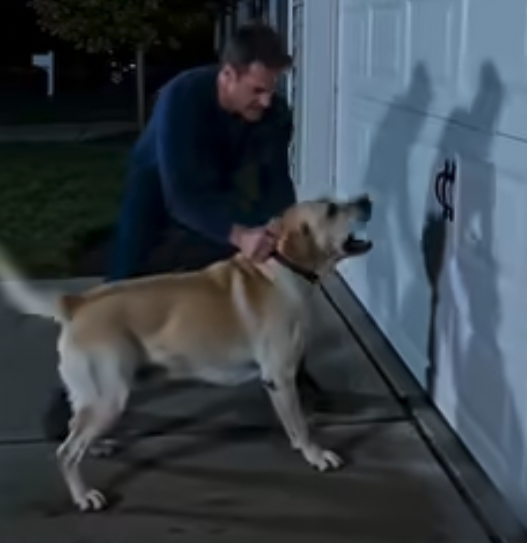
The old dog began barking at the garage door just after sunset, and by midnight, everyone on Briar Lane hated him.
His name was Rufus, though most people had stopped calling him that with affection years ago. Once, he had been the kind of dog children chased across lawns and fathers bragged about at barbecues. A broad-chested golden retriever with a white blaze down his snout, he had fetched newspapers, guarded sleeping babies, and followed the Gray family through every season of their lives.
But now Rufus was fifteen.
His hips trembled when he stood. His eyes had clouded with age. His muzzle was nearly all white, and sometimes he walked into rooms as if he had forgotten why he entered them.
So when he first scratched at the garage door that evening, David Gray only glanced up from the couch and sighed.
“Rufus,” he muttered, rubbing his temples, “knock it off.”
The dog did not stop.
His claws scraped against the peeling wooden panels with a dry, frantic sound.
Scritch. Scritch. Scritch.
David’s wife, Claire, looked up from the bills spread across the kitchen table. A yellow lamp cast tired shadows beneath her eyes.
“He’s been doing that for ten minutes,” she said.
“He’s old,” David replied. “He gets confused.”
Their daughter Lily, twelve years old and curled at the end of the couch with a blanket around her shoulders, looked toward the hallway.
“He doesn’t sound confused.”
David gave her the sharp look of a man with too many worries and too little patience.
“He sounds like a dog, Lily.”
Rufus barked then.
Not a lazy bark. Not the weak complaint of an old animal wanting food or attention.
It was deep. Urgent. Furious.
Claire flinched.
Outside, rain tapped softly against the windows. The garage stood attached to the side of the house, its inner door at the end of the hallway beside the laundry room. Beyond it sat boxes, old paint cans, Christmas decorations, David’s tools, and the sedan Claire had stopped driving after the accident.
No one had opened that garage in three days.
Not since David had dragged several boxes inside from his late father’s storage unit.
At the thought of those boxes, David’s jaw tightened.
His father, Walter Gray, had died six months earlier. People had called him difficult, stubborn, strange. David had called him worse. Their last conversation had ended with Walter shouting, “One day that dog will know the truth before you do.”
David had slammed the phone down.
He had not gone to the hospital before Walter died.
Rufus barked again and threw his shoulder against the garage door.
The whole house shuddered.
“Dad,” Lily whispered.
David stood too quickly.
“That’s enough.”
He marched down the hallway, his socks slipping slightly against the floorboards. Rufus was pressed against the door, body shaking, ears flattened, teeth bared at whatever waited beyond the wood.
David grabbed his collar.
The dog twisted violently.
“Rufus!”
For an old animal, he fought with terrifying strength. His paws dug into the floor. His nails scraped lines across the hallway boards Claire had polished that morning. When David tried to drag him away, Rufus gave a sound David had never heard from him before.
Not a growl.
A warning.
Claire stepped into the hallway.
“David, stop. You’re hurting him.”
“He’s hurting himself!”
And he was. Blood dotted the floor beneath Rufus’s paws. His claws had split from scratching. A thin red smear marked the lower edge of the garage door.
Lily rushed forward, eyes filling with tears.
“Don’t pull him like that!”
David released the collar with a curse. Rufus stumbled, then immediately lunged back at the door, barking so loudly the windows seemed to tremble.
Across the street, a porch light came on.
Then another.
David closed his eyes.
“Great,” he said. “Wonderful.”
Within minutes, neighbors had gathered under umbrellas and porch awnings, watching the Gray house as if it were entertainment.
Mrs. Ellis from next door crossed her arms.
“That dog’s been barking all evening,” she called. “Some of us have work tomorrow.”
“He’s sick,” another neighbor muttered. “They should’ve put him down last year.”
Lily heard it.
Her face crumpled.
Claire put an arm around her, but the girl pulled away and knelt beside Rufus.
“Please,” Lily whispered into his ear. “Please stop. You’re scaring everyone.”
For half a second, Rufus looked at her.
His cloudy eyes softened.
Then he turned back to the door and barked again with such desperation that Lily began to sob.
David felt shame prick behind his anger. He hated being watched. Hated being judged. Hated that his life had become a series of things falling apart where everyone could see.
The unpaid bills. His failing contracting business. Claire’s silence at night. Lily’s distance. His father’s death. And now this old dog making the whole family look insane.
David stormed outside through the front door.
“What are you all staring at?” he snapped.
Nobody answered.
Behind him, Rufus threw himself against the garage door again.
Bang.
Bang.
Bang.
Then, beneath the rain and barking and neighborly whispers, something else drifted through the air.
A smell.
Faint at first.
Sharp.
Chemical.
David froze.
Claire stepped out behind him.
“Do you smell that?”
Mrs. Ellis’s expression changed.
“That’s smoke.”
The word passed through the gathered neighbors like a match touching dry grass.
Smoke.
David spun toward the garage. A thin gray ribbon curled from the top seam of the outer garage door. It was barely visible in the rain, but once he saw it, he could not unsee it.
“Oh God,” Claire breathed.
David ran.
He yanked at the exterior garage handle.
Locked.
“Keys!” he shouted.
Claire fumbled in her pocket, but her hands shook too badly.
Inside the house, Rufus had gone mad.
His barking turned hoarse. He slammed his body against the inner door again and again, as though he would break every bone before giving up.
David grabbed a shovel leaning against the porch and wedged it beneath the garage handle.
“Move back!”
A neighbor helped. Then another.
Wood splintered. Metal shrieked.
The garage door groaned upward three inches, then a foot. Smoke spilled out in a thick black wave, carrying the bitter stink of burning plastic.
Claire screamed.
The old sedan inside was not burning, but the workbench beside it was. Flames crawled along a stack of cardboard boxes. One had collapsed, spilling papers and yellowed cloth into the fire. A red gas can lay tipped on its side nearby, though later David would swear he had never left it there.
“Call 911!” someone yelled.
David coughed, covering his mouth. He could barely see through the smoke.
Then Rufus burst through the inner door.
Not because anyone opened it.
Because the old dog finally broke it.
The bottom panel cracked inward beneath his weight, and Rufus forced himself through the jagged gap, scraping his side bloody as he entered the garage.
“Rufus!” Lily screamed.
David lunged after him, but the heat pushed him back.
The dog disappeared into the smoke.
For one terrible moment, David thought that was it. The old fool had killed himself.
Then Rufus emerged, coughing, dragging something in his teeth.
A blanket.
No.
Not a blanket.
A sleeve.
David’s heart stopped.
Rufus pulled again, muscles trembling, paws slipping on the concrete.
A small hand appeared from beneath the smoke.
Lily screamed so sharply that Claire nearly collapsed.
David rushed in, ignoring the heat this time. He grabbed the child under the arms and dragged him out onto the driveway.
It was a boy.
Maybe six years old.
Soot streaked his face. His lips were pale. He wore red pajamas with tiny rockets on them.
For one suspended second, nobody moved.
Then Claire dropped beside him.
“He’s breathing!” she cried. “Barely, but he’s breathing!”
The neighbors erupted into chaos.
Someone shouted for blankets. Someone else repeated that an ambulance was coming. Mrs. Ellis fell to her knees and began praying.
David stared at the boy’s face, unable to understand what he was seeing.
A child.
There had been a child inside his garage.
“How?” he whispered.
Lily clutched Rufus’s neck as the old dog coughed and trembled against her.
“You saved him,” she sobbed. “You saved him, boy.”
But Rufus was not looking at the child.
He was looking back into the garage.
His ears rose.
A low growl built in his chest.
Claire turned.
“What is it now?”
Smoke rolled from the open garage like something alive. Flames snapped against the workbench. Sirens wailed in the distance.
Rufus pulled free from Lily and staggered toward the garage again.
“No!” David shouted.
He grabbed the dog, but Rufus resisted, staring into the smoke with terror and fury.
David looked where the dog looked.
At first, he saw only flames.
Then the smoke thinned.
And at the back of the garage, behind stacked boxes from Walter’s storage unit, something moved.
Not a person.
A panel.
A narrow section of the wall shifted inward and clicked shut.
David’s blood went cold.
The fire department arrived moments later.
Men in heavy gear rushed past, dragging hoses, shouting commands. The boy was lifted onto a stretcher. Claire rode with him to the hospital because his tiny hand had closed around her sleeve and would not let go.
David stayed behind with Lily and Rufus as firefighters drowned the flames.
By two in the morning, the fire was out.
By three, the police had arrived.
By four, David learned the boy’s name.
Noah.
He had been reported missing two nights earlier from a town thirty miles away.
His mother had died when he was a baby. His father, a quiet electrician named Aaron Pike, had vanished the same night Noah disappeared.
Police had assumed the father had taken him.
But Noah had not been with his father.
Noah had been inside David Gray’s garage.
No one could explain it.
Except Rufus, who lay wrapped in towels on the kitchen floor, his paws bandaged, his breathing rough but steady.
Lily refused to leave his side.
David sat across from him, elbows on his knees, staring at the dog he had almost dragged away from the door.
“I’m sorry,” he whispered.
Rufus lifted his head weakly.
For a moment, David saw him young again, bounding across Walter’s yard, carrying a tennis ball in his mouth while David, still a teenager then, laughed with a lightness he no longer recognized.
Walter had loved Rufus first.
That was the part David rarely admitted.
Rufus had belonged to Walter before Walter moved into assisted living. David had taken the dog reluctantly, mostly because Lily begged him.
“He’s family,” Walter had said on the day David came to collect him.
“No,” David had replied coldly. “He’s a dog.”
Walter’s eyes had hardened.
“You’ve forgotten how to recognize loyalty.”
The memory pierced him now.
At dawn, Detective Mara Voss returned to the house. She was a compact woman with silver-streaked hair and the exhausted eyes of someone who had seen too many families break in too many ways.
“We found something behind the garage wall,” she said.
David stood.
“What?”
“A hidden passage.”
Lily’s hand tightened around Rufus’s fur.
“That’s impossible,” David said.
Detective Voss looked toward the hallway.
“Your garage shares a back wall with the old maintenance structure behind the property. It was sealed years ago, but someone reopened it from the other side.”
David remembered the abandoned utility shed behind the fence. Walter had always warned him not to play near it as a child.
“It’s full of old drainage access points,” Voss continued. “Someone used them to bring the boy into your garage.”
“Why my garage?”
The detective studied him carefully.
“Because of the boxes you brought home from your father’s storage unit.”
David felt the room tilt.
“What do my father’s boxes have to do with this?”
Voss placed a plastic evidence bag on the table.
Inside was a metal key.
Old. Brass. Tied with a faded strip of blue ribbon.
“We found this near the hidden panel. Does it mean anything to you?”
David shook his head.
But Lily leaned forward.
“Grandpa had one like that.”
David looked at her.
“What?”
“In his necklace box,” Lily said softly. “He showed me once. He said it opened something important, but only Rufus knew where.”
A silence settled over the kitchen.
Detective Voss removed a folded photograph from her folder and placed it beside the key.
David’s knees nearly failed.
The photograph showed Walter Gray, twenty years younger, standing beside a much younger Rufus. Beside them stood a woman David did not recognize, holding a baby wrapped in a blue blanket.
On the back, in Walter’s handwriting, were five words.
Forgive me. Keep him safe.
David stared at the baby.
A strange pressure built in his chest.
“Who is that?”
Detective Voss’s voice softened.
“We think the baby was your brother.”
The world stopped.
Lily looked at her father.
“Dad?”
David laughed once, but there was no humor in it.
“I don’t have a brother.”
Voss did not look away.
“Your father may have believed otherwise.”
The next hours unfolded like a nightmare buried inside another nightmare.
At the station, while Rufus received oxygen at the emergency vet and Noah slept under guard at the hospital, the truth began surfacing piece by piece.
Walter Gray had spent the last twenty years investigating a private adoption ring that operated through a church charity. The woman in the photograph had been named Emily Pike. She had given birth to twins.
One child had been legally recorded.
Aaron.
The other had disappeared.
David.
At first, David refused to understand.
Then Detective Voss placed another document in front of him.
A birth certificate.
His name was not on it.
But his birth date was.
His mother’s name was Emily Pike.
His twin brother was Aaron Pike.
David stared until the letters blurred.
“My father…” he whispered.
“Walter Gray adopted you,” Voss said. “Illegally at first. Then through forged paperwork. We believe he discovered what the adoption ring was doing too late. He may have tried to expose them, but someone threatened your family. After that, he hid the evidence.”
David thought of Walter’s paranoia. His locked drawers. His refusal to talk about David’s childhood. His anger whenever David mentioned selling the house.
He had thought it was bitterness.
Maybe it had been fear.
“And Noah?” David asked, though some part of him already knew.
Voss’s expression changed.
“Noah is Aaron Pike’s son.”
David pressed a hand over his mouth.
His nephew.
The boy Rufus had dragged from the smoke was his nephew.
“Where is Aaron?”
The detective hesitated.
“We don’t know yet.”
But Rufus knew.
That evening, against every medical recommendation, Rufus refused to stay at the vet. He whined until Lily cried, and the veterinarian finally allowed the family to take him home with strict instructions.
Rufus could barely walk.
But the moment David opened the car door, the old dog limped toward the backyard.
“No,” David said. “Absolutely not.”
Rufus looked back.
There was something in his eyes that David had spent his whole life misunderstanding.
Not madness.
Memory.
David followed.
So did Lily, Claire, and Detective Voss, who had returned after hearing Rufus was behaving strangely again.
The old dog led them past the fence, through wet weeds, toward the abandoned utility shed.
Every few steps, he stumbled.
Every time, Lily whispered, “Come on, boy.”
Behind the shed, half-hidden beneath ivy, Rufus stopped at a rusted metal hatch in the ground.
Then he lay down beside it and placed one bleeding paw on the lid.
Detective Voss called for backup.
The hatch opened to a narrow drainage tunnel.
And inside, barely alive, they found Aaron Pike.
He had been beaten, bound, and left in the dark.
But he was breathing.
When paramedics carried him out, his eyes fluttered open. They landed on David’s face, and something passed between the two men before either knew the whole truth.
Recognition without memory.
Blood calling to blood.
At the hospital the next day, Noah woke first.
Claire brought him a stuffed bear. Lily brought him a drawing of Rufus wearing a superhero cape.
David stood awkwardly in the doorway, afraid to step closer.
Noah looked at him with wide, solemn eyes.
“Is the dog okay?”
David swallowed hard.
“He’s okay.”
Noah nodded.
“He kept barking in the dark,” the boy whispered. “I was scared. But I heard him. I knew somebody would come.”
David had to turn away.
Later, Aaron woke.
The reunion was not dramatic. There were no instant embraces, no speeches, no perfect healing. Aaron was weak, suspicious, and grieving. David was overwhelmed by guilt for a brother he had never known he had.
But when they looked at each other, the truth was impossible to deny.
Same eyes.
Same hands.
Same small scar above the left eyebrow, though Aaron’s came from a childhood fall and David’s from a bike accident he barely remembered.
Walter had kept the secret.
Not out of cruelty alone.
Out of fear.
The criminals behind the adoption ring had returned after Walter died, searching for the evidence he had hidden in the storage boxes. Aaron had found them first. That was why he vanished. Noah had been taken to force him to talk.
But Walter had trusted one guardian more than any lock.
Rufus.
Inside one of the burned boxes, investigators found a fireproof tin beneath a false bottom. It contained names, ledgers, photographs, payments, and enough evidence to reopen dozens of missing-child cases.
Taped to the inside of the lid was one final note from Walter.
David read it with shaking hands.
David,
If you are reading this, then I failed to tell you the truth while I was alive.
I was a coward in some ways and a father in others.
I took you because I loved you. I stayed silent because I feared losing you.
But Rufus remembers the tunnels. Rufus remembers the boy in the blue blanket. Rufus remembers where loyalty lives when men become afraid.
Trust him.
He has always known the way home.
David cried then.
Not quietly.
Not with restraint.
He broke in a hospital hallway, with Claire’s arms around him, Lily pressed against his side, and his newly found brother sleeping behind a glass door.
Three weeks later, Rufus came home from the animal hospital to a street full of people waiting for him.
The same neighbors who had complained stood holding signs.
WELCOME HOME, HERO.
Mrs. Ellis brought him a roast chicken and cried so hard she could barely apologize.
Rufus accepted the chicken.
He accepted the apologies with less enthusiasm.
Noah and Aaron moved into the Gray house while Aaron recovered. At first, everything felt strange. Two families orbiting each other in a home too full of secrets. David and Aaron spoke carefully, like men defusing old bombs.
But children are braver than adults.
Lily taught Noah how to make pancakes shaped like dinosaurs. Noah taught Lily how to whistle through her fingers. Claire started setting two extra plates at dinner before anyone asked.
And Rufus slept between the children’s rooms every night.
One evening, months later, David found Aaron in the garage.
The rebuilt door stood open. Golden light spilled across the clean concrete floor. The burned boxes were gone. The hidden panel had been sealed. The old sedan had been sold.
Aaron stood near the workbench, holding Walter’s photograph.
“He saved us both,” Aaron said.
David nodded.
“Dad?”
Aaron looked at him.
David corrected himself softly.
“Walter.”
Aaron studied the photograph.
“Maybe both can be true.”
David looked toward the yard, where Rufus lay beneath the maple tree while Lily and Noah decorated his collar with yellow flowers.
For years, David had thought family was something simple. A name. A house. A legal document. A version of the past everyone agreed to repeat.
He knew better now.
Family was the old dog who bled through a door because a child needed saving.
Family was the brother who survived the dark.
Family was the father who made terrible mistakes and still left behind a path toward the truth.
Family was forgiveness, arriving late, limping, stubborn, and covered in smoke.
That night, the whole house gathered in the backyard.
Claire lit lanterns along the fence. Lily brought out a cake shaped badly but lovingly like a dog bone. Noah insisted Rufus needed a party hat, and Rufus endured it with the weary dignity of a king.
David raised a glass.
“To Rufus,” he said.
Everyone cheered.
Rufus opened one eye, thumped his tail once, and went back to sleep.
But just before dawn, David woke to a soft sound in the hallway.
For one terrifying second, he thought Rufus was scratching at the garage again.
He ran from bed.
The hallway was quiet.
The garage door stood untouched.
Rufus lay curled on the rug, breathing softly, Noah asleep against his side with one small hand buried in his fur. Lily had fallen asleep nearby with a blanket half over her shoulder.
David stood there for a long time.
Then Aaron appeared beside him.
Neither man spoke.
The house creaked gently around them. Outside, morning light touched the windows.
At last, Aaron whispered, “He found us.”
David’s throat tightened.
“No,” he said, smiling through tears. “He brought us home.”
And the old dog, hearing his name in the silence, opened his cloudy eyes just long enough to make sure everyone he loved was still there.
Then Rufus sighed, rested his head on Noah’s foot, and slept like a hero who had finally finished his watch.
