The old Labrador knocked over the flower stand during the quietest moment of the memorial, and everyone in the cemetery turned on him before they understood he was the only one there who remembered the truth.
Rain fell in cold silver sheets over Maple Hollow Cemetery, tapping against black umbrellas and polished headstones. The mourners had gathered beneath a canopy near the eastern hill, where fresh roses and lilies had been arranged in tall glass vases around a newly opened grave.
It was meant to be a peaceful farewell for Mrs. Eleanor Whitcomb, a retired schoolteacher who had outlived her husband, her friends, and almost everyone who had ever called her by her first name.
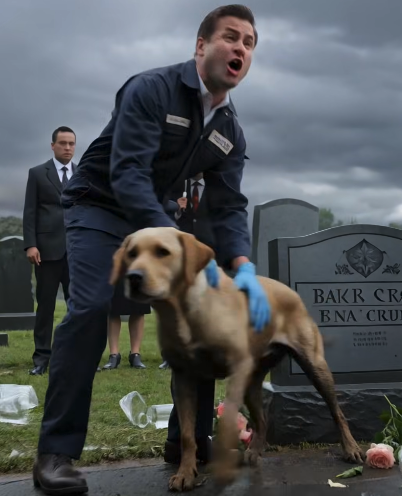
But peace ended when the muddy Labrador came running from between the graves.
He was old, soaked, and limping badly. His coat, once golden, had faded to the color of wet straw. His ribs showed beneath his fur. One ear hung lower than the other, and his cloudy eyes burned with a strange desperation.
Before anyone could stop him, he slammed into the flower stand beside the neighboring grave.
Vases shattered.
White lilies spilled across the mud.
A framed wreath toppled sideways.
People gasped as petals scattered over the cemetery path like torn paper.
“Get that dog out of here!” someone shouted.
A groundskeeper rushed forward and grabbed the Labrador by the collar, but the dog twisted away with a sharp, frightened whine.
“Easy!” the man barked. “Stop fighting!”
But the dog did not stop.
He clawed at the fallen flowers.
Not angrily.
Desperately.
His paws scraped through the wet petals and mud as if something beneath them mattered more than pain, more than noise, more than the hands trying to drag him away.
“He’s ruining the grave!” a woman cried.
The dog whimpered and dug harder.
Then something slid from beneath the muddy flowers.
A photograph.
It skidded across the stone path and stopped beside the shoe of an elderly man standing under a black umbrella.
The man looked down.
And the entire cemetery seemed to fall silent.
The photograph was faded and curled at the edges. Rain had blurred part of the image, but the picture was still clear enough.
A little boy, perhaps nine years old, knelt beside that exact grave, hugging a Labrador puppy with both arms. The puppy’s pink tongue hung out happily. The boy’s smile was wide, innocent, alive.
Across the bottom, written in a child’s crooked handwriting, were six words:
WAIT FOR ME HERE EVERY YEAR, BUDDY.
The elderly man’s umbrella slipped from his hand.
“Oh my Lord,” he whispered.
Everyone turned toward him.
His name was Henry Calloway, and at eighty-one, he had buried enough neighbors to recognize grief in all its forms. But now his face had gone pale in a way that made the funeral director step closer.
“You know that boy?” someone asked.
Henry bent slowly and picked up the photograph with trembling fingers.
His eyes moved from the image to the old Labrador, who had stopped digging and was staring at him.
“Yes,” Henry said, voice breaking. “That’s Thomas Bell.”
A few people drew in sharp breaths.
The name still lived in Maple Hollow, though the boy had died twelve years earlier. Thomas Bell had been the child who saved his little sister from a car accident on County Road 9. The story had been printed in every local paper. Brave Boy Dies Saving Sister. Nine-Year-Old Hero Remembered.
But stories fade. Headlines yellow. People move on.
The dog had not.
Henry swallowed hard.
“And that,” he said, pointing at the Labrador, “is Buddy.”
The groundskeeper immediately released the collar.
Buddy staggered forward, wet and shaking, then pressed his nose against the old grave beneath the fallen flowers.
No one yelled after that.
The rain grew louder.
Near the back of the crowd, a young woman froze beneath a blue umbrella.
Her name was Anna Bell, though most people had not recognized her at first. She had left Maple Hollow years ago, first for college, then for nursing school, then for a life she built far away from the road where her brother had died.
She had returned that morning only because Eleanor Whitcomb had once been Thomas’s teacher.
Anna had planned to stand quietly at the edge of the memorial, pay her respects, and leave before anyone asked about the past.
Then she saw the photograph.
Her hand flew to her mouth.
“No,” she whispered.
Henry turned at the sound.
His expression softened with painful recognition.
“Anna?”
She stepped forward slowly, as if the mud might open beneath her.
Buddy lifted his head.
For one impossible second, the old dog looked young again. His tail gave one weak thump against the wet grass.
Anna dropped to her knees.
“Buddy?”
The Labrador limped into her arms.
She buried her face in his soaked fur, and the cemetery watched as the grown woman began to sob like the little girl she had been.
“I thought you died,” she cried. “I thought you were gone.”
Buddy only pressed closer, trembling against her chest.
Henry closed the photograph gently in his hand.
“He came back every year,” he said. “Every single year, on the anniversary. Same grave. Same time. Rain, snow, heat. Didn’t matter.”
Anna looked up through tears.
“What?”
Henry nodded toward Thomas’s headstone.
“Your brother made him a promise. Or maybe Buddy made one to him.”
Anna looked at the words carved into the stone.
THOMAS ELI BELL
Beloved Son. Brave Brother. Forever Nine.
Forever nine.
The phrase had haunted her for twelve years.
To everyone else, Thomas had remained a hero frozen in childhood. To Anna, he had become a voice in her sleep, a hand pushing her out of danger, a laugh she could no longer hear without pain.
“I don’t understand,” she said. “Buddy disappeared after the funeral. We searched for weeks.”
Henry’s face darkened.
“That’s what everyone thought.”
Anna stood slowly.
“What does that mean?”
Before Henry could answer, Buddy pulled away from her and returned to the grave. He pushed his nose beneath the collapsed flowers, whining softly.
“He’s still looking for something,” the groundskeeper murmured.
Anna wiped her face with shaking hands.
“What is it, Buddy?”
The old dog pawed at the base of the headstone.
Not randomly.
Carefully.
As if he knew exactly where to dig.
The funeral director hesitated. “Miss Bell, we shouldn’t disturb—”
“Move the flowers,” Anna said.
Her voice was quiet, but something in it made everyone obey.
The groundskeeper crouched and lifted the broken flower stand aside. Beneath it, wedged between the stone base and wet soil, was a rusted metal box no larger than a lunch tin.
Anna’s breath caught.
She recognized it immediately.
Thomas had kept his treasures in that box.
Marbles. Baseball cards. Bottle caps. Notes. Things adults called trash and children called priceless.
But that box had been buried with him.
Her mother had placed it beside his small coffin herself.
Anna backed away.
“That’s impossible.”
Henry crossed himself.
The groundskeeper lifted the tin from the mud. Its latch had rusted shut, but the accident of the fallen stand had cracked one corner open.
Inside was a plastic-wrapped bundle.
And on top of it lay a small blue ribbon.
Anna made a choking sound.
The ribbon had belonged to her.
She had worn it in her hair the night of the accident.
The world tilted, and suddenly she was six years old again.
The rain was not cemetery rain.
It was storm rain.
The car smelled like wet clothes and peppermint gum. Thomas sat beside her in the back seat, holding Buddy the puppy in his lap. Their father drove too fast because he had been angry. Their mother kept telling him to slow down.
Then headlights.
A scream.
Metal folding like paper.
Anna remembered being upside down.
She remembered Thomas calling her name.
She remembered smoke.
She remembered his small hands fumbling with her seat belt.
“Don’t cry, Annie,” he had whispered. “I’ll get you out.”
Her brother had pushed her through the broken window.
Buddy had jumped after her.
Then Thomas went back.
That was the part nobody talked about.
He went back for something.
Or someone.
And the car exploded before he returned.
Anna had lived her entire life believing Thomas died saving her.
That was true.
But not complete.
Henry seemed to know it too.
He touched her shoulder gently.
“There’s something your family never told you.”
Anna turned to him.
“My parents are dead,” she said. “Whatever they didn’t tell me, they took with them.”
Henry’s eyes filled.
“No, child. They tried to take it. But Thomas didn’t let them.”
The cemetery had gone utterly still.
Even Mrs. Whitcomb’s mourners remained, drawn helplessly into the grief unfolding beside the old grave.
Anna looked down at the tin.
“Open it.”
The groundskeeper fetched a tool from his belt and pried the latch.
The lid creaked.
Inside was a bundle of papers wrapped in plastic, a tiny toy fire truck, a dog tag engraved BUDDY, and a cassette tape labeled in Thomas’s handwriting.
FOR ANNA WHEN SHE’S BIG.
Anna pressed both hands to her mouth.
The funeral director hurried to the office and returned with an old cassette player from the cemetery chapel. Nobody spoke while he fumbled with the tape, rewound it, and pressed play.
At first there was only static.
Then a boy’s voice filled the rain.
“Hi, Annie.”
Anna collapsed to her knees.
Thomas’s voice was thinner than memory, but unmistakable.
“If you’re hearing this, it means Buddy found it. He’s smart. I told him every year. Same place.”
A little laugh crackled through the speaker.
“I know grown-ups don’t believe dogs understand promises, but Buddy does.”
Buddy lowered himself beside Anna, his head on her lap.
Thomas continued.
“I’m making this because I heard Dad talking to Mom. He said if anything ever happened, nobody could know about the papers. But I think secrets are bad when they hurt people.”
Anna looked at Henry.
He closed his eyes.
On the tape, Thomas’s voice grew quieter.
“Dad wasn’t just driving too fast that night. He was scared. We were going to meet Mr. Calloway because Dad said he finally had proof. Proof that the bridge company used cheap parts and people got hurt because of it.”
Anna’s mind spun.
The bridge company.
Her father had worked construction for Halvern Industries, the largest employer in the county. Six months before the accident, a temporary bridge collapse had killed three workers. The company blamed weather. Her father had stopped speaking about work after that.
Thomas’s voice trembled.
“Dad said if he told the truth, bad men would come. Mom cried. Then Dad put papers in my treasure box because he said nobody would look in a kid’s stuff.”
A sob escaped Anna.
“The night we crashed, a black truck followed us. I saw it. Dad tried to go faster. Mom screamed. The truck hit us from behind.”
The cemetery erupted in murmurs.
Anna could barely breathe.
For twelve years, the Bell family accident had been blamed on rain.
On speed.
On her father.
Thomas’s voice broke through the static again.
“If I don’t get to tell you later, I want you to know something. I wasn’t scared when I helped you. Well… maybe a little. But I was more scared you’d think I left you.”
Anna rocked forward, clutching Buddy.
“I don’t want you to remember the crash. I want you to remember the creek. And pancakes. And how Buddy used to steal socks.”
A few mourners laughed through tears.
Then Thomas whispered the words that shattered her completely.
“I went back because Dad was still moving. He gave me the box. He said, ‘Give it to Henry.’ But I couldn’t get out again. So I made Buddy take the ribbon. I told him, ‘Find Annie. Wait for me.’”
The tape clicked.
Static hissed.
Then one final sentence came through, faint but clear.
“Don’t be mad at Buddy. He tried.”
The cassette ended.
No one moved.
Anna bent over the old Labrador and cried into his fur.
For twelve years, she had carried guilt like a stone in her chest. She had believed Thomas died because she was too small, too helpless, too slow. She had believed Buddy disappeared because even the dog could not bear to stay with her.
But Buddy had not abandoned her.
He had been carrying a promise too heavy for any animal, returning year after year to the only place Thomas had told him to wait.
Henry wiped his face with a handkerchief.
“I was supposed to meet your father that night,” he said. “He called me from a pay phone. Said he had documents proving Halvern executives knew the bridge supports were defective. When he never arrived, I assumed the papers burned in the crash.”
Anna stared at the plastic bundle inside the tin.
“But they didn’t.”
“No,” Henry whispered. “Thomas saved them.”
The discovery changed everything.
Within days, investigators reopened the old accident. The documents in Thomas’s tin exposed falsified safety reports, bribed inspectors, and a cover-up connected not only to the bridge collapse but to the Bell family crash. The black truck Thomas mentioned had belonged to a Halvern security contractor.
For the first time in twelve years, Anna’s father’s name was cleared.
But the greatest healing did not happen in courtrooms or newspaper headlines.
It happened in small, quiet places.
Anna took Buddy home.
At first, she was afraid he would not survive the week. The veterinarian warned her gently that Buddy was very old, exhausted, and sick from years of wandering.
But Buddy had waited twelve years for Anna.
He was not done yet.
He slept on a warm blanket beside her bed. He ate chicken from her hand. He followed her slowly from room to room, always keeping her in sight, as if afraid the world might steal her again.
One evening, Anna opened an old suitcase she had avoided for years. Inside were things from childhood: Thomas’s baseball cap, her mother’s scarf, a cracked plastic bracelet, and a drawing Thomas had made of the three of them.
Anna, Thomas, Buddy.
Under it, written in blue crayon, were the words:
WE ALWAYS FIND EACH OTHER.
She placed the drawing beside Buddy’s bed.
The old dog sniffed it, sighed, and rested his head on Thomas’s drawn shoes.
Months later, Maple Hollow Cemetery held another gathering beside Thomas Bell’s grave.
This time, there were no shattered vases.
No angry voices.
No accusations.
The town had placed a small bronze plaque beside the stone.
THOMAS ELI BELL
Saved his sister. Protected the truth. Kept his promise.
Beside his name was a paw print.
Buddy sat beside Anna, wearing a clean blue collar with Thomas’s old ribbon sewn into it.
Henry stood near them, leaning on his cane.
“You know,” he said, “your brother always did hate unfinished stories.”
Anna smiled through tears.
“He finished this one.”
Henry looked at Buddy.
“I think they both did.”
Just then, Buddy stood.
The crowd quieted.
He walked slowly to Thomas’s grave and lay down in the grass, exactly where he had waited every year. Anna knelt beside him, afraid for a moment that this was goodbye.
But Buddy only nudged the soil gently with his nose.
Anna followed his gaze.
At the base of the headstone, half-hidden beneath fresh flowers, was one more thing.
A tiny plastic firefighter helmet.
The toy from Thomas’s treasure box.
Anna picked it up, confused.
A folded note had been tucked inside.
It was old, but not from Thomas.
The handwriting belonged to her mother.
Anna unfolded it carefully.
My sweet Anna,
If this is ever found, forgive me.
Your father and I were afraid. After the crash, men came to the hospital. They said if I spoke, they would make sure you disappeared too.
I was weak. I let the world blame your father. I let Buddy be taken away because they said the dog might lead people back to the truth.
But Buddy escaped.
Every year, I saw him at the cemetery. Every year, I wanted to tell you. And every year, fear stopped me.
Thomas was braver than all of us.
So was Buddy.
Please live, my darling. Not just survive.
Live.
Anna pressed the letter to her heart.
For years she had been angry at her mother without knowing why. Angry at the silence. Angry at the way grief had turned their home into a museum of things nobody could touch.
Now the anger loosened.
Not vanished.
But softened into understanding.
Her mother had been afraid.
Thomas had been brave.
Buddy had been faithful.
And Anna, finally, was free.
That afternoon, Buddy did not return to Anna’s apartment.
Instead, Anna brought him somewhere else.
A small yellow house at the edge of town, with a fenced yard and a porch that caught the sunset. She had bought it with part of the settlement money from the reopened case, but she did not think of it as payment.
She thought of it as a promise.
A home.
Inside, she had prepared a room with photographs: Thomas laughing in a creek, her parents on their wedding day, Buddy as a puppy, Buddy as an old dog, Buddy sleeping with Thomas’s ribbon beneath his paw.
Anna opened the back door.
Buddy stepped into the yard and lifted his nose.
For the first time since she had found him, he did not look like he was searching.
He looked like he had arrived.
A week later, on a bright morning washed clean by spring rain, Anna woke to find Buddy waiting by the door with his tail moving slowly.
Not frantic.
Not desperate.
Just ready.
She took him to Thomas’s grave one last time that year. The grass was dry, the sky blue, and sunlight warmed the stone.
Anna sat beside Buddy and read aloud from a letter she had written.
“Dear Thomas,” she began, voice trembling but steady. “I remember the creek. I remember pancakes. I remember how Buddy stole socks. And I remember that you didn’t leave me. You sent him back.”
Buddy placed his head on her knee.
Anna smiled.
“I’m going to live now. I promise.”
The wind moved through the cemetery trees.
For a moment, Anna could almost hear a boy laughing.
Buddy looked toward the headstone, ears lifting slightly.
Then, with a soft sigh, he leaned against Anna and closed his eyes.
He did not die that day.
That would have been too cruel for a story Thomas had worked so hard to save.
Buddy lived two more years.
Two gentle, golden years.
He slept in sunlight. He chased nothing faster than butterflies. He attended every memorial, every court hearing, every school assembly where Thomas’s story was told. Children learned to kneel before touching him. Adults learned to apologize to old dogs before assuming they were lost.
And every year, Anna brought him to the cemetery.
Not because Buddy needed to wait anymore.
Because promises, once fulfilled, become love.
On Buddy’s final morning, Anna found him under the porch where the sunlight fell warmest. His breathing was slow, his eyes peaceful.
She sat beside him with Thomas’s ribbon in her hand.
“It’s okay,” she whispered. “You found me.”
Buddy opened his cloudy eyes.
His tail moved once.
Anna bent and kissed his head.
“Tell Thomas I remember everything.”
Buddy exhaled softly, as if letting go of twelve years of rain, mud, fear, and waiting.
When Anna buried him, she placed him beside Thomas.
Not on top of the grave.
Beside it.
The town gathered again, but this time no one came with pity. They came with gratitude.
Henry spoke last.
“Some heroes run into fire,” he said. “Some push their sisters through broken windows. And some come back, year after year, even when the whole world misunderstands them.”
Anna stood with one hand on Thomas’s stone and the other on Buddy’s new marker.
The inscription was simple.
BUDDY
He kept waiting. He brought her home.
Years later, when children visited Maple Hollow Cemetery, they always stopped at the boy’s grave and the dog’s marker beside it. Parents told them the story of Thomas Bell and the Labrador who ruined a flower stand to uncover the truth.
But Anna told it differently.
She told them Buddy never ruined anything.
He only knocked down what had been hiding the truth.
And whenever rain began to fall over the cemetery, Anna would smile instead of cry, because she no longer heard the storm from the night of the crash.
She heard paws in the mud.
A boy’s voice on an old tape.
And six words that had crossed death, fear, silence, and time:
Wait for me here every year.
Buddy had waited.
Anna had come home.
And somewhere beyond the cemetery hill, where promises never break and loyal hearts never grow old, a little boy and his Labrador were running together again.
