The lunch rush at Big Benny’s BBQ Truck was the kind of chaos that made people either quit on the first day or stay forever.
Smoke rolled from the grill. Orders flew across the counter. Customers crowded the sidewalk. The line stretched so far down the block that people at the back couldn’t even see the menu.
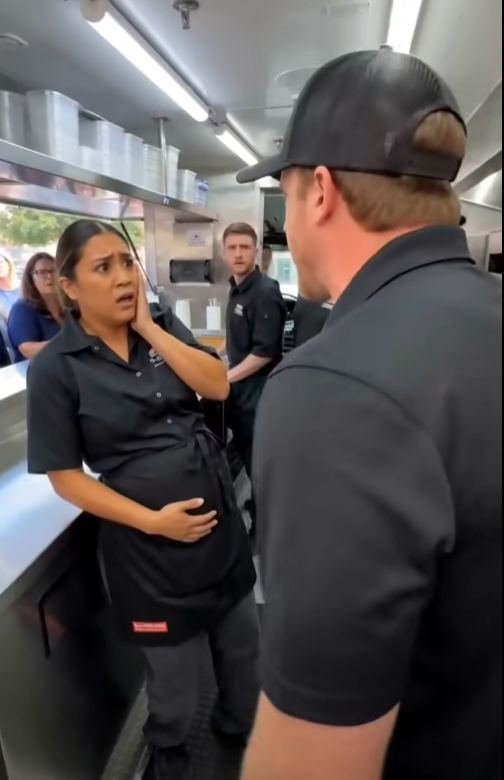
I was six months pregnant, sweating through my uniform, balancing a dozen things at once.
And somehow, despite everything, I loved my job.
At least, I had loved it until that day.
The mistake itself was tiny.
One customer ordered a pulled pork sandwich and fries. Another ordered a brisket combo.
I accidentally handed them the wrong bags.
The customer noticed immediately.
“No worries,” he laughed. “Happens all the time.”
I apologized, switched the bags, and moved on.
Problem solved.
Or at least I thought it was.
Then I heard Benny’s voice.
“ARE YOU KIDDING ME?”
The entire truck seemed to shake.
I turned around.
My boss, Benny Parker, was marching toward me from the prep station.
His face was red.
Veins bulged from his neck.
“Do you know how stupid that made us look?” he shouted.
“I’m sorry,” I said. “I fixed it.”
“That’s not the point.”
The customer who had received the wrong order tried to speak.
“Sir, it’s really fine—”
Benny ignored him.
Customers outside began staring through the service window.
My coworker Marcus looked away.
Nobody wanted to get involved.
Benny stepped closer.
“Ever since you got pregnant you’ve been slowing everyone down.”
The words hit harder than I expected.
“I’ve never missed a shift.”
“You make mistakes.”
“So does everyone.”
Wrong answer.
His eyes narrowed.
I immediately regretted saying it.
The truck became silent except for the hiss of the grill.
I felt dozens of eyes watching.
“Stop yelling at me in front of customers,” I said quietly.
The words seemed to ignite something inside him.
He moved closer.
Too close.
I instinctively backed against the counter and placed both hands over my stomach.
He pointed a finger directly at my face.
“You are a liability.”
“I’m doing my best.”
Then it happened.
His hand swung across my face.
CRACK.
The sound seemed impossibly loud.
Pain exploded across my cheek.
For a second, I couldn’t even process what had happened.
The entire world froze.
A woman near the window gasped.
Someone dropped a drink.
Marcus whispered, “Oh my God.”
I stood there in shock.
Pregnant.
Humiliated.
And slapped by my boss in front of fifty customers.
Then everything erupted.
“What the hell!”
“Did he just hit her?”
“Call the police!”
Several people immediately pulled out phones.
One woman began recording.
Benny spun around.
“Stop filming!”
She didn’t move.
“Turn that off!” he screamed.
But something strange happened.
Her expression changed.
The anger vanished.
Then surprise appeared.
She lowered her phone and looked down at the screen.
A call was coming in.
She answered.
“Hello?”
She listened for only a few seconds before her eyes widened.
Then she turned the phone toward Benny.
The moment he saw the screen, every drop of color vanished from his face.
Because the person calling her was Governor Rebecca Hayes.
And the woman Benny had just screamed at wasn’t a random customer.
She was the governor’s younger sister.
Nobody moved.
Nobody spoke.
The silence felt unreal.
The woman calmly held the phone toward Benny.
“Would you like to explain what just happened?” she asked.
Benny stared at the screen.
His mouth opened.
Nothing came out.
The governor’s voice echoed loudly enough for everyone nearby to hear.
“Karen?”
The woman nodded.
“Yes.”
“Are you alright?”
Karen glanced at me.
“No.”
Then she looked directly at Benny.
“Neither is this employee.”
The governor’s tone immediately sharpened.
“What happened?”
Karen didn’t sugarcoat it.
“He slapped a pregnant worker.”
Every customer went silent again.
The governor didn’t respond for a full three seconds.
When she finally spoke, her voice sounded dangerously calm.
“Are police on the way?”
“Several people already called.”
“Good.”
Benny finally found his voice.
“Wait—”
Karen held up a finger.
He stopped talking.
The governor continued.
“Karen, stay there.”
“I’m not leaving.”
“Good.”
Then the call ended.
For the first time all day, Benny looked scared.
Actually scared.
Not angry.
Not annoyed.
Terrified.
Because suddenly he understood something.
This wasn’t staying inside a food truck.
This wasn’t disappearing.
And dozens of phones had recorded everything.
The police arrived seven minutes later.
Those seven minutes felt like seven hours.
Nobody left.
Customers stayed.
Witnesses waited.
Some stood in line simply because they wanted to see what happened next.
When the officers arrived, the crowd immediately parted.
Karen approached them first.
“I have video.”
“So do I.”
“So do I.”
“So do I.”
At least fifteen people stepped forward.
The officers exchanged looks.
One officer asked me what happened.
I told him everything.
The yelling.
The insults.
The slap.
The comments about my pregnancy.
Everything.
Marcus finally spoke up too.
His hands were shaking.
“He does stuff like this all the time.”
Benny’s head snapped toward him.
Marcus ignored him.
Another employee joined in.
Then another.
Stories started pouring out.
Verbal abuse.
Threats.
Unpaid overtime.
Discrimination.
Things nobody had dared report.
Until now.
The officer took notes for nearly half an hour.
Then he turned toward Benny.
“Sir, place your hands behind your back.”
Benny blinked.
“What?”
“You are being detained pending investigation.”
“You can’t arrest me!”
The officer simply repeated himself.
Benny looked around desperately.
Nobody came to his defense.
Not one person.
As handcuffs clicked around his wrists, the crowd erupted into applause.
I never thought I’d see a crowd cheer for someone’s arrest.
But they did.
And Benny looked like he might faint.
I thought that was the end.
I was wrong.
It was only the beginning.
By evening, videos from the food truck had spread everywhere.
Social media exploded.
Millions of views appeared overnight.
People weren’t just angry about the slap.
They were furious about who had been slapped.
A pregnant employee.
Working through lunch rush.
Trying to support her family.
The story hit every nerve possible.
By the next morning, local news stations were calling.
By lunchtime, national outlets picked it up.
By evening, the video was everywhere.
Everywhere.
And Benny became the most hated restaurant owner in the state.
Then an even bigger surprise arrived.
The governor’s office called me.
At first I thought it was fake.
I nearly hung up.
But it wasn’t.
Governor Hayes wanted to meet me personally.
Two days later, I found myself sitting inside her office.
I felt completely out of place.
The governor greeted me warmly.
She asked about my pregnancy.
My family.
My health.
Then she apologized.
Not because she had done anything wrong.
Because she believed workers deserved better protection.
What happened next shocked me.
She asked if I would testify before a labor committee.
Apparently lawmakers had been debating stronger workplace protections for pregnant employees.
My case suddenly became the example everyone was talking about.
I said yes.
Not because I wanted attention.
But because I didn’t want another woman experiencing what I had.
Meanwhile, Benny’s problems multiplied.
Investigators discovered unpaid wages.
Labor violations.
Health code issues.
Employee intimidation.
The deeper they looked, the worse things became.
Former workers came forward by the dozens.
Some hadn’t spoken about their experiences for years.
Now they finally felt safe.
Lawsuits appeared.
Then more lawsuits.
Then even more.
The food truck was shut down.
Then his restaurant.
Then his catering business.
Within weeks, the empire he’d spent fifteen years building began collapsing.
People said he deserved it.
Maybe he did.
But I wasn’t thinking about revenge anymore.
I was thinking about survival.
Because losing my job created new problems.
Medical bills.
Rent.
Baby expenses.
Reality doesn’t pause just because justice happens.
One evening, I sat at home staring at numbers that refused to work.
I had no idea what I was going to do.
Then my phone rang.
It was Karen.
The governor’s sister.
We had stayed in touch after everything happened.
“I have an idea,” she said.
That sentence changed my life.
Karen happened to own several commercial properties.
One of them contained an empty storefront.
“You know food service better than almost anyone,” she said.
I laughed.
“I know how to survive food service.”
“Same thing.”
“No, it isn’t.”
She ignored me.
“What if we open something?”
I nearly choked.
“Open what?”
“A restaurant.”
I laughed again.
This time harder.
Because it sounded ridiculous.
I was pregnant.
Unemployed.
Nearly broke.
And she was suggesting opening a business.
Then she said something that made me stop laughing.
“I’ll fund it.”
The next month felt like a dream.
Meetings.
Planning.
Paperwork.
Menus.
Designs.
Budgets.
Everything happened so quickly I barely had time to process it.
Karen wasn’t interested in creating another giant restaurant.
She wanted something different.
A place built around fair treatment.
Fair pay.
Flexible schedules.
Especially for parents.
Especially for pregnant workers.
We named it Second Chance Kitchen.
Because that was exactly what it represented.
A second chance.
For me.
For employees.
For everyone.
Three months later, my daughter arrived.
Healthy.
Perfect.
Beautiful.
The happiest day of my life.
Karen visited the hospital carrying flowers bigger than the baby.
The governor came too.
Reporters somehow found out.
Pictures appeared everywhere.
People joked that my daughter already had political connections.
I didn’t care.
I only cared that she was healthy.
For the first time in a long time, the future looked bright.
Six months after the slap, Second Chance Kitchen opened.
The line stretched around the block.
People drove from neighboring cities.
Some came for the food.
Others came because they knew the story.
Many came to support what we represented.
Every employee received fair wages.
Paid breaks.
Family leave.
Respect.
The things that should have been normal all along.
Business exploded.
We sold out before closing.
Then again the next day.
And the next.
Soon we needed a larger location.
Then another.
Then another.
What started as one restaurant became three.
Then five.
Then eight.
Every new location followed the same rules.
People first.
Profit second.
Strangely enough, putting people first turned out to be very profitable.
Nearly two years after the incident, I received a letter.
No return address.
I opened it cautiously.
Inside was a handwritten note.
From Benny.
My stomach tightened.
For a moment I considered throwing it away.
Instead, I read it.
The letter was short.
Only a few paragraphs.
He wrote that losing everything forced him to confront who he’d become.
He admitted the slap wasn’t a momentary mistake.
It was the result of years of arrogance.
Years of believing employees existed solely to make him money.
He apologized.
Not for being caught.
For doing it.
There was a difference.
And surprisingly, I believed him.
I folded the letter and placed it in a drawer.
Not because I forgave him completely.
Some wounds don’t disappear that easily.
But because carrying anger forever is exhausting.
A year later, something happened that nobody could have predicted.
Not Karen.
Not the governor.
Not me.
Not anyone.
Second Chance Kitchen won a national award for workplace excellence.
We were invited to a ceremony in Washington.
I stood on stage holding the trophy while cameras flashed.
My daughter sat in the front row beside Karen.
She was almost three years old.
She waved enthusiastically every time she saw me.
The audience laughed.
Then I gave a short speech.
I told them about respect.
About dignity.
About how one terrible moment can sometimes become the beginning of something extraordinary.
The crowd stood and applauded.
I looked down at my daughter.
And suddenly remembered that afternoon inside the food truck.
The slap.
The humiliation.
The fear.
Back then, I thought my life was falling apart.
I couldn’t have been more wrong.
It was actually being rebuilt.
Into something better than I ever imagined.
After the ceremony ended, a young woman approached me.
She looked nervous.
“I just wanted to thank you,” she said.
“For what?”
“I’m pregnant.”
I smiled.
“Congratulations.”
She laughed.
Then tears filled her eyes.
“My boss started treating me differently.”
The smile faded.
“But after your story became public, our company changed its policies.”
She wiped her eyes.
“I get paid leave now.”
I stared at her.
Speechless.
She continued.
“My daughter is going to have a better start because of that.”
At that moment I finally understood something.
The slap had never really been the story.
The story wasn’t Benny.
It wasn’t the arrest.
It wasn’t the viral video.
The story was what happened afterward.
The people who stood up.
The witnesses who refused to stay silent.
The stranger who pulled out her phone.
The governor’s sister who happened to be standing in line for lunch.
And the thousands of workers who discovered they deserved better.
One small moment had created a ripple that spread farther than anyone could have imagined.
And that’s why the ending was something nobody could have predicted.
Because the day my boss slapped me in front of fifty customers wasn’t the day my future was destroyed.
It was the day it began.
