There was silence on the other end of the phone.
Then Judge Thorne’s voice changed.
Not frightened.
Not dramatic.
Professional.
“Elena, listen carefully. You cannot personally handle a case involving your own family.”
“I know.”
“Is your mother in immediate danger?”
I looked at her.
She was sitting on the closed toilet lid, wrapped in a clean robe, both hands trembling.
“Yes.”
“Then call the emergency protective-services line and law enforcement. I’ll alert the duty clerk that an emergency application may be coming, but you go through the same process as everyone else.”
That was exactly what I needed to hear.
Not special treatment.
Procedure.
Evidence.
People Julian could not intimidate by saying his mother was confused.
I called.
Within forty minutes, two officers, a paramedic team and an adult-protective-services investigator were at the house.
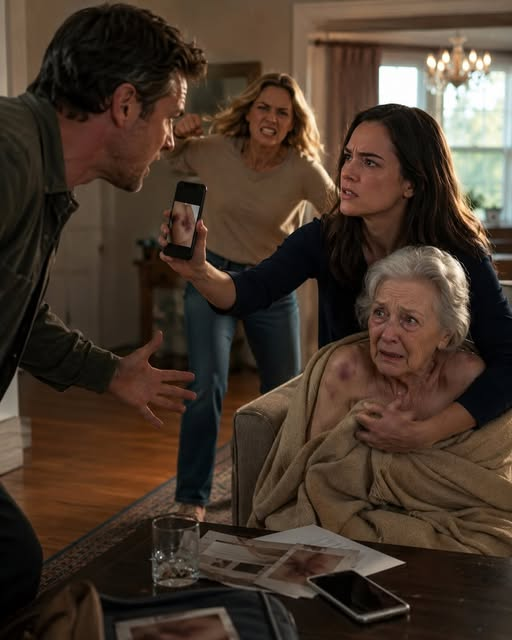
Julian came down the stairs furious.
“What is this?”
I stood beside my mother.
“Help.”
His face changed when he saw the investigator’s badge.
Chloe appeared behind him.
She immediately began crying.
“Mrs. Vance is confused! She bruises easily. Elena hasn’t been here in months and now she suddenly arrives acting like—”
The investigator raised a hand.
“Ma’am, we’ll speak to everyone separately.”
Julian looked at me.
“You called them?”
“Yes.”
His voice dropped.
“You’re destroying this family.”
I looked at my mother.
“No.”
“You mistook silence for a family.”
Mom was taken to the hospital that night.
Not because I demanded it.
Because an independent physician needed to examine her and document her condition.
I followed in my own car.
Julian tried to follow.
The temporary protective order reached him before he reached the hospital.
No contact with Mom.
No access to her accounts.
No removal of documents from the house.
No financial transactions made on her behalf until the court reviewed his authority.
For the first time in years, he could not simply say:
“I’m her son.”
And make everyone move aside.
At three in the morning, Mom was finally asleep.
I sat beside her bed.
She opened her eyes briefly.
“Elena?”
“I’m here.”
“Julian will be angry.”
That sentence broke my heart more than anything I had seen earlier.
A seventy-eight-year-old woman was lying in a hospital and still afraid of upsetting her own son.
I took her hand.
“He’s not making decisions tonight.”
She stared at me.
Then whispered:
“My money…”
“We’ll find out what happened.”
“The cabin?”
“We’ll find out.”
“The will?”
“That too.”
Her eyes filled.
“I signed things.”
“I know.”
“He said if I didn’t—”
“You don’t need to explain tonight.”
She closed her eyes.
Then, so quietly I almost missed it:
“I thought you forgot me.”
I leaned closer.
“I didn’t.”
“But I should have looked harder when you stopped calling.”
A tear slid toward her ear.
Then she fell asleep.
I stayed beside her until sunrise.
The next morning, I formally removed myself from anything that could resemble prosecution.
I was her daughter.
Not the Assistant Attorney General.
That distinction mattered.
A private elder-law attorney represented Mom.
A separate prosecutor handled the criminal investigation.
Adult Protective Services handled safety.
The bank’s fraud department handled the accounts.
My job was simple.
Sit beside my mother.
Bring her glasses.
Make sure she ate.
And finally listen.
It turned out Julian had made one enormous mistake.
He believed paperwork always protects the person holding it.
Sometimes paperwork protects the person being exploited.
The power of attorney he had shown me so proudly was real.
But it was limited.
It allowed him to pay routine bills and coordinate certain financial matters while Mom recovered from a hospitalization two years earlier.
It did not authorize him to transfer her property to himself.
It did not authorize large gifts.
It did not permit sales to related parties without independent review.
And it could be revoked by Mom at any time while she retained capacity.
An independent geriatric specialist evaluated her.
Mom sometimes forgot appointments.
She repeated stories.
She occasionally misplaced names.
But when asked who owned her property, what her accounts were for, who her children were, and what Julian had asked her to sign—
her answers were clear.
The doctor concluded she could still make her own financial and legal decisions.
Julian had spent months telling everyone she was incapable.
The medical assessment said otherwise.
That was the first wall to fall.
Then came the cabin.
Mom had owned a small lake property for thirty-six years.
My father built the porch before he died.
Julian told her maintenance had become too expensive and that he was “handling the sale.”
The property had indeed been sold.
But not at the value he had described.
The buyer was a small company.
That company belonged to Chloe’s brother.
The purchase price was far below the independent appraisal obtained afterward.
Two months later, the property had been resold for substantially more.
When investigators asked Julian about it, he said:
“It was a family arrangement.”
My mother’s attorney answered:
“Then why was Mrs. Vance never told who the buyer was?”
Julian had no good answer.
The investment accounts were worse.
Transfers had paid for:
Renovations to Julian and Chloe’s house.
A vehicle.
Credit-card balances.
Several pieces of expensive jewelry.
And a private-school deposit for their daughter.
Not all at once.
That would have been obvious.
Little by little.
Five thousand.
Eight thousand.
Twelve thousand.
Amounts small enough that Julian apparently thought no one would notice.
The total was not small.
Chloe blamed Julian.
Julian blamed Chloe.
It happened almost immediately.
The marriage that had looked so united while my mother was frightened became remarkably fragile once investigators started asking separate questions.
Chloe said:
“Julian handled the finances.”
Julian said:
“Chloe made the purchases.”
Chloe said:
“I thought his mother agreed.”
Julian said:
“My mother always wanted to help us.”
Then investigators showed him one bank form.
A large transfer request.
Beside the signature, the bank employee had written:
Client appears distressed. Son answered questions for client. Transaction delayed pending verification.
The transfer had gone through several days later through another channel.
Julian stopped talking.
The new will never took effect.
Not because I tore it up.
Not because I demanded Mom leave everything to me.
Because once she had independent counsel and no one standing over her shoulder, she revoked it.
Then she surprised everyone.
Including me.
“I don’t want to write another will yet,” she told her attorney.
“What would you prefer?”
“My money takes care of me first.”
The attorney smiled.
“That is exactly what it should do.”
Mom arranged her finances around her own care.
A professional fiduciary handled larger transactions.
She kept direct control of her everyday spending.
No child—including me—had unilateral authority over her accounts.
When I told her I thought that was wise, she looked suspicious.
“You don’t want to manage it?”
“No.”
“Why?”
“Because you spent your whole life earning it.”
I smiled.
“You should finally get to use it.”
She laughed.
It was a small laugh.
But it sounded different from the frightened voice I had heard behind that bathroom door.
Julian called me after the protection order was extended.
I almost didn’t answer.
Then I did.
“Elena.”
“Yes?”
“You’ve made your point.”
I looked out the hospital window.
“What point?”
“Mom is safe.”
“Yes.”
“So tell them to drop everything else.”
I stared at the phone.
“You think this was about teaching you a lesson?”
“Come on.”
His voice hardened.
“She’s our mother.”
“Yes.”
“Exactly. Family handles things privately.”
I almost laughed.
“Is that what you called it when you took her money?”
Silence.
“Elena, I was under pressure.”
“With what?”
“Debts.”
“Then you should have told her you needed help.”
“She would have said no.”
“That was her right.”
His breathing grew heavy.
“You always got everything easy.”
I stopped.
There it was.
Something older.
Something uglier.
“You left.”
He continued.
“You built your career.”
“I stayed.”
“I handled Dad’s funeral.”
“I handled the house.”
“I handled Mom.”
I listened.
Some of it was true.
Julian had carried responsibilities I had not.
But responsibility had slowly turned into entitlement.
Then entitlement had become control.
“You should have asked me for help,” I said.
He laughed bitterly.
“You were always busy.”
“Yes.”
“That hurt you.”
“Yes.”
“But Mom’s loneliness did not make her bank account your salary.”
He went silent.
I continued:
“And caring for a parent does not create the right to frighten them.”
His voice became smaller.
“I never meant for it to go this far.”
I believed him.
That did not make it disappear.
I said goodbye.
And blocked his number.
The case took more than a year.
There was no single dramatic courtroom scene where I stood up and destroyed Julian.
I never testified as a government lawyer.
I testified as a daughter.
The neighbor testified that Mom once tried to borrow her phone and Julian quickly came outside to bring her home.
A former home-care worker testified that she had raised concerns about Mom’s fearfulness and was dismissed soon afterward.
Bank employees described unusual transactions.
Doctors described Mom’s capacity.
Documents told the rest.
Julian eventually accepted responsibility for financial exploitation and abuse-related charges rather than continue toward trial.
Chloe faced consequences for her own documented role.
Restitution orders followed.
The cabin transaction was challenged and part of the financial loss was recovered.
Not everything came back.
Money rarely returns as neatly as it leaves.
But enough was recovered to secure Mom’s care comfortably.
Julian lost access to her.
That mattered more.
Mom did not return to the old house.
She chose an assisted-living apartment near me.
Not locked.
Not hidden.
Not controlled.
The first thing she noticed was the windows.
Huge windows.
She made me open every curtain.
“All of them?”
“All.”
Sunlight flooded the room.
Then she pointed toward the balcony.
“I want tomatoes.”
“You hate gardening.”
“I’m seventy-nine. I can change.”
So we bought tomato plants.
She killed the first two.
The third survived out of fear.
Every Sunday, I visited.
Not out of guilt.
Because I wanted to.
Sometimes we talked for hours.
Sometimes she watched television while I answered emails.
Sometimes she told the same story three times.
I listened all three times.
Not because she was fragile.
Because I finally understood how much time I had assumed I would always have.
One afternoon, almost two years after I found her in that coat, Mom was getting ready for a physical-therapy appointment.
I held out a light cardigan.
She looked at it.
Then at me.
For one second, I remembered the bathroom.
The fear.
Her whisper:
Please don’t take off my coat.
Mom must have remembered too.
Because she slowly removed the cardigan she was wearing and handed it to me herself.
“Too warm.”
I swallowed.
“Yes.”
She looked at me.
“What?”
“Nothing.”
“You’re crying.”
“I’m not.”
“Elena.”
I laughed.
“Fine.”
She smiled.
Then walked toward the door with her cane.
No coat.
No closed curtains.
No one asking permission from Julian.
People later told me I had “saved” my mother with one phone call.
That isn’t true.
The call mattered.
But one judge did not save her.
One daughter did not save her.
A doctor believed her.
An investigator listened.
A bank employee had once written down that something felt wrong.
A neighbor remembered.
A home-care worker spoke.
An attorney asked her what she wanted.
And eventually, my mother was surrounded by enough people telling the truth that Julian could no longer make his version louder.
For years, he had relied on one sentence:
No one will believe an old woman who forgets things.
He was wrong.
My mother did forget things.
Appointments.
Names.
Where she put her glasses.
But she remembered fear.
She remembered signatures she never wanted to give.
She remembered her own home becoming a place where she no longer felt safe.
And most importantly—
when someone finally asked her without Julian standing nearby, she remembered that her voice still belonged to her.
The night I made that call, I thought I was using the law to protect my mother.
What happened afterward taught me something bigger.
The law mattered.
The evidence mattered.
But the first thing she needed was much simpler.
Someone to look at her and say:
“I believe you.”
And then act like her answer mattered.
