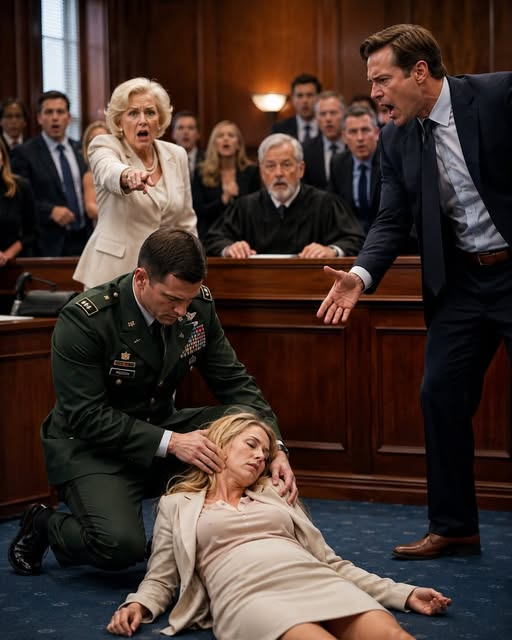
Judge Hanley was already on his feet when Colonel Carter shouted again.
“Someone call emergency services now.”
The smirk disappeared from Daniel’s face.
For the first time all morning, Patricia stopped talking.
I remember fragments after that.
The ceiling.
A paramedic asking my name.
Colonel Carter telling them what he had observed.
Judge Hanley ordering the courtroom cleared.
Then darkness.
When I woke up, I was in a hospital room.
A nurse was adjusting the monitor beside me.
My first question was:
“Lily?”
“She’s safe.”
A woman answered from the doorway.
Not Daniel.
Not Patricia.
A court clerk.
“Judge Hanley postponed the hearing. Your daughter is staying with the temporary caregiver already listed in your file until further order.”
I closed my eyes.
Then another voice spoke.
“You frightened everyone.”
Colonel Carter stood outside the curtain.
He had changed out of his jacket but still wore his uniform trousers.
I stared at him.
“Why are you here?”
“To give the emergency physician what I observed before you lost consciousness.”
He paused.
“And because I wanted to make sure you woke up.”
I looked away.
“Daniel says I fake it.”
Colonel Carter’s expression hardened.
“I don’t know your marriage.”
“I don’t know your custody case.”
“But what I saw in that courtroom was not someone performing for attention.”
That sentence nearly broke me.
Not because he had rescued me.
Because he was the first person in months who had looked at my symptoms without first asking whether Daniel believed them.
The hospital kept me overnight.
By morning, the physicians had enough information to say one thing clearly:
The episodes were real.
My bloodwork showed a serious underlying problem that required further evaluation and treatment.
The fainting was not imagined.
Not dramatized.
Not voluntary.
One doctor looked through my previous records and frowned.
“You were referred to a specialist four months ago.”
I stared at him.
“What referral?”
He turned the screen slightly.
“This one.”
There it was.
A specialist consultation.
Marked:
Canceled by patient portal.
“I didn’t cancel that.”
The doctor looked at me.
“Who had access to your account?”
I already knew the answer.
Daniel.
During our marriage, he handled the insurance logins because he said I was “bad with paperwork.”
After we separated, I changed the password.
But not immediately.
My stomach turned cold.
“Can you print that?”
“Yes.”
“And the cancellation details?”
“I can request the audit information.”
That afternoon, I called a new lawyer.
This time, I did not ask whether I could afford her.
I told her exactly what had happened.
She listened for twenty minutes.
Then said:
“First, we stop arguing emotionally.”
I almost laughed.
“Daniel’s entire case is that I’m emotional.”
“Good.”
Her voice stayed calm.
“Then we’ll use documents.”
Her name was Rebecca Sloan.
And she was very good at documents.
The custody hearing resumed three weeks later.
This time I was not alone.
Rebecca sat beside me.
Daniel looked irritated.
Patricia looked offended.
Colonel Carter sat in the back because he had been subpoenaed only to describe what he had witnessed in court.
Nothing more.
Judge Hanley entered.
Everyone stood.
He looked first at Daniel.
Then Patricia.
Then at me.
“Before we continue, I want one thing understood.”
His voice was cold.
“This court will not characterize documented medical symptoms as manipulation without evidence.”
Daniel’s attorney stood.
“Your Honor, Mr. Whitaker never intended—”
“I heard Mr. Whitaker.”
Silence.
“So did everyone else.”
Daniel looked down.
Rebecca opened our first exhibit.
My medical records.
Not selected pages.
The complete file.
For months, Daniel’s attorney had repeatedly cited one note:
Patient reports dizziness during periods of stress.
They had ignored the next sentences.
Recurrent episodes require further investigation. Specialist referral recommended.
Rebecca placed the cancellation record beside it.
“The referral was canceled through the family insurance portal while Mr. Whitaker still had administrative access.”
Daniel’s attorney stood immediately.
“Objection. There is no proof my client canceled it.”
Rebecca nodded.
“Correct.”
Then she placed the next document down.
“That is why we requested the portal audit.”
The cancellation had come from an IP address registered to Daniel’s home office.
The courtroom became silent.
Daniel leaned toward his attorney.
Rebecca continued.
“Mr. Whitaker, did you cancel the appointment?”
He swallowed.
“I don’t remember.”
“Did Mrs. Whitaker?”
“I don’t know.”
“You told this court she repeatedly refused treatment.”
“Yes.”
“Yet when a specialist appointment was scheduled, it was canceled from your home office.”
“I may have thought it conflicted with something.”
“With what?”
He hesitated.
Then:
“Lily had a school event.”
Rebecca checked the date.
“No.”
Daniel’s face changed.
“Lily was with her mother that weekend.”
He said nothing.
Rebecca did not accuse him of trying to make me sick.
There was no evidence of that.
She did something worse.
She showed how careless he had been with something he later used against me.
“You had access to her medical scheduling.”
“Yes.”
“You knew she was experiencing blackouts.”
“Yes.”
“You described those blackouts as fake.”
“I thought she exaggerated them.”
“Based on what medical training?”
His attorney objected.
Judge Hanley sustained it.
But the question had already landed.
Then Rebecca turned to Patricia.
“Mrs. Whitaker, in the previous hearing you said your daughter-in-law ‘always collapses when she wants sympathy.’”
Patricia straightened.
“That’s what I observed.”
“How many times did you personally witness her lose consciousness?”
Her mouth opened.
Then closed.
“None?”
“She always said she felt faint.”
“So you never actually saw her collapse before court?”
“No.”
“But you testified as though you knew the episodes were false.”
Patricia’s face reddened.
“I know her personality.”
Rebecca sat down.
“That will be all.”
For seven years, Patricia had spoken about me as though confidence were the same thing as truth.
In court, confidence finally met a transcript.
But the medical evidence was only half the case.
The harder question was Lily.
Why did she cry every Sunday before going to Daniel’s house?
I had my answer.
Daniel had his.
Neither mattered as much as hers.
Judge Hanley appointed a neutral child evaluator.
I was ordered not to discuss the case with Lily.
So was Daniel.
For two weeks, I said nothing.
No questions.
No:
“What happens at Dad’s house?”
No:
“Did Grandma say something?”
Nothing.
Then the evaluator filed her report.
I read it in Rebecca’s office.
Halfway through, I had to stop.
Lily had not said Daniel hit her.
He didn’t.
She had not said Patricia starved her, locked her away, or committed some dramatic cruelty.
The truth was quieter.
And uglier in a different way.
Every Sunday night, Patricia asked Lily questions.
“Did Mommy faint this week?”
“Did Mommy forget anything?”
“Did Mommy cry?”
“Did Mommy take her medicine?”
Then Daniel would ask:
“Do you ever feel unsafe with Mom?”
Again.
And again.
And again.
Lily told the evaluator:
“I think if I say the wrong thing, Mommy will go away.”
That sentence destroyed me.
The evaluator also reported that Lily had started trying to monitor me.
Checking whether I ate.
Watching me stand up.
Asking if I was dizzy.
A seven-year-old child had begun acting like my nurse because adults had turned my health into a custody weapon.
At the next hearing, Judge Hanley read that section twice.
Then looked at Daniel.
“Do you question your daughter about her mother’s medical condition?”
Daniel shifted.
“I need to know whether Lily is safe.”
“Do you ask her every visit?”
“I don’t know.”
The judge looked toward the evaluator.
She answered:
“Lily described it as frequent and distressing.”
Patricia interrupted from behind him.
“We were protecting her.”
Judge Hanley turned.
“No.”
His voice was quiet.
“You were involving a seven-year-old in adult litigation.”
Patricia stopped speaking.
For once.
The final custody order was not a victory speech.
It was a plan.
I received primary residential custody while my medical treatment stabilized.
Daniel retained regular parenting time.
Major decisions remained shared.
Both of us were ordered to use a parenting communication system instead of sending messages through Lily.
Neither parent was permitted to question her about the other household.
Patricia could see Lily, but she was explicitly told not to discuss my health, custody, or the court case with her.
Daniel was also ordered to contribute toward the legal fees caused by his improper depletion of the joint account during litigation.
That part shocked him.
After court, he cornered me near the elevators.
“You won.”
I looked at him.
“No.”
His face tightened.
“You got primary custody.”
“Our daughter got boundaries.”
“That’s different.”
He stared at me.
Then said:
“You made me look like a monster.”
I almost laughed.
“Daniel, I didn’t cancel the referral on a courtroom projector.”
“I didn’t ask your mother to call me fake.”
“I didn’t make Lily afraid that one wrong answer would make her mother disappear.”
His eyes dropped.
“I thought you were using the illness.”
“Why?”
He looked at me again.
“Because every time something happened, it happened when we were fighting.”
I nodded.
“Stress made the symptoms worse.”
He froze.
The hospital had explained that too.
A real medical condition could worsen under stress.
That did not make it imaginary.
Daniel rubbed both hands over his face.
“I didn’t understand.”
“No.”
“You didn’t want to.”
That hurt him more.
Because it was true.
Understanding would have required inconvenience.
Appointments.
Patience.
Listening.
Believing something he could not see.
Calling me dramatic had been easier.
He whispered:
“I’m sorry.”
I believed he regretted it.
That did not mean I trusted him.
“I hope you are.”
Then I walked away.
My health improved gradually.
Not overnight.
There were appointments.
Treatment changes.
Days when I still needed to sit down suddenly.
But once I actually had appropriate medical care, the episodes became less frequent.
Lily noticed.
One morning, she stood beside the kitchen table watching me.
“Mom?”
“Yes?”
“Are you dizzy?”
“No.”
She nodded.
Then paused.
“Do I have to ask?”
I put down my mug.
“No.”
Her little shoulders relaxed.
“Doctors take care of Mom’s health.”
I touched her hair.
“Your job is to be seven.”
She smiled.
That became one of the most important rules in our house.
Daniel changed too.
Not because the judge humiliated him.
Because Lily eventually stopped wanting to talk to him.
For several visits, she answered him with one-word responses.
Finally he asked why.
She said:
“Because you always want information.”
According to the parenting counselor, Daniel cried afterward.
I did not see it.
I did not need to.
Slowly, he learned to ask different questions.
How was school?
What book was she reading?
Did she want pancakes?
Normal father questions.
Patricia took longer.
But boundaries can teach lessons affection never manages to.
Once she realized every violation could affect her time with Lily, she stopped interrogating her.
Eventually, she even apologized to me.
Not warmly.
Not beautifully.
She stood outside Lily’s school one afternoon and said:
“I was wrong in court.”
I looked at her.
She continued:
“I thought you were using your health to keep Daniel.”
“I wasn’t.”
“I know.”
Then she walked away.
That was enough.
A year later, I returned to the same courthouse for a routine review.
Judge Hanley looked over the updated reports.
My treatment was stable.
Lily was doing well.
Daniel had complied with the parenting plan.
The evaluator recommended transitioning toward more balanced parenting time.
I agreed.
Rebecca glanced at me.
“Are you sure?”
“Yes.”
Daniel was Lily’s father.
The case had never been about punishing him forever.
It was about making him safe to parent without making our daughter manage his conflict with me.
Outside the courtroom, Daniel approached.
“You agreed.”
“Yes.”
He looked almost confused.
“After everything?”
I shrugged.
“This isn’t a reward for you.”
“It’s good for Lily.”
He nodded slowly.
Then looked toward the courtroom doors.
“Do you remember the day you collapsed?”
“Yes.”
“I still hear Carter shouting.”
So did I.
Daniel swallowed.
“I was annoyed.”
I looked at him.
“I know.”
“You were on the floor and I was annoyed.”
His eyes reddened.
“I don’t know how I became that person.”
I thought for a moment.
“Probably one small excuse at a time.”
He looked at me.
I continued:
“You decided I was dramatic.”
“So everything afterward became proof.”
“If I cried, dramatic.”
“If I was dizzy, dramatic.”
“If I asked for help, dramatic.”
“You didn’t have to examine anything after that.”
Daniel nodded.
It was the most honest conversation we had ever had.
Then he asked:
“Could we ever try again?”
“No.”
He closed his eyes.
“I thought so.”
“I forgive you enough to co-parent.”
“That is not the same as trusting you with my life.”
He accepted it.
Finally.
Two years after the courtroom collapse, Lily had a school play.
Daniel sat on one side of the auditorium.
I sat on the other.
Patricia was several seats behind him.
Nobody asked Lily questions about my health.
Nobody whispered about custody.
Nobody made her carry adult information.
After the performance, she ran out wearing a cardboard crown.
She hugged Daniel.
Then me.
Then shouted:
“I forgot my line!”
I laughed.
“You recovered.”
She grinned.
“Yeah.”
Simple.
Ordinary.
Safe.
That was what I had wanted all along.
The day I collapsed in court, everyone thought the dramatic moment was Colonel Carter rushing forward and shouting for someone to call 911.
It wasn’t.
He did something important.
He treated a medical emergency like a medical emergency.
But he did not save my custody case.
Documents did.
Doctors did.
A neutral evaluator did.
And eventually, my daughter’s own words did.
Daniel and Patricia had spent months telling everyone I was unstable.
Then my body failed in front of the very people they had convinced.
For a while, I thought that collapse was the worst thing that could have happened to me.
I was wrong.
It was the first moment the room stopped listening to what Daniel said about my body—
and started listening to the evidence.
Years later, I barely remember hitting the floor.
What I remember is Lily asking:
“Do I have to ask if you’re dizzy?”
And me finally being able to tell her:
“No. You only have to be a child.”
That was the real victory.
Not proving that I had been sick.
Not proving Daniel had been wrong.
But taking an adult burden out of my daughter’s hands—
and giving her childhood back.
